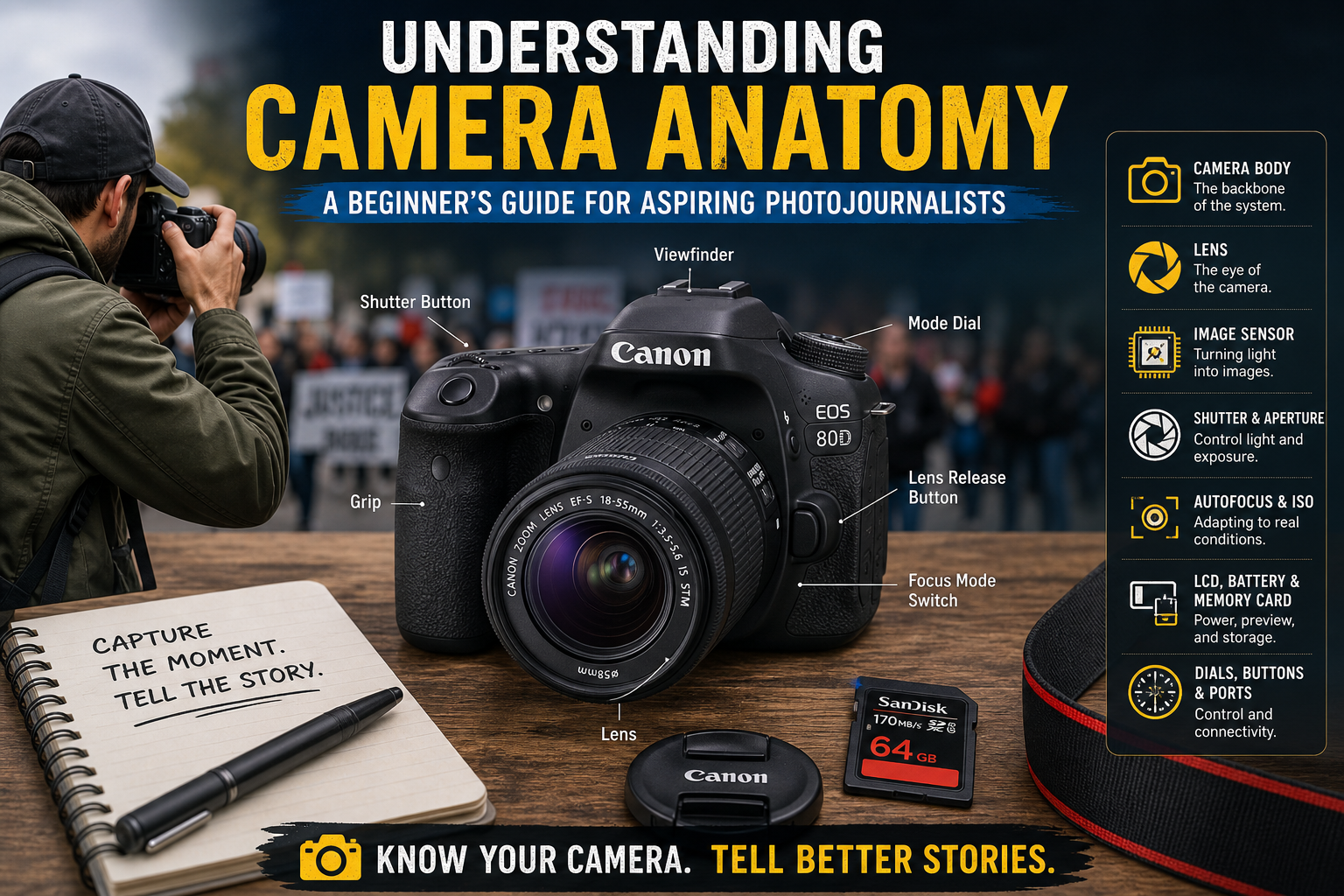
To upcoming photojournalists, a camera is not merely a photo-taking device. It is the means by which reality is recorded, significant events are saved, and visual narratives that educate the population are conveyed. In journalism, timing and accuracy do count, and the knowledge of the camera would do in journalism just as much as the knowledge of how to tell a story. Most amateurs are initially concerned with composition or editing, yet they are unaware of camera anatomy, which are the main parts of a camera, and it is challenging to operate the gear in a crisis. Because photojournalism can be unpredictable at times, the technical knowledge of camera anatomy enables the beginner to respond swiftly and take powerful photos.
Photojournalism does not resemble studio or portrait photography, since moments are one-time occurrences and cannot be repeated. Photographers must adapt swiftly to fluctuating light, movement, and emotion, whether it be covering protests, sports, political rallies, or community events. Those adjustments are easier to understand when one is aware of the physical structure of a camera. It assists photographers in understanding the locations of the controls, the capturing of light, and the settings to use to influence the image quality. The following guide simplifies the main components of a camera, to enable beginners to develop self-confidence and technical mastery in real-world journalism.
What are the key parts of a camera?
The key parts of a camera would be the camera body, lens, image sensor, shutter, aperture system, ISO controls, autofocus system, viewfinder, LCD screen, battery, and memory card slot. All these components have a distinct role to play, yet they all combine to store and record an image. The lens collects the light, aperture regulates the amount of light the sensor gets, and the shutter regulates the duration the sensor gets the light, and the sensor converts the light into a digital image. Additional features such as the autofocus system, battery, and storage are supported to facilitate a smooth operation. To the novice, these elements simplify the learning of photography and enhance technical self-confidence.
The importance of Camera Anatomy in Photojournalism
The anatomy of the cameras is important, since photojournalism is all about speed and unpredictability. Journalists are frequently left to work in uncontrolled situations, compared to the studio where photographers can control the lighting and position subjects. An opportunity that is missed cannot be replayed. When a photographer is knowledgeable about the camera, then quick changes are more convenient. The ability to alter shutter speed when at a sports match, or to raise ISO in a low-light scenario, or to change focus settings when at a live event, can rescue a valuable shot.
Technical knowledge assists photographers to problem-solve as well. When an image is blurry, too dark, or not well exposed, one can correct the issue by knowing which aspect of the camera to adjust. With time, one gains knowledge on camera anatomy, which enhances speed and confidence. Photographers are able to concentrate on telling the story and capturing the truth, as opposed to equipment issues.
The Camera Body: The backbone of the System
The central component that comprises all the internal systems of the camera is the camera body. It has the sensor, battery compartment, memory card slot, processor, and control buttons. It is the control center of the camera. It is what links all the parts together into a single functioning system. Photojournalists will mainly use DSLR and mirrorless cameras due to their manual controls and replaceable lenses.
This makes a good camera body essential in journalism, since in most cases, the photographer will be operating in harsh conditions. Rain, dust, and congested areas can be hazards to equipment life. Extra protection is offered in weather-sealed bodies. Comfort also matters. A good grip camera body enables the photographer to work long without any pain. The body camera layout is crucial to learn, as it enhances speed and minimizes hesitation when doing the assignments.
The Lens: The Eye of the Camera
One of the most significant parts of the camera is the lens, as it regulates the amount of light entering the camera and the way the scene is to be recorded. With no lens, there is no image. Dissimilar lenses produce varying visions. Wide-angle lenses are applicable in taking large shots like protests or environment stories, and telephoto lenses are applicable in taking distant shots like sports and speakers.
Focal length is also controlled by lenses, influencing framing and composition. A shorter focal length captures a larger part of a scene, whereas a longer focal length will reduce the frame size and bring the distant objects nearer to the camera. The lens system also includes aperture, which influences the brightness and depth of focus. Lenses choice is a significant choice to photojournalists who use the right lens to create the story in a visual way.
The Image Sensor: Turning Light Into Images
The camera component that captures light and transforms it into digital image information is called the image sensor. In the olden day movie cameras, the film would do the work, but in the new digital cameras, the sensor would do the work. It has a direct impact on image quality, sharpness, and low-light.
The size of the sensor is important, as it will have more light, creating better details and cleaner images. It is particularly applicable in journalism, since most of the tasks occur during bad lighting, e.g., indoor interviews or nocturnal events. Knowledge of the sensor assists amateurs to know why a particular camera will perform more effectively than others and why sensor quality is important in professional photography.
The Viewfinder: Framing the story
The viewfinder enables the photographers to frame and preview their shot prior to making the picture. It indicates the view of the lens, and it assists photographers in composing the image. Optical viewfinders are normally found in DSLR cameras, whereas mirrorless cameras have electronic ones.
In the context of photojournalists, framing is relevant, as it helps determine what the viewer should focus on and reinforces narratives. Powerful composition can make a picture stronger and more comprehensible. Using the viewfinder allows novices to develop superior framing habits and enhances their capacity to record meaningful images.
The Shutter and Aperture
The shutter is used to regulate the duration of light exposure to the sensor. This shutter speed is known as timing. The high shutter speed captures motion, and the low captures motion blur. In the case of photojournalists, the shutter speed is a consideration, as most events are action-oriented. Sporting events, demonstrations, and live shows usually demand high shutter speed in order to get clear photos.
Aperture is the amount of light that passes through the lens. It is given in f-stops. A larger aperture will allow more light through and makes the background blurred, whereas a smaller aperture will allow less light to pass through and will retain most of the scene in focus. Shutter speed and aperture combination are the determinant of exposure and impact storytelling. Emotion can be isolated on a blurred background and can be given some context on a sharp background.
The ISO and Autofocus: Adapting to Real Conditions
The sensitivity of the sensor to light is regulated by ISO. Images are cleaner with low ISO settings, and dark scenes are brightened with high ISO settings, although noise may be introduced. Lighting conditions in journalism vary rapidly, thus ISO adjustments may have to be made. The knowledge of ISO assists photographers to balance between brightness and quality.
Two focus modes (autofocus) assist in maintaining focus. The refined cameras have several autofocus options of still or changing subjects. Photojournalism is a field where the subject is likely to be in motion, and therefore the speed and accuracy of the autofocus is very important. Knowing how to set an autofocus will assist novices to gain some reliability and prevent the capture of blurred images.
LCD Display, Battery, and Memory Card
The LCD display enables photographers to view images, set the camera settings, and access camera menus. It offers immediate feedback, assisting photographers to verify focus and exposure. Nevertheless, when it comes to journalism, one may lose some significant moments because of taking too much time to examine images.
All camera functions are powered by the battery. Long-lasting assignments and excessive use may lead to rapid power depletion, and it is best to have additional batteries. All the images captured are stored on the memory card. Fast memory cards enhance the speed of performance, particularly in the taking of multiple images in a short period of time. Habits of reliable storage and power management are helpful to any journalist.
Dials, Buttons, and Ports
The important settings such as the ISO, shutter speed, playback, and shooting modes are easily accessed via buttons and dials. Speed is important in journalism. Browsing through menus is time-consuming, and therefore familiarity of where the controls are is important to enable the photographer to respond immediately.
Connections ports including USB, HDMI, Wi-Fi, and Bluetooth enhance workflow, as they enable a quicker transfer of images. This is significant in contemporary journalism, whereby editors might require photos on the spot. Knowing the characteristics can assist photographers in their work.
Commonly Asked Questions (FAQs)
What are the main components of a camera?
A camera consists of the body, lens, sensor, shutter, aperture system, ISO controls, autofocus system, battery, memory card, and viewfinder, which are the main parts of a camera. The parts play a role in capturing or storing images. They put together an entire system of image making.
Why is camera anatomy important for beginners?
The reason why camera anatomy is significant is that it enables beginners to know the way images are composed. The knowledge enhances confidence, accelerates learning, and enables photographers to make superior technical choices in field scenarios.
Which camera part affects image quality the most?
Image quality is most affected by the lens and sensor. Light and sharpness is managed by the lens, whereas the sensor records the image and influences the detail, color, and performance in low light.
What lens is best for beginner photojournalists?
An all-round zoom lens can be recommended in most cases to beginners, as it would suit in most scenarios without a need to switch lenses all the time. This malleability comes in handy within journalism contexts that are fast-paced.
How does shutter speed affect photojournalism?
Motion is influenced by shutter speed. The speed of the shutter would capture the action, and the speed would blur the image. The speed selected assists a photographer to record images in a clear and precise manner.
Why do photojournalists carry extra batteries and memory cards?
Photojournalists tend to work at lengthy hours and take numerous photographs. Additional batteries and memory cards will make sure that they do not run out of power or storage when they are on vital assignments.
Conclusion
Learning the anatomy of the camera is among the most significant processes of would-be photojournalists. Photographers must have a grasp of the machine upon which they depend before learning the art of editing or more sophisticated creativity. The body, lens, sensor, shutter, aperture, ISO system, autofocus, battery, and storage are the primary parts of a camera that collaborate to produce each image.
In journalism, there are moments that do not last long and cannot be replicated. When a photographer is familiar with his or her camera, then he or she can respond faster, problem-solve faster, and take meaningful stories more accurately. The study of camera anatomy is not merely the technical knowledge, it is the basis of visual storytelling. To the novice, learning it gives one confidence, becomes efficient, and it provides a great base to succeed in the harsh world of photojournalism.