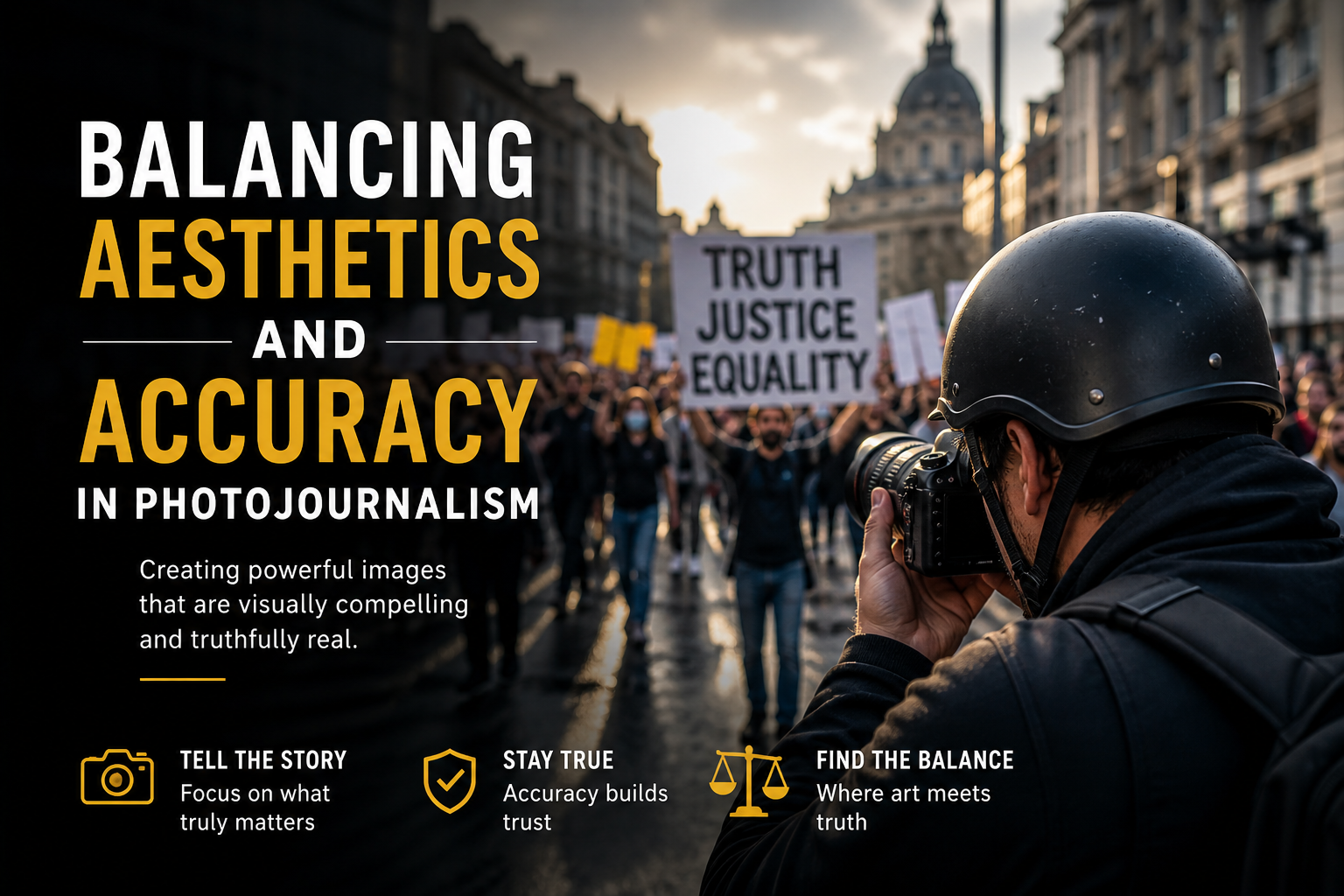
Photojournalism is at the borderland between art and truth. It is among those few careers that visual beauty and factual responsibility cannot be in conflict with each other. An effective photo can halt readers, influence popular opinion, and keep the history. However in journalism beauty is never sufficient. The picture has to be true. This is the place where most photographers fail to do well, how do you make good, eye catching photographs and also remain true to the reality? This problem of compromising between aesthetics and accuracy has now been of even greater concern in an era where viewers demand truthfulness and can manipulate digital images more than any other time.
Photojournalism is not all about creating ideal gallery art. It concerns itself with recording the truth as it is, in a manner that informs and educates and in some cases challenges the society. Nevertheless, one cannot forget the artistic nature of photography since composition, lighting, and framing have an impact on the effectiveness of communicating a story. Recognizing how visual attractiveness and truth relate is key in upholding the trust. Being aware of the tenets of factual reporting in photojournalism assists photographers to create images that are not only impactful but also credible, so that the storytelling can be genuine and yet compelling.
Understanding the Role of Aesthetics in Photojournalism
In photography, aesthetics are the appearance of a photograph that renders it interesting. These are composition, color balance, contrast, framing, depth, perspective, and timing. Aesthetics in photojournalism assist in the transformation of simple documentation into narration. An image with an incorrect frame or improperly revealed picture may not convey the level of urgency or significance of an event, whereas a well-written image can enhance its emotional and informational content. Aesthetics are not about decoration but communication. Each decision made in visual arrangement influences the interpretation of a scene by the audience.
Good photojournalists know that aesthetics may help put the focus on the important details. As an example, one can place a protester against a dramatic background, which can enhance the emotional impact of the story. Equally, the correct use of natural light can bring out facial expressions and other details in the environment that are important. But aesthetics should be used in the service of the story and not in its re-invention. The threat arises when photographers are more interested in visual beauty, disregarding the context of the facts. When an image is posed, altered or framed to give a false impression, then it ceases to be journalism. This is why artistic choices should never be attempted to be out of reality.
Why Accuracy Remains the Foundation of Photojournalism
The ethical foundation of journalism is accuracy. In contrast to commercial photography or fine art, photojournalism has a responsibility to show the truth as objectively as it can be. Journalistic images help the audiences to interpret events they are unable to observe. It is this trust that makes accuracy important. When the integrity is affected, people lose trust in journalism. Even a picture that is visually attractive will have no value when it distorts facts or bends the story.
Accuracy does not only mean not making edits. It involves context, timing and truthful representation. Distorting the truth can be done by cropping out key information, changing colors to emphasize mood, or placing subjects in unnatural positions. An image of a war should not be dramatized to create a visual effect but should be as true to reality as possible. The photojournalist is not to command, but to observe. Although photographers decide on the angles and framing, it should not alter the meaning of the happenings. Credibility is insured by accuracy and credibility is the cornerstone on which journalism lives.
The Fine Line between Art and Journalism
When Artistic Choices Improve Storytelling
Storytelling can be enhanced through artistic means when applied ethically. Composition assists in directing the eye of the viewer towards the subject. Timing is a decisive shot that expresses emotion or action. Lighting is able to emphasize key details without distorting the reality of the scene. Such tools are useful as they simplify and make the stories more interesting. When ethical choices are correlated with truth, aesthetic choices enhance the effectiveness of journalism.
As an example, photographing a humanitarian crisis in golden-hour light can produce an image that has an emotional appeal, but the experience of what is happening still takes place. Likewise, the low angle shot selected when the political rally is going on might highlight vitality and motion without altering facts. In aesthetics, there is the improvement of understanding and not distortion. Ethical artistic decisions enhance journalism because they enhance image clarity and emotional appeal without compromising on factual value.
When Artistic Choices Distort Reality
Aesthetics start to cause problems when it plays with perception. False narratives are created by over-editing, use of too many filters, selective cropping, and staged scenes. Framing can make a protest that would otherwise seem small appear bigger or bigger. Even a calm image may seem tight with distorted shadows and contrast. Such decisions affect the audience perception and can cause misinformation.
History has demonstrated that the photojournalism that is manipulated hurts reputations and confidence. Digital manipulation is highly disallowed in news organizations since even slight modifications can be credibility killers. Artistic ambition must not in any way justify distortion of facts. When a photograph invents a version of reality, which was not there, the photograph fails the journalistic test. There should be a difference between improvement and manipulation.
Techniques for Balancing Beauty and Truth
Prioritize Story Over Style
Always the story must precede. Photographers ought to determine the essence of the event before they can consider the artistic aspects. What happened? Who is affected? Why does it matter? When the story is clear, the aesthetic choices are to be in line with that message. Such an attitude does not give style the upper hand over substance and enables the focus to be on truth.
Story-first photography assists in keeping integrity since each creative decision is meaningful. Photographers do not pursue dramatic visuals, but meaningful moments. This method constructs more solid narratives and authenticity is kept in the center. The authenticity of the narration resonates more with the reader than the carefully edited images.
Use Natural Light Whenever Possible
Natural light maintains genuineness and lessens the urge to do scene manipulation. Artificial or flash lighting may change mood or distract subjects particularly in sensitive settings. Natural lighting maintains the environment as honest and provides a depth of visualization and the real world. One of the most important skills of photojournalists is to know how to adjust to the available light.
Trust is also enhanced with the use of natural light as audiences are observing scenes the way they were. Shadows and highlights, environmental tones help to become realistic. Although exposure changes might be needed, the preservation of the original ambiance enhances journalistic integrity.
Avoid Excessive Post-Processing
Simple editing like exposure, or white balance fixation is usually ok. These adjustments aid in restoring what the camera intuitively observed. But deleting details, creating objects or radically altering color is beyond the line of ethical behavior. Editing should be aimed at clarity, rather than transformation.
The truth of the image is safeguarded by responsible editing. The need to be truthful to their audiences makes news organizations oftentimes demand transparency in their editing practices. It is important to keep the amount of post-processing to the bare minimum so as to make sure that the image serves as a trustworthy source of information about reality.
Ethical Challenges in Modern Digital Journalism
Photojournalism has seen a transformation with the digital age. Phones, editing programs, and social media have made things faster and more accessible, but have also eradicated moral limits. Pictures are being manipulated in real time and can be broadcasted around the world without verification. This puts the photographers under pressure to provide quick and appealing content, and at the same time, upholding the standards of journalism.
Social media presumes that dramatic images are more rewarded than a deeper inherent fact, which guides some photographers toward sensationalism. The difficulty lies in not giving in to such a pressure. Ethical photojournalists should keep in mind the fact that credibility has a longer shelf life than virality. An honest picture might not get the highest attention at the time, but it will create a reputation over time. Trust is of more value as compared to short-lived engagement in modern journalism.
Building Audience Trust through Authentic Visual Storytelling
Credibility is gained over time. The audience gains authority to the work of a photographer when they realize that they are giving the truth in a real sense. True storytelling has an emotional appeal since the audience is aware that the events are genuine. A heart-rending reconciliation, a demonstration in the open air, or a scene of rejoicing, will be the more affecting when it is sincere.
Professional reputation is also developed by authenticity. Integrity helps photographers to gain preference by the editors and news organisations as their work makes the newsroom credible. It is becoming a contest in terms of authenticity as readers are becoming more and more suspicious of what they read online. The most admired photojournalists are not the ones who produce the most beautiful photographs but those who uncover the truth in a very straightforward yet sympathetic manner.
Conclusion
Striking the right balance between aesthetic and accuracy in photojournalism does not entail making a choice. It is concerning getting them to collaborate. Images are interesting, memorable and emotional using aesthetic techniques whereas accuracy holds the image to be true and reliable. The best photojournalism is a result of a combination of the two elements without compromising on the other.
The authenticity in the storytelling is more important than ever in a world where there is visual noise and digital manipulation. Photojournalists should apply the tools of art in a responsible way, and constantly with ethics and factual honesty. Journalism is empowered when beauty complements rather than substitutes the truth. The aim is not complicated but challenging: one should make pictures that would attract people, narrate the story in an understandable way, and be close to the reality.
Frequently Asked Questions (FAQ)
Can photojournalism be artistic?
Yes. Storytelling can be enhanced through artistic methods such as composition, timing and lighting, as long as they do not alter the truth or alter the context of the event.
Is editing allowed in photojournalism?
Simple adjustments, such as brightness, contrast and white balance are usually agreeable. Significant changes that modify what or mean the image is unethical.
Why is accuracy important in photojournalism?
Accuracy preserves the faith of people and makes sure that pictures are credible records of actual occurrences. Journalism will lack credibility without accuracy.
How can photojournalists avoid manipulation?
They can prevent manipulation by focusing more on the story, less post-processing, no posed scenes, and they can keep their workflow transparent.
What makes a strong photojournalistic image?
A good photojournalistic image is one that is clear in a visual sense, has depth in its emotions, is relevant and truthful to the events.