Introduction
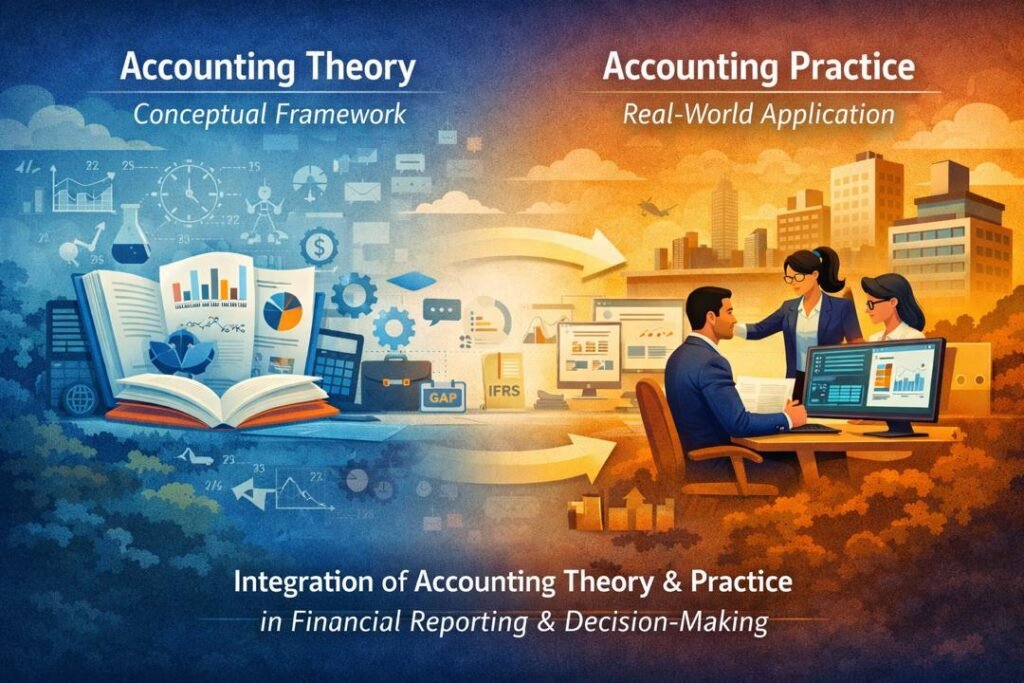
Accounting is commonly referred to as an art as well as science whereby it entails organized procedures as well as professional judgment. The core of this duality is the accounting theory and practice. The accounting theory gives the theoretical background on which the financial reporting is established, but the accounting practice is the practical implementation of these theories in business settings. Even though they are interdependent the gap, also known as the theory-practice gap, often exists in terms of what is taught or formulated in academic circles and what is applied by practitioners.
This gap is significant and must be comprehended and solved to keep the accounting systems relevant, effective and reliable in an ever-complicated global economy. The paper discusses the intersection of accounting theory and practice, reasons why these two are not close to each other, and potential solutions to close the gap between the two.
Understanding Theory of Accounting
The word accounting theory is an umbrella term that signifies the premises, models and approaches that are used to prepare and present financial statements. It includes principles like consistency, relevance, reliability, comparability and transparency. These theoretical constructions act as a roadmap to the standard-setting bodies and practitioners as well.
Both inductive and deductive reasoning usually provide the foundations of the accounting theory development. The inductive methods derive principles based on observed practices whereas the deductive methods start with known concepts and challenge their relevance in practice. Collectively, they contribute to the development of accounting standards and make the financial reporting to be adjusted to the changes in the economy and businesses.
Theories of accounting do not stand still; they change according to technological, regulatory, globalization and stakeholder changes. Indicatively, the transition to fair value accounting is an indication of a changing theoretical view of measuring and reporting of assets and liabilities.
The Nature of Accounting Practice
Accounting practice is the daily practice of accounting, which is the application of accounting principles in recording, summarizing and reporting of financial transactions. Financial analysts, auditors and other practitioners work in regulatory frameworks like International Financial Report Standards (IFRS) or Generally Accepted Accounting Principles (GAAP).
Practically, accountants have to work in complicated business conditions, with a lack of complete or unclear data and make professional judgments. Practice is constrained by factors like time, cost, compliance with the regulations, and organizational goals unlike the ideal conditions that theory can assume.
Technology is also applied in accounting practice (such as accounting software, data analytics tools, etc.), which in turn influences the implementation of theoretical concepts. With the rise in digitalization of businesses, technology is playing an even more important role of bridging the theory and practice.
The Relationship between the Accounting Theory and Practice
There is a close relationship between accounting theory and practice. Theory educates practice that gives guidance on why financial reporting is done in accordance to principles and frameworks. Practice, in its turn, has an impact on theory providing the insight of a concrete real-world application that could confirm, smooth, or disprove the pre-existing theoretical frameworks.
To illustrate, in the event practitioners find some challenges in the implementation of some accounting standards, these setbacks might result in the redefinition or elucidation of the theory behind these standards. Equally, the development of new theoretical frameworks is frequently required by the new business practices, including the crypto currency transactions or the environmental reporting.
The dynamic relationship makes accounting to be relevant and responsive to the needs of the stakeholders, such as investors, regulators, and the masses.
The Theory-Practice Gap
Although accounting theory and practice are interdependent, there is usually a disconnect between the two. This is a theory-practice gap meaning that this gap is the space between the theoretical research and practice. It is presented in different forms, such as:
- The difficulty of theoretical models which are challenging to implement in practice.
- Failure to communicate between academicians and practitioners.
- The differences in priorities where academics are more concerned with conceptual rigor whereas practitioners are more concerned with practicality and efficiency.
- Laggardly changes in accounting standards to new business reality.
The presence of this gap may result in discrepancies in the financial reporting, the diminished trustworthiness of financial data, and difficulties with decision-making.
Causes of the Theory-Practice Gap
1. Theoretical Framework Complexity
Most accounting theories are very abstract and mathematically complicated and therefore may not be easy to comprehend and implement by accounting practitioners. Though these models might be conceptually clear, they may not be practically applicable.
2. Lack of Collaboration
Academic researchers and industry professionals do not interact with each other adequately. Scholars can be interested in publishing their findings in academic publications, whereas professionals can be dedicated to addressing urgent business issues.
3. Rapid evolving Business Environment
Change in the business world, whether it is as a result of globalization, technological change or regulation change may move faster than an accounting theory. Consequently, the practitioners can use obsolete or incomplete theoretical advice.
4. Educational Gaps
Accounting education is known to sometimes lay more emphasis on theoretical information without sufficient focus on practical implementation. Graduates can join the workforce with the good conceptual knowledge and little practical work.
5. Regulatory Constraints
The rigidity in the accounting standards may occasionally curtail the flexibility in implementation of the theoretical concepts in different business situations.
Implications of the Gap
The presence of the gap in theory and practice has a number of implications:
1. Declined Qualities of Financial Reporting
The lack of accurate, transparent, and comparative financial statements could occur when theory is not effectively applied.
2. Inefficient Decision-Making
Financial information is used by managers and investors in making decisions. The disparity between theory and practice may cause the misinterpretation of data and make poor decisions.
3. Loss of Credibility
When there is a pronounced violation of accounting principles and they are not aligned with theoretical concepts, the profession will suffer loss of credibility.
4. Limited Innovation
The lack of connection between the academic and the practice may interfere with the creation of innovative solutions to accounting problems related to the emergence of challenges.
Bridging the Gap: Alignment Strategies
Resolving the theory-practice gap involves a delineation of using a multifaceted approach. Strategies that would assist in aligning the accounting theory with practice are:
1. Improvement of Academia-industry Collaboration
Knowledge can be exchanged by stronger relationships between universities and professional organizations. The gap can be bridged through joint research project, internship and industry placement.
2. Application of Practical Training in Education
Case studies, simulations, and practical projects need to be brought into the accounting curriculum to enable students to have practical experience. By so doing, the students learn how the theory is implemented in practice.
3. Simplifying Theoretical Models
There should be an effort among academicians to come up with theories that are rigorous but at the same time, accessible and practical. Diffusion of complex models can be useful in practicing in the real world.
4. Life-long Learning
Practitioners are expected to undergo continuous training in order to be familiar with new theories and standards. The role played by professional bodies may be to offer relevant and practical learning opportunities.
5. Leveraging Technology
The technology will assist in filling this gap by automating the complex computations and offering solutions to the data analysis. Theoretical principles can be connected into practice through accounting software and can be more convenient to apply.
6. Feedback Mechanisms
The creation of avenues through which practitioners can give comment on the accounting standards can be used to make sure that the theoretical frameworks are not rendered irrelevant and impractical.
The Role of Standard-Setting Bodies
Such institutions as the International Accounting Standards Board (IASB) and the Financial Accounting Standards Board (FASB) are instrumental in creating a gap between the theory and practice. Such bodies process and revise accounting standards, basing on the theoretical studies as well as practical factors.
It can be achieved through the involvement of stakeholders, such as academics, practitioners, and regulators to make sure that accounting standards provide a balance between conceptual and practicability.
Examples of Theory in the Field
1. Fair Value Accounting
The concept of fair value accounting depicts the impact of theory on practice. Theoretical idea of valuing assets and liabilities at the current market values has been integrated into the accounting standards that present more relevant information to the financial statement users.
2. Revenue Recognition
The evolution of the broad-based revenue recognition standards proves the fact that theoretical frameworks can be used to solve the practical problems. These standards can be used to create consistency and transparency in financial reporting because they offer clear guidelines.
3. Sustainability Reporting
There is an emerging body of theory regarding environmental, social, and governance reporting (ESG) reporting that is finding its way into practice. These models represent a wider concept of responsibility and the business place in society.
Future Directions
With the further development of accounting as a profession, the connection between theory and practice will be even more problematic. The world of accounting is changing because of the new trends, including artificial intelligence, blockchain technology, and integrated reporting.
Accounting theory needs to evolve with these changes in order to be relevant and offer advice on how to deal with the new challenges. Meanwhile, practitioners should be willing to embrace new innovations and embrace new technologies.
The future of accounting is the capacity to combine the theoretical knowledge with the real-life application to produce systems that are stable and flexible.
Conclusion
Accounting theory and practice nexus play a core role in the efficacy of financial reporting and decision-making. As much as theory gives the conceptual framework, practice puts these principles into practical use in real life. But the presence of the theory-practice gap shows that there should be more perfection between these two areas.
The accounting profession can help to close this divide and lead to better and more relevant financial information through collaboration, better education, simplification of theoretical models and use of technology. Finally, when the theory and practice are more closely related, the accounting systems will become more effective, the decisions made will be better, and the trust in the financial reporting will be higher.
This gap is not a simple academic exercise- it is a requirement of a further development and legitimacy of accounting profession in the fast changing world.
Get more well researched information about Accounting theory and practice here.