Introduction
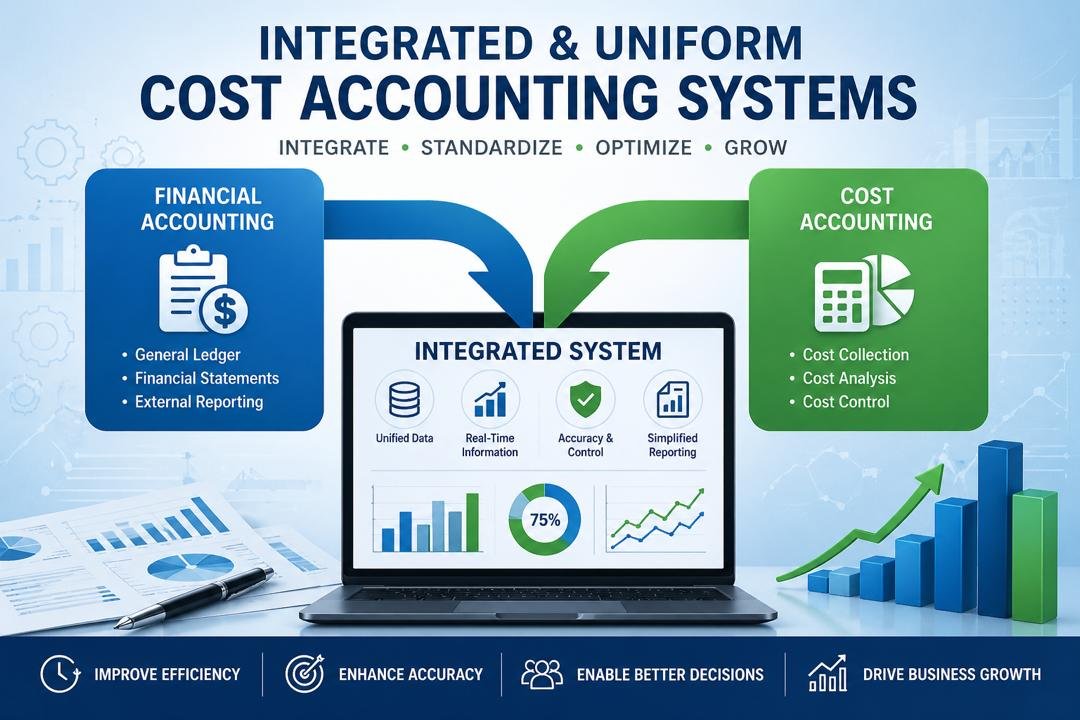
In present climate of ever changing business world companies are always on the look out to improve efficiency, see to it that our financial reports are accurate and that we maintain consistency in our cost management. To that end we have found that the best way is to implement integrated and uniform cost accounting systems. These systems not only put our accounting processes in a more organized fashion but also we are able to make better decisions which are based on reliable and like for like financial information.
This paper looks at integrated and uniform cost accounting systems which we will discuss in terms of what they are, what their main features are, what in particular sets them apart and how they bring about better performance in terms of efficiency, comparability and standardization for all organizations.
Understanding Cost Accounting Systems
Before jumping into integrated and uniform systems it is important to note what cost accounting is. Cost accounting which is part of the field of accounting that reports, analyzes and controls production related costs and service delivery. It is a tool which business use to calculate the price of products, to manage expenses and to increase profit.
Traditionally what we see is that companies run separate financial and cost accounting systems. While financial accounting is for external reporting, cost accounting is used for internal planning and control. What we also see is that which of the two separate systems causes issues of duplication of effort, inconsistency, and overall inefficiency.
What is an Integrated Cost Accounting System?
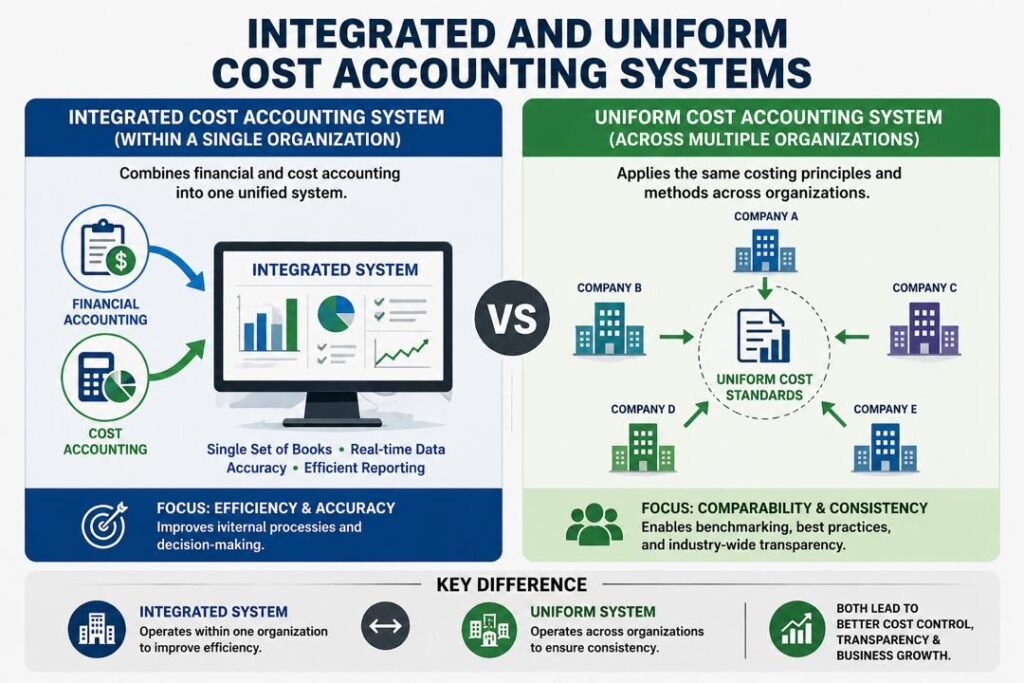
An integrated cost accounting system also known has integral accounting system which brings together financial and cost accounting into one unitary system. We do away with separate books for cost and financial accounts instead all transactions are recorded in a single set of books.
Integrated Cost Accounting Systems Features
1. Single set of books.
Both financial and cost information is recorded at the same time which in turn eliminates the need for reconciliation between separate systems.
2. Real time data recording.
Transactions are recorded at the same time in all related accounts.
3. Reduced Duplication
Since each entry is put in only one system we see a reduction in clerical work and error.
4. Consistency in Data
Uniformity in recording is applied to financial and cost data.
5. Simplified Reporting
Reports are a simple task without the need for record reconciliation.
How Integration Improves Efficiency
Integrated systems greatly improve in many ways:
1. Reduction of Redundant Tasks
In legacy systems the same transaction was recorded twice, once in the books of accounts as well as the cost accounting. Integration into new systems is what removed that redundancy, which in turn saved time and effort.
2. Faster Decision Making.
Since at a single location all data is present managers are able to access accurate and current info which in turn enables timely decisions.
3. Better Accuracy.
With less manual input and reconciliation the risk of errors is reduced.
4. Cost saving.
Reduced admin burden results in lower operational costs.
5. Improved Internal Control.
Integrated solutions provide better audit trails for easy monitoring and control of financial activities.
Practical Applications of Integrated Systems
Integrated into the core of many large scale manufacturing companies, service organizations and also extensive in very large corporations which use them for cost control and financial accuracy. For example:
- Manufacturing companies use which in real time to monitor raw material costs, labor, and overheads.
- Service organizations use them for accurate cost allocation between various projects and departments.
To see more of how businesses put these frameworks into practice, you can also learn about Integrated and standardized cost accounting systems and their use in present day organizations.
What is Uniform Cost Accounting?
Uniform across the board is what we see in uniform cost accounting which is the practice of using the same cost structures and methods across many organizations, mostly in the same industry. As opposed to integrated systems that put together accounts within a single entity, uniform costing is an effort to bring in alignment between different organizations.
Key Features of Uniform Cost Accounting
1. Standardized Procedures
All organizations that are part of it do so which the same costing principles and techniques.
2. Common Terminology
Uniform definitions create clarity and consistency in reporting.
3. Comparable Data
Financial reports which can be easily compared between organizations.
4. Industry-Wide Application
Within the domain of the same industry
Objectives of Uniform Costing
Uniform cost accounting systems are which put forth to achieve several key goals:
- Present performance data across companies.
- Improve upon best practices in our field.
- Improve efficiency through benchmarking
- Support regulatory bodies in tracking industry standards.
- Reduce unnecessary competition which is based on false cost reports.
How Uniform Costing Promotes Consistency
Uniform cost accounting which all companies in an industry do as a set routine they all follow. This which in turn brings about:
Simple Compare
When we see the same cost structures used by companies it is easy to compare their performance and efficiency.
Benchmark of Opportunities
Organizations may look at the leaders in their field and implement their top practices.
Transparency
Uniform costing increases transparency which in turn makes financial reports easy to understand for stakeholders.
Improved Policy Design.
Governments and regulatory agencies may put into practice better informed decisions with the use of standardized data.
Advantages of Integrated Cost Accounting Systems
- Simplified Account Procedures: A standalone system that does this.
- Time Efficiency: Eliminates the requirement of cost and financial accounts to be reconcile
- Enhanced Coordination: Enhances coordination between different departments.
- Accurate Costing Information: Provides accurate information for pricing and cost control decisions.
- Improved Reporting: Rapidly produces financial and cost reports.
Advantages of Uniform Cost Accounting Systems
- Comparability across Firm: Enables meaningful comparisons between organizations.
- Industry Standardization: Promotes uniform practices within an industry.
- Enhanced Efficiency: Encourages adoption of best practices.
- Better Cost Control: Identifies issues and better areas for growth.
- Support for Regulatory Compliance: Part of upholding industry standards and which also.
Differences between Integrated and Uniform Cost Accounting Systems
While both of them aim at improved efficiency and consistency they have different functions:
| Aspect | Integrated Cost Accounting | Uniform Cost Accounting |
| Scope | Within a single organization | Across multiple organizations |
| Objective | Combine financial and cost accounts | Standardize costing practices |
| Focus | Efficiency and accuracy | Comparability and consistency |
| Application | Internal accounting system | Industry-wide practice |
| Data Use | Internal decision-making | Benchmarking and comparison |
Problems with Integrated Cost Accounting Systems
While there are advantages to integrated systems, there are also disadvantages:
- Cost of Set-up: Initial set-up of a fully integrated system is expensive.
- Complexity Variety: Careful planning and expertise needed.
- Training: Users need to be trained to use the system.
- System Review System Review: Systems need to be maintained.
Challenges of Uniform Cost Accounting Systems
There are also challenges of uniform costing: Uniform cost accounting also has its issues:
- Not Flexible: Uniform costing may not work for all companies
- Reluctance to Adopt: Some firms may be resistant to adopt the common practices.
- Privacy Concerns: Allocation of health care costs could have privacy concerns.
- Difficulty in Implementing: It may be difficult to coordinate different organizations.
Technology in today’s cost accounting systems
Integrated and uniform cost accounting systems have been improved by the use of technology.
- Enterprise Resource Planning Systems: ERP systems integrate various business functions such as accounting, procurement and production.
- Robotics: Automation eliminates manual work, reduces errors and we see process acceleration.
- Analytics Data: Complex analytics systems for business to analyze and use cost data for decision making.
- Software as a Service: Cloud based solutions help to share information in real time and provides collaboration across multiple sites.
The importance of Integrated and Uniform Cost Accounting Systems
Efficiency, transparency and standardization are the key to be successful in today’s competitive global market. We notice that integrated and uniform cost accounting systems are very important in this regard.
- Enhancing Decision Making: Timely and reliable information.
- Cost Reduction: Helps organizations manage costs.
- Enhancing Growth: Streamlined systems which allow for growth.
- Ensuring Compliance: Uniform practices help maintain compliance.
- Creating a Level Playing Field: Standardized costs across the industry in order to create a level playing field.
Real-World Relevance
Manufacturing, Construction and Banking are found using these systems which result in increased efficiency and stability. For example:
- Integrated systems are used for costing in manufacturing companies.
- Trade groups advocate the adoption of uniform costing which in turn leads to uniform price and structure.
Best Practices for Implementation
In establishing effective integrated and uniform cost systems, companies should:
- Perform a needs assessment
- Provide adequate technology
- Provide employee training
- Have policies and procedures
- Periodically monitor system performance.
Conclusion
Integrated and unified cost accounting systems are a must for today’s organizations which are out to improve in terms of efficiency, accuracy and consistency. As to integrated systems which tie in financial and cost accounts thus improving internal processes go that is what they do. Also via uniform costing we see a trend towards standardization which in turn enables for better comparisons between organizations and which in turn promotes best practices.
These systems when put together increase transparency, improve decision making, and foster sustainable business growth. While they do present some issues they in the end have greater benefit in the long term. By adoption of these systems organizations may see greater efficiency, maintain consistency and stay competitive in a very complex business environment. Integrated and effective cost accounting systems which in turn transform how businesses manage costs, make decisions and achieve strategy.
Get more well researched information on Integrated and Uniform Cost Accounting Systems here.