Introduction
The accounting equation is the one simple yet powerful accounting principle that every successful accounting system is based on. You can make any bookkeeping equation easier to grasp: whether you’re a small business owner, handling company funds, or simply starting out learning bookkeeping, understanding this equation is crucial because it is the secret behind the fact that monetary records always remain balanced. It serves as the basis for all the accounting, financial reporting and double entry book keeping systems that have been developed. If not, companies would have a tough time creating accurate financial statements and wouldn’t know if there was an error in their books.
The formula Assets = Liabilities + Equity at first glance seems simple. But there is logic behind this simple equation that dictates all financial transactions a business makes are recorded. Any transaction that is made, such as buying something, selling something, loaning or investing money, spending money, affects at least two accounts and follows the equation. It is this built-in balance that ensures accounting accuracy and enables trust in financial reporting by business owners, investors, lenders and regulators.
If you already know what a journal entry is, and what debits and credits are, then accounting equation is the remaining piece of the puzzle that links all of these together. It elucidates the nature of every debit, credit, and the impact of each transaction on the financial situation of a business. In this guide, you’ll find out what this accounting equation is, what it’s important, how it works and how transactions have an effect on this equation and how it remains in perfect balance.
To get some background and industry information, before plunging into reading, you could also take a look at this thorough article on the accounting equation.
What is the Accounting Equation?
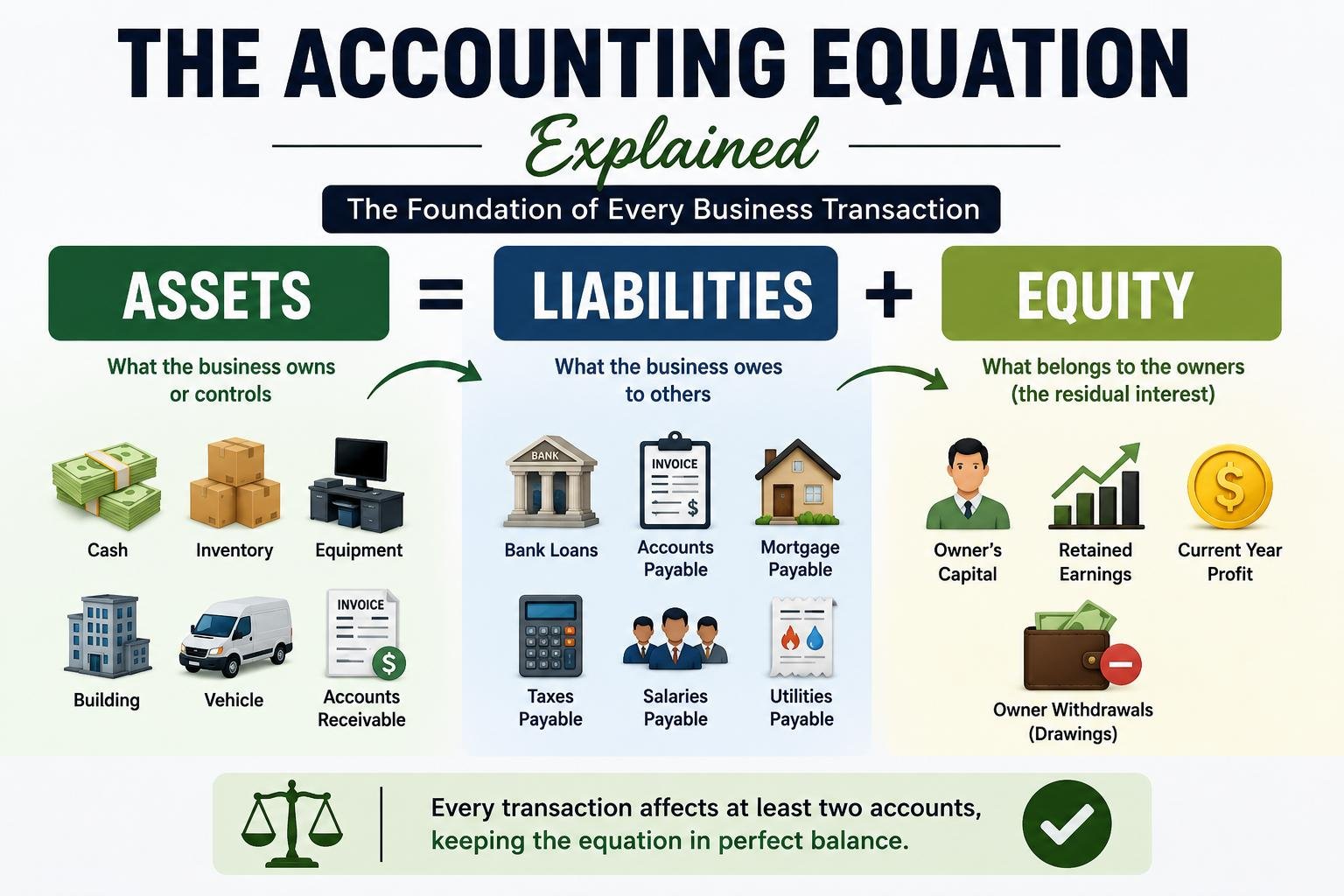
The basis of the entire accounting system is the mathematical relationship that is known as the accounting equation. It is a statement which says that all that a business possesses has been borrowed from some other business or supplied by the businesses owners. The equation will look like this:
Assets = Liabilities + Equity
This equation will always have to be balanced, no matter how many transactions are carried out in the business’ operations. Each financial transaction should affect two or more accounts, and alter one account’s balance by an equal amount to the other accounts. This constant balance is what ensures that an accountant can have confidence in the financial records to accurately show the company’s financial position. The accounting equation is not a formula that must be memorized, but rather it is the economic reality of all organizations. All business assets are financed by its creditors or its owners and a relationship between these two never changes, irrespective of the size or complexity of the business.
The Accounting Equation and why it is Important
Many people who are new to accounting often ask, “Why is this equation so important to accountants? It’s very easy to say, but simply every financial report relies on it. The accounting equation is just presented in a formal financial statement in the balance sheet. It is used by investors to assess the financial stability, lenders to check the creditworthiness, and business owners to understand their company’s financial health. If it is not balanced, then the chances are that there is a mistake somewhere in the accounting records and these needs to be identified.
The accounting equation is used in addition to identifying errors, to give a logical framework for the understanding of business activities affecting financial performance. It explains the concept that in order to acquire an asset you must finance it and reduce the debt load, that in order to earn a profit you must increase the equity and that withdrawals by the owner must be deducted from the owner’s stake on the business. After gaining the understanding of this concept, many other accounting concepts will be easier to comprehend as they also follow the same accounting guideline.
The Concept of the Three Parts of the Accounting Equation
Assets
A business’s assets are all the things that it owns or controls that can be used to provide future benefits and have economic value. These are the assets the business has to utilize in order to be able to function and earn money. They may be physical such as cash, inventory, buildings, machinery and office equipment or non-physical such as trademarks, patents, software licenses etc. Typically, assets are split into those that can be converted into cash within one year, known as current assets, and those assets that are held for long-term use, known as non-current assets.
For instance, if a business buys into a delivery van, the van will be an asset since it is helping to produce revenue in the form of delivery services. Similarly, money deposited in the bank, goods that have not been sold yet and money that customers owe the company also count as assets as they hold an economic value. The accounting equation should remain balanced in each business transaction and an increase in an asset should be balanced by a decrease in some other asset, or a decrease in an asset should be balanced by an increase in some other asset.
Examples of Assets
- Cash
- Inventory
- Equipment
- Furniture
- Buildings
- Vehicles
- Accounts Receivable
- Land
- Investments
- Patents
Liabilities
The debts or financial obligations that a business owes to outside parties are liabilities. They occur when a company takes out a loan, buys items on credit or pays bills that have not yet been settled. A liability is a claim against assets and is expected to be settled in the future by cash payment, delivery of goods or services.
These are typically liabilities such as bank loans, accounts payable, salaries payable, taxes payable and mortgage obligations. Liabilities can be used to help companies fund growth, acquire assets or deal with cash flow. Increasing the resources of the business, liabilities also impose future obligations for the management to carefully monitor. An increase or decrease in liabilities will always have an impact on the accounting equation as borrowed funds will usually increase asset and also increase the liability.
Examples of Liabilities
- Bank loans
- Accounts payable
- Mortgage payable
- Salaries payable
- Taxes payable
- Interest payable
- Notes payable
- Utility bills outstanding
Equity
Equity is the net monetary value of the assets in the business the owner owns. It is also known as owner’s equity, shareholders’ equity or net assets, depending upon the form of business organization. As more capital is invested in the company by the owners or if the company makes a profit, equity goes up. On the other hand, equity will reduce if owners take out cash and/or if the business loses money.
So, equity in simple terms is the net worth of a business after creditors are settled. If a company has assets valued at $500,000 and liabilities valued at $200,000, then the owners will have $300,000 of equity. It is therefore not cash in the bank, but the residual claim on the company’s assets, that is equity. It is important to understand this difference as a beginning entrepreneur so as you can begin to value how profits can be built over time and help your business grow.
Components of Equity
- Owner’s Capital
- Share Capital
- Retained Earnings
- Current Year Profit
How Double-Entry Bookkeeping Keeps the Equation Balanced
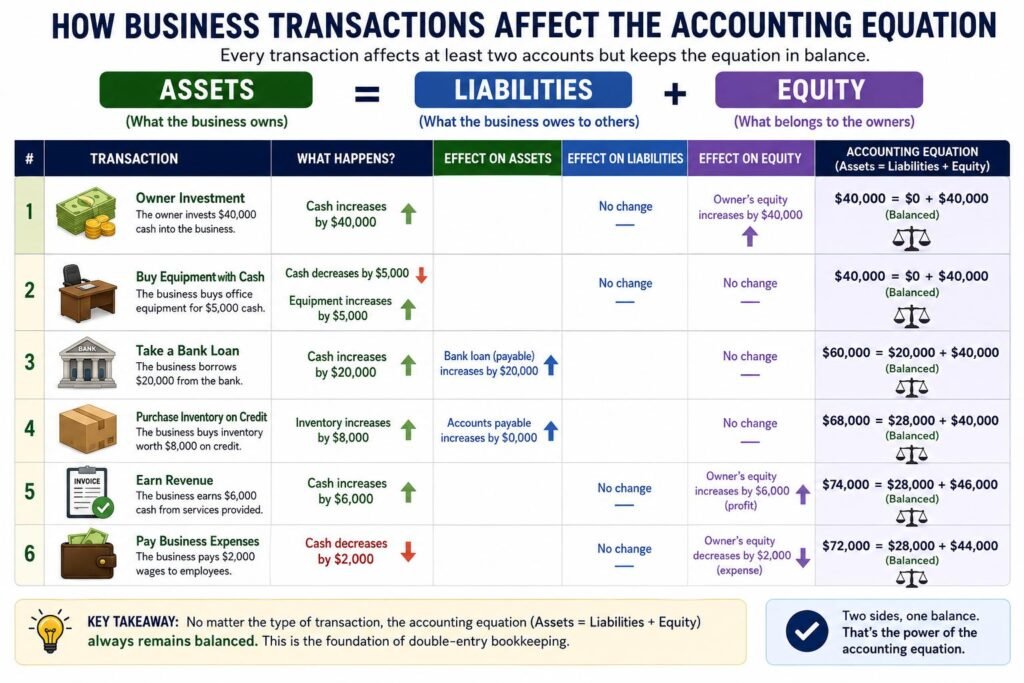
Double entry book keeping is an accounting system specially created to keep the accounting equation in balance. Each transaction will involve the changes to at least two accounts, and never the total of debits will not exceed the total of credits. That’s not a coincidence; it’s a result of every business event having a business event to which it adds value.
Consider purchasing office equipment with cash. The equipment account gets a credit when the company acquires more equipment. The cash account is also diminished by the same amount as the amount of money that has been spent. The value of one asset is rising by the same amount as another asset is falling by so that assets are conserved. Likewise, when equipment is bought on a bank loan rather than with cash, assets go up because the business is able to buy equipment and liabilities go up since the company now owes the bank. In both cases, the double-entry bookkeeping system is able to keep the books in perfect balance, showing that it works well.
The Following are some Practical Examples of the Accounting Equation:
Example 1: money invested in a business by the owner.
Sarah has an initial cash investment of $40,000 in her business.
Before Transaction
Assets = $0
Liabilities = $0
Equity = $0
After Transaction
Assets = $40,000
Liabilities = $0
Equity = $40,000
Equation
$40,000 = $0 + $40,000
The business gets cash, and the owner’s investment adds equity to the business by the same amount.
Owner Withdrawals (Drawings): This figure is deducted from this account.
Example 2: you buy equipment with cash.
A business purchases some office furniture for $5000 cash.
Before:
Cash = $40,000
Equipment = $0
After:
Cash = $35,000
Equipment = $5,000
Total Assets remain $40,000.
Liabilities remain $0.
Equity remains $40,000.
There’s no gain or loss; the equation remains in balance because one asset is being traded for another.
Example 3: Taking a Bank Loan
The company receives a $20,000 loan from the bank.
As cash increases assets increase.
The company is indebted to the bank and this makes the liabilities go up.
Equation:
Assets = $60,000
Liabilities = $20,000
Equity = $40,000
$60,000 = $20,000 + $40,000
Example4: Purchase Inventory on Credit
A supplier is bought at a cost of $8,000 with the condition that the purchase is not paid for immediately.
Assets increase by $8,000.
AP increases by $8,000.
Equation:
Assets = $68,000
Liabilities = $28,000
Equity = $40,000 Still balanced.
Example 5: Earning Revenue
The company receives $6000 cash as a result of consulting services.
Cash increases.
Profit adds to owner’s equity because it is a source of revenue, which is the increase in owner’s equity.
Assets = $74,000
Liabilities = $28,000
Equity = $46,000
Equation remains balanced.
Example 6: Paying Business Expenses
The business pays $2,000 of wages to its employees.
Cash decreases.
Costs diminish profits which diminish equity.
Assets = $72,000
Liabilities = $28,000
Equity = $44,000
Balanced again.
How Each of the Following Transactions will Impact the Accounting Equation.
In all business transactions, at least two components of the accounting equation are affected, even if it seems as if only one of the sides of the equation was involved. Some transactions have an impact on assets (e.g., cash exchange for equipment) and others are a combination of assets and liabilities (e.g., loan from a bank). Revenue generating activities will create additional assets and equity since the profit goes to the owners, cost-driven activities will reduce assets and equity because the cost diminishes retained earnings. If you are a beginner in the accounting process, knowing these relationships will enable you to anticipate how transactions will affect financial statements without journal entries. As accounting situations get more intricate, this analytical skill is even more useful to accountants to pinpoint mistakes promptly and to ensure that records are kept correct all through the accounting cycle.
The most Frequently made Errors in the Accounting Equation by Beginners:
Perhaps the biggest thing beginners do wrong is thinking that just because they’ve added more assets, that the business is more profitable. In fact, assets can grow because they enlarge the amount of borrowed money, but will not add to equity. The other common mistake is mistaking revenue for cash – remember the revenue is a growth in equity, not cash. Some students also erroneously think of expenses as liabilities instead of expenses being a reduction in equity because expenses are a reduction in profits. Some people don’t realize that owner withdrawals are depriving them of their business’s equity without impacting their business’s profitability. Learners may clear up these misconceptions simply by consistently examining each transaction and its effect on the accounting equation, rather than examining each account separately.
The Accounting Equation is the Purpose of Constructing the Balance Sheet.
The accounting equation, formally displayed in a financial statement as a balance sheet, can be represented as a balance sheet. On the left side it shows all business assets and on the right side it shows all liabilities and equity, or how all assets are funded. Since all transactions are entered in the double entry accounting system, this also maintains the accounting equation, which means the balance sheet will also remain in balance. This balance is used by investors, creditors, auditors, and business managers to assess financial stability, liquidity, and solvency of the business. An accounting equation is a tool that makes it easy for accountants to see that the total values on the two sides of the balance sheet match if they don’t, then there’s an error somewhere in the accounting records.
Some Tips to help you Master the Accounting Equation.
It is easier and easier to understand the accounting equation if practiced with every business transaction and is able to identify which accounts are to be increased and which are to be decreased. When making transactions, consider three simple questions: What asset changed? Has there been a change in liability? Was it an increase or decrease in equity? A paper exercise of creating the accounting equation, then adjusting it after every transaction is a great exercise for the beginner because it helps them to understand the relationship between financial transactions and account balances. As you learn more, you will also understand why all journal entries must have equal debits and credits, and why financial statements will never be unbalanced, even if a business transacts a huge number of transactions.
Conclusion
The accounting equation is far from being simply a mathematical formula; it is the basis of the entire accounting system. For every financial transaction, it is important that the relationship between assets, liabilities and equity is maintained, irrespective of the volume and the complexity of the transaction. Beginner users become more aware of the source of any resource the company owns in a process of borrowing or own investment and why double-entry bookkeeping works so well.
Because all these accounting transactions are based on the same principle, the accounting equation is essential for the understanding of journal entries, accounting ledger posting, trial balance and financial statements. Depending on the kind of new transaction, always ask yourself this equation as you learn accounting. If the equation is still balanced, then you’re probably recording the transactions properly. This simple practice will support your bookkeeping abilities, confidence and a foundation for further knowledge and concepts in accounting.
Get more well researched information about accounting equation here.