Introduction
All businesses big or small require a system which enables them to effectively analyze and report on their finances. Businesses will engage in various financial related processes including buying stock, paying staff, receiving payments and paying suppliers. It is important that businesses can recognize, analyze and accurately document these financial processes. An accounting cycle is therefore key to enabling this. Essentially, this is the method that companies utilize to recognize, analyze, adjust and summarize business financial processes that occur within an accounting period and so facilitate financial reporting. Recognizing the accounting cycle therefore assists business owners, accountants and financial managers to review and assess business performance and detect errors. Each stage develops from the last and so financial processes can be analyzed and developed into reports.
Explanation of the Accounting Cycle
An accounting cycle typically commences when a business engages in a financial process and concludes once the post-closing trial balance has been drawn up. It is continually applied to each accounting period so that businesses can effectively analyze and report on their finances. Whilst many aspects of the accounting process can be undertaken via accounting software, the core concepts of the cycle remain constant. All business processes must be recognized and then documented and analyzed. For example, if a retail store buys stock for ₦500,000 in cash this financial activity must be recognized and analyzed so that it can be appropriately reflected in financial reports. Therefore adhering to the accounting cycle prevents business processes being missed and/or misanalysed.
Key Stages of the Accounting Cycle
1. Recognizing Financial Processes
Businesses must recognize financial processes and determine whether they should be analyzed. Typically, business processes such as conducting interviews for prospective staff or planning a marketing strategy will not immediately constitute a financial process. Rather, processes will become financial related if there is an exchange of either money or other quantifiable resources, or if a commitment is formed. Examples of processes which should be analyzed would include buying goods and services, receiving payments, remitting salaries and obtaining loans. Accountants will analyze these processes and so as to recognize whether they influence an entity’s assets, liabilities, equity, revenue and/or expenses. Correct recognition of financial processes is key to ensuring that financial analysis and reporting is comprehensive and accurate. Businesses should implement systems to regularly analyze business processes so that relevant financial processes can be recognized and analyzed.
2. Analyzing and Gathering Source Documents
Having recognized relevant financial processes, businesses must analyze and gather the source documents that evidence these processes. Such documents can typically include sales invoices, purchase receipts, bank statements, payment vouchers and payroll data, alongside credit notes and supplier statements. Usually, source documents will specify the nature, value and date of a financial process together with the parties involved. For instance, if a firm acquires office furniture for ₦250,000 then the relevant supplier invoice or receipt serves as evidence for and can be utilized to analyze this financial process. Effectively managing source documents facilitates the analysis of financial processes and enables businesses to easily detect and analyze discrepancies. Furthermore, it facilitates the production of financial reports. It also generates an audit trail so that both accountants and auditors can trace financial analyses back to the source documents.
3. Analyzing and Documenting Processes in the General Journal
The general journal is then used to analyze and document financial processes. This process is commonly referred to as journalizing. Each journal entry details which accounts are influenced by, and to what extent, together with the date of a financial process together with a short description of the process. Businesses apply a double-entry book-keeping system so that for each financial process at least one debit and one credit will be identified. Thus, the sum of all the debits will always match the sum of all the credits. For example, if an entity uses ₦300,000 in cash to buy new equipment then the accountant will analyze this process by debiting the Equipment Account and crediting the Cash Account by ₦300,000. This reflects that the entity’s equipment (an asset) has increased in value and that its cash has decreased. Journal entries should be analyzed in date order and must be evidenced by source documents. Efficiently analyzing and documenting processes is therefore key to enabling businesses to effectively analyze business financial processes and to then analyze these further.
4. Transferring Entries onto the General Ledger
Following the analysis and documentation of financial processes, these are then analyzed and moved, or posted, onto the general ledger. Specific accounts are maintained within this ledger for different types of business financial processes, such as cash, stock, equipment, receivables, payables, capital, revenue and expenses. Debits and credits from each journal entry are analyzed and then allocated to relevant accounts within the general ledger. Accountants can then analyze the volume of and balance of individual accounts. For instance, if a business conducts a number of cash sales, incurs costs and makes cash disbursements throughout a month, then those financial processes which relate to cash will be analyzed and posted onto the Cash Account. The resulting Cash Account balance indicates the amount of cash the entity holds having analyzed these processes. Structuring financial processes in this way facilitates account analysis, the examination of financial processes and the detection of any anomalous processes. It also aids in the production of a trial balance.
5. Creating an Unadjusted Trial Balance
An unadjusted trial balance is analyzed and compiled following the analysis and posting of financial processes onto the general ledger. This is a summary of the balances of accounts at a specific date and divides these into debit and credit balances. Essentially, it is used to verify that the sum of all debit balances and the sum of all credit balances are equivalent in accordance with the double-entry book-keeping system. For example, an entity may hold ₦800,000 cash, ₦400,000 stock, ₦600,000 equipment and a range of liability, capital and revenue accounts. These will be analyzed and then entered onto the unadjusted trial balance. The sums of the debit and credit balances are then analyzed to ensure that they are equivalent. However, even if these sums are shown to be equivalent, inaccuracies may still exist whereby financial processes have been analyzed incorrectly or even omitted entirely. Hence, accountants must thoroughly analyze an unadjusted trial balance prior to analyzing and posting adjusting entries.
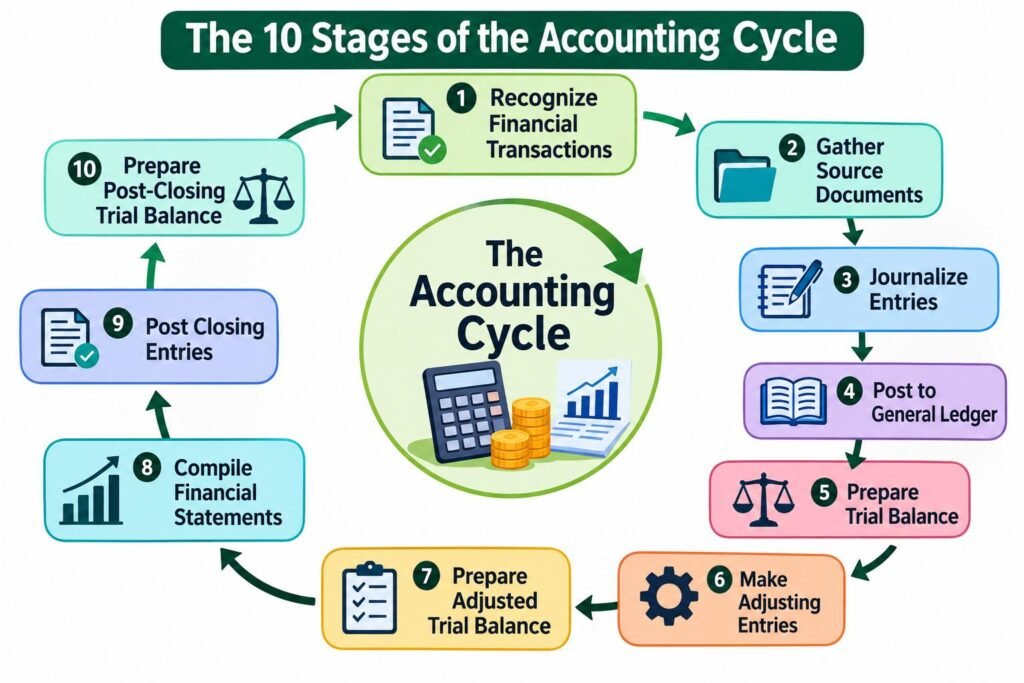
6. Creating Adjusting Entries
Adjusting entries are analyzed and posted at the end of an accounting period to ensure that revenue and costs are analyzed in the correct periods. Businesses adhere to the accruals concept of accounting for this reason. Occasionally financial processes will not yet have been paid for and/or prepayments for financial processes may have been made. Typical adjusting entries pertain to: income accrued, costs accrued, prepayments, depreciation and income received in advance. Continuing with the example above, if an entity has yet to remit salaries of ₦150,000 to staff for work completed before the end of a month, then the accountant will analyze and post an entry to debit Salaries Expense and credit Salaries Payable of ₦150,000. Additionally, should an entity pay ₦120,000 for one years’ insurance cover, then the value of the insurance for the months yet to come will continue to constitute an asset until it is actually utilized. Through analyzing and posting adjusting entries, entities can ensure that financial reports correctly analyze revenue and costs for the relevant accounting period, rather than merely reflecting cash inflows and outflows.
7. Creating an Adjusted Trial Balance
Having analyzed and posted all relevant adjusting entries, an accountant will then analyze and compile an adjusted trial balance. This is a summary of all accounts and shows the balances of these accounts having analyzed and posted adjusting entries. It is analyzed to firstly verify that the sums of all debit and credit balances are again equivalent and secondly to ascertain the final balances of accounts so that financial reports can then be analyzed and compiled. To continue with the above example, if an entity initially analyzed and posted an adjusting entry to recognize that equipment had depreciated by ₦50,000 then both the depreciation expense and the accumulated depreciation account will have been analyzed and posted to increase by this figure. Consequently, these amended balances must be analyzed and posted onto the adjusted trial balance. As mentioned above, this stage is especially significant as it analyses financial processes having considered commitments, income earned, prepayments and asset depreciation. It also enables accountants to further analyze financial processes and detect discrepancies prior to financial reports being compiled.
8. Compiling Financial Reports
Financial reports are subsequently analyzed and compiled based upon the adjusted trial balance. These reports summarize a business’ financial performance and status and can thus inform business owners, investors, lenders, managers and others about a business. Key financial reports are an income statement, statement of changes in equity, statement of financial position and statement of cash flows. An income statement analyses an entity’s revenue, costs and so determines its profit or loss. A statement of financial position summarizes a business’ assets, liabilities and equity at a specific date. The statement of changes in equity analyses changes to an owner/shareholders’ interest. Finally, a statement of cash flows analyses the cash inflows and outflows associated with a business’ operating, investment and financing activities. Overall, financial reports enable businesses to analyze their profitability, financial health, liquidity and performance. Accurate financial reports can be achieved by correctly analyzing and posting financial processes through the accounting cycle.
9. Analyzing and Posting Closing Entries
Following the compilation of financial reports, closing entries are analyzed and posted so that a business can effectively prepare its accounts for the next accounting period. Closing entries reallocate the balances of temporary accounts to permanent accounts. Temporary accounts will typically comprise of revenue, costs and drawings/dividends (depending on a business’ structure). These accounts are analyzed and re-allocated as they analyze business financial processes for a defined accounting period and so should start afresh in the next accounting period with a nil balance. To illustrate, if in a year of operations a business analyses and posts revenue of ₦2,000,000 and costs of ₦1,400,000 then it will have realized a net profit of ₦600,000. Revenue and costs are analyzed and re-allocated to the relevant income summary account. The resulting profit or loss is then analyzed and re-allocated to either retained earnings or an owner’s capital account. By analyzing and posting closing entries, businesses can ensure that the correct balances are in place at the commencement of the next accounting period and that previous financial processes do not impact upon the analysis of new financial processes.
10. Analyzing and Posting a Post-Closing Trial Balance
Finally, a post-closing trial balance is analyzed and posted. This is analyzed and posted following the analysis and posting of closing entries. Unlike previous trial balances, this will exclusively comprise of permanent accounts and so will not include revenue and costs as these balances will have already been re-allocated to the relevant equity account. Essentially, the function of a post-closing trial balance is to verify that the sums of all debit and credit balances are again equivalent having analyzed and posted closing entries. For example, an entity may re-allocate its cash, stock, equipment, payables, loans and retained earnings balances to the next accounting period. These will then act as the starting point for this next accounting period. Analyzing and posting a post-closing trial balance is key to accountants as it enables them to verify that a business’ accounts are correctly balanced and that temporary accounts have been effectively re-allocated prior to the analysis of new financial processes.
Example of the Accounting Cycle
Suppose that a small retail business receives an initial injection of capital of ₦1,000,000 from its owner. During a month of operations, the entity buys stock for ₦300,000 in cash, sells products for ₦500,000 and pays ₦80,000 in rent. Moreover, the entity has electricity costs of ₦20,000 which have yet to be paid. Suitable source documents will be analyzed and gathered for each of these processes (for example, purchase receipts, sales invoices and electricity bills). Financial processes will then be analyzed and documented within the general journal and then analyzed and posted onto relevant general ledger accounts. Having analyzed and posted financial processes, the accountant will then analyze and post an adjusting entry to recognize the outstanding electricity costs. For this, the accountant will debit Electricity Expense and credit Electricity Payable of ₦20,000. The accountant will then analyze and post an adjusted trial balance so that amended balances can be analyzed. Financial reports can then be analyzed and compiled to show an entity’s revenue, costs, assets and payables. Finally, revenue and costs accounts will be analyzed and re-allocated and a post-closing trial balance will be analyzed and posted to verify that permanent accounts are correctly balanced.
Significance of the Accounting Cycle
An accounting cycle is key to assisting businesses in effectively analyzing and reporting on their finances. By adhering to a uniform process, entities can minimize errors and ensure that financial processes are not missed. Moreover, financial processes can be accurately analyzed. Undertaking an accounting cycle also enables companies to comply with accounting and financial reporting guidelines. Furthermore, it is important as it allows businesses to effectively make decisions. Business owners and managers utilize financial reports to analyze a business’ profitability, control costs, manage cash flow and plan investment. Additionally, as financial processes can be traced back to source documents, journals and general ledger accounts, an accounting cycle also promotes business accountability. It further assists in the auditing process as it provides a clear indication of how a business has analyzed its financial processes. Although accounting software can ease the accounting process, suitable internal controls and qualified staff are still essential so that businesses can analyze financial processes, verify account balances and ensure that financial reports accurately analyze a business’ financial processes.
Conclusion
The accounting cycle is integral to effectively analyzing and reporting on business financial processes. Each stage of the cycle recognizing financial processes, analyzing and gathering source documents, analyzing and documenting financial processes, analyzing and posting financial processes and analyzing and posting adjusting entries all contribute towards the accurate analysis of a business’ finances. Financial reports are then analyzed so that a business can effectively assess its financial performance and status. Closing entries and a post-closing trial balance are then analyzed and posted so that a business can effectively prepare its accounts for the subsequent accounting period. Uniformly applying an accounting cycle is therefore key to promoting business transparency, facilitating compliance with reporting requirements and enabling businesses to detect financial issues. Irrespective of a business’ size, it is vital that businesses recognize and implement an accounting cycle so that book-keeping can be effectively undertaken, financial management can be appropriately executed and business success can be successfully pursued.
Get more well researched information about Accounting cycle here.