The efficiency of reproduction and distribution of information is an important aspect of mass communication. Although the digital media has been increasing at a high rate, printing techniques in mass communication remains an important element in the way messages are communicated particularly in the field of publishing, advertising and packaging. In the background of any printed newspaper, magazine, brochure or product label is a special printing method that is intended to address certain production requirements.
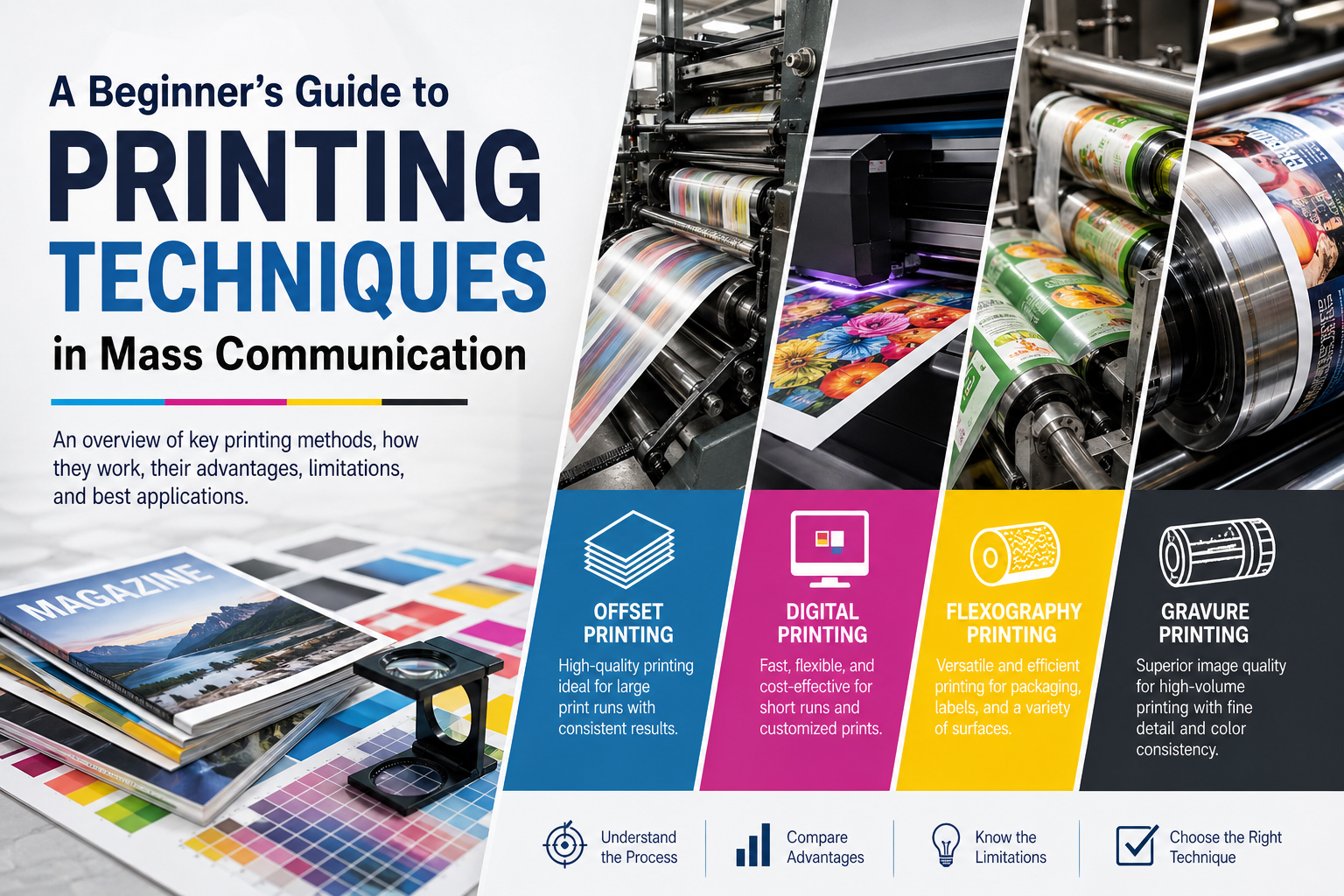
it is important to learn these methods of printing in order to get a technical understanding of graphic communication. This guide discusses the four most common approaches-offset printing, digital printing, flexography and gravure and how each works, their strengths, weaknesses and how each can be used in mass communication.
Understanding Printing in Mass Communication
Printing refers to the act of moving text and images to a material in the form of paper, plastic, fabric or metal. With mass communication, printing is more than merely creating copies; it is about creating uniformity, quality and efficiency in mass.
There are various printing methods since there is no one method that can suit all the production requirements. There are methods which are designed to produce high-volume and fast, whilst others are designed to be flexible, customizable or to match a material. The decision of the designers and communication professionals should be the most suitable method depending on the cost, turnaround time, quality of print and the material which is being used.
Offset Printing
Offset printing is one of the most popular and reliable techniques of the printing industry. It is especially used in large scale commercial printing.
How Offset Printing Works
The principle of offset printing is that oil and water are not soluble. This is done using metal plates which depict various colors. These plates are used to print onto a rubber blanket, which in turn transfers the image to the printing surface.
The steps include:
- Preparation of images and plate making.
- Application of ink to the areas of the image on the plate.
- Transference of ink on plate to rubber blanket.
- Take it out of blanket and onto paper.
This process of indirect transfer can be used to preserve high-quality images, and the life of the printing plates is extended.
The benefits of Offset Printing
The use of offset printing is much preferred due to several reasons:
- It produces high-resolution and coherent pictures.
- When large volumes are to be printed, it is cost-effective.
- It aids in a broad paper selection and finishes.
- There is correct and consistent reproduction of color.
Disadvantages of Offset Printing
Although it has its benefits, there are certain disadvantages to offset printing:
- Expensive startup of plates because of plate production.
- Will take longer than digital printing to prepare.
- Unsuitable for short print run or in rush work.
Best Applications
The offset printing is ideal in:
- Newspapers and magazines
- Books and catalogs
- Corporate reports and brochures.
- High-volume marketing materials
Digital Printing
One of the most convenient and versatile printing technologies in the present is that of digital printing. It is also fast and easy to use, hence becoming popular.
The process of Digital printing
Digital printing does not use plates as opposed to offset printing. Instead, digital files are transmitted to the printer, which prints them on the material using ink or toner. It is a process which is like desktop printing but on a larger scale.
The benefits of Digital Printing
Digital printing has a number of advantages:
- Quick turnaround time and low set-up.
- Economical when printing small quantities.
- Can be customized and personalized.
- Supports on-demand printing.
Nonetheless, it has its drawbacks:
- Greater price per unit in large quantities.
- Very slightly worse color accuracy than offset.
- Low compatibility with some materials.
Best Applications
Digital printing is most suitable for:
- Business cards and flyers.
- Posters and banners
- Personalized marketing materials
- Short-run publications
Flexography
Flexography, also known as flexo printing, is a popular process in the packaging industry because it is versatile and efficient.
How Flexography Works
Flexography employs rubber or photopolymer plates, which are flexible. These plates are attached to cylinders, which rotate. The ink that is transferred is from an ink roller to a plate and subsequently to the printing surface. It is very efficient in large-scale production as it is a continuous process.
Advantages of Flexography
Flexography has some special benefits:
- Printing ability on different materials such as plastic, foil and paper.
- High-speed production capabilities
- Economical when printing a large number of copies.
- Works with dry inks that can be used in packaging.
Limitations of Flexography
Some limitations include:
- The early installation can be costly.
- The quality of the images is a bit worse than offset and gravure.
- The production of plates needs to be precise.
Best Applications
Flexography has a wide range of applications:
- Packaging and wrappers of food.
- Labels and stickers
- Plastic films and bags.
- Corrugated boxes
Gravure Printing
Gravure printing has one of the best image qualities, and it is applied in printing projects of the highest volumes.
The working of Gravure printing
In gravure printing, the pictures are cut in metal cylinders. The ink is contained in these engraved cells and then transferred onto the printing surface. The depth of each cell is used to control the amount of ink used and can be used to vary the tonal range accurately.
The benefits of Gravure Printing
Gravure printing provides:
- High quality of images with delicate detail.
- Stable production at high print volumes.
- Gradual color transitions and luxurious images.
- Large-scale production with high efficiency.
Disadvantages of Gravure printing
Its disadvantages include:
- Very large set up costs.
- Unsuitable for small or medium printings.
- Longer preparation time
Best Applications
The gravure printing is suitable for:
- High-end magazines
- Packaging films
- Wallpaper and ornaments.
- Large-volume catalogs
Comparing Printing Techniques
The differences between these methods will aid in the choice of the most suitable one to use in a particular project.
Print Quality
The best printing is gravure printing, which comes second to offset printing. The quality of printing produced using digital printing is good and can be used in general printing, but flexography would be best applied in functional printing as opposed to fine detail.
Cost Efficiency
At large quantities, offset and flexography are cost-effective. Digital printing is cost-effective when it comes to small quantities, whereas gravure is only feasible in the case of exceptionally large quantities.
Speed and Flexibility
The most flexible and quickest is digital printing, which is particularly effective in customized jobs. Flexography is quick in continuous production as compared to offset and gravure, which take more time to set up.
Material Compatibility
Flexography is compatible with the largest variety of materials. The most common situation with the use of offset and digital printing is on paper products, whereas gravure is applicable in packaging materials.
The Role of Printing in the Contemporary Mass Communication
Print is also a strong medium of communication, even in the digital era. The newspapers, magazines, brochures, and packaging continue to use traditional methods of printing to reach their audiences.
Every printing method is used in a certain way:
- The offset printing provides a uniform quality to editorial material.
- Digital printing promotes personalized and fast communication.
- The packaging industry is propelled by flexography.
- Gravure produces quality visual experiences.
The knowledge of these roles assists professionals in making informed decisions when developing communication strategies.
Selection of the appropriate Printing Technique
The choice of the printing method is determined by a number of factors:
Volume
Big runs prefer to use offset or gravure printing, whereas the small runs are more suited to digital printing.
Budget
Digital printing suits the small budgets, and offset and flexography are more appropriate for large production.
Material
Offset or digital printing is generally used in paper-based projects, and flexography or gravure is needed in packaging materials.
Time
Digital printing is applicable when there is a sense of urgency, and offset and gravure are applicable when the production is planned and in large volumes.
Trends in printing in the future
Technology has kept on improving in the printing industry. There are some key trends, such as:
- Environmentally friendly inks and materials.
- Hybrid printing systems are those that combine digital with traditional printing.
- More automation to achieve efficiency.
- Expanding personalized and variable printing of data.
These innovations are rendering printing more flexible and eco-friendly.
Conclusion: Printing Techniques in Mass Communication
The foundations of mass communication are printing techniques that allow the visual content to be produced on a large scale. Every process has its purpose, with offset, digital, flexography, and gravure providing various benefits based on the needs of the project. To a novice, a knowledge of these printing techniques in mass communication can offer a good idea of how communication materials are created and disseminated. The knowledge not only increases the technical awareness, but also plays a role in closing the divide between design and production.
With the current and ever-growing developments in technology, a combination of the traditional and digital printing will further enhance the value of print in mass communication, thereby making it relevant in a digital world that is ever-growing.