
Introduction
Financial stress testing can be performed by financial institutions in order to identify weaknesses within financial positions due to changes in financial and economic factors. If interest rates rise, inflation increases, currencies depreciate, asset values fall and loan defaults increase in unison, this can have a detrimental impact on financial institutions. By performing financial risk testing, banks can identify possible weaknesses within their financial positions. Conducting financial stress tests allows banks to analyze how a severe yet realistic set of economic/financial factors may impact financial positions. Identifying potential losses in advance allows financial institutions to build resilience within their financial position, so they are better prepared for uncertain economic times.
Financial Stress Testing in Financial Institutions
Financial stress tests are used by financial institutions in order to understand how they would be impacted by unforeseen negative economic, market and financial factors. Hypothetical scenarios in difficult economic situations are created in order to see the impact on capital, liquidity, profitability and financial security. (Investopedia) Financial stress testing is used to give an understanding of the ability of an organization to cope in adverse conditions. Additionally, it allows organizations to identify weaknesses within the financial position. While banks may understand how they performed in the past, they use financial stress tests to understand how they may face significant pressure in the future. This allows the management within banks to understand potential threats, estimate potential losses and determine whether existing resources are adequate to cope with unexpected issues.
It is very important for financial institutions to conduct financial stress tests in order to evaluate how multiple financial pressures may be impacting the financial operation. For example, if interest rates increase, borrowing costs may increase. Investment values may decrease and customers may find it more difficult to pay back loans. At the same time, if inflation occurs, consumers may have less disposable income. If currencies devalue, it will be more expensive for companies to purchase foreign goods and pay debts in foreign currency. This may result in an increase in default payments, and a decrease in the quality of assets held within the bank. Using financial stress tests, financial institutions can understand how different pressures may combine to put the institution under pressure. Risk management within financial institutions can be evaluated to ensure they are well protected from suffering significant losses.
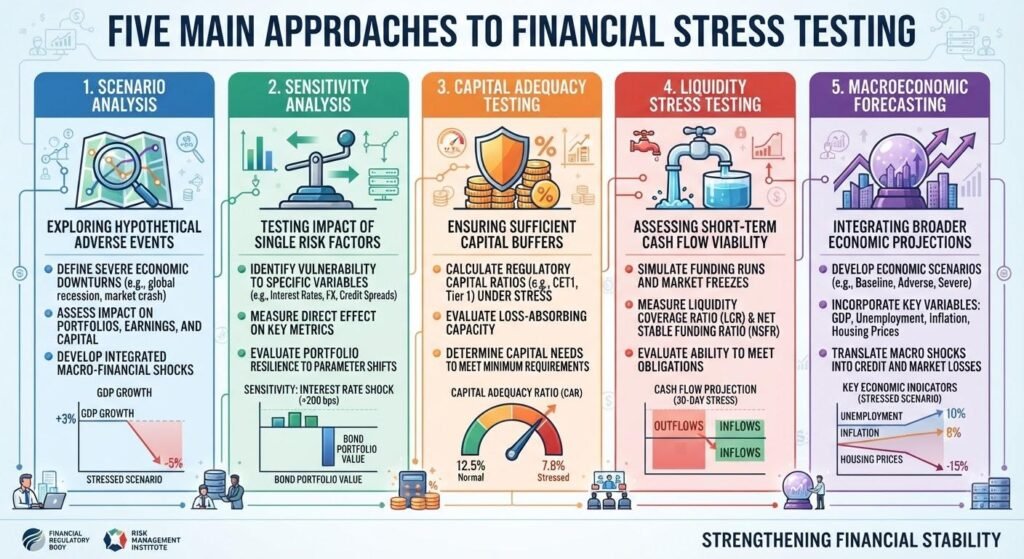
Main Approaches
1. Scenario Analysis
Scenario analysis is an important approach to financial stress testing, as it allows assessment of how banks may be affected in various negative economic situations. Scenarios are put in place to represent extreme economic conditions. Examples of these may include high levels of inflation, higher unemployment, economic recessions, currency depreciation, increased interest rates, or falling property/investment values. The scenarios within financial stress tests may be of medium severity, or they may be extremely severe and pose a risk to financial stability. By producing these scenarios, banks can analyze the impacts on income, loans, investments, capital and liquidity. For example, if a recession occurs and unemployment increases significantly, businesses may begin to suffer reduced profits. As a result, there may be increased levels of missed loan payments. Credit losses may increase within the bank and profits may decrease. Knowing this enables banks to identify potential weaknesses within their operations, and be prepared with countermeasures in case of economic difficulties.
2. Sensitivity Analysis
Sensitivity analysis is used to understand how individual changes in financial factors may impact the financial position of a bank. Unlike scenario analysis, sensitivity analysis usually considers only one change in factors, with all other factors being relatively unchanged. Financial institutions may test how a 2% increase in interest rates may impact loan repayments, investment values or net interest income. In addition, they may assess how a certain amount of currency depreciation may affect foreign currency liabilities, or how falling property prices may affect the value of secured loans. This can allow banks to understand which financial factors have the most impact on their performance. Risk management within financial institutions can be improved by identifying areas that need to be more closely monitored, setting appropriate risk limits and understanding how sensitive balance sheets are to unexpected market movements.
3. Capital Adequacy Testing
Capital adequacy testing is performed in order to understand whether a financial institution has sufficient capital to absorb unexpected losses. Banks hold capital within to ensure depositors are protected, and to allow lending operations to occur. Within financial stress testing, financial institutions estimate the impact of adverse economic conditions on capital within the institution, by considering increased loan defaults, falling investment values and reduced earnings. For example, if there is an economic recession, many businesses and individuals may default on their loans. As a result, the bank may have to account for significant credit losses. This can reduce the level of capital available to the bank, and reduce their ability to support future lending. By performing capital adequacy testing, management can understand whether current capital reserves are sufficient to absorb potential losses. It can also be used to aid decisions regarding holding profits in the bank, raising additional capital, adapting loan processes, and ensuring capital requirements set by regulators are met.
4. Liquidity Stress Testing
Liquidity stress testing is used to understand whether the bank is capable of covering its financial obligations in unexpected instances of liquidity shortages. Even though financial institutions may hold valuable assets, if they cannot be quickly turned into cash, the institution may face significant issues. Liquidity pressure may occur if many deposits are made by customers, instability in financial markets and/or other institutions becoming unwilling to provide short term funding. During stress tests, banks consider these conditions and estimate how long they would be able to cover withdrawals, settle transactions, and meet other obligations, without raising additional funds. For example, if consumer confidence in an institution drops suddenly, many customers may withdraw their money in a short space of time. Performing liquidity stress tests in this instance can allow institutions to understand how much cash reserves are available, what emergency funds are available, and how liquid assets can be sold, without incurring significant losses. This improves preparedness in cases of unexpected liquidity issues.
5. Macroeconomic Forecasting
Macroeconomic forecasting can be used in conjunction with financial stress testing to understand how macroeconomic factors may impact financial institutions. By monitoring macroeconomic factors such as inflation, unemployment, gross domestic product, exchange rates, interest rates and economic growth, financial institutions can make realistic assumptions within their stress tests. For example, if economic growth is predicted to fall, it may mean that businesses face reduced revenue, and individuals may struggle to repay loans in addition to increasing unemployment. Similarly, if currency depreciation is expected, additional risks may be faced by financial institutions with foreign currency exposure. Combining macroeconomic forecasting and stress testing within banks means that banks can understand how economic factors may impact their financial position over time. While it is not always accurate to predict all crises, macroeconomic forecasting can be very useful to understand emerging risks and allow better financial decisions to be made.
Scenario Simulation
Financial stress tests can be used by financial institutions to understand how different economic/financial scenarios may affect operations. Increasing interest rates can increase borrowing costs for businesses and customers, and reduce investment values. Banks can assess whether increased interest rates may lead to increased loan defaults, reduced borrowing and losses within financial assets. Inflation can increase operating costs for businesses and individuals, reducing disposable income for individuals. This may mean that individuals find it harder to repay loans. Currency depreciation also places pressure on businesses and banks with foreign currency liabilities. As a result, financial institutions can assess how changes in exchange rates may impact repayment ability, foreign currency exposure and the value of international transactions.
Falling asset values and increased loan defaults may also be assessed. Banks hold a range of financial assets, including government bonds, company bonds, investment products and secured loans (secured using property/other assets). In a downturn, market values of these assets may fall, meaning that institutions that depend on them may be weakened. Businesses may be unable to earn the same level of sales, and individuals may be unemployed, meaning that they may struggle to make repayments. Through financial stress tests, institutions can understand potential credit losses, asset quality and whether existing resources can cope with this pressure. This is very useful as it allows financial institutions to understand how financial risks within the industry may be interlinked. For example, falling asset values may occur alongside increased loan defaults and liquidity issues. As a result, this creates a far more serious risk than each individual risk would alone.
Predicting Economic Crises
Using financial stress tests can help identify economic and financial risks within banks early. By regularly conducting stress tests for adverse economic circumstances, banks can spot potential issues within financial institutions. If too many loans are concentrated in certain areas, insufficient capital reserves exist, unstable funding sources are present or credit risk is increasing, this may mean that the institution may struggle with deteriorating economic conditions. Although financial stress tests cannot accurately predict the exact time and scale of all financial crises, it can still provide an insight into how vulnerable financial institutions are to different pressures. It also means that management within financial institutions pay attention to emerging risks, instead of just relying on previous performance. By spotting potential issues early, banks can implement solutions to prevent financial issues from escalating into larger issues for the institution, or even within the financial system as a whole.
Stress tests can also allow financial institutions to understand how risks may spread within the banking industry. As banks are interlinked with each other through lending, markets, payments, investments and inter-bank transactions, if one financial institution faces significant financial issues, it may cause issues for other institutions that rely on it, or hold financial commitments with it. For example, if there is a large increase in loan default rates, capital may be reduced within the bank. As a result, the bank may be less willing to lend, causing additional pressure on businesses that rely on this financing. If many institutions face similar issues, this may have an impact on the wider economy. By understanding inter-related risks, financial institutions can understand the extent to which they are exposed to wider financial instability, and create strategies to ensure greater resilience within the banking industry.
Meeting Regulation Requirements
Conducting financial stress tests can allow financial institutions to meet regulation requirements. Regulations set by banking regulators are put in place to ensure financial institutions have sufficient capital, effective liquidity management and operate responsibly. Financial stress tests allow banks to demonstrate that they regularly understand the risks they may face in adverse economic situations and know how they may be unable to meet regulatory expectations. In many areas, regulatory bodies require certain financial institutions to complete stress tests, and provide results to enable effective supervision. This enables regulators to understand whether financial institutions have sufficient financial cushions and risk management processes in place. The results can also inform supervisory decisions, for example requesting institutions to have higher capital positions or improve their risk management. By meeting stress testing requirements, financial institutions can improve transparency, accountability and give confidence in the wider financial system.
Improved Contingency Planning and Risk Management
By conducting financial stress testing, banks can improve contingency planning. After identifying potential weaknesses, appropriate measures can be implemented by management in response to specific economic situations. Measures may include holding more liquid assets, putting in place alternative funding sources, changing lending strategies, improving credit evaluation, reducing excessively risky positions and raising new capital. For example, if a bank identifies through stress testing that it may face serious liquidity pressure in an instance of widespread withdrawals, management may put in place emergency funding sources, and improve processes to monitor cash flows. Similarly, if a scenario highlights excessive risk to the institution from currency depreciation, the institution may review its currency risk management strategy. Having appropriate measures in place enables financial institutions to be more effective in reacting to difficult economic situations, without having to make key decisions without enough preparation.
Also, financial stress testing can improve communication and decision making within financial institutions. The results give senior management, risk managers, financial analysts and director’s greater knowledge of potential weaknesses in financial positions and the level of risk that an institution may be facing from economic pressures. This can influence decisions in relation to lending, investing, capital allocation, liquidity management and expansion. As financial risks may affect many areas of a financial institution, it encourages collaboration between different departments. For example, if credit risk managers discover increased default rates, treasury departments may assess the impact on liquidity, and finance teams may evaluate impacts on profitability and capital. Considering these findings in combination enables management to create more comprehensive risk management strategies. As a result, financial stress testing does not simply serve a regulatory purpose, but is an important way to improve financial discipline within an institution to allow long term stability.
Limitations
Despite the benefits of financial stress testing, there are some limitations within this method. One of the main limitations is the uncertainty of the scenarios. As financial stress tests are based on assumptions, previous data, models and estimations of customer and market reactions, it may be difficult to accurately predict the impact of real financial crises. Unexpected events such as conflict in other countries, natural disasters, technological change and sudden changes in government policy may create financial pressures that were not adequately covered by models. In addition, inaccurate data and incorrect assumptions may lead to misleading results. As a result, financial institutions may underestimate exposure to certain risks. To avoid this, the models should be regularly reviewed, data quality should be improved, and different potential outcomes should be considered, rather than making predictions.
Another limitation is that financial stress testing can be costly and complex within complex financial institutions with large portfolios. In order to effectively complete stress tests, accurate financial data, knowledgeable risk management staff, appropriate technology and monitoring of economic factors must be in place. Smaller financial institutions may struggle to acquire all of these resources, meaning that the quality and frequency of stress tests may be limited. In addition, management may begin to become over confident in stress test results and assume that all major risks have been identified. However, stress testing cannot guarantee that financial institutions will not fail. The effectiveness of stress testing depends on how accurately scenarios are created and how seriously the findings are taken by institutions. Therefore, banks should also implement other risk management methods, independent checks, good governance and regular assessments of changing financial factors in order to reduce risks.
Conclusion
Financial stress testing within banks is an important tool to understand how they would cope in unexpected financial/economic situations. Using scenario analysis, sensitivity analysis, capital adequacy testing, liquidity stress testing and macroeconomic forecasting, financial institutions can assess how increased interest rates, inflation, currency depreciation, falling asset values and increased loan defaults may impact financial stability. This allows potential weaknesses to be identified, potential losses to be estimated, and whether existing resources are sufficient to handle difficult economic circumstances. Financial stress tests help financial institutions meet regulation requirements, improve contingency planning and make effective risk management decisions. Although it cannot accurately predict all financial crises and completely remove financial risk, it provides useful insights to allow financial institutions to prepare for uncertainty. As economic and financial factors become increasingly interlinked, effective and regular financial stress testing will be very important in protecting financial operations, giving confidence within the public and creating long term financial stability.
Get more well researched information about Financial stress testing here.