Introduction
Banks rely on financial forecasting in order to improve long term profitability and appropriately navigate the unpredictable market. Predictive analytics can allow banks to make improved forecasts, using large amounts of financial data. Traditional forecasting methods typically rely on analyzing past data manually, and making predictions based on simple statistical analysis. However, these methods may not be as quick to adapt to changes within the market, and unexpected changes in customer behavior. Predictive analytics in banking allows banks to make improved forecasts based on large sets of financial data. Using advanced analysis, statistical techniques and machine learning, banks can make improved predictions on income, expenditure, cash flow, loan demand and market trends.
Predictive Analytics in Financial Forecasting
Predictive analytics uses information from previous data, and statistical and advanced analytical techniques to make predictions about future figures. Within banking, predictive analytics allows financial institutions to gain insight into potential changes in financial figures, and appropriately prepare. Banks collect information from many sources. For example, transaction data, repayment of loans, deposits, operating expenditures, interest rates and wider economic factors. Analysis can be carried out on the data to form insight into correlations, and trends that may affect future financial figures. For example, by analysing previous loan data, and income data from customers, a bank can predict how much loan demand may occur in a given time period. Overall, this means financial forecasts can be made with reference to data. It provides useful information to management teams within banks to make decisions, effectively managing costs, and preparing for potential issues within financial figures.
Due to the increasing importance of predictive analytics in banking, businesses can improve their ability to make sense of financial data, and predict future changes. Using predictive models, banks are able to consider multiple scenarios and understand how different changes may impact their business. This allows businesses to identify trends, and predict financial figures, along with identifying any potential risks. As predictive analytics is used to make decisions within financial planning, decisions made within the business can be more consistent as they have been informed by quantifiable data. As banking becomes increasingly digital, banks have access to very detailed financial data. Therefore, using predictive forecasting can allow banks to remain competitive, and improve performance.
Using Data to Improve Financial Predictions
Previous Financial Data
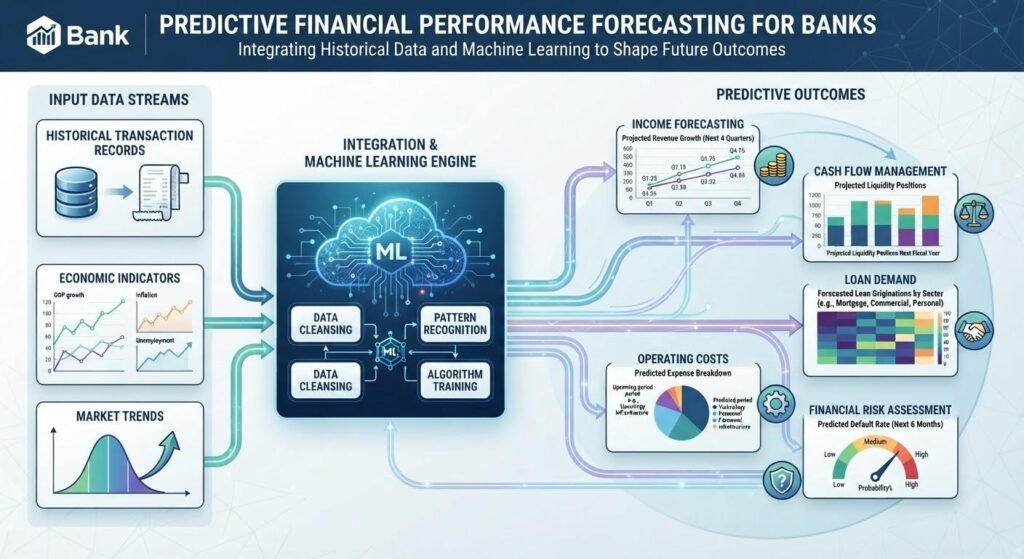
Previous financial data allows banks to make predictive forecasts. Income, costs, repayments of loans, deposits, interest income, and returns from investments can all be found within a bank’s financial data. Analyzing financial data over several years of information can help banks identify trends, trends related to time of year, and outliers which may affect future figures. Transaction data can also be used to gain more insight into customer behavior. This includes how frequently customers spend, transfer money, and withdraw money, and the total amount of money in their accounts. Combining financial data with transaction data within predictive systems means banks can gain a full understanding of financial activity. Correlations in financial data may be identified. For example, a bank may find that money being withdrawn by customers regularly increases during certain times of the year. The bank can then prepare to have enough liquidity to meet this increased demand.
Economic Data
As banking performance is closely linked to the wider economy, financial institutions will consider economic data to inform financial forecasting. Key economic data to consider includes inflation levels, unemployment levels, interest rates, currency exchange rates, gross domestic product, and changes in consumer spending. These factors will impact borrowing costs, spending power, saving behavior, investment and loan repayment ability. For example, increasing interest rates may mean that some customers no longer borrow from the bank. However, this may benefit banks as they may gain increased returns on interest bearing assets. Increasing inflation can increase costs for banks, and may also mean that customers have difficulties repaying loans. Using Predictive Analytics, banks can analyze both internal financial data, and external economic data to understand how these economic changes may impact future performance. This allows banks to make more realistic forecasts, rather than simply basing decisions upon previous financial performance.
Key Uses of Predictive Analytics in Banking
Predicting Income and Costs
Income forecasting within banks allows businesses to predict how much income they may receive in a time period. Income can be gained through charging interest on loans, fees, charges, investment, and other banking services. To predict future income, previous income, customer activity, interest rate changes, and market trends can be analyzed. This allows management to understand if expected income will be suitable to support the desired business activities. Similarly, predictive analytics can be used to improve cost forecasting within banks. Salary, technological costs, administrative costs, maintenance costs for branches, and other costs can all be considered. Identifying trends in costs, and predicting potential increases means that appropriate budgeting can occur. Unnecessary costs can be controlled, and money can be allocated more effectively. This overall means that financial managers can have a better understanding of expected profits, and make decisions within the business to create sustainable growth.
Improved Cash Flow Management
It is very important for banks to predict cash flow accurately in order to ensure they have enough cash within the business to accommodate customer withdrawals, paying money owed, giving out loans and other financial commitments. Predictive analytics can be used to predict cash and outflows based on previous deposit activity, withdrawal activity, repayment activity, payment activity, and customer behavior. For example, if transaction data shows that customers tend to withdraw more money at certain points in time, the bank can prepare for this increased demand, and ensure there is enough liquidity. If unusual changes in deposit activity are found, this can be predicted to effect the level of funding within the institution. Overall, more accurate cash flow forecasts can allow banks to manage their available funds more effectively. This reduces the risk of a cash flow issue, and allows better decisions to be made on investment and short term funding.
Predicting Loan Demand
Predictive analytics allows financial institutions to understand likely changes in loan demand based on customer behavior, economic factors and market trends. By analyzing previous loan applications, repayment activity, customer income, credit history, and interest rate changes, banks can predict future demand for specific loan products. For example, business loan demand may increase during times in the economy that encourage businesses to expand. Alternatively, household loan demand may decrease if borrowing costs are expensive. Knowing this information allows banks to know how much capital to allocate for lending in the future. It also means that banks can understand which customer groups may require additional products. Predictive models can be used to predict the chance of late repayments or default in loans. This means that informed decisions can be made regarding lending, appropriate controls can be put in place to manage risk, and banks can balance increasing loans with responsible lending.
Technology and Methods Used in Predictive Financial Forecasting
Machine Learning Models
Machine learning is a key method used within predictive analysis. It means that computer systems can identify trends within large data sets and improve predictions as more data is processed. Many different types of machine learning can be used within banks to make financial predictions. Decision trees, random forests, regression, and neural networks can be used. Regression analysis can help predict income based on the relationship between income, interest rates, transaction volumes and customer activity. Time series data can be used to identify trends within financial data recorded regularly. This can be used to predict future cash flows, deposits and costs. More advanced models can be used to identify complex relationships between many financial and economic variables. However, as predictions are dependent on the data input, banks must ensure that data is accurate. In order to obtain accurate predictions, financial institutions must regularly assess model effectiveness, and ensure that forecasting is appropriate for current business conditions.
Trend Analysis and Automated Financial Predictions
By analyzing trends in financial data, banks can understand consistent trends, seasonal trends and major changes. Using analytical systems, banks can see trends in financial data over periods of weeks, months, or years. This allows banks to understand if income is increasing, costs are increasing, or deposits are decreasing. Automated financial predictions allow banks to gather data, update models to make predictions, and make financial predictions with minimal manual input. For example, if a bank has an automatic financial planning system, income predictions may be automatically updated when new transaction data is added. This means financial reports can be created quicker, and means management can react to changing conditions quicker. Automating predictions means continuous monitoring can occur, and therefore financial institutions can identify discrepancies in expected vs actual financial data.
Making Improved Decisions in Banking
Having accurate financial forecasts means banks can make improved decisions regarding investment. Before investing in a new project within the business, it is important for financial institutions to understand what returns they may gain, and what costs and risks are involved. Using predictive analysis can allow management to determine which investment opportunities are best, and how economic changes may alter expected performance. For example, if a bank is looking to increase digital banking services, customer adoption trends, costs of technology and estimated transaction volumes can be analyzed to give insight into what financial benefits the investment may bring. This allows investment to be prioritized in more informed ways. While financial forecasts cannot guarantee investment success, they do provide useful evidence to compare investment opportunities. They mean possible outcomes can be assessed, and therefore decisions can be made in a less assumption driven way.
Improved Resource Allocation
By predicting financial data, financial institutions can understand where money, staff, technology, and support may be needed in the future. By knowing expected customer demand, transaction volume, loan activity and costs, banks can determine which departments may require additional resources. For example, if a financial institution is expecting increased digital transactions they may decide to invest in payment systems, cyber security, and support for customers, before too many transactions come in at once. Alternatively, financial forecasting can allow management to understand areas in which they should be reducing expenditure, or reallocating resources. Overall, having good resource planning means financial institutions avoid unnecessary costs and operate efficiently within the business. If financial forecasts are regularly compared to actual performance, management can identify differences in performance. Budgets can be adjusted accordingly, and resources can be ensured to be aligned with business objectives, and changing customer needs.
Preparation for Uncertainty and Risk
Uncertainty within the economy can cause issues for banks. Interest rates, inflation, customer deposits, loan repayments, and return from investments can be unexpectedly altered. Using Predictive Analytics allows financial institutions to make appropriate preparations. Scenario analysis can be used to understand how different economic conditions may affect financial performance. For example, management may consider what may happen if inflation, unemployment, or interest rates change significantly. Stress testing takes scenario analysis further by understanding how well the institution would be able to manage extremely challenging financial situations. This means banks can identify any potential issues, and understand potential losses. Appropriate strategies can be devised to manage these issues. Considering multiple possible outcomes can allow financial institutions to be more prepared for uncertainty in economic conditions, and make more responsible decisions.
Predictive analytics can also allow institutions to identify risks early. If unusual trends occur in financial data, this may be an indicator of developing issues. For example, customer repayment patterns may be changing, customer deposits may be decreasing, transaction volumes may be unexpected, and operational costs may be increasing. If predictive models identify these changes quickly, financial institutions will be able to investigate the causes, and take action to solve the problem. For example, if forecasts indicate increased loan defaults in a customer group, a bank may review their lending policies, improve monitoring of creditworthiness, and adjust risk exposure. However, predictions made using predictive models may not always be accurate. If data is incomplete, outdated or affected by unexpected occurrences, predictions may be unreliable. Therefore, banks should combine predictive analysis with professional decision making, appropriate risk management, and regular evaluation of models.
Issues with Predictive Analytics in Financial Forecasting
There are several issues faced by banks Using Predictive Analytics in financial forecasting. Firstly, ensuring accurate data is a key issue. In order to make accurate predictions, it is important that data is accurate, complete, and relevant. If transaction data is incorrect, financial data is missing, economic data is outdated, and inconsistencies occur within datasets, predictions may be inaccurate. Secondly, protecting data in accordance with data security and privacy is a significant issue. As banks hold sensitive data relating to customers, and financial information, strong security measures must be put in place to protect this data. Access to data should be strictly controlled, encryption should be applied, and appropriate data security procedures should be followed. Finally, high costs may be an issue for smaller financial institutions. Advanced analytical technology will require significant investment in IT, employee training, and maintenance. Due to this, smaller financial institutions may struggle to invest in predictive forecasting. Therefore, banks must consider what resources they have, what they require and what benefits they will get from incorporating predictive forecasting into their business.
Model Complexity and Bias
Some advanced predictive forecasting models may be difficult for employees and management teams to understand. If complex machine learning processes are used within the model, management may struggle to understand how a prediction was reached. If predictions are obtained, and the factors leading to them are unclear, it may be difficult for decision makers to determine if the prediction makes sense. If the historical data used contains biases, or inaccuracies, predictions may be influenced by this unfairness. Therefore, financial institutions should implement model management, regularly audit models, test how accurate predictions are, and ensure human oversight occurs in important financial decisions. Compliance with regulation should also be prioritized in relation to predictive models. If predictive models influence lending decisions, and customer evaluations, and risk management, they must be implemented responsibly. To ensure predictive analytics improves financial forecasting, and does not compromise transparency, fairness, security, or customer confidence in the business, it should be implemented responsibly.
Future of Predictive Analytics in Banking
In the future, predictive analytics within banking is likely to be combined with AI, cloud computing, real time data, and automated planning systems. As more data is collected through mobile banking, digital payments, online transactions, and other methods of banking, predictive forecasting systems will have access to highly detailed data. This means they may be able to get insight into new customer trends, and make predictions to accommodate changes in financial activity. If predictive systems are hosted on cloud platforms, it may be easier for businesses to utilize advanced predictive forecasting methods. Flexible computing can be provided, and businesses do not have to house all of their analytical resources themselves. Improvements in machine learning may mean that financial predictions can be updated regularly, and complex relationships within economic data can be analyzed. Overall, financial planning within banks may be quicker, more flexible, and more suitable to the changing needs of customers.
However, in order to be successful in the future, data, technology, and forecasting methods must be managed responsibly within financial institutions. Skilled employees must be employed to manage finances, statistics, interpreting data, and technology management. Reliable predictive forecasts must be made, and be able to adapt to changing economic conditions without creating unnecessary risks. As decisions in financial institutions often include factors not fully represented in data sets and mathematical models, predictive analytics should be used to support, but not fully replace decision making. If advanced analytical technology is combined with experienced financial professionals within an institution, they will be well placed to make decisions on opportunities, manage uncertainties, and improve long term business performance. As competition increases, and banking services become more data driven, predictive forecasting will be an important aspect of effective financial management.
Conclusion
Within modern banking, predictive analytics is transforming financial forecasting. By analyzing previous financial data, transaction data, economic data, and using statistical analysis, banks can make informed predictions on future financial figures. By using machine learning models, trend analysis, and automated predictions, banks can make improved predictions on income, costs, cash flow, loan demand and market trends. This helps in making improved investment decisions, allocating resources, managing cash flow, and assessing financial risk. Although there are challenges to overcome (data accuracy, data security, costs of implementation and reliable predictions), predictive forecasting is becoming an increasingly valuable tool in banking. If reliable data is combined with suitable technical analysis, effective management, and experienced professionals, informed decisions can be made by financial institutions. Overall, predictive analytics allows banks to make improved financial performance, remain stable, and sustain growth.
Get more well researched information about Predictive Analytics in Banking here.