
Introduction
Boolean logic is one of the most important aspects of modern computing, as every piece of digital equipment would use Boolean logic, this includes smartphones, laptops, servers, calculators and smart devices to name a few. Computers can perform very complex tasks; however they are using simple logical principles to decide whether things are true or false. This allows systems to understand, compare, decide and produce information. Without Boolean logic we wouldn’t have the modern day digital technology we have today. Understanding how Boolean logic works will provide you with a good understanding of how computers work and how software interacts with hardware.
Boolean logic uses just two values, TRUE and FALSE. These are usually shown using the binary numbers 1 and 0. These are used to represent the two states in any digital electronic system. Using logical operations computers are able to perform advanced tasks using these binary values. These operations are based around simple operations such as AND, OR and NOT which can be used to perform more complex operations such as NAND, NOR, XOR and XNOR. These are performed using digital logic gates. Engineers can combine different gates to create circuits that can perform mathematical operations, store information and decide how systems react to instructions.
Boolean Logic
Boolean logic is a mathematical system that uses two logical values; TRUE and FALSE. This was developed from the work of a British mathematician and logician named George Boole. This is different to normal maths as it doesn’t use numerical values but instead focuses on logic conditions. For example when a program is running it may need to decide whether a password is correct, if a user has permission to access a file or if two conditions have been met. This can be done using Boolean logic.
In digital computing Boolean values are usually shown using binary. TRUE is represented by 1 and FALSE by 0. These values are interpreted by electronic circuits using different voltages. When a circuit receives certain binary inputs it will use logical operations to produce an output. Boolean logic is ideal to use in digital hardware as there are only two states and electronic components can easily differentiate between them. For example a computer processor can use logical operations to compare information, decide what to do and determine what operations to carry out next. Engineers can combine simple Boolean operations to create complex digital systems that can process large amounts of data.
The Seven Fundamental Boolean Logic Operations
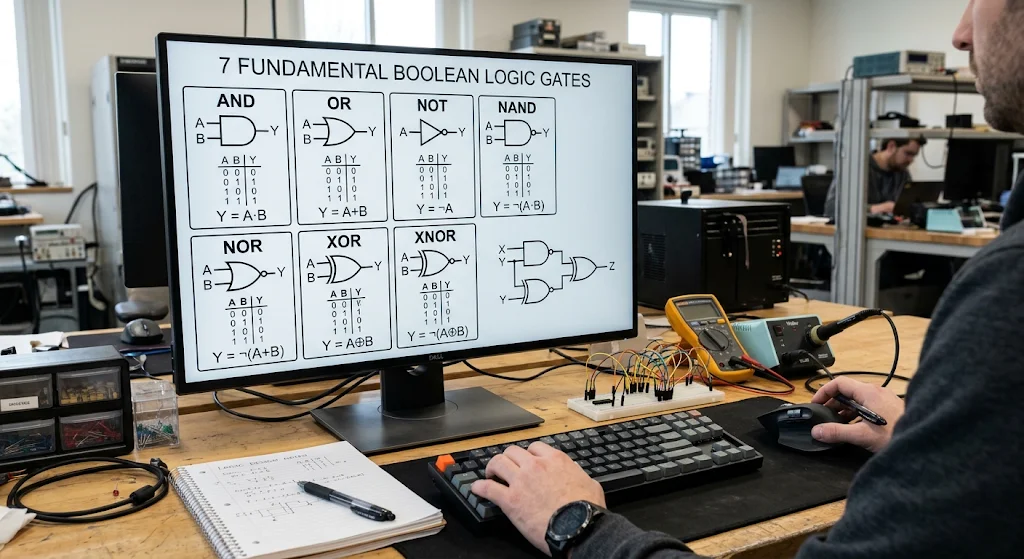
Boolean logic uses a variety of fundamental operations. These are usually performed using logic gates. A logic gate is an electronic component that takes one or more binary inputs and produces a specific output. There are seven common operations that are discussed; AND, OR, NOT, NAND, NOR, XOR and XNOR.
Each of these follow a logical rule. It is important to understand what these operations are as they are used to create digital circuits, processors, memory and many other computing technologies. whilst each gate carries out a simple task, combining multiple gates can create complex electronic systems that can perform advanced instructions.
1. AND Operation
The AND operation will only output a TRUE value if all inputs are TRUE. If any inputs are FALSE then the output will be FALSE. In digital electronics an AND gate will usually have two binary inputs and one output. For example if a system required both a correct username and password to gain access it could use an AND operation. Only if both conditions have been met will the output be TRUE.
If the username is correct but the password is incorrect then the output will still be FALSE. AND gates are used in digital circuits to decide if multiple conditions have been met. This means this operation can be used to control processes, decide programming conditions and create electronic systems.
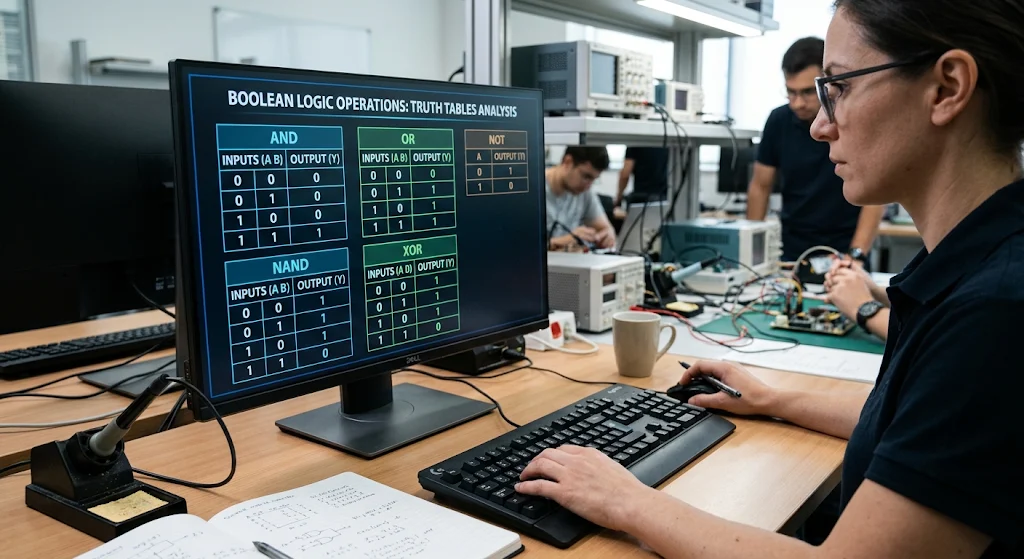
Truth Table:
| Input A | Input B | Output |
| 0 | 0 | 0 |
| 0 | 1 | 0 |
| 1 | 0 | 0 |
| 1 | 1 | 1 |
Boolean Expression:
A · B = Y
2. OR Operation
The OR operation will give a TRUE output if at least one input is TRUE. This is different to the AND operation as it doesn’t require all inputs to be TRUE. For example an electronic security system may use an OR operation to trigger an alert if a door or window sensor detects something unexpected.
This means an OR operation can help digital systems to decide between different conditions. OR operations are commonly used in programming to decide if an instruction should be carried out if at least one condition has been met. OR gates are very useful in control circuits, decision making and digital hardware.
Truth Table:
| Input A | Input B | Output |
| 0 | 0 | 0 |
| 0 | 1 | 1 |
| 1 | 0 | 1 |
| 1 | 1 | 1 |
Boolean Expression:
A + B = Y
3. NOT Operation
The NOT operation, also known as logical negation, will invert the Boolean value. If the input is TRUE the output will be FALSE and vice versa. Unlike AND and OR gates this only uses one input. The main purpose of this gate is to produce the inverse of the input signal.
This means if a system receives a signal showing that a condition is active it can produce an output showing that it is not active. NOT gates are commonly used in electronic circuits, control systems and processors. They are also important in creating more complex logic gates.
Truth Table:
| Input A | Output |
| 0 | 1 |
| 1 | 0 |
Boolean Expression:
Y = A̅
4. NAND Operation
The NAND operation stands for NOT AND. This uses the NOT operation with the AND operation. This means it will produce the inverse of an AND gate. A NAND gate will only produce a FALSE output if all inputs are TRUE. In all other scenarios it will produce a TRUE output. NAND gates are very important in digital electronics as they are known as universal logic gates.
This means they can be used to create other fundamental logic gates using combinations of NAND gates. They are also commonly associated with memory as they are used in NAND Flash memory. This is used in USB drives, memory cards, SSDs and many other digital storage devices.
Truth Table:
| Input A | Input B | Output |
| 0 | 0 | 1 |
| 0 | 1 | 1 |
| 1 | 0 | 1 |
| 1 | 1 | 0 |
Boolean Expression:
Y = (A · B)̅
5. NOR Operation
The NOR operation stands for NOT OR. This will produce the inverse of an OR operation. It will only produce a TRUE output if all inputs are FALSE. If any inputs are TRUE then the output will be FALSE. Like NAND gates this is known as universal logic gates.
This means they can be used to create other fundamental Boolean operations using combinations of NOR gates. They are useful in digital control circuits, signal processing and deciding if multiple conditions are not active. For example a digital circuit may use a NOR operation to decide if none of the input signals have been activated. NOR gates are also used in memory circuits and processor design.
Truth Table:
| Input A | Input B | Output |
| 0 | 0 | 1 |
| 0 | 1 | 0 |
| 1 | 0 | 0 |
| 1 | 1 | 0 |
Boolean Expression:
Y = (A + B)̅
6. XOR Operation
The XOR operation stands for Exclusive OR. This will produce a TRUE output if the inputs are different and a FALSE output if they are the same. An XOR gate with two inputs will produce a TRUE output if one input is 1 and the other is 0. If both inputs are 0 or 1 then it will produce a FALSE output. XOR operations are very important in computer arithmetic as they are used in binary addition circuits.
An XOR gate can be used to calculate the sum bit in a half adder circuit. XOR operations are also used in comparing data, detecting errors and certain encryption algorithms. As they can detect differences between binary values they can be useful in deciding if two signals have different states.
Truth Table:
| Input A | Input B | Output |
| 0 | 0 | 0 |
| 0 | 1 | 1 |
| 1 | 0 | 1 |
| 1 | 1 | 0 |
Boolean Expression:
Y = A ⊕ B
7. XNOR Operation
The XNOR operation stands for Exclusive NOR. This will produce the inverse of an XOR gate. This means if the inputs are the same it will produce a TRUE output and if they are different it will produce a FALSE output. This means if both inputs are 0 or 1 then the output will be TRUE. XNOR gates are useful in digital comparison circuits.
When multiple XNOR gates are combined they can be used to compare multiple pairs of bits to decide if two binary numbers are the same. This makes this operation useful in processors, digital communication and verification circuits. For example a digital system may use XNOR operations to compare two sets of binary information to see if the corresponding bits have the same values. As they can detect when two binary inputs are the same they are an important component in digital equality circuits.
Truth Table:
| Input A | Input B | Output |
| 0 | 0 | 1 |
| 0 | 1 | 0 |
| 1 | 0 | 0 |
| 1 | 1 | 1 |
Boolean Expression:
Y = (A ⊕ B)̅
How Boolean Logic Gates Work
Boolean logic operations can be used in real computing using electronic devices called logic gates. A logic gate is a digital circuit that takes one or more binary inputs and uses a specific logical rule to produce an output. These are made using electronic components. Most notably using transistors. Modern processors use billions of transistors to create complex structures. These transistors help with logical and arithmetic operations. Each transistor helps with the switching functions in electronic circuits. Multiple transistors can be connected together in specific ways to create AND, OR, NOT, NAND, NOR, XOR and XNOR operations. All these gates work together to create complex digital circuits.
Logic gates can be understood by looking at how they work. For example an AND gate will take two electrical signals and will only produce an active output if both inputs are 1. An OR gate will produce an active output if either input is active. By connecting these gates together in different ways engineers can create complex circuits. Processors use combinations of logic gates to compare data, perform calculations and decide which instructions to carry out. These circuits operate at very fast speeds meaning computers can perform millions/billions of logical operations per second. Although these are simple concepts they can be implemented using integrated circuits to create modern computing.
Boolean Logic in Modern Computing
Boolean logic is used throughout modern computing. As digital systems constantly need to assess information and make decisions. It is used in computer processors, memory, programming, search systems and digital hardware. Every time a computer decides if a condition has been met, compares two values, chooses between operations or processes binary information Boolean logic is involved.
This shows why Boolean algebra is still important even with advances in artificial intelligence, cloud computing and other modern technologies. Below are some examples of where Boolean logic is used.
1. Boolean Logic in Computer Processors
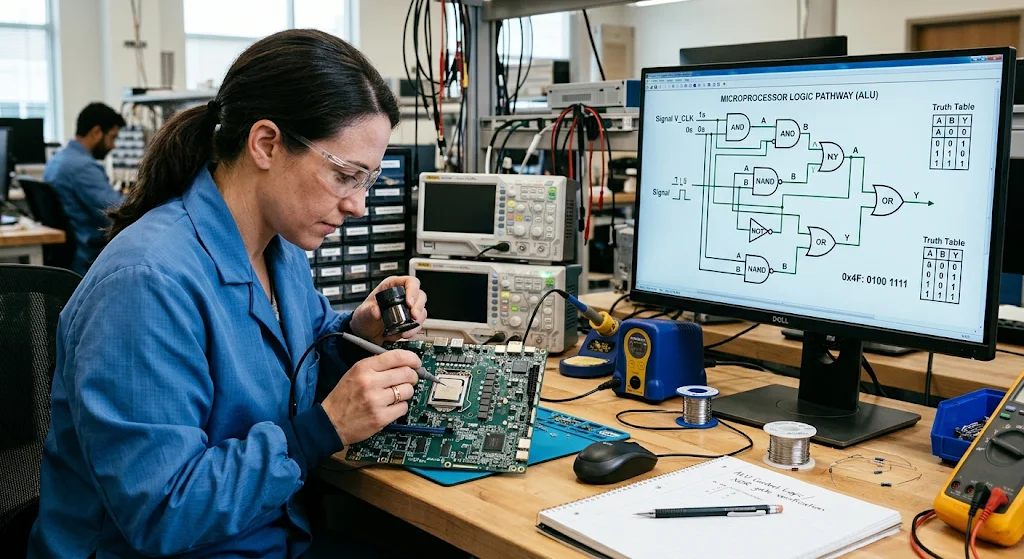
Computer processors use Boolean logic heavily. A processor contains several important components such as the arithmetic logic unit (ALU), control unit, registers and internal connections. The ALU performs arithmetic and logical operations such as addition, subtraction, comparisons and bitwise operations. Many of these operations use Boolean logic gates. XOR gates are used in binary addition circuits.
AND and OR operations help processors perform logical operations. The control unit uses logical conditions. Modern processors use millions/billions of transistors to create complex circuits. This means these operations can be performed at incredibly fast speeds allowing computers to run applications, process data and perform multiple tasks.
2. Boolean Logic in Computer Memory
Boolean logic is fundamental in computer memory. As digital memory systems use binary values to represent information. Computer memory needs to store, retrieve and keep information. Memory circuits use electronic components and switching to represent binary. This means computers can store anything from simple instructions to large files and application data. For example static random access memory (SRAM) uses circuits made from transistors to keep the stored bits active whilst powered.
Dynamic random access memory (DRAM) uses capacitors and transistors to store information. NAND flash memory uses structures with memory cells to store information without needing constant power. Although these memory systems work differently they all use digital electronics principles and binary. Boolean logic can help control, choose, read and manipulate information.
3. Boolean Logic in Programming Conditions
Boolean logic can be used in programming languages to help software make decisions. Boolean expressions can only output TRUE or FALSE. This means a program can decide if an instruction should be carried out. Common operators used in programming languages such as C, C++ and Java are AND (&&), OR (||) and NOT (!).
Python uses the keywords and, or and not. For example an application may want to decide if a user has entered a valid email address and password. This can be done using an AND operator to combine the two conditions. An OR condition can be used to allow a user to access a feature using either of two authorised authentication methods.
Example of Boolean Logic in Python:
username_correct = Truepassword_correct = Trueif username_correct and password_correct: print(“Access granted”)else: print(“Access denied”)
In this example the program uses an AND operator to assess two conditions. It will only print “Access granted” if both Boolean variables are TRUE. If either are FALSE it will print “Access denied”. This shows how Boolean logic can be used to translate mathematical rules into programming instructions.
4. Boolean Logic in Search Algorithms
Boolean logic is commonly used in information retrieval systems. Search engines, databases, digital libraries and research systems often have Boolean search options. The three most common are AND, OR and NOT. Using AND will narrow down search results by requiring all the search terms to be present. Using OR will widen search results by allowing documents with at least one of the search terms.
Using NOT will remove any information with the search term. For example if a user wanted to search for information relating to computer security they may search using “database AND security”. This would show results with both terms. If they searched using “database OR information systems” it would show results relating to either of those topics. This makes searches more accurate.
5. Boolean Logic in Digital Hardware Design
Digital hardware engineers use Boolean logic to design and optimize circuits to perform certain operations. Before building a circuit engineers can use Boolean expressions and logical diagrams to show what they want the circuit to do. Engineers can then convert these expressions into logic gates and connect them to create a working digital circuit.
For example a circuit to control an automatic lighting system could use Boolean conditions to decide if the lights should turn on. Digital hardware designs for calculators, communication and embedded systems all use combinations of logical operations. Boolean algebra can be used to analyse how circuits work, identify any redundant operations, reduce hardware complexity and improve efficiency. This makes it an essential part of modern electronic design and computer engineering.
Understanding Boolean Algebra and Laws
Boolean Algebra is a type of mathematical system used to define, analyse and simplify logical expressions. It uses a set of rules to show how we can manipulate Boolean variables and operations whilst still producing the same logical outcome. Unlike normal algebra which uses numbers, Boolean algebra uses binary, TRUE and FALSE. Being able to simplify expressions using Boolean algebra means that engineers and programmers can reduce complex logical expressions to simple equivalents.
This is important in digital circuits as having too many logic gates can cause increased complexity, more power consumption and more space required. Boolean algebra helps reduce the amount of logic gates needed for a particular function whilst not affecting the intended function of the circuit. Boolean algebra can also be useful when developing software, analysing digital systems and optimising logical expressions.
Key Laws of Boolean Algebra
There are various laws that make up Boolean Algebra. Knowing these laws can help simplify expressions.
Identity Law:
This law describes that when combining a Boolean variable with the correct identity value it will not change the outcome.
A + 0 = A
A 1 = A
When combining a variable with 0 it will produce the original variable. Combining a variable with 1 will also produce the original variable.
Null/Domination Law:
This law describes that if you have one Boolean value it will determine the outcome.
A + 1 = 1
A 0 = 0
Combining a variable with 1 using OR will always produce 1. Combining a variable with 0 using AND will always produce 0.
Idempotent Law:
This law describes that combining a Boolean variable with itself will produce the same variable.
A + A = A
A A = A
This is helpful when removing repeated logical expressions.
Complement Law:
This law describes how combining a Boolean variable with its opposite will produce an outcome.
A + A̅ = 1
A A̅ = 0
When combining a variable with its complement it will always produce 1 with OR and 0 with AND.
Commutative Law:
This law describes that the order of Boolean variables does not matter.
A + B = B + A
A B = B A
Engineers can rearrange logical expressions.
Associative Law:
This law describes how you can group variables in different ways.
(A + B) + C = A + (B + C)
(A B) C = A (B C)
This is useful when dealing with multiple logical inputs.
Distributive Law:
This law describes that you can expand Boolean operations.
A (B + C) = (A B) + (A C)
A + (B C) = (A + B) (A + C)
These relationships are important when trying to convert expressions into different logical forms.
De Morgan’s Laws:
These laws describe how NOT interacts with AND and OR. They are useful when simplifying expressions and converting between different logic gate configurations.
(A B)̅ = A̅ + B̅
(A + B)̅ = A̅ B̅
Using De Morgan’s laws you can convert expressions with AND, OR and NOT into different logical expressions.
Simplifying Boolean Algebra:
Simplifying Boolean Algebra is the process of reducing a logical expression to a simplified version. This is important in digital electronics as complex expressions may require many logic gates. By simplifying you can remove some of the logic gates and connections.
This can help reduce the complexity of your circuit. Having a simpler circuit means you can use fewer electronic components which can save space and potentially power. They can also be easier to design, test and maintain. Engineers use Boolean algebra laws, truth tables and other logical methods to simplify expressions. For more information on these methods click here.
Example of Boolean Algebra Simplification:
Let’s take the following Boolean expression:
Y = A B + A B̅
We can simplify this expression by using the distributive law.
Step 1: Find the common variable.
Both terms have an A so we can factorise.
Y = A (B + B̅)
Step 2: Use the complement law.
The complement law tells us that when combining a variable and its opposite using OR it will always produce 1.
Y = A 1
Step 3: Use the identity law.
When multiplying a Boolean variable by 1 it will produce the original variable.
[Y = A]
This simplifies to:
[Y = A]
This shows how Boolean algebra can simplify a more complex expression. In practice this could have had multiple logic gates but after being simplified there may not be any extra logic operations required. This shows why simplifying is important when designing efficient circuits.
How Boolean Expressions Can Be Used in Real World Applications
Boolean expressions can be used to mathematically describe the behaviour of a digital system. Boolean expressions can be used by engineers to create logic gates. Boolean expressions can be used by programmers to create conditional statements. For example if a digital system needs to trigger an alarm when either a security sensor detects movement or an emergency button is pressed this can be described using an OR statement. If a digital system needs to allow access to a system only when a valid password and approved account status is entered this can be described using an AND statement. You can see how mathematical logic can be used to control digital systems.
Imagine a simple electronic system that needs to activate a warning light when either of two conditions have been met. Let’s say condition A is the temperature sensor detecting high temperatures and condition B is the safety sensor detecting an unusual condition. Our system should activate the warning light when either of these conditions are TRUE. We can describe this using the Boolean expression:
[Y = A + B]
This is an OR statement meaning our warning light will activate if either A, B or both are TRUE. If both are FALSE then our warning light will not activate. An engineer can create this using an OR gate. A programmer can create this using an OR operator. Although the implementation is different the Boolean expression is the same. This shows how Boolean expressions can be used in maths, computer code and electronics.

Relationship Between Boolean Logic and Binary
Boolean logic is closely related to binary. Computers use binary to store numerical information. Whilst Boolean operations are used to describe logical conditions they can also be used to create many arithmetic circuits. Binary addition can be created using a combination of XOR, AND and other logic gates. A Half Adder is a simple digital circuit that adds together two single bit binary numbers.
It has two outputs, sum and carry. The XOR gate calculates the sum and the AND gate calculates whether there should be a carry. More complex circuits can be created such as Full Adders. These take more inputs and allow multiple binary digits to be calculated. These can be linked together to create bigger arithmetic circuits. This shows how Boolean logic can be used for more than just conditions; it can also be used to calculate numerical values.
Challenges of Boolean Logic
Whilst Boolean logic is fundamental to digital computing, using logical operations in modern electronic systems can pose many challenges. Modern digital devices are becoming very powerful, meaning there are lots of transistors and logic gates in circuits. When designing circuits great care needs to be taken when considering timing, electrical properties, power consumption and signal reliability. An issue with circuits is propagation delay. This is the time it takes for a signal to pass through a logic gate and impact the output. When there are many gates this can have an impact on the performance of a circuit. Engineers need to design circuits so that they are optimised for the signals to pass through in the correct time frame. Another issue with circuits is power consumption. Having lots of transistors switching can cause heat issues.
Another issue with Boolean logic is the complexity of large logical systems. Whilst individual expressions may be simple, having thousands or millions of logical operations can create complex circuits. Small design errors can cause issues with the whole digital system. Engineers use specialised design tools, simulation tools, automated verification and hardware description languages to design digital systems. These help to find logical errors, analyse how circuits will perform and ensure that the hardware will behave as expected. Despite these challenges Boolean logic is fundamental as it provides a reliable mathematical base to design digital electronic systems.
Future of Boolean Logic
Boolean logic will continue to be important for the development of modern computing technologies. Whilst new technologies are emerging such as artificial intelligence, quantum computing and advanced semiconductors, traditional digital systems still heavily rely on binary. Modern processors, memory, communication devices and embedded systems all use logical operations. Semiconductor technology is improving meaning engineers can create very complex circuits with huge amounts of transistors. This means it is very important to design logical circuits efficiently. Manufacturers need to consider how fast they can process information, power consumption, reliability and limitations. Boolean logic will continue to be fundamental as digital systems become more advanced.
New technologies are emerging meaning Boolean logic can be applied in new areas. Artificial intelligence systems use digital systems to complete many logical and arithmetic operations. Cloud computing systems use complex digital systems to manage information, run software and communicate between servers. Internet of Things devices use logical circuits to interpret sensor signals. Whilst new technologies are emerging it is still essential to be able to describe information using binary and analyse logical relationships. Boolean logic provides a long lasting base to link traditional digital electronics with new computing technologies and future hardware.
Conclusion
Boolean logic is a fundamental part of modern computing. It provides the mathematical principles used to process information, analyse conditions and complete operations within digital systems. Using the 7 main operations (AND, OR, NOT, NAND, NOR, XOR and XNOR) computers can manipulate binary. These operations are completed using logic gates. Boolean algebra helps improve the design of digital systems by providing laws and methods to simplify logical expressions. This removes unnecessary operations.
Boolean algebra can be used in many areas of computing including processors, memory, programming languages, search algorithms and digital electronics. Boolean logic helps computers complete many operations including password checking, binary comparisons, calculations and finding information. Whilst modern computing is continuing to advance with technologies such as artificial intelligence, cloud and advanced semiconductors Boolean logic is still fundamental. Understanding Boolean logic will give you a better understanding of how electronic devices interpret information and how simple binary signals can be turned into complex computing operations.