
Introduction
Insurance companies deal with thousands of claims which can cover accidents, damage, medical costs, theft and more. With this comes a lot of admin including gathering information, policy checks, determining damages, looking for possible fraud, authorizing payments and keeping customers informed. This can cause increased admin and costly issues within the company. Insurance claim automation uses AI to automate repetitive tasks within the insurance claims process. This includes using machine learning, OCR and automation to speed up the processing of information and help the company to be consistent with their processing whilst allowing employees to focus on claims requiring professional insight.
Automation can be used throughout the entire claims process from start to finish. This ensures information is organized, there are no missing documents, simple claims can be assessed and claims can be kept up to date with the customer. However, some claims can require the expertise of a professional investigator and claims professional due to them being complex. Understanding how AI can improve claims processing will help you understand how insurance companies can use these technologies to improve efficiency.
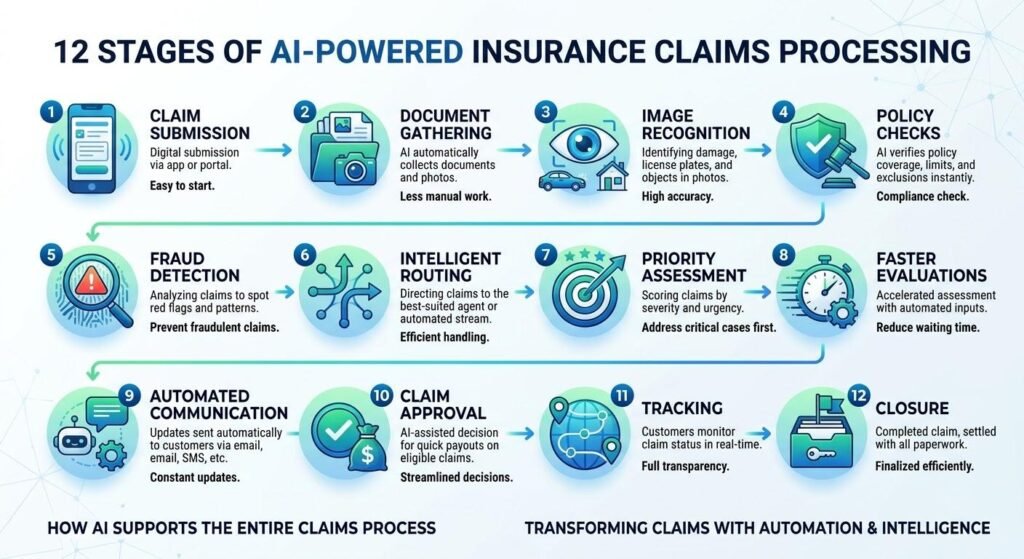
12 Ways AI Can Improve Claims Processing
1. Automated Claim Submission
One of the first ways AI can improve claims processing is by making the process of submitting claims easier. Traditionally claims can be submitted by completing long forms, visiting your insurance office or contacting customer services. However, using automation to submit claims means the customer can submit the information via a website, app or portal. The customer will be guided through the process using AI to gather the right information, which will highlight any missing information. This can reduce incomplete submissions and reduce the need to keep contacting the customer for basic information. This means claims can be processed quicker and the customer will find it more convenient.
2. Automated Document Gathering
Insurance claims will often require documents to be submitted. This can include medical reports, police statements, repair quotes, receipts, photos and proof of ownership. Manually going through these documents can take up a lot of time especially if a large amount of claims are submitted. Using AI you can process the documents using OCR and NLP. This will help identify what type of document it is, capture the key information, organize the documents and show what information is missing. Some systems will also look at the information submitted and compare it to claims that have already been submitted to identify any discrepancies. This can reduce repetitive admin and help staff find the information they need.
3. Image Recognition
Using AI image recognition can help assess visible damage to vehicles, buildings and other insured items. Customers can submit photos via an app and an automated system can help identify what areas are damaged and what severity the issue is. This can help reduce the time taken to get an image based damage assessment. Research has been carried out into computer vision and automated damage recognition. This shows there is a lot of potential for this in insurance. However, photos may not always show what is going on underneath so a professional inspection is needed.
4. Automated Policy Check
Before a claim can be approved it needs to be checked against the customer’s policy. Manually doing this can be complicated as staffs need to look through the policy to check coverage, exclusions, renewal dates and premium payments. An automated system can help by searching for the relevant policy information and comparing it to the information provided in the claim. This will show if the policy is out of date, missing coverage, what the deductible is and what exclusions could be. This can help reduce any delays when processing claims. However, this relies on having accurate and up to date policies. If the customer has incorrect information or the coverage is out of date decisions may not be made appropriately.
5. AI Fraud Detection
Fraud can cause loss for insurance companies and can also cause increased premiums for honest policyholders. Fraudulent claims can include over claiming for damage, fake accidents, duplicate claims and misleading information. Using AI you can look at large amounts of historical and current claims to identify any unusual patterns or suspicious links. This can include highlighting any duplicate claims, mismatched dates for the accident, unusual payment requests and links between multiple claimants. Using machine learning models can help improve the system to identify suspicious patterns. However, just because there is a fraud alert doesn’t mean there is anything wrong. The evidence needs to be looked at by investigators.
6. Intelligent Routing
Not all claims will be the same. Simple claims with little damage to a vehicle may be processed differently to a complex claim relating to property damage or medical. Using AI you can categorize the claims depending on the type, estimated value, urgency, complexity and potential risk. This will then route it to the correct department, claims adjuster, specialist or investigation team. This saves time for staff as they don’t need to search for where to send the claim. It also helps the insurance company to manage their workload more effectively, reduce bottlenecks and ensure claims that require specialist knowledge go to the correct professionals.
7. Priority Claims
Insurance companies often have busy periods where there are more claims coming in than can be processed, after major incidents such as flooding, storms, road accidents etc. There can be a large amount of claims coming in causing a large amount of admin. Using AI you can prioritize claims based on how urgent they are potential risk, customer circumstances and evidence. This will help identify claims that require urgent repairs or assistance. Routine claims can be processed as normal. This lets the insurance company use their resources more strategically. However, it is important to have clear criteria for how claims are prioritized to avoid any unfairness.
8. Faster Assessments
To determine the value of a claim you will need to look at the loss, policy coverage, repair costs and evidence. Using AI you can compare the information submitted with historical claims, industry pricing and estimation models. This will give an initial cost. For example, a vehicle insurance system can look at photos and identify what damage is visible. It will then suggest an estimated cost for repairs based on similar claims. This can help claims professionals to give a quicker and more consistent initial assessment. However, this shouldn’t be taken as the final decision. Significant differences in repair requirements, unusual circumstances and disputed values may require further inspections and professional opinion.
9. Automated Communication
Communication is key when dealing with claims. Customers like to know if their claim has been received, assessed, approved or denied. Without automation staff may waste a lot of time replying to simple queries. Using an AI enabled claims platform you can send emails, texts and messages via an app to keep the customer informed. This can include confirmation of submission, requests for additional documents, updates on assessments and payment. This helps to keep things transparent and reduces any uncertainty. This also means customer service can focus on more complex queries.
10. Automated Approval
Once a claim has been assessed you will need to decide if it can be settled. Using automation you can check if the correct documents have been submitted, policy terms have been met and the correct approvals have been completed. Simple claims that fit the criteria can be approved using pre-set approval processes, once authorized the payment can be sent to the financial processing system. This can help reduce any delays and errors from repetitive data entry. However, you should ensure there are the correct approvals in place, especially for larger payments and unusual circumstances.
11. Better Tracking
Automation will allow the insurance company to have better insight into how claims are progressing. You can use digital dashboards to track how many claims have been received, are under assessment, waiting on documents, approved and unresolved. Using AI you can look at this information to see if there are any common delays, busy departments and areas where staff are struggling. This can help managers to adjust workloads, improve internal processes and identify any areas that may need extra training. It can also help the company to see how quickly claims are being processed, how they are being settled and how much it is costing to process. Instead of relying on manual reports, they can make informed decisions based on up to date information.
12. Automated Closure
A claim doesn’t always finish when a payment is made. The insurance company will need to confirm the settlement has been made, update the records, store documents and close the claim. Using automation you can complete these tasks once the conditions have been met. This can include updating the status of the claim, organizing digital records, sending confirmation of closure and storing information for future reference. This will reduce any chance of tasks being missed and makes it easier for authorized staff to access previous claim information. Keeping good records will help with internal audits, regulatory reviews and future customer queries.
Benefits of Using AI & Automation in Claims
Insurance claim automation can provide many benefits. One of these is increased efficiency. Using automation to complete repetitive tasks such as gathering documents, extracting information, policy checks and sending communications to customers will help staff focus on investigating claims. This can reduce any admin delays especially for those with large customer portfolios. Automation can also help keep things consistent. By using pre-set processes and checks for similar claims you can reduce any unnecessary variation. As long as the automation is set up correctly there won’t be any unnecessary variation caused by data entry.
Another great benefit of using automation is better resource management and customer experience. Using AI you can identify which claims need to be prioritized, where delays are happening and how to best distribute workloads. Customers may find claims are acknowledged quicker, clear communication and more predictable processing. Automation can also reduce costs by reducing repetitive tasks. However, this depends on the quality of the technology, accurate information and internal processes. Automation should help to run a well-managed claims process.
Disadvantages of Using Automation in Claims
AI can’t accurately assess all insurance claims without involvement from humans. Whilst image recognition can help identify visible damage to vehicles it may miss any hidden mechanical issues, structural damage and the full impact of the incident. Fraud detection may also not be 100% accurate and could wrongly flag up genuine claims. Poor quality images, incomplete documents, unusual circumstances and inconsistent records can also affect the outcome of automated claims. It is important to have clear processes in place to review any unclear outcomes. Staff should have the authority to investigate flagged claims, ask for further evidence and adjust any inaccurate assessments.
Having accurate policies is also important, as automation relies on existing records to determine if a claim is covered. If the policyholder doesn’t have the correct information, the coverage is out of date, there are missing endorsements or exclusions weren’t correctly noted then inaccurate results can be given. Insurance companies should ensure they have good data management processes in place, regular updates and secure systems. High value claims, disputed settlements, suspected fraud and complex legal/contractual issues should be investigated by humans. Customers should have the correct channels to challenge decisions and have further reviews. A balance should be found to ensure automation is helping to improve efficiency.
Conclusion
AI is transforming the way insurance claims are processed. This can help automate many parts of the process including submission, gathering documents, assessing, approving, paying and closing claims. This can include using image recognition, policy checks, fraud detection, intelligent routing, communication and tracking. This can help reduce any admin delays, keep things consistent, improve communication and help to manage resources better. However, to ensure it is successful you need to have accurate policies, secure customer information, track how the system is performing and have the correct processes in place for human review. By using AI automation alongside professional insight insurance companies can create a more efficient claims process.
Get more well researched information about AI insurance claims automation here.