
Introduction
Modern technology often relies on the connections between people, devices, places, applications and information systems. Many aspects of the digital world rely on mathematical structures to represent how these elements can be connected. Graph algorithms provide an efficient way to analyse connections, find connections, optimal paths and solve complex problems.
Graphs consist of vertices (or nodes) and edges which represent connections. There are various different methods that developers can use to analyse the connected data, including Breadth First Search, Depth First Search, Dijkstra’s Algorithm and Minimum Spanning Tree algorithms. Understanding these algorithms are key for computer science students, software engineers, AI developers and anyone interested in how modern digital technology works.
Understanding Graphs in Computer Science
Graphs are a fundamental data structure that can be used to represent relationships between objects. A graph differs from arrays and linked lists as it allows multiple elements to be connected using a range of different connections. Each element will be represented as a vertex and the relationship(connection) between two elements will be represented using an edge.
An example of this could be if you were building an application for social networking. Each individual user can be represented as a vertex whilst relationships between users can be represented as edges. In a transport system cities can be represented as vertices and roads can be represented as edges.
- Vertices and Edges
Vertices and edges are the two main parts of a graph. A vertex can represent any individual object, place, person, computer or anything else. An edge represents the relationship between two vertices. For example, in a graph that represents a road network, cities can be represented as vertices and roads can be represented as edges.
If there is a direct road between two cities there will be an edge connecting the two vertices. Weights can be added to the edges. These weights can be used to represent things like distance, travel time, cost and latency. This allows algorithms to be smart with the connections. Using a combination of vertices, edges and weights we can represent complex systems.
- Types of Graph
There are various different types of graphs. An undirected graph will have edges that can be connected in both directions. For example a mutual friendship between two users on social media can be represented using an undirected edge. A directed graph will have directional edges. This means that just because there is a connection between two vertices does not mean there will be a connection in the opposite direction.
Something like following someone on a social media platform. Weighted graphs will have weights on the edges whilst unweighted graphs will have equal connections. There are also connected graphs and disconnected graphs. Cyclic graphs and acyclic graphs. Understanding these will help developers choose the right algorithm for their problem.
What are Graph Algorithms?
Graph algorithms are a step by step process that help computers analyse networks. They can help find connections, relationships, paths, connections and optimize resources. There are many different types of graph algorithms that can be used depending on what the graph looks like and what you want to achieve. For example if you want to find someone nearby on a social network you will need to use a different algorithm compared to finding the shortest driving route between two cities.
Some algorithms will look to visit vertices in a specific order whilst others will calculate the most efficient path. Graph algorithms are very important as many modern applications will contain very large amounts of interconnected data.
Breadth First Search (BFS)
Breadth First Search (BFS) is a graph traversal algorithm. This algorithm works by visiting vertices in layers. Rather than going down one path it will look to visit all the neighbours of the current starting vertex. This algorithm usually uses a queue data structure.
When the algorithm starts it will mark the starting vertex as visited and add it to the queue. Then it will take the first vertex in the queue and look at all the unvisited neighbours. It will mark these as visited and add them to the queue. This will continue until all the reachable vertices have been visited or the target has been found. BFS is useful as it can be used to find the shortest path in an unweighted graph.
How Breadth First Search Works
Imagine there is a transport network with a few different locations. If you wanted to find the path with the least amount of roads between two locations you could use a BFS. The algorithm will start at the starting location and look at all the direct connections.
Then it will look at the connections to these locations. As it uses a queue it will ensure that the locations are looked at in the order they were found. Every visited vertex will be kept track of so that they aren’t visited again. Usually this algorithm will have a time complexity of O(V+E) when using an adjacency list.
Real World Examples
BFS can be useful for finding connections between users. Social media platforms can use this to find users that are connected within a certain amount of friendships. For example if you wanted to find people that are two or three connections away from a user you could use this algorithm. Search engines and crawlers can use a BFS to find web pages that are connected through hyperlinks.
Communication networks can use this algorithm to look at devices that can be reached. It can also be useful for state space problems in AI. Whilst this algorithm cannot automatically find the cheapest path in a weighted network it can find the path with the least amount of edges which can be useful for many problems involving connected data.
Depth First Search (DFS)
Depth First Search (DFS) is another important graph traversal algorithm. This algorithm works by going down one of the available paths as far as possible. This can be done using recursion or a stack data structure. The algorithm will start at a chosen vertex and mark it as visited. It will then look at one of the unvisited neighbour vertices. It will continue to go down any connections it can until there are no more unvisited neighbours.
It will then backtrack to the previous vertex and look at another connection. This will continue until all reachable vertices have been visited. This algorithm can be useful for looking at complex graph structures, finding connections, finding cycles and solving problems.
How Depth First Search Works
Imagine there are a few computers in a graph connected via different connections. If you wanted to look at all the computers that can be reached from a certain starting device you could use a DFS. The algorithm will start at the starting device and then look at one of the connections. Rather than looking at all of the starting devices neighbours it will look at the connections of the newly discovered device.
When there are no more unvisited neighbours it will backtrack to the previous vertex and look at another connection. This will ensure that all the reachable vertices are visited. This algorithm will also have a time complexity of O(V+E) when using an adjacency list. Whilst this algorithm can be easily done using recursion very deep graphs may need to be done iteratively.
Real World Examples
Depth First Search can be useful in many situations. Dependency management systems can use this algorithm to look at the relationships between software. It can also be useful for finding cycles in directed graphs. This can help to identify any circular dependencies. Computer networks can use this algorithm to look at connected devices.
Maze solvers can use this algorithm to look at potential paths. AI systems can use this algorithm for searching through potential solutions. This algorithm can also be used as the base for more complex graph algorithms such as topological sort and strongly connected components. This algorithm can be very useful for problems involving complex relationships.

Dijkstra’s Algorithm
Dijkstra’s Algorithm is an algorithm used to find the shortest path between a starting vertex and other reachable vertices. This algorithm can only be used on weighted graphs with non-negative weights. Unlike BFS this algorithm takes into consideration the numerical weights of the edges. These weights can be used to represent distances between roads, travel time, transport cost or communication delay.
The algorithm will start by setting the distance of the starting vertex to 0 and the distance of other vertices to infinity. The algorithm will then look at the vertex with the smallest known distance that hasn’t been processed. It will look at the neighbour vertices and if the distance to get to them through the current vertex is smaller it will update the distance. This will continue until the shortest distances have been found.
How Dijkstra’s Algorithm Works
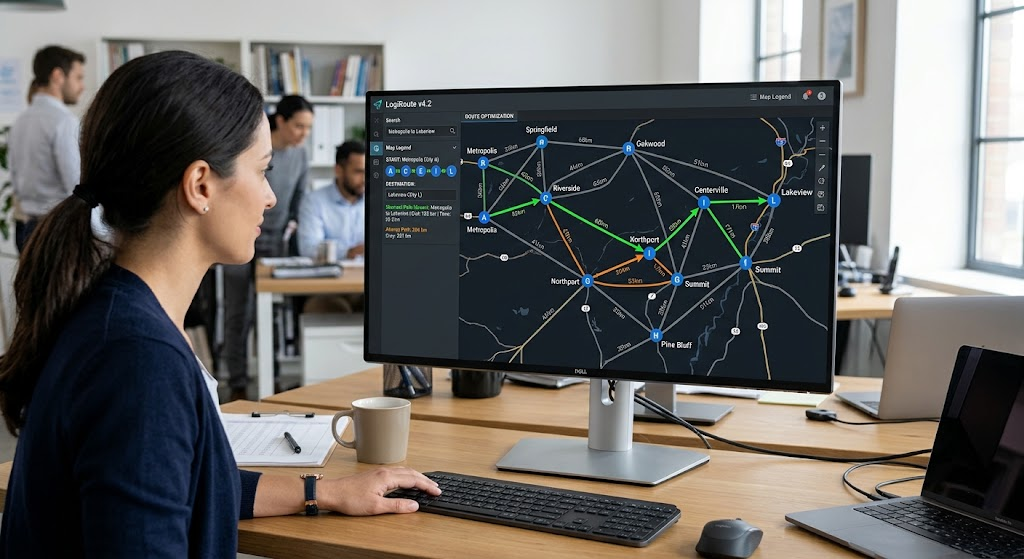
Imagine you have a navigation application that needs to find the shortest driving route between two cities. There are multiple roads between these two cities with numerical weights that represent the distance or estimated cost to travel along them. The algorithm will start at the starting city and look at the available connections. It will calculate the cost to get to the neighbouring cities and store the smallest distance.
If a shorter route to a city is found it will update the distance. A priority queue is commonly used to find the next vertex with the smallest tentative distance. Once the destination has been processed the algorithm can find the shortest route by following the predecessors. This algorithm usually has a time complexity of O((V+E) log V) when using an adjacency list and binary heap.
Real World Examples
This algorithm can be used in many situations. GPS applications use shortest path algorithms to find efficient routes between locations. Internet routing systems can use shortest path algorithms to find efficient communication paths. Logistics companies can use similar techniques to analyse transport networks and find cost effective routes between warehouses, distribution centres and customers.
Robotics can use shortest path calculations to navigate around environments. Standard Dijkstra’s algorithm assumes all of the edges have non-negative weights. It also doesn’t automatically take into consideration traffic changes. Real world navigation systems may use shortest path algorithms but also take into consideration real time traffic data, extra optimisation techniques and up to date road network data.
Minimum Spanning Tree Algorithms
A minimum spanning tree is a fundamental concept in graph theory. This algorithm is used to connect all vertices in a connected weighted undirected graph. A spanning tree is a tree that connects all the vertices. A minimum spanning tree is a spanning tree that has the lowest possible total edge weight.
This can be very useful in networking, telecommunications, electrical and transport. Prim’s algorithm and Kruskal’s algorithm are commonly used to create minimum spanning trees. Both algorithms try to solve the same problem but do it in different ways. Depending on the graph structure one algorithm may be more convenient.
Prim’s Algorithm
Prim’s algorithm creates a minimum spanning tree. This algorithm starts with one vertex and adds the cheapest edge to connect to another vertex outside of the tree. The algorithm will start by picking a random vertex. It will then look at the edges connecting the chosen vertices to unchosen vertices. It will pick the edge with the smallest weight. The new vertex will be added to the tree.
This will continue until all vertices have been added. Using a priority queue can help find the cheapest connection. This algorithm can be very useful for some dense graphs. The time complexity will depend on how the graph is represented. This algorithm usually has a time complexity of O(E log V) when using an adjacency list and binary heap.
Kruskal’s Algorithm
Kruskal’s algorithm creates a minimum spanning tree. This algorithm looks at the edges in the graph and processes them in order of the smallest weight. All the vertices will start off as individual components. The algorithm will sort all of the edges in order from the smallest to largest. It will then look at each edge. If the edge connects two different components without creating a cycle it will add it to the spanning tree.
A disjoint set (Union-Find) data structure can be used to determine if two vertices are already in the same connected component. This will continue until there are V-1 edges in the spanning tree. This algorithm can be very useful for sparse graphs. This algorithm usually has a time complexity of O(E log E).
Real World Examples
A minimum spanning tree can be very useful when companies want to connect multiple locations but want to keep the cost of the infrastructure low. For example a telecommunication company may want to install fibre optic cables to connect multiple buildings. Each connection will have a cost associated with it. Using a minimum spanning tree can help find a structure that will connect all the buildings without any unnecessary cycles.
Electrical infrastructures can use similar optimisation techniques. Water supplies and certain transport infrastructures will also have similar problems. This shows how graph theory can be used in real engineering situations. A minimum spanning tree may not be the best solution if you need backup connections in your network. The main goal of this algorithm is to connect everything at the lowest cost.

Uses of Graph Algorithms in Modern Technology
Graph algorithms are used in many different areas of technology. Many modern systems will use relationships between connected elements. These algorithms are not only useful in academic situations but can be used by businesses, technology companies, transport, telecoms companies and AI developers. The type of algorithm will depend on the problem, size of network and the information the edges hold.
BFS and DFS can be used to explore graphs. Dijkstra’s algorithm can be used to find the shortest path in an optimally weighted network. Minimum spanning tree algorithms can be used to optimize connections in a network. Knowing how these algorithms can be used can give developers practical knowledge when building systems.
- GPS Navigation
One of the most well known uses of graph algorithms is in GPS navigation. A road network can be represented as a weighted graph. The intersections and locations can be represented as vertices whilst the roads can be represented as edges. Each edge will have information like distance, estimated travel time and transport cost. When a user enters a destination the navigation system will analyse the connections between roads to find a suitable route.
Dijkstra’s algorithm and other shortest path algorithms can help find efficient routes. More complex navigation systems can use other algorithms like A to help find routes by taking into consideration estimates of how much further they have to go. The traffic, road closures and changing travel restrictions can also affect the recommended route.
- Social Media Platforms
Social media platforms have massive networks of relationships between users, organisations, communities and content. Each user can be represented as a vertex whilst relationships, following, messages and other connections can be represented as different types of edges. Graph algorithms can help analyse relationships between users.
BFS can help find users that are connected within a certain amount of relationships. This can be used to suggest mutual friends. DFS can be used to explore connected communities. More complex graph analysis can be used to find influential accounts, unusual patterns and users with similar interests. Recommendation systems can use graph algorithms to suggest relevant communities.
- Internet Routing
The internet is made up of many interconnected computers, routers, servers and communication systems. These can be represented as vertices whilst the connections can be represented as edges. Some of these connections will have weights to represent latency, cost relating to bandwidth and other factors. Routing algorithms can analyse these relationships to help decide how information should be sent between locations in a network.
Shortest path algorithms are important in many routing systems. Network devices can calculate suitable routes using the information available. Link state routing protocols use graph calculations to determine the route through the network. Graph traversal can also be used to analyse connections and see what devices can be reached. Efficient routing is important to reduce unnecessary delays, make communications more reliable and adapt to the ever increasing demand of internet services.
- Logistics and Supply Chain Management
Logistics companies have complex transport systems with many distribution centers, warehouses, suppliers, retailers and customers. This can be effectively represented using graphs. Vertices can be used to represent where operations take place and edges can represent the transport links between places. Dijkstra’s algorithm can be used to find efficient routes between distribution centers. Other optimization algorithms can also be used for more complicated delivery problems.
Minimum spanning tree algorithms can also be used to find the most cost-effective way to connect facilities to other facilities. However there are many factors to consider as vehicle space, delivery time, fuel usage, traffic, and delivery to multiple locations can all affect logistics planning. Graph algorithms can be used to help organisations with their logistics systems so businesses can manage their transport information.
- Network Infrastructure and Utilities
Many infrastructure projects involve connecting many locations together. Telecommunications services, energy companies and utilities will need to decide how to connect their facilities. These can be represented using graphs where locations are represented as vertices and connections between locations are represented as weighted edges. Minimum spanning tree algorithms can be used to find the cheapest way to connect all the necessary locations.
An internet service provider could use the minimum spanning tree concept to help decide how best to connect their buildings using fibre optic cables. Engineers can also use these algorithms to work out what connections they can make to set up their utility systems. However engineers will need to consider the reliability of connections, geographic limitations, safety, future expansion and alternative connections. Graph algorithms can help with infrastructure planning but further optimization methods may be required.
Key Graph Algorithms
Each algorithm has been created to solve a specific type of problem. BFS uses a breadth first approach and is great for finding the shortest path in an unweighted graph. DFS uses a depth first approach and is good for determining if a network is connected, finding cycles and exploring dependencies. Dijkstra’s algorithm finds the shortest path in a weighted graph with non-negative weights so it can help with navigation.
Prim’s and Kruskal’s algorithm can create a minimum spanning tree which connects all the vertices in a connected, weighted, undirected graph with the smallest total weight. While each algorithm uses the same graph type, they are all trying to achieve different outcomes. Developers should be aware of the differences between each algorithm.
Problems When Applying Graph Algorithms
Using graph algorithms can cause some issues. If there are millions of vertices and edges within a graph then performance can be a big issue. An algorithm that works well on a small scale may take a long time to process and require lots of memory. When using an adjacency list representation of a graph this is usually efficient for sparse graphs but using an adjacency matrix can be useful if the graph is dense or there are many queries to see if there is a specific connection.
Changes to the network can cause issues such as roads being closed, internet issues, and changing relationships. Developers need to consider negative weights, disconnected parts, correct data and reliable networks.
Choosing the Correct Algorithm
To choose the correct graph algorithm it is important to fully understand the problem. Firstly determine if the graph is directed or undirected, weighted or unweighted, and if it is connected or disconnected. Decide what outcome you are trying to achieve with your graph. Are you trying to explore the relationships in the graph, find the shortest path, detect cycles or find the lowest total cost of connecting vertices? BFS is a good choice if you want to find the least number of edges between vertices in an unweighted graph.
DFS is a good choice if you want to explore connections in the graph. Dijkstra’s algorithm is a good choice if you want to find the shortest path in a graph with non-negative weights. Prim’s and Kruskal’s algorithms are a good choice if you want to find a minimum spanning tree. Consider the size of the graph, memory usage, complexity of implementation and expected performance.
Future of Graph Algorithms in AI
As AI systems become more complex with lots of interconnections, graph algorithms are becoming increasingly important. Often traditional machine learning techniques look at individual data points but many problems involve relationships. Graph machine learning techniques allow AI systems to look at the properties of individual nodes and the relationships between them. Graph neural networks use information from vertices and their neighbouring relationships to learn.
These techniques can be used for recommendations, fraud detection, scientific research, drug discovery and knowledge representation. Graph algorithms can also aid intelligent transport, robotics and communication systems so AI applications can understand complex environments. As organisations start to collect more connected data, graph based computing will probably continue to play a key role in modern AI and software development.
Conclusion
Graph algorithms provide vital techniques to help understand and solve relationship problems. By representing entities as vertices and connections as edges, developers can create complex models and use the correct algorithms to analyse them. Breadth first search allows traversal of the graph level by level. Depth first search allows deep traversal.
Dijkstra’s algorithm finds the shortest path in a weighted graph with non-negative weights. Minimum spanning tree algorithms can help connect vertices with the lowest total cost of connections. These can be used for GPS navigation, social media, routing on the internet, logistics and infrastructure. As technology continues to advance, graph algorithms will continue to be important to computer scientists, software engineers and AI developers to create efficient systems that use connected data.