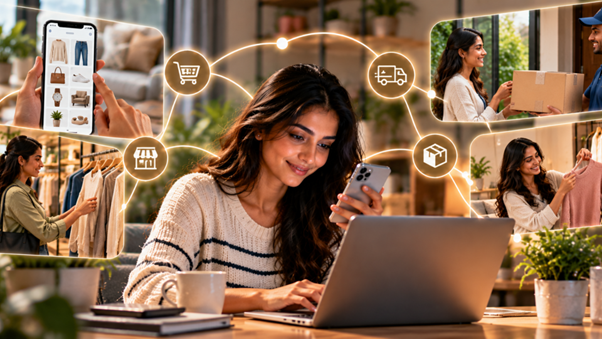
A customer sees a pair of shoes on Instagram, checks reviews on a phone, visits the store to try a size, and finally orders online because the store had run out. Which channel earned the sale? To the customer, it does not matter. To them, it was one shopping journey.
This is the heart of omnichannel retail. It is not about being present on many platforms. It is about connecting them so the customer never has to start over. For any Ecommerce App Development Company in India, this expectation has become a core design requirement.
Multichannel vs. Omnichannel
The two terms are often confused.
• Multichannel means selling through several channels, such as a website, a store and a marketplace, each operating separately.
• Omnichannel means those channels share data, inventory and customer information so the experience feels continuous.
In a multichannel setup, a customer’s cart on the app is invisible in the store, and a return bought online may need a postal courier even when a store is nearby. Omnichannel removes those gaps.
What Shoppers Now Expect
Customers rarely say “omnichannel,” but their expectations reveal it:
• Seeing accurate stock before visiting a store
• Picking up online orders in a store
• Returning online purchases at a physical outlet
• Continuing a cart from phone to laptop
• Receiving the same price and offers everywhere
• Reaching support through whichever channel they prefer
When any of these fail, trust drops quickly. A customer told “that’s not available” after seeing it online rarely forgets it.
Unified Inventory: The Quiet Foundation
Most omnichannel problems begin with inventory. If store stock, warehouse stock and online availability sit in different systems, errors are unavoidable.
A unified view allows retailers to:
1. Show real-time availability on product pages
2. Fulfill online orders from the nearest store
3. Reduce overselling and cancellations
4. Move slow stock to places where it sells faster
Accuracy is more important than sophistication. A simple, reliable inventory sync often delivers more value than an advanced feature built on unreliable data.
One Customer, One Profile
Another pillar is a single customer profile. When purchases, wishlists, support tickets and loyalty points are connected, a retailer can recognize the same person across channels.
This enables relevant experiences such as:
• Recommending products based on both online browsing and store purchases
• Applying loyalty points regardless of where the purchase occurs
• Avoiding duplicate promotions for items the customer already bought
• Giving support teams the full history before they respond
Personalization That Feels Helpful
Personalization works best when it saves effort. Examples include showing the right sizes first, highlighting categories a shopper frequently visits and reminding them when a wishlist item returns to stock.
It should not feel intrusive. Shoppers appreciate relevance but dislike feeling followed. Clear preference controls and sensible use of data help maintain the balance.
Payments Customers Are Comfortable With
Payment flexibility has a direct effect on conversion. In India, shoppers use UPI, cards, wallets, net banking, EMI options and cash on delivery, sometimes all within the same week. Fast, secure checkout with saved methods reduces abandoned carts.
Consistency also matters across channels. A customer who pays in store should be able to apply an online voucher, and a refund should reach the original payment method without confusion.
Mobile as the Connector
The smartphone often links the digital and physical worlds. Shoppers scan QR codes for product details, compare prices, check reviews while standing in an aisle and use apps for loyalty and payments. Retailers that treat the mobile app as the central hub, rather than a smaller copy of the website, tend to create stronger journeys.
When marketplace-style selling is also part of the strategy, such as multiple vendors listing on one storefront, retailers may explore Marketplace App Development Services to extend the catalog without holding all the inventory themselves.
Measuring What Matters
Omnichannel success is not just sales volume. Useful indicators include:
• Customer retention and repeat purchase rate
• Order fulfillment accuracy
• Return rates and resolution time
• Cross-channel conversion, such as online research leading to store purchases
• Customer satisfaction scores
Attribution can be difficult, since a sale may involve several touchpoints. Retailers should avoid over-crediting any single channel.
Practical First Steps
Retailers do not need to transform everything at once. A realistic approach might be:
1. Connect inventory across channels
2. Offer click-and-collect or in-store returns
3. Unify customer accounts and loyalty
4. Improve mobile checkout
5. Add personalization once data is reliable
Conclusion
Customers do not think in channels, and retailers should not make them. Omnichannel shopping succeeds when inventory, customer data, payments and service work together so every interaction feels like part of the same story.
Building this foundation requires careful system integration and long-term planning. An experienced Software Development Company in India can help retailers connect their channels into a platform that is dependable today and flexible tomorrow.