Introduction
Modern computing systems need to process more and more data content while providing quick, accurate results. Some applications like video editing, financial analysis, weather forecasting, scientific simulation, and artificial intelligence demand more computational power than can be provided by a single processor core. A solution to this problem is parallel computing, which breaks up the computation into smaller tasks that run concurrently on multiple processing units. A parallel computing system is a computing system that coordinates multiple cores or processors to solve a problem more efficiently as opposed to doing it sequentially. But it’s not just about adding processors when you want to get good performance. Various aspects of the architecture of the system, its organisation of memory, its methods of communication and the distribution of workload all affect the efficiency with which resources are utilised. These considerations are important to developers, researchers, and technology enthusiasts for determining appropriate computing applications.
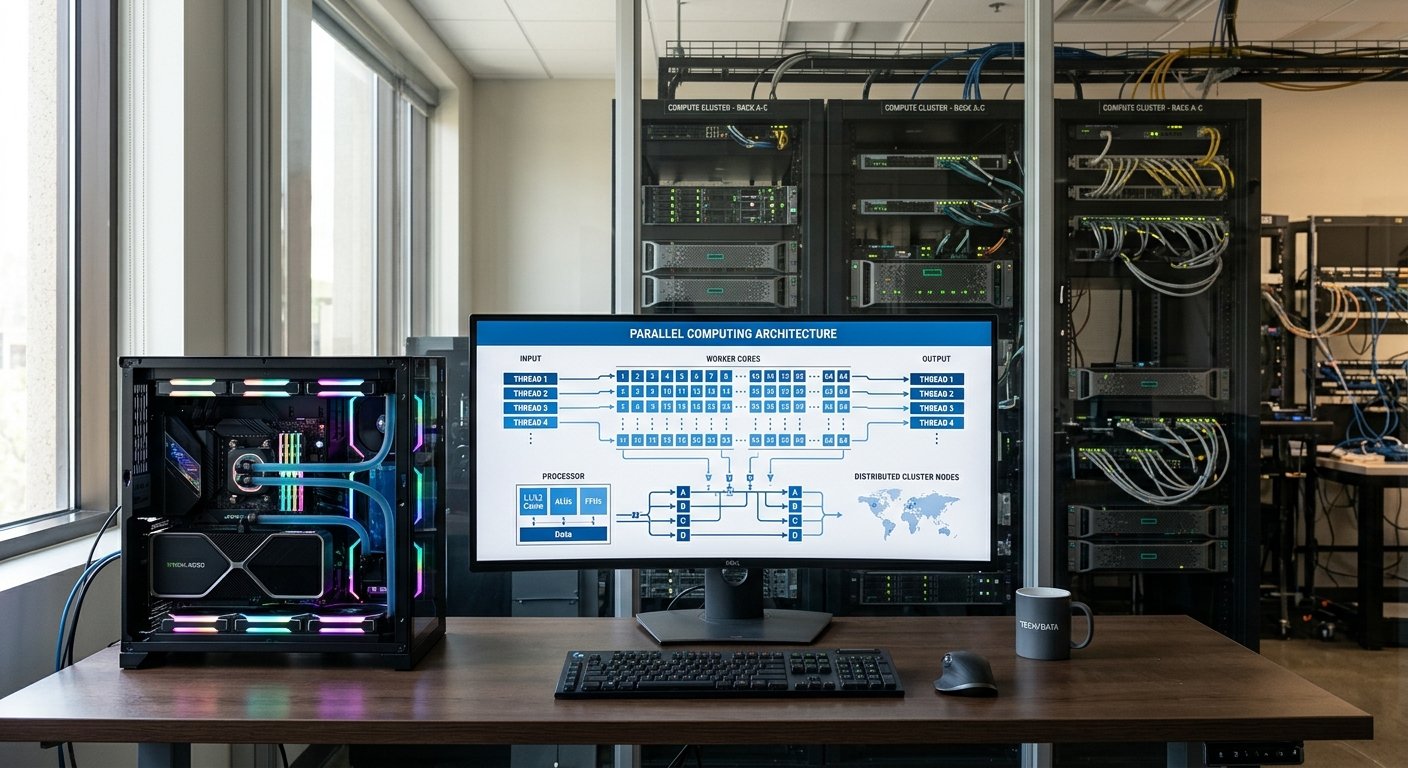
A parallel computing architecture is the organization of processors, memory and communication in a computer system. Multiple processing cores are contained in a single processing chip (some architectures), or independent computers are networked together to solve the same problem (some architectures). Large numbers of specialized processing units are used to perform similar operations on large quantities of data in graphics processing units (GPUs). In the other direction, massively parallel systems are applications that run many processors or computing nodes together to achieve tasks which are too complex for a regular computer. There are various benefits for each of these 2 designs in terms of speed, scalability, complexity of programming, and utilization of resources. The discussion of these architectures and their principles of operation will facilitate understanding of how parallel processing is applied in everyday problems and how it is being used in the development of more sophisticated programs used in current technology.
- Parallel Computing Architecture
The design of a computing system which allows multiple processing units to perform operations simultaneously is called parallel computing architecture. They can be separate processors sharing memory, individual cores of a processor or separate computers linked over a network. The architecture dictates the distribution of computational tasks, the manner in which processors are able to access data, and the distribution and combination of results. For instance, a desktop computer might involve multiple CPU cores in executing multiple application tasks, and a scientific computing cluster might spread a large simulation across hundreds or thousands of computers. Both systems are parallel computers but are very different in terms of their hardware organization and communication needs. The selection of an architecture will be driven by the type of problem, data volume, hardware available and the performance demands of the application.
Generally, there are two important principles in parallel processing: task decomposition and coordination. Task decomposition is a technique of breaking large computational problems into small tasks that can be done in parallel. These units can carry out the same operation on different data, can be used to carry out different operations, or can be used to execute a workflow that includes different operations. Coordination allows the tasks to communicate information as needed and the individual outcomes to be combined to achieve a correct final result. For instance, for a large image, a program might split the image into parts, and assign each part to another processor. Each processor then applies the appropriate transformation to the pixels it is responsible for and then the output from each processor is merged together to obtain the final image. The benefit of this method is dependent on the balance of the workload and the amount of time processors spend communicating or waiting for other processors to complete their tasks.
SIMD and MIMD Processing Models
SIMD and MIMD are two important models of parallel processing. SIMD is also known as Single Instruction Multiple Data. In this model, the same instruction is executed on multiple data elements, all by the same processing unit or by a coordinated group of processing units. The technique can be particularly useful for repetitive operations that need to be performed on large amounts of data. This includes tasks such as image filtering, numerical computations, audio processing, and some machine learning tasks. There exist CPU vector instructions that can be used to implement SIMD capabilities, and many GPUs have similar execution strategies. The idea can be read in greater detail via the linked explanation of Single Instruction Multiple Data, the core concept of this model of parallel processing. SIMD’s greatest benefit is that it cuts the overhead of running repetitive operations one by one, but it can only be efficient if the workload has enough repetitive operations to keep the processing units busy.
MIMD: Multiple Instruction Multiple Data. MIMD is a multiprocessor system with each processor or core capable of running different instructions on different sets of data simultaneously.In MIMD the various processors or cores can run different instructions on the different sets of data simultaneously. The flexibility of MIMD makes possible its use in those applications where more than one task is running, where decisions are complex, and where the operations of the workloads do not have the same structure. For example, each user request to a web server may be executed on a different CPU core, and each request may have different processing steps and information to access. Likewise, a problem can be broken down into zones where local conditions call for different calculations in different areas. Most modern multicore CPUs execute the code in MIMD fashion; distributed-memory clusters are often based on MIMD approaches because the individual processors are usually able to execute independently with some mechanism of communication between processors. At every level SIMD and MIMD are not mutually exclusive, as a MIMD system may include processors with SIMD instructions.SIMD and MIMD are not mutually exclusive at every level, because a MIMD system might include processors that have SIMD instructions within them, providing flexibility in terms of tasks as well as data-level parallelism.
2. Multicore Processor Architecture
Multicore processors are processors that have two or more processing cores, all on the same physical processor chip. A computer can run multiple computational tasks simultaneously using the multiple cores. The multi-core PC is today a standard item found on desktop PCs, laptop computers, smart phones, workstations and servers. Processors don’t need to be based just on raising the operating rate of a single processor core but can be designed to increase performance through the addition of multiple cores and the way they share resources. For instance, one core could run an application, while another runs background computations, processes audio, manages files, or performs operating system functions. If software is programmed to take advantage of the multiple cores, a multicore processor can work faster than a similar single-core processor. But if the application is not parallelizable into independent tasks, there may be only marginal gains due to the extra cores not being able to perform equally in parallel processing.
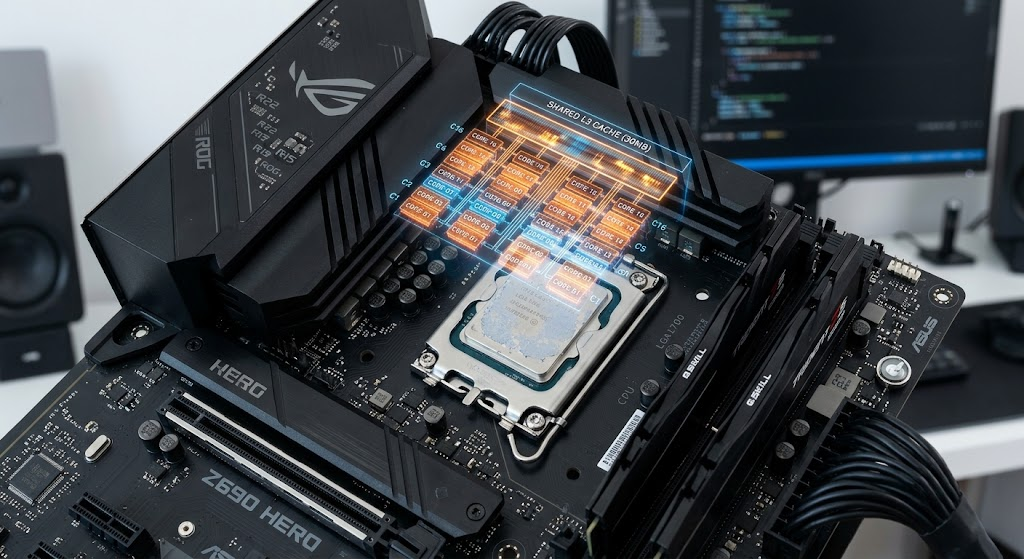
The design of the intracore architecture in a multicore processor has an impact on the communication efficiency and data access efficiency between cores. Core architecture often has its own execution units and registers, and processors commonly have a number of private or shared cache levels to minimize the number of times frequently accessed data needs to be retrieved. Some caches are private to the individual cores, others can be shared by multiple cores. If there are several cores accessing the same memory locations, the processor should ensure proper data consistency. Mechanisms are in place to ensure that cores do not keep using old versions of data, if another core has updated it. These mechanisms enable correct execution of parallel programs, but frequent communication between cores and contention for shared resources can mean lower performance. Thus, the developer must consider issues such as synchronization, data dependencies, and memory access patterns in developing software that runs on a multicore system.
How Multicore Processors Distribute Workloads
In a parallel application, processes running on a multicore processor typically break down the application into threads or tasks that are executed in parallel. Such threads are scheduled by the operating system and runtime environment of the computer hardware, and the number of cores utilized depends on the operations which can be executed safely independently by the application. Imagine that you’re designing a photo editor that is responsible for adjusting the brightness of a large photo. The program can partition the image into multiple sections and split them into multiple threads. Each thread runs its portion and when operations are complete, the application merges the output. This can increase the responsiveness and decrease the processing time since the multiple cores will work on separate portions of the job. However, the advantages are dependent on the number of cores, the efficiency of the algorithm and the coordination between the threads.
General purpose computing is one area where multi-core processors excel for providing the right mix of flexibility, cost and performance. Applications like web browsers, office software, communication tools and media editors can run multiple cores and use them for background tasks without affecting the responsiveness of the user interface. Multicore’s benefits also extend to professional applications in software development, 3-D graphics rendering, file compression, and simulations. But as you add cores, an application is not necessarily proportionately faster. There are tasks that have to be done in order and there are tasks in which frequent communication or synchronization is necessary. A single thread may be a limiting factor if it needs to complete its task before the other threads are able to proceed. In order to develop efficient parallel programs, it is important to determine how programs can be broken into independent work, how much of the work doesn’t really need to be synchronized, and how to break programs into pieces so that the available cores are used efficiently.
3. Shared-Memory Computing Architecture
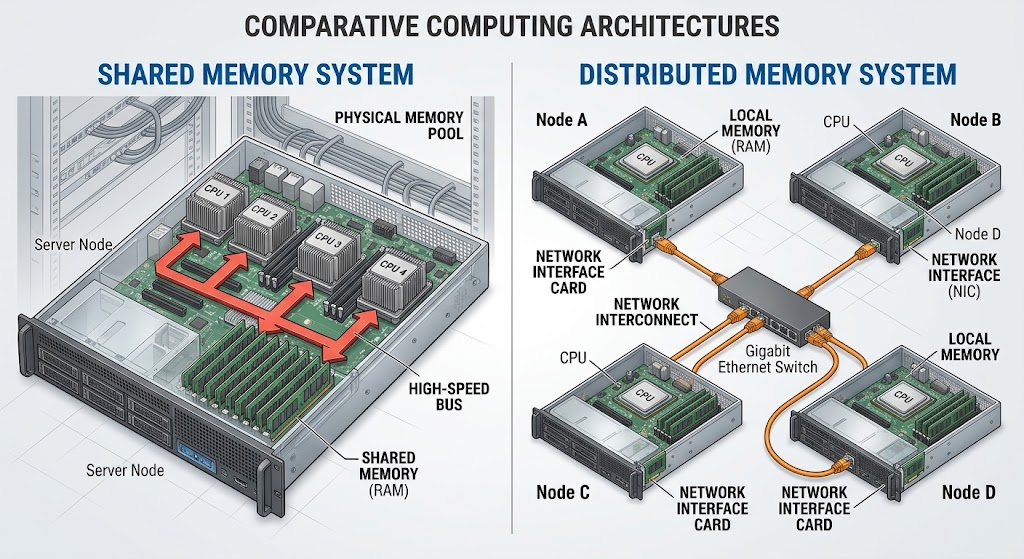
Shared Memory Architecture: These are systems with multiple processors or cores that share the same address space. The system does not have two separate memories for each processor, but instead lets the participating processing units use shared memory to read and write to it. This is a typical configuration for computers with multiple cores and multiprocessor servers. It also eases communication for processors to share information with each other without having to send messages over the network. In a program for analyzing data, for instance, several threads may need to read and write to the same set of records, but work on different parts of the data set. Other threads may be able to utilize the updated value of the shared information provided that certain synchronization and memory consistency rules are adhered to. This architecture is appealing for many applications because of the ease of access to shared memory, but there are issues that have to be handled with care due to the possibility of concurrent access to shared resources.
There are a number of ways of categorising shared-memory systems based on how evenly the processors share the memory. A uniform memory access (UMA) system is a type of memory system in which the memory-access latency for all locations in the shared main memory are roughly equal. A non-uniform memory access (NUMA) system has memory that is physically distinct among processor sockets or nodes, but that appears to be a shared address space. The local memory of a processor is generally faster to access than memory available to other processors. While NUMA systems are capable of supporting large multiprocessor servers, software performance may be dependent on the location of data and which processors use it. Often programs that have data local to the cores that are doing the processing will be more efficient than programs that repeatedly move data from a distant memory. Shared-memory architecture makes programming easy but still has performance constraints based on memory location, memory access and memory coordination between processing units.
Synchronization and Memory Contention
The most difficult aspect of shared-memory computer systems is to prevent concurrent operations from interfering with each other. If an application doesn’t coordinate the operations, it can suffer from race conditions when multiple threads are accessing the same data. For instance, two threads trying to increment the same counter may get an incorrect value if both read the initial value prior to writing the new value. Mutexes, locks, semaphores and atomic operations are examples of synchronization tools that are used to manage access to shared resources. The mechanisms are crucial for correctness, but they can cause a degradation of the parallel performance when threads find themselves waiting when they could be doing some useful work. The task for the developers is thus to identify data that really needs to be accessed concurrently and to develop algorithms that do not over-share data.
Another limitation is the memory contention. If multiple cores are frequently accessing the same memory addresses, or accessing memory at the same time, but only a small number of cores are allowed access to the memory bandwidth, then the system may not be able to deliver data fast enough to keep all of the cores occupied. As the number of cores that are active increases, shared caches, memory controllers and interconnection networks can become bottlenecks. For instance, a data-processing application can spawn dozens of threads, with each one processing a single data structure; then all the threads may be slow to read and update the same data structure, and the application may not perform as quickly as expected. A solution is to partition the data into independent regions, so that each thread can operate mainly on one region of the data and then merge the results. While the shared-memory model is still very useful to those applications that often require communication, good management of the resources is necessary to be scalable.
Distributed-Memory Computing Architecture
Distributed-memory architecture is a collection of computing nodes that are each equipped with a processor or processors and local memory. The nodes are cooperating in information exchange via the communication network, instead of having a single shared main memory. This design is frequently used for computing clusters, research labs, enterprise data processing systems, and high-performance computing systems. Each node does calculations based on its own data, and passes information to other nodes when it needs something that is not stored in its own node. As an example, a weather simulation could be subdivided into smaller areas of the geographic area and each area could be assigned to a separate node. Each node computes the state of his region and communicates boundary values with neighboring nodes so that the same model is used throughout the network. Distributed-memory systems can be expanded to support large workloads by adding more nodes to the system, but they are only efficient if they have a high degree of independence in terms of the computational tasks and if the communication network between processors can be expanded.
One of the key benefits of a distributed-memory architecture is that it can scale beyond the physical and resource constraints of one computer. They can be used to link several machines to create a greater processing power, more memory space and greater computing speed overall. A cluster is composed of nodes each of which supplies its own resources, and thus can process datasets or simulations that would be too large to process on a single workstation. But distributed computing adds communication costs which are not as obvious in shared memory systems. Data transmission between nodes involves network operations, and messages can be delayed or have limited bandwidth in the network. If programs share a lot of information that occurs often, communication can take up a lot of the execution time. The coupling of computation and communication is thus important for the design of distributed applications, and the developers have to take it into consideration.
Message: The unit of data sent from one processor to another.
Message passing is a common communication technique used in a distributed-memory system. A process sends a message containing data or instructions to another process instead of direct access to another process’s memory. That information is then used in the receiving process to calculate further. Message Passing Interface (MPI) is a popular standard for parallel programming using messages. These include sending and receiving data, broadcasting to multiple processes and gathering from multiple nodes. A scientific application could, for instance, split a large matrix among many nodes and have each node perform a portion of the computation. If a process needs information from another part of the matrix, then they exchange messages and proceed to work. This model offers flexibility in large parallel jobs, but care needs to be taken to avoid needless communication and delays.
Communication patterns can have a large impact on the performance of distributed applications. Some workloads need a lot of communication between nodes that are close together, while others can do a lot of work without communicating with others. A simulation with spatial regions can rely on periodic local-to-local communications between the processes in the local regions, while a large data-analysis application could break the data into independent records, send them out in parallel to the nodes, and bring back summary information at the end. The goal of an efficient system is to minimize the amount of data sent, to eliminate any communication delays, and to overlap communication of data with useful computation as much as possible. Load balancing is also essential, since if a node has too many tasks ahead of it, then it can cause delays in the entire application if other nodes need its output. So distributed-memory programming involves algorithm design, partitioning of workload, optimization of communication, and performance measurement.
Graphics Processing Unit (GPU) Architecture
Originally designed to speed up graphics operations like rendering images, transforming geometric objects, and computing lighting effects, GPUs are widely used in graphics, video, and multimedia applications.GPUs are widely used in graphics, video, and multimedia applications and were originally designed to increase the speed of graphics operations such as rendering images, transforming geometric objects, and calculating lighting effects. They have developed their architecture to accommodate a much greater variety of parallel workloads, such as scientific computing, machine learning, deep learning, image processing and data analytics. CPUs tend to focus on multiple instructions that can be performed in a flexible manner and are capable of performing many operations in sequence, while GPUs have many processing elements that carry out many operations simultaneously. This is particularly useful if there is a lot of data parallelism in the workload. For instance, if you’re processing millions of pixels, the same processing is done for each of these pixels, and many operations can be done simultaneously on the GPU. But GPUs are not necessarily quicker than CPUs. Complex branching or small datasets, or frequent communication with the CPU might not gain as much from GPU acceleration.
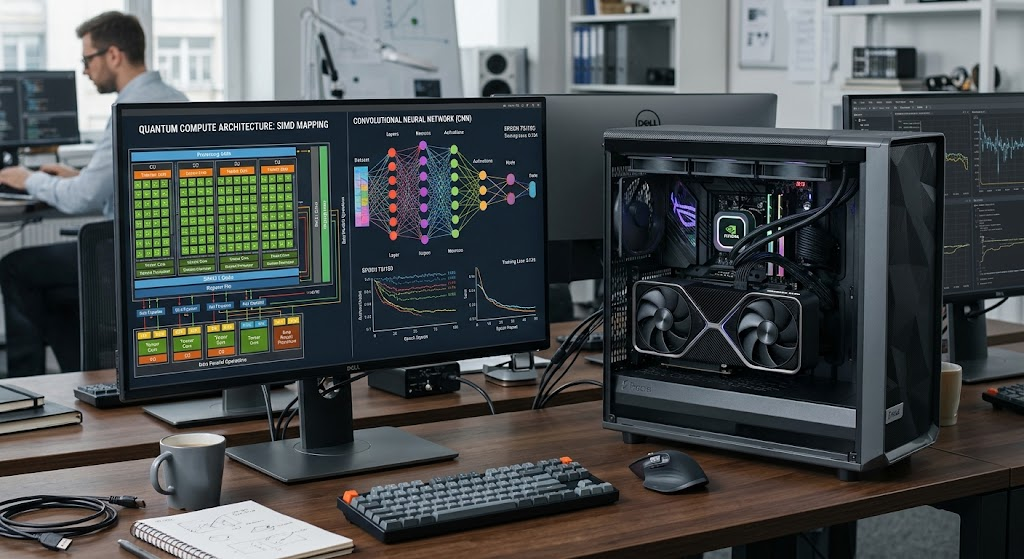
Most architectures of GPUs organize their processing resources into groups that perform large numbers of related threads. These groups can be known as streaming multiprocessors, compute units, or other architecture-specific terms. GPUs also have memory systems optimized for high data throughput, allowing for the transfer of large amounts of data between the memory and processing units. The power of these is to perform a lot of the same operations concurrently, particularly when there is sufficient data to feed the processing power. Modern GPUs can process general computing frameworks designed for programmers to use the graphics hardware for more than graphics. This has enabled GPUs to become a key component in numerous AI applications, where tasks like training and inference can involve large-scale matrix operations and tensor manipulation. However, they rely on memory capacity, data transfer, software optimisations, and the appropriateness of the workload.
SIMD, SIMT and Data Parallelism in GPUs
Though SIMD is an important concept to understand data-parallel processing, modern GPUs typically employ a model called Single Instruction, Multiple Threads (SIMT). With SIMT, many of the light threads perform the same instructions in parallel groups, and the hardware can process many numbers of data elements in parallel. The model has many similarities with SIMD, but the programming abstraction is different: programs tend to be written in terms of threads, whereas the GPU hardware implements threads in its own fashion. For example, a GPU program may be able to send a separate thread to each pixel of an image, or each element of a mathematical array. The GPU can be used to get high throughput if many threads are doing similar operations. If the control-flow paths followed by threads in the same execution group are significantly different, however, then execution efficiency may degrade since the hardware could have to process the different paths separately.
Machine learning requires a lot of mathematical operations on matrices and tensors, which is where GPUs come in handy. A trained model keeps going through the same process over and over again when it is being used to make predictions, calculating errors and adjusting its parameters. Many of the calculations can be made in parallel and are easily mapped to the GPU hardware. Inference also involves the ability of GPUs to speed up the calculations needed to make predictions with trained models, especially for large batches or for heavy workloads. If a model is responsible for processing thousands of images to classify them, for instance, the GPU parallelism can be used to efficiently compute features and predictions. But the GPU needs to have data flow in and out of it as well as have results come out, and all through the right software and memory pipeline. However, CPUs can be a viable option for many applications of lightweight AI, as the additional costs of data-transfer and launch may not provide enough benefits to justify the expense of dedicated GPUs.
Massively Parallel Computing Systems
Massively Parallel Computing systems are a series of extremely large number of Processing Units which are used to solve computational problems which demand a large amount of processing power. They can take the form of large supercomputers, GPU-accelerated clusters, specialized computing systems or even cloud-based systems that manage huge amounts of computing resources. They are distinguished by the ability to execute a multitude of calculations in parallel using a large number of processing elements. These can be employed in intensive scientific simulations, climate modelling, molecular studies, high-level engineering, large-scale data analysis and the training of artificial intelligence models. For instance, climate change scientists might want to model atmospheric conditions, currents of the oceans, land processes and interactions between them for extended durations. A massive parallel system can break up the simulation into many separate portions and send them to each of the many processors, thereby saving time in completing calculations that would be too time consuming on a conventional computer.
There are a number of different architectures that can be used in massively parallel systems, such as a combination of distributed memory nodes, a large array of GPUs, or a hybrid system of CPU and accelerator nodes. A supercomputer can consist of thousands of compute nodes, each with multiple CPU cores and one or more GPUs. The CPUs can handle tasks and general operations while the GPUs are used to process the task that is heavy on computations. High-speed interconnects enable nodes to communicate with each other, while parallel software distributes computations among the resources. While these systems can provide wonderful performance, they also provide their own problems with operation and energy usage, cooling, fault management, programming complexity and resource scheduling. Whether an algorithm can be designed to effectively leverage existing hardware without restriction due to communication, synchronization, or sequential operations is the key to the success of a massively parallel application.
Scalability and the Limits of Parallel Performance
The ability of parallel systems to manage growing workloads or additional computing resources is called scalability. Strong scaling is the performance of the solution as the number of processors is increased on a fixed problem.Weak scaling is the performance of the solution as the size of the problem is increased with the number of processors. Ideally, adding processors decreases the processing time for a given amount of work or enables the processor to perform more work at the same time. However, in practice, it is rare to get a perfect scaling as the overhead of communication, synchronization, memory access and other factors grow with the expansion of the system. A programme that is efficient on 8 processors might get less improvement if it is scaled up to hundreds or thousands of processors because the tasks are often interdependent and rely on common results or shared resources.
Part of the reason for this is well understood, and is the concept of Amdahl’s law: Sequential portions of an application constrain the benefits of parallel processing. The portion of a program that has to be executed sequentially imposes a limit on how fast the program can be made to run faster by adding more processors. If there is a large and critical initialization before starting the parallel part of the program, more processors may not greatly decrease the total execution time if the parallel part is relatively fast. Other practical challenges are unequal workload distribution, network congestion, bandwidth of memory, and slowest participating node delay. Rewriting algorithms to reveal more independent work, to minimize unnecessary communication, to distribute computational resources as evenly as possible, and to measure performance at various system sizes will help increase the scalability of the algorithms. These practices are especially critical when dealing with massively parallel processors, where minor inefficiencies in the processes can add up in the thousands.
Hybrid Parallel Computing Architectures
Hybrid parallel computing is a mixture of various architectures, exploiting the strengths of each. The typical example being a system featuring multicore CPUs and GPUs. The CPU handles the logic of the application, coordinates tasks and carries out operations requiring flexible control flow, while the GPU performs computationally intensive parallel workloads. This setup is frequently employed in scientific computing, AI, computer vision, and engineering simulations. A third hybrid parallel programming model is an intermingling of shared-memory parallelism inside the computing node and distributed memory communication across nodes. Such a system consists of several CPU cores or GPUs in each node, and the communication between the nodes is carried out by using a high-speed network. Hybrid architectures enable applications to be implemented in parallel using multiple architectures, at the same time, but hybrid architectures also need software that coordinates communication between multiple processing units and multiple memory spaces.
Imagine an experiment that has to be simulated on a cluster of GPU servers. The application can partition a large simulation domain between several nodes each of which will handle one part of the problem. Each node has a CPU whose threads process the data preparation and coordination tasks, and a GPU whose threads handle intensive mathematical calculations. The distributed-memory communication layer provides boundary data to a node when it needs it. This design is scalable – it uses a cluster – but also has the high throughput of GPUs and the flexibility of multicore CPUs. But these are areas that need to be addressed for the effective implementation: data transfer from CPU to GPU memory, network communication, thread scheduling and synchronization. While hybrid computing can produce outstanding results, inadequate coordination of data movement can cause the performance benefits of using both types of technologies to be reduced or even null.
Comparing the Major Parallel Computing Architectures
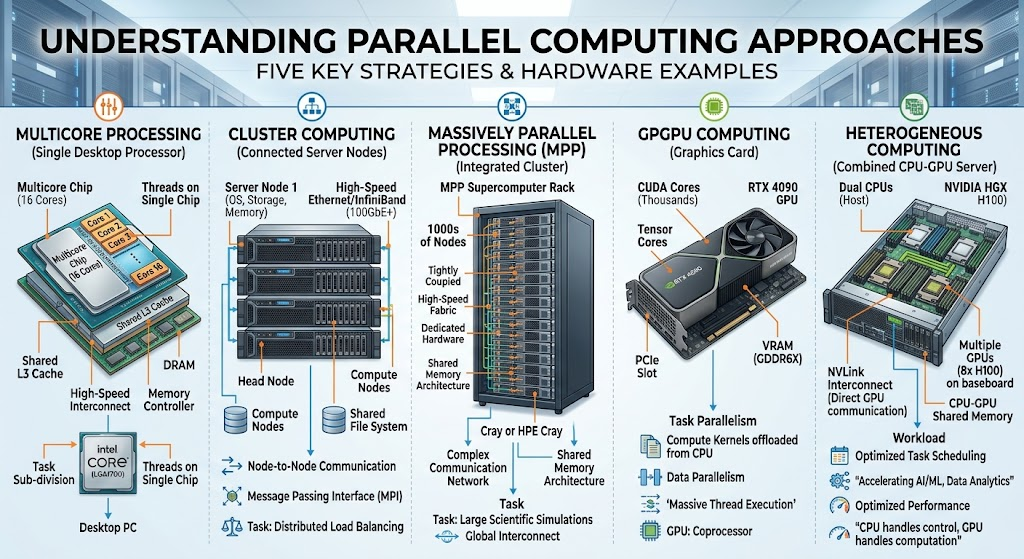
Different priorities are involved in the design of each parallel computing architecture and it is necessary to compare the processing capabilities, organization of memory, communication needs, and scalability of each architecture. Multicore processors provide a handy means of boosting the performance of common applications and tasks that may be distributed across a small number of CPU cores. Shared-memory systems are ideal for applications which access common data structures often, since it is easier to exchange data between threads. Distributed-memory clusters can span many independent computers and are useful resources for workloads that use more resources than any individual computer. High throughput data parallel processing is the domain of GPUs and very high pressure applications are those handled by massively parallel systems. These strategies can be combined in a hybrid design to achieve a balance between flexible computation, specialized acceleration and system-wide scalability.
For these architectures, the following table outlines the major differences.
| Architecture | Processor Organization | Memory Model | Main Advantages | Common Applications |
| Multicore processors | The ability to use several CPU cores on a single chip. | Shared main memory, with core-level caches | Excellent all-round performance and an optimum multi-tasking ability | The desktop application, web servers, compilation and media editing. |
| Shared-memory systems | Each core or processor has its own address space and memory. | Shared Memory (and sometimes Cache-coherence mechanisms) | Easy communications and simple data sharing. | Storage in databases, multithreaded applications and in-memory analytics. |
| Distributed-memory clusters | A system with several separate computing nodes. | Local memory available at each node. | Scalability between machines and across aggregates of computing resources. | Large-scale computation, distributed analytics and scientific simulations |
| GPUs | A number of parallel processing elements that are grouped together for execution | Specialized memory hierarchy which has high throughput access is used in the system. | High throughput of data-parallel workloads | Deep learning, image processing, scientific calculations and rendering |
| Massively parallel systems | A massive array of processors, accelerators or compute nodes | Shared, distributed or hybrid memory architectures | Highly powerful computing power. | Climate modeling, super-computing, advanced research and big AI workloads |
| Hybrid architectures | CPUs, GPUs and several nodes in parallel | Shared and distributed memory (SDSM) | Ability to adapt to changes in workloads and to increase speed in various workload types | GPU clusters, engineering simulations and AI training |
It’s important to note from the table that there is no single architecture that is perfect for every application. A small business app can run well on a multicore desktop computer, and a large-scale weather simulation can run on a distributed-memory supercomputer. If an application has a large number of matrix operations, then it might need to be accelerated by using GPU; if an application relies on unpredictable decision making then CPU cores might be more important. In practice, one or more of the following factors determines which is the best option: size of workload, amount of available parallelism, memory requirements, communication patterns, budget and energy constraints. Finally, software compatibility is also a factor since developers have to have appropriate programming frameworks, libraries, and tools to make use of the hardware. By taking these trade-offs into account, an organization can choose a system that will meet its performance goals without investing resources in superfluous computing power.
Applications of Parallel Computing Architectures
There are many applications using parallel computing architectures, including everyday consumer applications and sophisticated scientific research. In normal computing, multicore chips enable the OS to run background processes without slowing the apps. Web servers may have multiple cores or multiple nodes that serve requests from a large number of users, and databases may be able to parallelize certain queries to process large data sets in less time. Graphics applications rely on GPUs to create graphics, perform visual effects, and speed up some of the editing processes. Financial analysis, transaction processing, search systems, and large-scale reporting are examples of other application areas that are also dependent on parallel processing in businesses. In fact, these examples are strong enough to illustrate that parallel computing isn’t confined to supercomputers or research laboratories. It’s part of the devices and services that people use on a daily basis, but the architecture of each application might not be apparent to the user.
For scientific and industrial applications, much higher computational resources are typically required. The models of the atmosphere are partitioned into regions to be computed, the calculations are split between the processors, and the information is passed between the neighbouring regions. Combined with a high-performance supercomputer, the use of parallel computing by engineers enables them to model the behavior of fluids, structures, and aerodynamics, simulations that would otherwise be costly to conduct in real life. A large cluster can be used to simulate interaction of molecules or materials that require a very large number of calculations. The AI systems leverage distributed training infrastructure and GPUs to handle massive amounts of data and fine-tune model parameters. In every instance, the architecture should be similar to the computational structure of the workload. Data-parallel applications can benefit from the use of GPUs, while communication-intensive simulations can benefit from well-designed distributed-memory architectures, and workloads can perform best on hybrid architectures. Thus, the key to successful parallel computing relies on the problem, algorithm, and hardware.
Difficulties Faced and Best Practices in Parallel Computing
While parallel computing may lead to better performance, it comes with its own set of difficulties which may not be present in a sequential program. It can be challenging to partition a problem into independent tasks when outcomes of each task rely on outcomes of previous tasks. Synchronization can induce delays, and communication between processors can take a lot of time and energy. The workload may not be evenly distributed and some of the processing units may be idle while others are working. Unexpected interaction of concurrent operations can also lead to race conditions, deadlocks and hard-to-reproduce errors in parallel programs. Besides, software developed for one architecture can be quite different in its operation on another. Correction, maintainability, portability and resource utilisation are therefore other issues which must be taken into account, besides raw processing speed, when designing parallel applications.
There are a number of practices that can be used to surmount these difficulties. First, the developers must be able to isolate the parts of the workload that can be executed in parallel, and figure out if parallelization will be beneficial. Second, they need to select an architecture to fit the memory requirements, memory communication patterns and computational intensity of the problem. Third, they should use appropriate profiling and benchmarking tools, rather than believe that adding more processors will necessarily speed execution up. Fourth, they should limit to a minimum any useless synchronization and data transfer, as well as maintain a balanced workload allocation among the available resources. Lastly, there is a need to test parallel programs under a variety of conditions to ensure their correctness and scalability. These practices increase the chance that parallel processing will provide real benefits to the developer instead of providing just more complexity for little return.
Conclusion
As workloads become more complex, parallel computing architectures offer the hardware foundations to process increasingly complex workloads efficiently. Multi-core processors allow multiple CPU cores to run at the same time, and shared memory systems allow easy communication, using a shared memory address space. Distributed-memory clusters provide more computing capacity than a single machine, while GPUs are able to process the data parallel workloads quickly with lots of GPUs. With massively parallel systems, there is a massive array of computing resources for intensive scientific, industrial and AI applications, and hybrid architectures integrate CPUs, GPUs, and distributed nodes to leverage their complementary capabilities. These systems are organised in such a way that they coordinate and organise their operations using concepts like SIMD, MIMD, processor communication, memory access, and workload distribution.
This awareness of the architectural differences can assist organizations and developers in making informed choices on their computing infrastructure. Depending on the size of the problem, the available parallelism, requirements for communication, memory, scalability, and practical considerations such as cost and energy consumption, the best design will vary. The mere addition of processors does not necessarily lead to better performance when it comes to parallel computing, proper algorithms and load balancing, memory management and coordination are necessary as well. With the continuous development of AI, scientific research, business analytics, and digital services, parallel computing architectures will continue to play a vital role in modern technology. An understanding of these systems gives a foundation for computing systems both today and in the future, including high performance computing.