Introduction
Open banking is changing the way financial products and services are accessed, managed and utilized by all kinds of businesses and individuals by allowing secure banking connections between participating banks and third party financial service providers. Financial data was traditionally limited to individual banks, so it was hard for customers to be able to see all their accounts in one place, and share financial data with other services. Open banking acts as a solution to this by enabling application program interfaces (APIs) that enable the sharing of information within the defined permissions and security measures. This progress will help services like personal finance management applications, electronic lending platforms, and incorporated payment solutions. Open banking ensures that customers have more control over the processing of their data, which fosters innovation, makes things more convenient and offers banks and fintechs the chance to build more integrated financial experiences.
What is Open Banking?
Open banking is a system that facilitates the linking up of financial data with specific third parties either by the customer granting permission to the financial institution to share a certain amount of information, or by the customers giving permission to the third party to use the financial institution’s services for payments. Compatible systems may use standard or institution-specific APIs to share data with customers instead of them having to go through the trouble of downloading statements or typing in account information repeatedly. These connections are made in accordance with the laws and regulatory requirements, contractual agreements and security controls. Importantly, open banking is not about giving financial data to the public or allowing any company to open a bank account or have access to a customer’s bank account. Access is dependent upon permissions, institutions supported and authorization. The underlying idea is to provide a more flexible approach to data sharing, offering customer’s greater options without compromising security of financial data.
The Importance of APIs in Open Banking
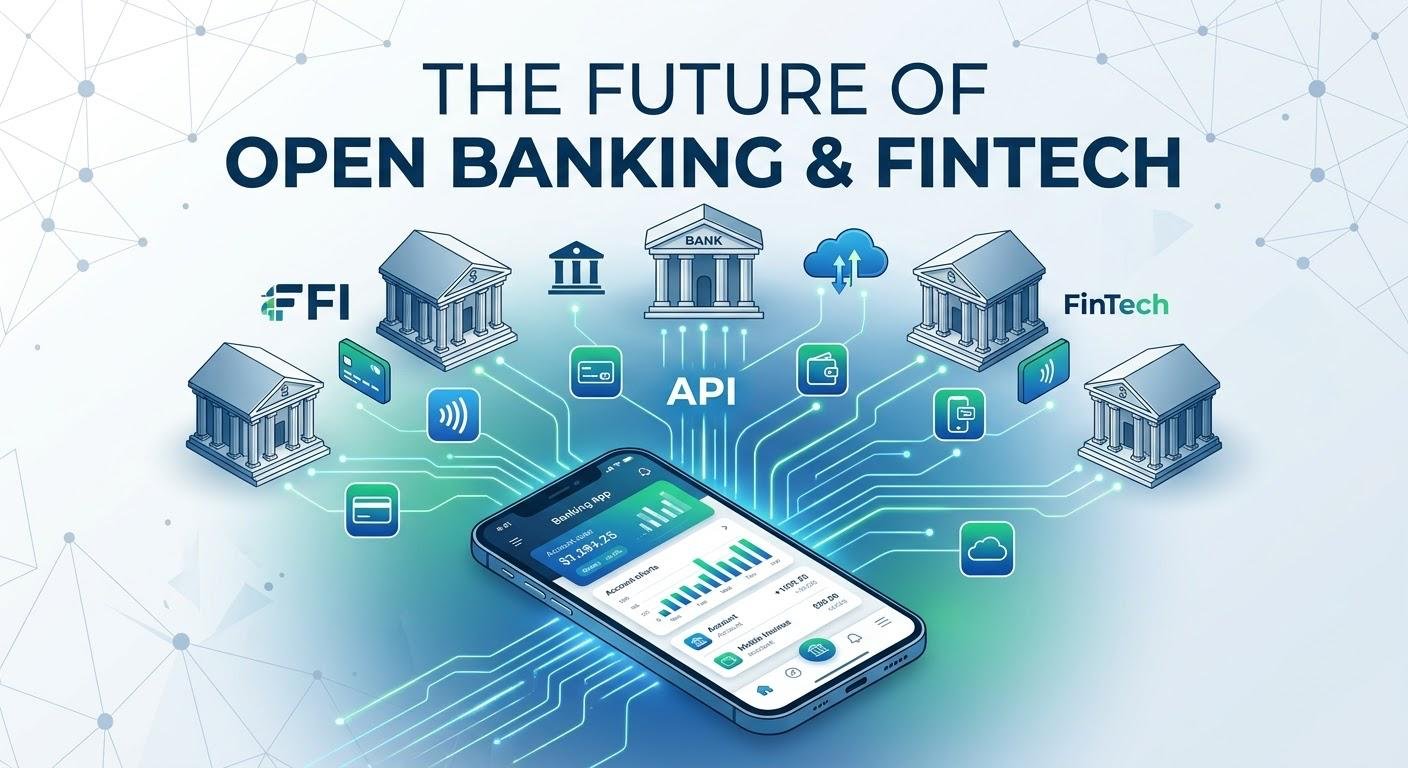
Open banking relies on application programming interfaces (APIs) to enable the systems to communicate with each other technically. If a service permits, a bank can make certain API endpoints accessible that enable an authorized application to ask for the desired information from an account, to come back transaction details, or to start a payment. The API provides a standardized approach to data sharing, eliminating the need for the third party to have access to the bank’s internal systems. The security mechanisms, authentication procedures, access tokens, permissions and monitoring determine which requests are accepted. Standardized interfaces can also lower the cost and complexity of integration of various services. But APIs can’t be secure by themselves – they need to be implemented properly, access controls are necessary, regular testing is essential, and clear guidelines are required on data that can be shared.

Cases of Open Banking
Financial Management Linked with Account Aggregation.
Account aggregation enables customers to access financial data from a number of banks/electronic money issuers under the umbrella of an authorized interface. One person, for instance, might have a salary account at one bank, savings at another bank, and payment account at another bank; they could be able to view the balances they’re allowed to see and transactions they’re allowed to see in one application. This all in one view can help you see how you are spending, how your money is moving, recurring expenses and how you compare your financial obligations. Based on information available, personal finance tools may classify transactions, create reports and reminders. These features are helpful when their accounts are linked, they have the necessary permissions to access, and institutions regularly update their data. Where accuracy and/or time are critical, customers should ensure that they check key balances and transactions with their financial institutions.
Payment Initiation
Open banking can also enable payment initiation; this is where a third party service, authorised by the customer, and that has an agreement with a participating bank, can ask the bank to make a payment. It can be used by customers for online shopping, invoice payments or transferring funds between accessible services in the system, depending on the system. A customer can choose a bank, validate it via a validated method, check the payment details and confirm the payment. This can result in other payment experiences and a lower dependency on some middlemen. However, there are differences in availability, fees, settlement times and consumer protections offered by markets and providers. But the payment initiation process is no guarantee of safe authentication, transaction verification or confirmation safe authentication, verification and confirmation are key to protecting customers and merchants.
Assessment of Digital Lending and Credit
Customer-authorized banking information can be utilized by digital lenders to help with their credit evaluation, provided they comply with privacy, lending, and data protection laws. A lender can review the income deposit, regular expenses, account activity and cash flow, rather than just traditional credit records, with proper access. This may be beneficial for some applicants who do not have a well-established credit history. The automated analysis can also speed up the process of applications and assist lenders in spotting discrepancies that need to be reviewed further. But transaction data is not always complete or accurate and spending habits do not necessarily indicate an individual’s broader financial situation. The role of responsible lenders is to explain how information is used for decision making, fairly consider the relevant risks, safeguard sensitive information and offer relevant avenues for questions/concerns when needed.
Connected Financial Services Approach Embedded in Banking.
Open banking can be used to enable financial services to be seamlessly embedded into other platforms that customers are already using, such as accounting software, online marketplaces, business management systems, and digital commerce applications. For instance, a small business app can link official bank transactions with bookkeeping software, making data entry much less cumbersome and assisting business owners reconcile funding. During check out, an online service can also provide a supported financial payment option; a financial application can include account info and budgeting functions. Sometimes embedded finance is equated with open banking, but it’s not the same: embedded finance refers to the financial services that are embedded in non-financial customer journeys, while open banking is open access to banking information, and some payment capability. While their relationship can help to make routine tasks more efficient, it is important to have clarity around permissions, responsibilities and data handling.
Customer Consent, Privacy and Security
The first line of security in open banking is customer consent as financial information can contain details of their income, spending, debts, relationships and personal habits. Customers should be informed about the information that will be shared, that it will be shared with, the purpose of sharing it and the length of time access will be provided. Permission should be granted for the purpose stated and appropriate procedures should be put in place to revoke permission when appropriate. Further requirements for consent, retention, deletion and the use of the data may be required by applicable regulations. It’s also important for customers to read privacy policies and be certain that they are not granting access to any unfamiliar apps just for the sake of convenience. The withdrawal of permission may result in the inability to access the information in the future, but existing access may have different retention requirements. The meaningful choice of customers and the responsible data governance of all organizations involved are key to the protection of privacy.
Authentication, Encryption, API Security
Multiple security measures are employed in open banking to ensure data is safe when being shared between institutions and approved service providers. Authentication is a way to determine the identity of a customer (or system) and multifactor authentication may involve more than one form of verification beyond a password. Where possible, fingerprints or facial recognition are verified using biometric checks, but the extent to which they are used differs. Encryption is used to protect data when it’s being sent and, if properly implemented, when it’s stored. Access tokens, strictly defined permissions, rate limits, secure software development, and frequency of vulnerability testing are among the other aspects of API security. The financial institutions need to keep an eye on any strange requests made, remove any compromised credentials and take action immediately on the discovery of any weaknesses. Layered defenses, careful configuration and continuous maintenance are necessary – there is no one single way to control an individual. There’s no one single way to control an individual— layered defenses, careful configuration and continuous maintenance are necessary, as attackers are constantly coming up with new methods of exploiting software and human behavior.
Challenges and Risks of Open Banking.
While open banking can offer great potential benefits, there are risks that institutions and customers need to be aware of and take steps to mitigate. Phishing and social engineering may trick users into revealing their credentials, or give access that they do not understand. Applications that are not as well protected as you would like could leak data, and too many permissions can mean that if you have your account compromised, the repercussions will be greater. Insecure software updates and failure to monitor properly could also make it possible to breach API. What’s more, incorrect categorization of purchases or incomplete data might lead to incorrect monetary suggestions or credit checks. Further concerns arise with the use of artificial intelligence, as the ability to target customers and service providers with convincing impersonation, automated phishing and synthetic identities can also be accomplished. There are several steps organizations should take to determine and evaluate the security of the third party conducting the transaction, perform regular audits, put in place incident response plans, educate customers and let them know how complaints, unauthorized transactions, and suspected data breaches will be handled.
Open Banking vs. Open Finance
Open banking is connected with Open Finance, but is not the same. The main areas of interest of open banking are about qualified financial information about banking products, and supported payment products, such as payment initiation, transactions, and account balances. Open finance takes the same concept of permissioned sharing of data with others and expands the possibilities of financial products to which it can apply, such as insurance policies, pensions, investments, mortgages, and other financial accounts. Within an open finance concept, the customers could get a wider perspective of their financial situation on several product groups instead of financing relationships. But to enable greater access, the technical requirements, processes for consent, legal authorizations and protections should be tailored to the different information types. Open finance is not always the same and its availability is dependent on the specific market, financial institutions entering the market and applicable regulatory arrangements.
The Future of Open Banking
Whether financial institutions, technology providers, regulators and customers are able to create reliable systems that are convenient and accountable in the future will be a matter of success. API standards could be more consistent, and better consent dashboards could make connections more straightforward, and help consumers understand and control permissions across services. Improved data quality and responsible automation can help to enable more helpful budgeting tools, business accounting more efficiently, and alternative payment experiences. Meanwhile, more widespread participation will involve establishing liability guidelines, ensuring robust cybersecurity protocols, providing easy access to customer support and safeguarding against discriminatory or misleading automated decision-making. Banks might be able to woo customers by providing better services and through joint ventures, not by merely maintaining the customer accounts. With good governance and customer engagement, open banking can play a key role in building a financial system where data is safely transferred to provide services to both businesses and individuals that are more suited to their needs.
Conclusion
Open banking is facilitated by the linking of financial institutions to authorized third-party services via APIs, which allows for the sharing of financial data in a controlled way and payment initiation supported. Some of its use cases are account aggregation, personal finance management, digital lending and banking functionalities on non-financial platforms. All these features can make the handling of money easy, make money more accessible and foster competition between the traditional financial sector and the FinTech firms. The advantages, however, rely on robust customer consent, the correct authentication, encryption, API protection and responsible data handling. Phishing, account compromise, third-party vulnerabilities, and new attacks using AI-powered technology are just a few of the threats that open banking needs to tackle. The point is clearly still the same, in the era of moving towards Open Finance, provide meaningful options to the customer without compromising privacy, security and trust.
Get more well researched information about Open Banking here.