Introduction
In the modern digital age, the most common technologies mentioned are artificial intelligence (AI), machine learning (ML) and deep learning (DL). They are used in various modern technologies such as virtual assistants, recommendation systems, fraud prevention software, driverless cars, and generative AI applications. These words can be interchangeable in use, but have different meanings, applications, methods, and purposes. It is crucial for anyone with an interest in technology, business innovation, software development, or the future of digital services to understand the distinctions between them. Artificial Intelligence is a broad-based area of the study that deals with the development of machines that can do tasks of human intelligence. Machine learning is one of the applications of AI that uses algorithms to analyze data and learn from it to better predict outcomes. Neural networks with multiple layers of processing are used in deep learning, a specialized form of machine learning, to learn complex patterns. While there are some similarities between the three concepts, they are not synonymous and understanding the relationship between these concepts helps to assess contemporary technologies and to understand behind the scenes what is going on with the digital tools people utilize daily.
What is Artificial Intelligence (AI)?
AI is an area of computer science that involves creating systems with intelligence. These tasks involve using reasoning, problem solving, planning, understanding language, recognising objects, interpreting information and decision making. AI systems can be built using rules, logic, statistics, machine learning or a combination of these. The overall goal is to develop computer systems that can perform useful functions that would normally require significant human effort.
Not all AI systems have to learn from experiences and not all AI applications require massive data sets to operate. Some systems have complex models trained from vast databases and others are designed to make suitable responses to instructions. An example of this is a rule-based customer service system that can direct customers to various departments based on their options. While this system is not designed to learn from past interactions, it is still often referred to as a “simple” AI system, as it relies on programmed logic to make decisions.
How Artificial Intelligence Works
AI is essentially a process that brings together computational techniques, algorithms, data, and the programmed goals to create valuable outcomes. The exact process will vary depending on the type of AI system being created. In a rule-based system, it will execute instructions set by the developers, and in a search-based system, it will consider what actions to take and choose an appropriate solution to the problem. Other AI systems are based on machine learning models, which learn patterns from examples instead of merely from manually codified rules. The first step is usually to state the problem to be solved by the system, to choose a method to solve the problem, and to organize data or rules that will be needed to solve the problem.
They then install the system, evaluate its performance and improve the system if needed. In the case of a chess-playing program, for instance, it could consider options through search algorithms and chess logic. On the other hand, a translation application with an AI can leverage machine learning to interpret the language patterns and translate them. While the methods used may vary significantly, both applications are part of the larger category of AI.
Common Applications of Artificial Intelligence
AI is applied in many industries to boost efficiency, automate repetitive tasks, aid in decision making, and customer experience. AI can also help healthcare professionals in tasks like analyzing medical images, organizing patient data, and identifying patterns that could warrant further investigation. In banking, AI is used to track transactions, to detect suspicious activity, and in customer service to assist. AI is helping retail companies to optimize stock management, understand customer buying patterns, and deliver individual product recommendations. AI technologies are used by transportation companies in route planning, traffic prediction, and vehicle assistance.
Other applications include language translation, virtual assistants, document processing, and industrial automation. The examples show that AI is not just one algorithm or one product, but is a broad domain with various techniques to tackle various problems. Some applications are based on traditional programming, others with machine learning or deep learning. The type of approach chosen will depend on the task, the information available, desired accuracy, cost of what is to be done, and the consequences of getting things wrong.
What is Machine Learning (ML)?
Machine learning is a type of artificial intelligence where computer systems can learn patterns in data and apply those patterns to make predictions, classify information, or make decisions. Programmers no longer have to define all possible conditions explicitly, as developers would train machine learning algorithms with examples that would represent the problem being solved. An algorithm changes internal parameters during training to acquire relations in the given data. After training, the model can make predictions on new data, as it has learned a pattern.
For instance, an email filtering system may be taught with regards to the messages marked as spam or proper e-mail. The model identifies email types using features like words, sender details, and the structure of the email. If it receives a new message, it makes an initial guess on which of the categories is most suitable. Machine learning does not refer to something where computers think or understand information in exactly the same way as humans do; rather, it is a set of computational techniques that learn about what information is useful for a certain purpose and use that information for that purpose.
How Machine Learning Works
Generally, machine learning consists of four major steps: data collection, data preparation, algorithm selection, model training, model evaluation, and deployment. Data preparation is especially significant because if information is incomplete, incorrect and poorly organized, it can impact the quality of the model that is created. The algorithm is trained by looking at examples and modifying its parameters based on some objective function, such as minimizing prediction error or maximizing classification accuracy.
The developers then test the model using data not used to train the model and make sure that the model can generalize to new examples. A business building a sales forecasting model, for example, could feed its model with past sales data, seasonal trends, product pricing and marketing promotions. The model may then be able to predict future sales with the data. Even with effective training, however, there is still no guarantee of flawless predictions. Customer behaviour change, data inaccuracies, or unforeseen economic conditions can lower performance and the ongoing monitoring and evaluation of the model throughout its operation are critical.
Main Types of Machine Learning
There are various significant machine learning methods, all of which have their own specific applications and data sets. In supervised learning, the training data is provided in the form of examples with labels, i.e. known answers or target values are provided. It’s frequently used in the prediction of house prices, detecting fraudulent transactions and categorizing emails. Unsupervised learning is learning from data where the labels are not predetermined, and tries to find patterns, groups or relationships. For instance, a retailer can segment their customers into clusters based on their buying behaviour.
Reinforcement learning is a learning system where an agent is rewarded or penalized for their actions and learns to make decisions based on the environment. The method is extended to robotics, game-playing systems and some optimization problems. These categories are representative of the diversity of the methods in machine learning. The best approach is one which adapts to the task whether it is predicting known consequences, uncovering hidden patterns or learning a strategy from feedback. The various methods require different kinds of data, possess various strengths and weaknesses and have various computational requirements.
Common Applications of Machine Learning
From the tourism sector to the finance industry, machine learning is in use across a variety of industries and applications, where organisations are required to process information, detect patterns, and forecast predictions on a large scale. Financial institutions use it to detect fraud, analyzing the characteristics of transactions and patterns of activity that deviate from typical ones. Machine learning algorithms can be used by online retailers to suggest items to customers based on their interests, browsing history, and past shopping habits. It is employed in hospitals and research institutions to process medical data and is particularly useful in analysing medical information, but clinical decisions must be made in an appropriate manner with the right professional supervision.
Machine learning is also used in businesses for demand forecasting, predictive maintenance, customer segmentation and sentiment analysis. In the manufacturing sector, models can be used to predict equipment failure before it happens by analysing readings. Machine learning can be used in agriculture to analyse weather data, soil readings and crop photos to inform agricultural decisions. The examples highlight the value of machine learning in discovering relationships in vast quantities of data that could be challenging to find manually. However, its application is contingent upon data quality, appropriate modeling selection, careful evaluation, and responsible application.
What is Deep Learning (DL)?
Deep learning is a specialized type of machine learning that relies on artificial neural networks with multiple layers of processing to learn complex relationships in data. The networks are loosely based on biological nervous networks, but they operate on different mathematical principles than does a human brain. A deep learning model works by using a series of interconnected artificial neurons that process information, changing the input signals and passing the results to other layers. When the model is trained, it works out the numerical parameters so that there is a minimum difference between the model’s results and the desired outcomes.
The multiple layers enable the network to learn more complex representations of information. In particular, early layers might react to basic visual elements like edges, and later layers might synthesize elements to generate a representation that corresponds to an object, a shape or a scene. It is especially valuable for complex tasks that rely on images, sound, video and natural language, where specifying all of the relevant features would be cumbersome. It has also played a key role in the development of speech recognition, computer vision, and generative AI.
How Deep Learning Works
Deep learning models take in information by traversing a series of artificial neurons linked together by tunable numerical weights. The input layer is where input information is entered, the hidden layers are used to process the input and output information, and the output layer is where the output information is obtained. Every “neuron” sums up the inputs, computes a mathematical function of the sum, and feeds the result into the next layer. In training, the model is presented with a target value and the loss function computes the difference between the model’s prediction and the target value. An optimisation algorithm then changes the value of the parameters of the model; a technique commonly used for calculating the contribution to the error of each of the parameters is called backpropagation.
By repeating this process across numerous training examples, the model can pick up helpful patterns. A deep learning system, with many labelled photographs, for instance, can be taught to tell the difference between various animal species. The model will learn important representations from the training images without having to manually specify all the visual properties of those images. But deep learning often needs significant computational power, well-structured data sets, and lots of testing to guarantee good performance.
Understanding Multilayer Neural Networks
Many deep learning systems rely on multilayered neural networks, which enable information to be processed through multiple stacked layers of interconnected networks. Each layer may also learn a different representation of the input, so that the entire network can model relationships that simpler methods might not be able to model. For example, in image recognition, a network can learn to recognise simple visual features, learn to recognise parts of an object, and subsequently learn to recognise the object as a whole. Neural networks can be used in NLP to learn representations that can help capture the relationships between words and phrases and also between words and wider language context.
How many layers are not necessarily the key to good performance; the architecture, training data, number of parameters, optimization method, and task of the model also affect performance. Those who seek a more technical introduction can check out this overview of multilayer neural networks. The concept helps to understand why deep learning is considered as a subset of machine learning: machine learning also has a lot of approaches that do not rely on deep neural networks.

Common Applications of Deep Learning
Deep learning is especially relevant to use in applications where there is complex or unstructured information, like photographs, speech recordings, videos, written language, and more. It can also be used in the medical industry to analyse medical images and detect patterns that require professional review. In transportation, deep learning models can be used to understand the meaning of image data captured by cameras and other sensors for driver assistance and autonomous driving. The voice assistant involves deep learning algorithms for speech recognition and natural language processing, while the translation system employs neural models to translate and generate text in various languages.
Deep learning also plays a key role in the applications of generative AI. Large language models create text from a neural network architecture, and image-generating systems can create images using a model that has been trained on a large number of examples. For industrial settings, deep learning can be used for visual inspection, where defects in products passing along production lines can be spotted. Nevertheless, deep learning is not the optimal way to solve all problems. Before it is used it has to be taken into account that it requires a certain amount of computation, has some specific demands for data, can be found to be biased and that it has some limitations in explaining some predictions.
Differences between Machine Learning, Artificial Intelligence and Deep Learning.
The difference between artificial intelligence, machine learning, and deep learning is mostly in terms of scope and in the way in which they are solving problems. The term artificial intelligence is the most general term, as it contains many techniques that allow the machine to do intelligent tasks. Machine Learning is a sub-area of AI which focuses on identifying patterns and learning to perform tasks based on data driven algorithms. Deep learning is a type of machine learning which utilizes multilayered neural networks for learning complex representations.
These relationships are not competitive: AI is made up of machine learning, which is made up of deep learning. Thus, a deep learning application is also a machine learning application, and an AI application. An AI system that is entirely rule-based, however, is not a machine learning system and a machine learning model does not have to be deep learning. These differences enable readers to grasp the technology description correctly, to assess software claims, and to determine the approach that is most suitable for specific business and/or technical issues.
Comparison Table: AI vs ML vs DL
The following table highlights the key differences between AI, machine learning and deep learning. While they share similar capabilities, they are different in the kinds of data they need to process, their operation and their common uses. AI can employ programmed rules, logical reasoning, machine learning or a mixture of the three, while machine learning is a specific method of learning patterns from data. Deep learning is primarily about the multilevel neural networks that are able to learn more and more complicated representations. Additionally, their resource needs differ: A simple AI app based on rules could use low-powered hardware, whereas a large deep learning model might demand significant processing power and specialised accelerators for training. These are general trends and not rules as each system is unique. There are many different technologies that may be used depending on the complexity of the task, the training data available, the accuracy required, the need for the application to be explainable, the budget, and the environment the application will be deployed in.
| Feature | Artificial Intelligence (AI) | Machine Learning (ML) | Deep Learning (DL) |
| Feature | Artificial Intelligence (AI) | Machine Learning (ML) | Deep Learning (DL) |
| Definition | A wide area of interest concerned with intelligent machine behaviour | An aspect of AI that learns patterns from information | Multilayer perceptron based neural network branch of A branch of ML based on multilayer neural networks |
| Scope | Broadest category | Subset of AI | Subset of ML |
| Main approach | Rules, logic, search, learning, or combinations | Algorithms are designed to learn relations from examples. | Multiple layers learning complex representations in neural networks. |
| Data requirements | Relies on the technique | Frequently needs training data to be relevant to the situation | Often needs very large training set, but is subject to variation |
| Feature extraction | May use manually set rules or features | May use features manually designed or learned representations | Learns to use features that are beneficial without explicit instruction |
| Computing requirements | May vary from low to high | Relies on the algorithm and data set | May be elevated, especially for large models |
| Common examples | Rule-based assistants, planning systems, intelligent automation | Fraud detection, forecast, customer segmentation | The technology behind image recognition, speech processing, and generative AI.The technology of image recognition, speech processing, and generative AI. |
| Interpretability | The technique used, | Varies by algorithm | The following models are hard to understand. |
| Relationship | There are AI techniques like ML that are used in this process. | Part of AI | Part of ML and AI |
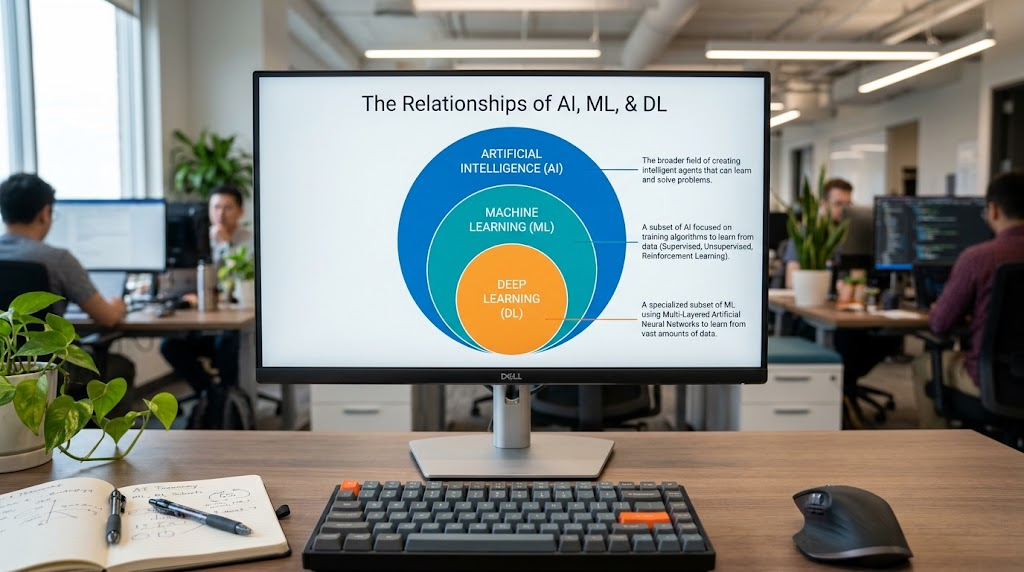
Understand the relationship between AI, ML, and DL.
A set of nested categories can be used to help understand the relationship among the three concepts. Think of three circles, the biggest being artificial intelligence, the next the smaller one machine learning, and the smallest one deep learning. This arrangement demonstrates that all deep learning models are a part of machine learning, and all machine learning models are part of AI. But AI also has techniques that aren’t machine learning based, such as rule-based reasoning, planning and some search algorithms.
Likewise, there are techniques for machine learning that don’t involve deep neural networks, like the decision tree, linear regression, and clustering. This is important to note since many practical systems employ simpler methods and do not qualify as deep learning. It would also set lofty expectations for what certain technology can achieve. The knowledge of the hierarchy gives a helpful starting point for analyzing technological debates and unpacking the technical processes underpinning the intelligent capabilities of digital products.
Practical Examples that highlight the differences
The differences between Artificial Intelligence, Machine Learning and Deep Learning are easier to understand with practical examples. Think about using some type of email filter. The simplest type of AI system could consist of a set of predefined rules that recognize certain words or phrases that appear to be suspicious. A machine learning version could learn from those emails that are already classified as spam, and recognize combinations of characteristics for spam. A deep learning version could leverage a neural network to detect intricate patterns in the text, structure, and other provided data of messages.
All three systems solve a similar problem, albeit in different ways. For example, a retail recommendation system. An AI application based on rules could suggest a product that is in the same category as the customer’s previous purchase. A purchasing history and customer behaviour can be used in a machine learning model to predict the products that are likely to be of interest to the customer. A deep learning system can interpret the more complex relationship between products, users, user interaction, text description, and so on. The selection depends on the existing data, the desired performance, the constraints, and complexity of the problem.
Example 1: AI in Healthcare
Let’s also take another example of a situation where these technologies can intersect: healthcare. An AI system, based on a set of rules, could look at the measurements taken by the patient and alert a healthcare worker if the patient’s recorded measurements are outside a certain range. Such a system is purely programmed, without it necessarily learning from previous cases. If the machine learning application is trained to model such an outcome and validated for this purpose, a historical patient database could inform a prediction of how likely a given outcome is to occur. A deep learning model could be used to detect patterns in medical images that could correspond to specific abnormalities and alert the medical professional to specific regions of interest for further examination.
These methods can be applied to healthcare activities, but they cannot be used interchangeably, and their effectiveness is dependent upon the quality of the evidence that is used to create them. For medical use, strict validation, proper privacy measures, and the supervision of qualified experts are necessary. The examples below showcase the use of simple rules systems as well as more sophisticated learning systems to demonstrate the breadth of what can be considered under the umbrella of AI. They provide insight into the value of comprehending the underlying technology when assessing claims of automated diagnosis, clinical decision support, and healthcare innovation.
Example 2: AI in Online Shopping
Many online retail sites use multiple AI tools to enhance their operations and user experience.Online retailers often incorporate a variety of AI technologies to deliver a more customised and improved customer experience while also boosting their business operations. When a customer looks at a specific accessory, a basic AI system could suggest the accessory based on a set of rules pre-programmed into the system by the retailer. By analysing the purchasing history, product ratings, browsing history and customer interaction, a machine learning model can predict which products are relevant for which users.
A deep learning model could learn more complex representations from product images and written descriptions, and from interactions, in order to be able to discover relationships between products that wouldn’t be obvious to the platform. These methods can also be used to aid in demand forecasting, inventory planning, customer service, and detection of suspicious transactions. But the most advanced approach does not always work best or cost the least. A simple recommendation system might be better suited for a small online store with a small customer base, rather than a more complex deep learning model. Choosing an appropriate approach is a trade-off between the benefits of the approach, costs of implementation, expertise, data quality, and the effort required to keep the system functioning.

Socio-Economic and Society Value of AI, ML, and DL
AI can handle repetitive tasks, boost efficiency, aid in decision-making, and facilitate consistent information handling within organisations. It has a wide variety of techniques, giving the developer some flexibility as to how it can be implemented, either through a transparent rule-based system or through more adaptive data-driven techniques. Machine learning also gives the ability to recognize patterns from examples: This is useful for prediction, classification, forecasting and anomaly detection. However, machine learning models can also be programmed with biases in the data they are trained on, fail to perform as well in new situations, and make predictions that are wrong on new data. Deep learning can capture complex relationships in images, speech and language, which will minimize the amount of information that developers need to include manually.
The training of large neural networks can, however, require significant computing resources, expertise and large quantities of appropriate data. Additionally, some deep learning models are hard to interpret, which poses an issue in accounting for the individual prediction. In each of the three, there are key factors of testing, monitoring, security, appropriate human oversight, and consideration for privacy and fairness that must be addressed and maintained in the process of implementing the system responsibly. The right technology, therefore, isn’t the one with the greatest reputation, but rather is the technology that is reliable and proportionate to the needs of the problem.
How to Choose Between AI, Machine Learning, and Deep Learning
Choosing between AI, machine learning, and deep learning begins with defining the problem clearly. If a task can be handled reliably through straightforward rules, a rule-based AI system may be sufficient and easier to maintain. For example, a business that needs to route customer enquiries according to selected categories may not require a model trained on thousands of examples. Machine learning becomes more useful when the task involves patterns that are difficult to describe manually, such as predicting customer demand, identifying unusual transactions, or estimating future equipment failures.
Deep learning may be appropriate when the problem involves complex information, such as images, audio, video, or language, and the available data and computing resources justify its use. Developers should also consider accuracy requirements, interpretability, implementation costs, data availability, privacy obligations, and the consequences of incorrect results. In high-stakes environments, transparent and easily audited methods may be preferable when they provide sufficient performance. Evaluating these factors before selecting a technology helps organisations avoid unnecessary complexity and build systems that are practical, reliable, and suited to their intended purpose.
The Future of Artificial Intelligence, Machine Learning, and Deep Learning
Artificial intelligence, machine learning, and deep learning will continue to influence how people work, communicate, learn, and interact with digital services. Advances in generative AI, language models, robotics, computer vision, and automated decision support are expanding the range of tasks that computer systems can assist with. Deep learning has contributed significantly to recent progress in language and image generation, while other machine learning methods remain useful for forecasting, structured-data analysis, and business optimisation. Traditional AI techniques also continue to play important roles in planning, scheduling, logical reasoning, and systems that require clearly defined rules.
Increasingly, practical applications combine several approaches instead of relying on a single technique. For example, an intelligent business platform might use a language model to interpret customer enquiries, a rule-based system to enforce business policies, and a machine learning model to estimate demand. As these technologies develop, organisations will need to pay close attention to reliability, security, privacy, fairness, and human accountability. Understanding the differences between AI, ML, and DL will remain valuable as new tools emerge and existing applications become more sophisticated.
Conclusion
Artificial intelligence, machine learning, and deep learning are closely related technologies, but each term describes a different level of scope and a distinct set of methods. Artificial intelligence is the broad field concerned with creating systems that perform tasks associated with intelligence. Machine learning is a branch of AI that enables systems to learn patterns from data and use those patterns to make predictions or decisions. Deep learning is a specialised branch of machine learning that uses multilayer neural networks to learn complex representations, particularly from information such as images, audio, and language.
Their relationship is best understood as a hierarchy: deep learning belongs to machine learning, and machine learning belongs to AI, but AI also includes methods that do not rely on learning from data. Understanding this distinction helps readers evaluate technology claims, recognise how digital products operate, and make better decisions about which approaches suit particular problems. As AI-powered applications become more common across industries, knowing how these concepts differ will provide a stronger foundation for understanding technological developments and their practical implications.