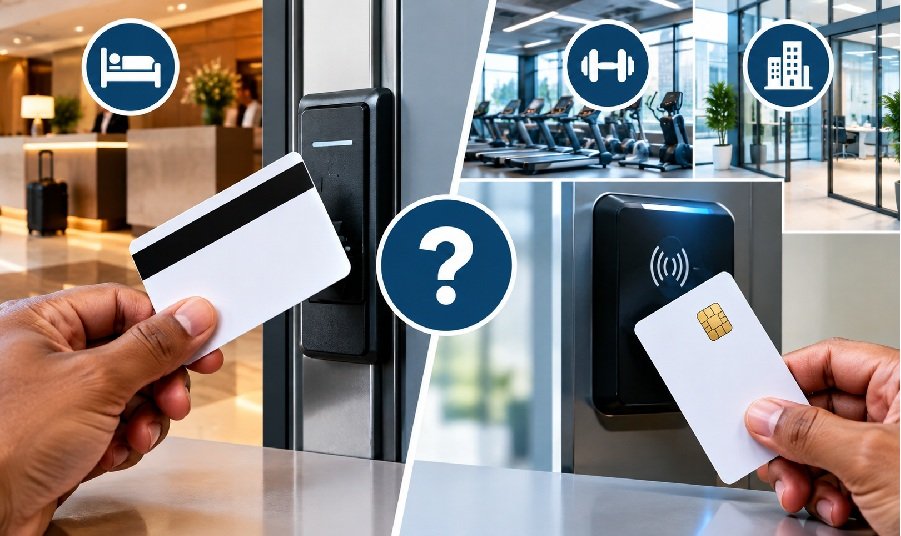
Hotels, gyms, coworking spaces and offices all need a card that opens a door, identifies a member or carries a balance. The choice usually comes down to two technologies: the magnetic stripe, which has been around for decades, and the contactless smart card, which is now standard in most new installations. Each has a place, and the right answer depends on the readers you already have and on what the card needs to do.
How a magnetic stripe card works
A magnetic stripe stores a small amount of data, typically an identifier or a room number, on up to three tracks defined by the ISO/IEC 7811 standard. The card is swiped or inserted into a reader that reads the tracks and passes the data to the lock or software.
There are two coercivity levels. LoCo (low coercivity, around 300 oersted, usually brown) is easy to encode and re-encode, which is why hotels use it for key cards rewritten at every check-in. HiCo (high coercivity, 2,750 oersted or more, usually black) is far more resistant to accidental erasure by phones, magnets or bag clasps, and suits membership, loyalty and staff cards that must keep the same data for years.
Strengths: low card cost, readers that are already installed in many buildings, and simple encoding. Weaknesses: the stripe wears with repeated swiping, data can be copied with basic equipment, and the card must physically touch the reader.
How a contactless smart card works
A smart card contains a chip and an antenna embedded in the plastic. When the card comes within a few centimetres of a reader, the reader’s field powers the chip and the two exchange data. The most common families are 125 kHz proximity chips (EM4100 and similar), which only transmit an identifier, and 13.56 MHz chips such as MIFARE Classic, MIFARE DESFire or NTAG, which can store data in protected sectors and support encryption.
Strengths: no wear on the reader or the card, faster entry, much better resistance to copying with modern chips such as DESFire, and the ability to hold several applications on one card (door access, cashless vending, printing). Weaknesses: higher card cost, and the chip must match the readers exactly.
Which one fits your situation
Hotels with existing swipe locks can keep using LoCo key cards, which cost little enough to be treated as consumables. Properties renovating their doors increasingly move to 13.56 MHz contactless locks, which guests find faster and which are harder to clone.
Gyms and leisure clubs often combine both: a contactless chip for the turnstile and a barcode or stripe for the front-desk software. A single printed card can carry both technologies.
Offices and coworking spaces should favour secure contactless chips for door access. A proximity card that only transmits a fixed identifier is simple to copy, while a DESFire-type card protects the data with cryptography.
Membership and loyalty schemes that run on an existing point-of-sale system often only need HiCo magnetic stripe cards or a printed barcode, which keep costs down while still identifying each member.
Questions to ask before ordering
- Which readers are installed, and what technology and frequency do they read?
- Does the card need to be encoded before delivery, and who provides the encoding specification (track layout, numbering, chip configuration)?
- Will the card be rewritten often (LoCo) or keep its data for years (HiCo or chip)?
- Does the card also need a photo, a name or a barcode printed on it?
- What is the expected life of the card, and how will lost cards be replaced?
The card supplier should always work from the specification provided by your access control or software vendor. Ask for a test batch to be checked on your own readers before the full order is produced.
The bottom line
Magnetic stripe cards remain a practical, low-cost choice where swipe readers are already in place or where cards are short-lived. Contactless smart cards are the better long-term investment for access control, thanks to their durability, speed and security. Many organisations end up using both on the same card during a transition, which is a perfectly sensible way to move from one technology to the other without replacing every reader at once.
