
Introduction
A common way of presenting algorithms to new computer programmers is as a set of instructions for solving a problem step by step. A programmer can learn to write a loop, arrange numbers, search through a list, or find the shortest route between two locations; but in each of these activities there is a set of mathematical ideas. Much of the theory that enables algorithms to be designed, understood, analyzed, and improved comes from the field of discrete mathematics. As opposed to continuous mathematics which typically involves quantities that may change continuously, discrete mathematics is concerned with objects that are distinct and countable, like numbers, sets, logical statements, relationships, graphs, trees, and sequences. In computer science, these structures look natural because the computer acts on singular pieces of information and acts in strict accordance to rules.
Programmers can then extend beyond getting their programs to run, and understanding discrete mathematics will help them to do so. It gives them insight into reasoning about correctness of algorithms, time and space efficiency, contexts they are able to apply them to, and whether there is a better solution. Logical thinking, sets, relations, graphs, trees, recursion, combinatorics, sequences, and mathematical proofs are not separate classroom subjects, but will be used to support key programming techniques and to provide insights into the behavior of algorithms.
The Mathematical Foundation of Algorithms
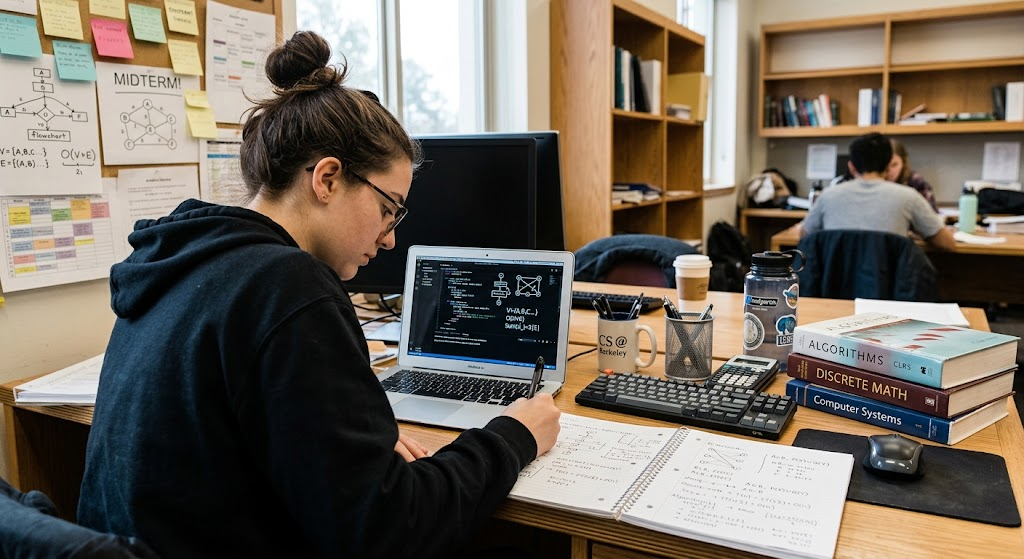
An algorithm can be thought of as a series of steps that is finite and exact, and is used to transform inputs into outputs. For instance, if we want to find the largest value in a list, we need to consider the values in the list, compare one to the other, track the maximum value we have seen so far in the list and finally return the proper value. This may sound like regular programming, but each step involves using mathematics. The programmer has to specify how the input is supposed to be filled in, how they are going to compare the two numbers and the reason the procedure will always return the correct result.
These conditions can be accurately described in the language of discrete mathematics. It also enables the programmer to know the possible conditions of a problem instead of just through individual examples. A program can be correct for 5 or 10 inputs, but using mathematical reasoning, it can be determined if it is correct for all inputs which are correct. The difference between testing and proving is one of the most critical ways in which discrete mathematics is relevant to the design of algorithms.
Logic: Making Precise Decisions
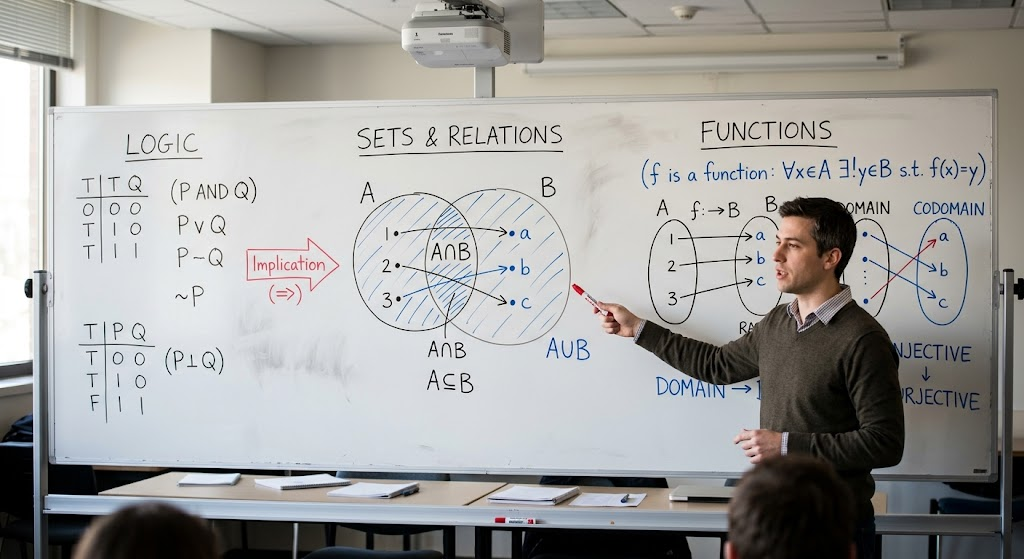
One of the most basic discrete structures in programming and algorithm development is logic. Mathematical logic is the study of statements that are capable of being true or false and operators for building combinations of statements. Examples of logical operations are AND, OR, NOT, and implication. These ideas are used directly in programming in conditional statements like if, else if, while. Logical conditions are used when an algorithm determines if a number is positive, if two numbers are the same, or if a user has permission to perform an operation.
When there are multiple interacting conditions in algorithms, logical thinking becomes crucial. It is important for the programmer to know how individual conditions act in combination. For instance, a search algorithm may be continued while a desired element has not yet been found AND there is at least one element remaining to be searched. It is important to know the meaning of these logical relationships to prevent programmers from writing incorrect conditions and to ensure that their algorithms’ decisions are predictable and mathematically correct.
Sets and its Use in Data Organization.
Another key mathematical concept needed for algorithms is sets, which are used to represent sets of distinct objects. The concepts of set theory can be used to explain many of the data structures and operations used in programming. A set can be a number, a name, a product, a location, or objects; operations like union, intersection and difference represent relationships between sets. Assume that there are two lists: one, students studying math; and the other, students studying computer science. The intersection of the two sets is those students who take both subjects, the union of the two sets is those students who take at least one of the two subjects.
The same type of operations are used in database queries, search systems, filtering algorithms, and programming languages. Set concepts are also useful for programmers when they are developing an algorithm and think about what inputs and outputs are possible. It may also be helpful when designing a solution to think of the set of input elements as being in a certain set and then make a note of what the algorithm does to that set. This mathematical view allows for more organized data structures and enables programmers to carefully consider relationships and uniqueness among sets of objects as well as membership.
Relations and Functions in Algorithm Design
Relations are connections among elements and functions are a special type of relation with exactly one output for each input. The concepts are very applicable to computer science. For instance, a relation can specify which users are related to other users in a social networking site, which cities have roads connecting them, or which courses are prerequisites to other courses. Functions are used in every algorithm, and a typical algorithm can be considered to be a function that takes an input and returns an output. The properties of relations, including reflexivity, symmetry and transitivity, can be helpful for the programmer to accurately model a real-world problem.
Finally, functions are also a convenient mechanism for thinking about deterministic algorithms, since the same input typically results in the same expected output if an algorithm is deterministic. While in databases a relation is used to help structure relationships between records, in graph algorithms, relationships between vertices and edges are the structure the algorithm needs to explore. These ideas demonstrate the way that mathematical definitions can be made useful in representing information.
Graphs: Modeling Connections & Networks
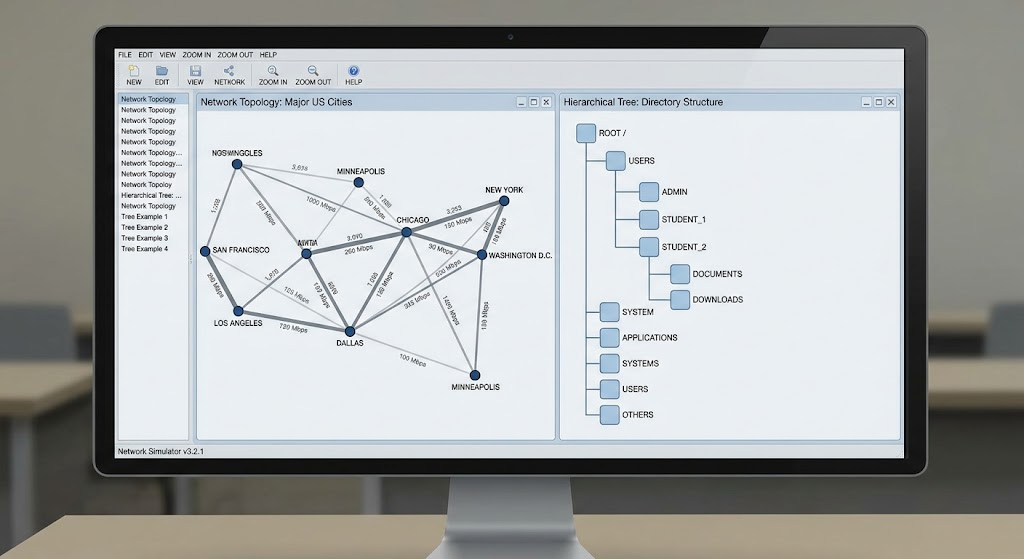
Discrete structures used in algorithm design include graphs, which are one of the most important. A graph is a collection of vertices (also known as nodes) that are linked together by edges. The vertices may be objects (e.g., cities, computers, people, web pages, or locations), and the edges may be relationships or connections between the objects. Many problems cannot be described with ordinary lists, but are easily modeled mathematically by graphs. For instance, a road network can be modeled as a graph having vertices as locations and lines as roads.
After formulating the problem in this manner, algorithms can be used for graph searching, path finding, graph connectivity, and optimization of routes. There are several algorithms for traversing graphs, including breadth-first and depth-first search. Shortest path and network optimization problems can be solved with more advanced algorithms. Graph theory is therefore related to real-world applications like navigation systems, communication networks, recommendation systems and social-network analysis.
Trees and Hierarchical Algorithms
A tree is a graph with a hierarchy in which there are no cycles. Trees are also very handy for visualizing information that has a natural hierarchy like folders and files, organizational structures, decision making processes, and family trees. There are important examples of binary trees and binary search trees in computer science. In a binary search tree, the smaller values are concentrated into one subtree and the larger values in the other so that if the tree is balanced, the operations of searching can be performed efficiently.
Sorting and searching algorithms are also strongly related to tree structures. A tree-based structure that allows efficient access to the largest or the smallest element in the structure, such as heap sort and priority queues, is a heap. The trees illustrate the effects of selecting a suitable mathematical structure on the performance of algorithms. An algorithm could be used to prune the amount of work needed by using the relationships that are represented by a tree, rather than looking at each individual item in an unorganized list.
Recursion, Mathematical Self-Similarity
Recursion is a method where a problem or function is broken down into smaller versions of the same problem or function. It is closely related to discrete mathematics as a large number of mathematical definitions involve recursive structures. The typical recursive algorithm has a base case, which terminates a recursive call, and a recursive case, which breaks down a problem into a smaller one. One simple example in maths is factorial calculation, where a factorial of positive integers can be expressed as the factorial of the previous integer. A recursive approach is particularly suitable for design when a problem can be broken down into smaller problems.
One example that is well known is merge sort, which repeatedly halves a list, sorts each half, and concatenates the sorted halves. Another typical application of recursion in tree traversal is because every branch of a tree can be considered as a smaller tree. The student gains an understanding of recursive programs by learning recursion and also how the process of recursive programs can be used to create an algorithm that implements a mathematical definition.
Sequences and Patterns in Algorithm Analysis
A sequence is a list of elements, where the elements are ordered, and is used to describe the behavior of an algorithm. The sequence can be the data stored in a data structure, the number of operations for various inputs, or the output obtained on multiple passes of an algorithm. Sequences are useful when examining an algorithm that varies in its complexity based on the input. As a specific example, if the size of an input is 5, the algorithm performs about 10 operations; if an input has a size of 10, the algorithm performs about 20 operations; and if an input has a size of 20, the algorithm performs 40 operations. This trend can be identified and used to describe mathematically how the algorithm grows.
Sequences can also be used in the following way: to describe the running time of recursive algorithms, which is another important use of sequences. Programmers can use an algorithm to analyze the computational requirements by translating it into a recurrence. This creates the opportunity for students to understand that counting instructions in one example is not the only way to study the algorithm; it is important that they find mathematical patterns that describe the algorithm’s behavior over many possible sizes of input.
Combinatorics and Counting Possible Solutions
Combinatorics is a subset of Discrete Mathematics that deals with the counting, ordering and choosing of objects. When there are numerous possible options in a problem, its relevance to algorithms becomes evident. Suppose there is an algorithm that has to look at a variety of different ways of arranging several objects. The number of different ways that a relatively small number of objects can be arranged can be very large. There are mathematical techniques to determine these possibilities; they are called permutations and combinations. This can be used in scheduling, route planning, password combinations, resource allocation and optimisation problems.
Combinatorial reasoning is also important for programming, in that it helps programmers grasp why some problems are hard to solve as the size of their input grows. Some algorithms will have to evaluate all possible cases, but the amount of cases can be too large for practical computation. This development will make programmers think of more clever ways, like using dynamic programming, greedy strategies, pruning, approximation, etc. and not considering all possibilities. Counting is thus important in grasping the potential solutions to a problem, as well as the cost of computing a solution.
Searches, Sorts, and Discrete Structures
Two very common uses of algorithms are searching and sorting, and both rely heavily on the discrete mathematics concepts. Simple linear search is a linear search that checks each element sequentially until it finds the element it is looking for or until all the elements have been checked. It can be analyzed using sequences and counting because the number of comparisons is dependent on the position of the target and size of the input. A different mathematical concept is used to solve a problem by repeatedly splitting an ordered set into smaller sets, as in binary search. It eliminates about half of the possibilities at each step, not by checking all the elements but by making comparisons. These differences are also seen in sorting algorithms.
The number of comparisons needed for simple sorting methods like selection sort and insertion sort can rapidly increase with the amount of data, whereas recursive division like merge sort can perform better. The examples illustrate the critical importance of mathematical structures. The structure of the data, the interactions between data elements and the partitioning of a problem can make the difference between an efficient algorithm and an unnecessarily expensive one.
Algorithms for Complexity and Efficiency.
Analyzing algorithms is one of the primary tasks in computer science, and a key objective is to determine how the size of the input affects the amount of calculation required. This is where the idea of algorithm complexity is of particular importance. The complexity of an algorithm takes into account resources like time and memory, as well as ways to describe the scaling of an algorithm. O(n) is a common expression for an upper-bound growth rate, such as O(1), O(log n), O(n), O(n log n) or O(n²). These expressions enable programmers to compare algorithms independently of the specific computer or programming language. For example, an O(n) algorithm will have a slower growth rate than an O(n²) algorithm for very large inputs.
Counting, functions, sequences, inequalities, and proofs are examples of methods in discrete mathematics that can be used in this analysis. When there are several algorithms available to solve the same problem, understanding complexity allows a programmer to make informed decisions as to which algorithm to use. The solution that works in 10 items might not be feasible for 10 million items, so mathematical analysis is crucial to predict the scalability.
Mathematical Proofs of Algorithms.
Writing an algorithm is only a part of the solution to a computational problem. Programmers should also be sure that the algorithm returns the right answer. Mathematical proofs are a systematic way to prove things correct. There are some proof techniques particularly helpful in computer science such as direct proof, proof by contradiction, proof by cases, and mathematical induction. Induction is especially useful for algorithms in that it can prove that a procedure is correct for every size of input. A typical induction argument starts by proving the algorithm works in a “base case”, and then proving that whenever it works for one particular step, it works for the next.
This is a similar argument to recursive algorithms. In addition to correctness proofs, invariants (pre- and post-conditions) can be used. For instance, an algorithm that sorts a portion of a list may keep a property that the part of the list that has been sorted is sorted after each iteration. Proofs then therefore convert confidence gained through testing into logical confidence.
Discrete Mathematics and Optimization.
Optimization problems require a programmer to determine the best solution, defined by some criterion, for example, minimum cost, shortest distance, maximum profit, or minimum number of resources. Optimization frequently requires choosing from a finite or countable number of options, which is why discrete mathematics is crucial. Transportation systems can be represented by graphs and the number of schedules (or arrangements) can be described by combinatorics. Logic may be used to specify the constraints that have to be met by a valid solution; relations may be used to model relationships between decisions. Shortest path, minimum spanning tree algorithms, and dynamic programming algorithms illustrate mathematical structures that can be turned into algorithms.
One of the reasons why algorithm complexity is emphasized in optimization is because a mathematically correct solution may not be feasible if too many possibilities must be considered. The challenge then turns to finding an answer that is not only valid, but efficient as well. When programming, discrete mathematics leads a programmer to see the structure of an optimization problem, and then choose an algorithmic strategy that corresponds to this structure.
Connecting to the Concepts
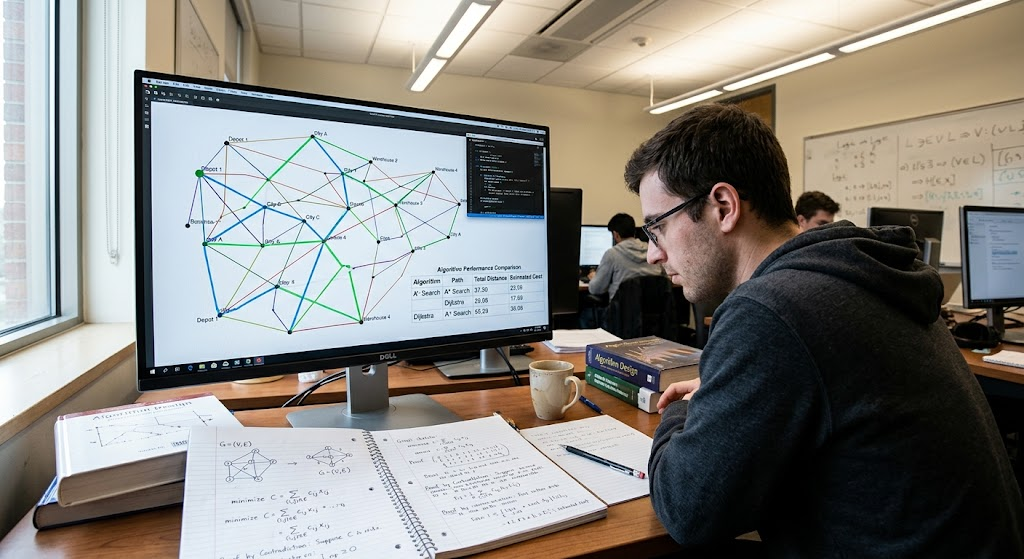
The various topics of discrete maths should not be taken as independent topics that programmers learn independently. They often collaborate in actual algorithm design. Imagine you have a navigation app that has to discover the shortest path between two points. The road network can be modeled as a graph, where the vertices are the locations, and the edges are the roads. Sets may be used to refer to sets of locations that are available, and relations may be used to indicate which locations are connected to each other. The conditions to determine whether a road is open or accessible are governed by logic. Sequences and counting may be used to analyse the number of places searched by the algorithm and in certain techniques for graph processing, using recursion may be used.
A mathematical proof can be used to show that the algorithm does indeed find a route given its assumptions; complexity analysis can show if the route is feasible for a large network. The main idea of discrete mathematics is illustrated in this example: discrete mathematics provides the tools for a programmer to represent a problem, reason about a solution, prove correctness, and assess efficiency.
Importance of Discrete Mathematics
Because of the use of symbols, definitions, proofs, sets, graphs, and formal reasoning, discrete mathematics might seem more abstract to the beginning programmer than programming. These ideas are, however, more easily understood when they are related to programming problems. Conditions and decisions are explained by logic, collections by sets, connections by relations, networks by graphs, hierarchical information by trees, repeated self-similar processes by recursion, possibilities by combinatorics, patterns by sequences, and correctness by proofs. All these ideas help to cultivate the precision of thought of a programmer.
Students are taught to ask questions about a program’s output rather than just whether it runs: Does it always return the right answer? If the input is very large, what is the result? Is there a more efficient solution to the same problem? What are the assumptions that are being made by the algorithm? How can you prove it is correct? The key questions of computer science are at the core of these, and the vocabulary and reasoning tools of discrete mathematics are required to answer these questions.
Conclusion
Discrete mathematics is one of the foundations upon which algorithm design and analysis are built. Algorithms are not merely collections of programming instructions; they are structured procedures supported by mathematical definitions, relationships, patterns, and proofs. Logic helps algorithms make precise decisions, sets provide a framework for organizing collections, relations describe connections, graphs model networks, and trees represent hierarchical structures. Recursion connects algorithms with self-referential mathematical definitions, while combinatorics helps programmers count possibilities and recognize when exhaustive approaches may become impractical.
Sequences and recurrence relations reveal patterns in algorithm behavior, while mathematical proofs provide ways to establish correctness rather than relying solely on testing. Finally, complexity analysis helps programmers understand how an algorithm’s resource requirements grow with input size. By learning these discrete structures, students gain more than mathematical knowledge: they develop a systematic way of thinking about computational problems. This mathematical perspective allows programmers to design algorithms that are not only functional but also correct, efficient, scalable, and easier to reason about.