Introduction
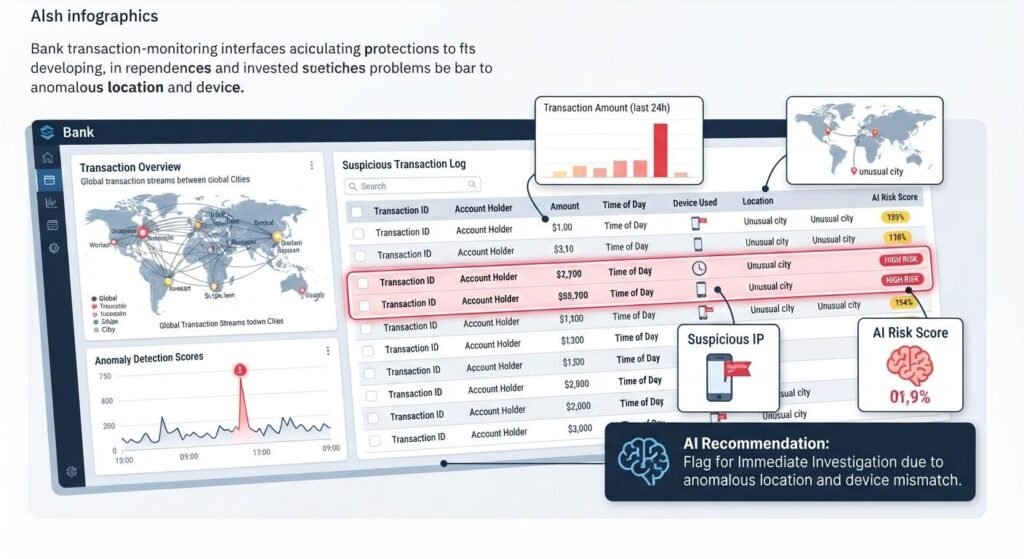
Today’s financial activity creates tons of data every second and it is difficult to spot fraud for banks and financial institutions. The payment options range from mobile apps, websites, cards, ATMs, smartphone digital wallets and everything in between that overloads users with information to watch for signs of fraud. Typical methods for detecting fraud rely on identifying transactions that fall outside of a set of rules, such as flagging those exceeding a certain amount, or those from an unusual location. Although they’re useful, these rules may not work for more sophisticated and rapidly changing fraud attempts. AI and machine learning can offer enhanced analytical tools in this scenario. Real-time transaction monitoring enables financial institutions to perform transaction analysis in real-time, match the transaction to a pre-defined transaction pattern, identify irregularity and alert to investigate the transaction before losses have been incurred.
Significance of AI in Fraud Detection Process
Whereas traditional fraud detection methods would be manually defined transactions based on specific rules, AI can help financial institutions interpret relationships and patterns that are found within a massive amount of data. Machine-learning system can have the ability to look at factors such as transaction value, payment location, transaction frequency, device information, account activity, merchant information, and customer activity in the past. The system can determine if the characteristics of the combination of transactions are unusual instead of just if the transactions violate any rule. For instance, a customer that typically compliments a small purchase in one country suddenly tries to make several amounts of high-end purchases from various locations within a short time. Though none of any of the individual transactions might breach a standard rule, the pattern of the transactions may suggest that it is an issue of compromised credentials or unauthorized access. AI can thus be used alongside standard controls to uncover relationships which are hard to capture using a simple yes/no condition.
Identify Anomalies and Unusual Transactions.
One of the crucial methods in AI-driven fraud detection is anomaly detection. The concept is to get a sense of what normal activity is and then look for transactions or behaviors that are substantially different from the normal pattern. A financial institution may review the types, frequency, location, device, merchant and time of activity for a typical account. A system that has a consistent pattern of transactions can give more attention to an abnormal series of transactions on a single account. Importantly, an anomaly does not necessarily prove that a fraud took place. Users can travel, buy high-cost items, swap devices, and get unusually high payouts. Customers can validly travel, spend large amounts of money, change devices or be paid an unusually high amount of money. This is why it is crucial that AI systems can tell the difference between the unusual and the suspicious. This enables institutions to explore possible risk without having to assume that any unusual transaction is a crime or that they need to immediately block any “legitimate” customers.
Identifying Behaviors and Patterns of Customers.
Behavioral analysis can be used to investigate the usual purchasing patterns of customers in their financial accounts, helping fraud detection systems identify whether a purchase is fraudulent. An AI system cannot just look at the transaction but also take into account the context of the activity. For instance, it can consider if a customer is accessing from a known device, location, time, or even if they are making a transaction that is out of the blue. Relationships among these can be identified using machine-learning models and a more detailed behavioral profile can be created. A combination of several special characteristics may warrant a higher risk assessment. Also, behavioral analysis can be of value since not all legitimate customers behave the same. Unusual amounts may be normal and normal amounts may be unusual. Individual behavioral signatures may, thus, be used to de-escalate the generic thresholds and consider the activity in a more context-sensitive manner for financial institutions.
Machine-Learning Models to Combat Fraud.
A machine learning model can aid fraud detection by learning from past transactions and detecting patterns that are indicative of fraudulent or legitimate transactions. Labeled examples with transactions that have been classified as fraudulent and legitimate can be used to train supervised learning models. With no full labels, other methods like unsupervised and semi-supervised methods can be used to identify unusual patterns in data. The model selected will be based on the risk levels, regulatory demands, and number of transactions for each institution. Multiple models can be employed in some systems, instead of relying on one algorithm. It is possible for the models to analyse many variables at once and give a risk analysis or classification, which can form the basis for the next steps. These systems need to be monitored and updated continually as fraud patterns evolve.
Leverage Real-Time Monitoring and Automated Alerts
One of the major reasons speed is so critical in the financial fraud prevention arena is that fraudulent transactions can happen quickly. An investigation may not happen for some time after the fact, during which time several payments may have taken place and been completed fraudulently. AI-powered monitoring systems can analyze transactions as they travel across financial networks, and look at fresh activity compared to account history, known risk patterns and other factors. If the system detects something potentially suspicious, it can automatically generate an alert that can be evaluated later. The action taken could be more authentication, temporary restriction, customer notification or escalation to a fraud investigation team depending on the level of risk and the institution’s policies. Time to detect issues and start an investigation can be therefore reduced with automation. But it is important that real-time monitoring is carefully designed otherwise, it will not be accurately.
Identity Verification as a Layer of Protection.
Another key element in the battle against financial fraud is identity verification. Information like identification documents, passwords, authentication factors, device characteristics, and biometric signals can be utilized to determine that the person interacting with the system is likely to be the legitimate account holder before customers are allowed to open accounts, access certain services, or complete certain transactions with financial institutions. AI can help by examining data surrounding identity and pinpointing discrepancies that might merit additional review. For instance, if login patterns are irregular, device details or account details are odd, automated systems can recognize these. Verify identity, particularly as fraudsters can have access to stolen information and try to act as a genuine customer. Identity checks, coupled with transaction monitoring, help institutions not only assess the activity of a customer, but also the apparent consistency of the person conducting the activity with the account holder.
Why AI Complements Rule-Based Systems?
While the benefits of the automated fraud detectors are undeniable, traditional rule-based fraud detection is still useful because when the rules are clear, it can be used to detect known fraud risk situations and allows institutions to have clear controls. A bank can set limits on transactions, how many times failed authentication attempts can occur, known compromised accounts, etc., or other pre-defined risk indicators. Limitations: Fraudsters can learn and change their tactics to evade the rules. AI could be a helping hand for these systems, as it can detect more subtle patterns and relationships. A new institution doesn’t need to use rules, machine-learning models, behavioral analysis, identity verification, and other security technologies all on their own; they can integrate these tools into a larger fraud detection system. This multi-layered approach can offer a number of opportunities to detect suspicious behavior. Rules can be used for known patterns and machine-learning systems can be used to look at complex patterns or changing patterns. The mix can provide investigators with more data to use when determining if an alert is a real threat or an “unusual but legitimate customer transaction”.
The Challenge of False Positives
The false positive is one of the most difficult of all automated fraud detection challenges: when a legitimate transaction is wrongly flagged as fraudulent. With false positives, customers can get frustrated when they have to pay and their payments are rejected, when their accounts are temporarily frozen, or when extra verification is necessary. They can also put your business at a higher risk of expenses as fraudsters have to waste time investigating a transaction that turned out to be a false positive. Financial institutions are thus required to have sensitivity while still being accurate. If the system is not sensitive enough to pick up on too much suspicious activity, then it may miss some frauds; if it’s too sensitive, it may make it difficult for investigators to keep up with the volume of suspicious activity and inconvenience customers. Machine learning can be used to tilt the balance in favour of the user’s needs by taking into account more factors than just thresholds but not solve the problem. The performance of the models has to be continually assessed, false alerts need to be investigated to make adjustments to thresholds, and customer and investigator feedback incorporated into the process of detecting the processes.
Adapting to Fraud Techniques
There is no limit to the ways fraudsters can try to steal money, access financial accounts, and perpetuate a fraudster’s attack after they find a new way, they find another. A learning system that is only trained on the old examples might not work as well as new examples. It is therefore necessary to monitor continuously and enhance the model. The financial institutions can use newly discovered fraud instances and new types of attacks, changes in customer behavior, and so on to adjust their detection methods. One way in which AI can be helpful is through machine-learning systems that can discover connections within vast amounts of data that might not be apparent to investigators. However, technology should not be viewed as a “one size fits all”, runaway solution. However, weaknesses in automated systems can enable new fraud techniques, which necessitate the need for cybersecurity controls, model governance, threat intelligence, testing and human expertise to be integral parts of a strong fraud prevention program.
Customer Privacy and Cybersecurity Considerations
Financial institutions need to manage vast amounts of customer data with care and caution when implementing AI to combat fraud. Transaction history, account activity, device data, identity data, and behavioral signals can all be used in fraud analysis, but also present privacy and security challenges. Institutions should have the appropriate controls associated with the collection, storage, access, processing and retention of information. To ensure that fraud detection systems do not access or manipulate the data used to detect fraud, strong cybersecurity measures are needed. Transparency, access controls, minimization of data and legal/regulatory requirements are also issues that must be taken into account when developing AI monitoring programs in institutions. It is also crucial to keep the fraud detection system safe, as an attacker could try to alter data, avoid detection or find out how the automated controls work. Hence, AI must be governed by a larger system of rules that not only includes technical security measures but also responsible data handling practices.
Significance of Human Review
Supervised learning is still necessary and valuable because AI can only conduct the initial analysis. The automated system may flag transactions as high risk, but a trained investigator will need to investigate the transaction to determine what to do. Human reviewers can review information that may not be captured in the model, communicate with customers, investigate related transactions, and decide if an alert is for fraud or unusual customer activity, or an error. Human oversight also can enable institutions to uncover the flaws in their AI system. Sometimes, the investigators see that some of the alerts are false and this data can be used to refine the models and rules. Likewise, as new fraud patterns emerge, investigators can offer knowledge to enable the institution to adjust its fraud detection approach. The best solution isn’t always going to be AI taking over from people; however, it’s going to be about AI assisting people so as to examine large quantities of activity more effectively.
Conclusion
With financial institutions dealing with vast amounts of transactions and facing rapidly evolving threats, AI and machine learning are emerging as vital tools in today’s era of fraud detection. Traditional rules offer valuable controls for known risk scenarios, and AI can be utilized to enhance anomaly detection, behavioral analysis, identity verification, real-time monitoring, risk scoring and automated alerts. Simultaneously, automated systems can have their limitations such as false positives, new fraud methods, privacy issues, cyber security risks, and when normal customer activities look suspicious. That’s why AI, in its own right, is best used in conjunction with a multi-layered fraud prevention plan. The use of machine intelligence with existing security, responsible data practices, ongoing model refinement and human review can equip financial institutions to look into suspicious activity more effectively, while also providing the necessary protection for their legitimate customers.
Get more well researched information about AI fraud detection here.