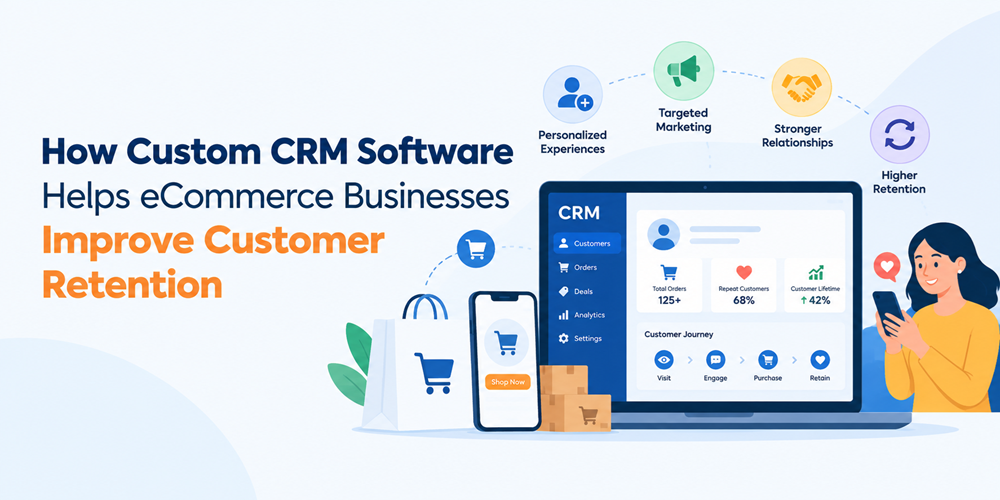
Getting a new client is costly because of the huge amount of money spent on ads, yet the key to success in eCommerce lies in recurring orders. Once a customer makes another purchase, their CLV gets higher, while the cost of customer acquisition stays stable and margins increase.
Standard Customer Relationship Management (CRM) systems deal with email lists quite easily, yet larger companies need something more tailored to their needs. Out-of-the-box solutions impose standard workflows, which lead to the separation of data between storefront, warehouse, and customer service.
Development of a custom system with help from a CRM software development company is what can solve all the problems mentioned. Having control over customers’ data will allow automating the process of engaging with clients by means of high-ROI methods.
The Core Retention Problem with Off-the-Shelf CRMs
Out-of-the-box CRMs are fast to set up, but generic functionality may often cause operational problems due to increasing complexity and number of orders:
- Fragmented Customer Data: Purchase history remains in the eCommerce system, tickets remain in the support system, and the click history is in analytics systems.
- Rigid Automation: Off-the-shelf workflow tools have limited triggers to standard events (such as “item purchased” or “form filled”), which makes it impossible to reach more sophisticated behavioral patterns.
- Escalating SaaS Costs: Most SaaS products charge depending on the number of contacts or records per month, making maintenance of a big database financially expensive.
- Limited Integration Depth: Plugins from third parties break during updates, which causes problems in syncing the data and missing communication opportunities.
Custom CRM serves as a central brain of all technologies, collecting every user action in one coherent profile.
5 Ways Custom CRM Software Elevates Retention
1. Unified 360-Degree Customer Views
Generic platforms separate user information into different channels. Custom CRM collects all touchpoints in one timeline:
If a support agent works with a customer, they will be able to check their previous orders, order status, AOV, and customer satisfaction right away. It helps to save time on repetitive questions like “What was your order number?” and provides quick solutions, thus building customers’ trust.
2. Precise Behavioral Segmentation
Standard segmentation divides customers by location or registration date. Custom CRMs allow segmenting by using event data to divide them based on their purchasing patterns:
- RFM Analysis: Score users automatically by their Recency, Frequency, and Monetary Value.
- Replenishment Cycles: Determine the actual frequency of using a consumable (e.g., supplements, skin care, specialty coffee) and schedule replenishments ahead of time.
- VIP Tiers: Identify top customers automatically to assign priority routing and VIP privileges to them.
3. Hyper-Personalized Post-Purchase Automation
Standard post-purchase campaigns send a generic thank-you email and discount coupon code. With custom CRMs, follow-ups are done in a more contextually aware manner, based on catalog relationships:
Purchase ──> CRM purchase history check ──> Selection of dynamic complementary items ──> Personalized recommendation
When a user buys an advanced camera lens, a custom CRM does not send them any promotions for unrelated items such as phone accessories. It rather waits until a purchase is delivered, analyzes the user’s past equipment, and recommends suitable filters or camera bags.
4. Predictive Churn Prevention
It is always much cheaper to retain customers than get them back. Custom CRM platforms predict disengagement by analyzing user behavior:
| Churn Risk Indicator | Automated CRM Countermeasure |
| Browsing drops off (user hasn’t opened emails or visited in 45 days). | Trigger a personalized “We miss you” offer featuring items saved to their wishlist. |
| Support Friction (Customer leaves low post-interaction rating) | Escalate the ticket to a supervisor and issue store credit automatically. |
| Subscription Delay (User delays a recurring order box) | Send an automated SMS allowing the user to swap products rather than cancel. |
5. Native Loyalty and Rewards Integration
Generic loyalty modules operate under the standard points system, which may not reflect the economic logic of your business. Custom CRM development will help to create a personalized loyalty program directly integrated into customer profiles:
- Behavior-Based Rewards: Award points for completing actions other than spending money, such as writing product reviews or sharing them on social media or not returning any purchases for months.
- Tiered Privileges: Grant free express shipping or access to exclusive pre-releases after reaching certain milestones in the CRM purchase history.
- Zero System Bloat: Manage everything natively without additional apps and slow scripts.
Standard CRM vs. Custom eCommerce CRM
| Feature / Metric | Off-the-Shelf CRM | Custom-Built CRM |
| Data Ownership | Stored on third-party servers; limited export control | 100% proprietary database ownership |
| Workflows | Limited to pre-built linear logic | Unlimited; customized to exact store operations |
| System Performance | Script bloat can slow site speed. | Optimized APIs engineered for speed |
| Pricing Model | Recurring monthly fees per user/contact | Upfront build cost with fixed maintenance |
| Scalability | Tiered feature paywalls | Unlimited scaling with business growth |
Maximize Customer Lifetime Value with Custom Software
Customer acquisition keeps an eCommerce store alive, but customer retention makes it thrive. Generic CRMs allow you to get a quick start, but custom software development provides all the tools for access to information and precise automation and optimization.
Collaboration with an experienced CRM software development company converts fragmented customer data into continuous profits through custom development based on specific business processes, allowing online stores to convert casual consumers into brand advocates for life.
Conclusion
Within the highly competitive environment of eCommerce, customer retention is not only a part of the game but also a prerequisite for scalable business growth. Although ready-made CRMs provide fast solutions to the problems at hand, they have fixed structures and siloed data that eventually lead to the growth ceiling of businesses.
Development of custom CRM software eliminates these barriers by uniting store information, providing precise behavioral segmentation, and automating proactive retention strategies. Thus, custom software converts customer interactions into brand loyalty. Collaboration with a competent CRM development agency helps you to align the technology directly with your business logic and convert occasional customers into brand advocates for life.