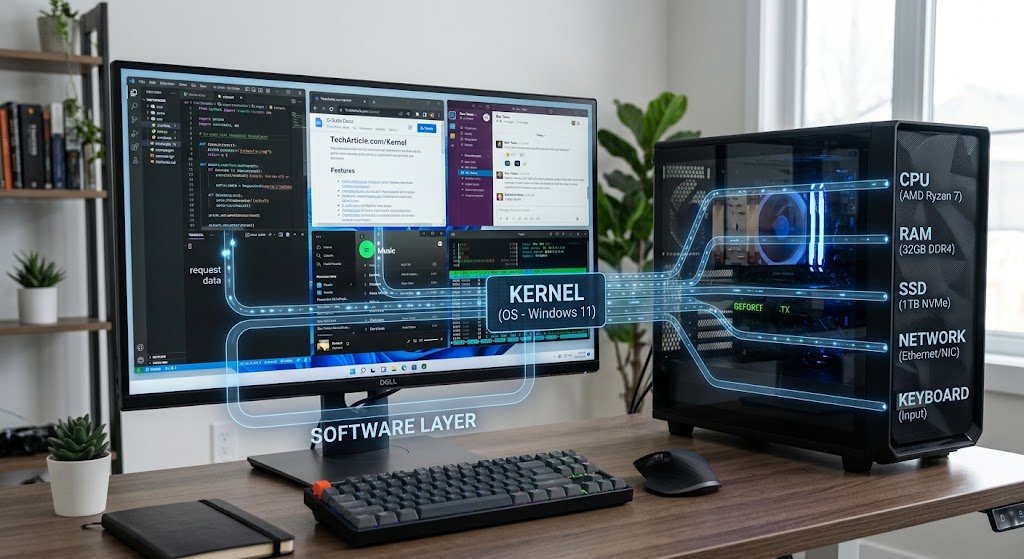
Start up when the computer is on, multiple layers of software run together and make the computer usable. Web browsers, word processors, games, and media players are among the many applications that can be used to perform tasks, but generally do not communicate with computer hardware. Rather, they rely on the core component of the operating system known as kernel. The kernel provides a bridge between the applications and the physical hardware resources, including the processor, memory, storage devices, keyboard, display, and network ports.
It determines the allocation of hardware resources, offers defined means of program services requests, and stops programs from interfering with each other. If an operating system didn’t have a kernel, it would not have any way of controlling hardware and software. It is therefore important that the reader of this book have a basic understanding of the operating system kernel for understanding how modern computers and other computing devices work.
What is Operating System Kernel?
The kernel is a part of the operating system that handles communication between the software and hardware. It runs with a high level of privilege, meaning that it can execute actions that a normal application cannot safely do. For instance, if an application must access data from a storage device, it doesn’t send electrical commands directly to the drive. Instead, it asks the operating system to do this, and the kernel manages the hardware access. This way, several applications can run simultaneously without using up the entire computer. The kernel coordinates resources, answers requests, deals with hardware events and acts as a crucial barrier between programs. Users do not normally directly manipulate the kernel, but almost all normal computing tasks rely on its services.
One way of thinking about the kernel is to visualize it as a traffic controller in the middle of a city with many cars. Applications are analogous to cars that need to be driven down different roads to different destinations, and hardware resources are like roads, bridges, traffic lights and parking lots. Without rules, every vehicle would be allowed to travel on every road, and it would soon become chaotic. Likewise, if applications were able to manipulate the processor, memory, storage and other devices without restriction, applications might interfere with each other or damage system data. The kernel sets up rules for the access to these resources. It decides which processes get processor time, which parts of memory they can access, how devices are accessed and how requests are passed between apps and devices. Many independent programs can run in concert, with a stable and predictable overall system.
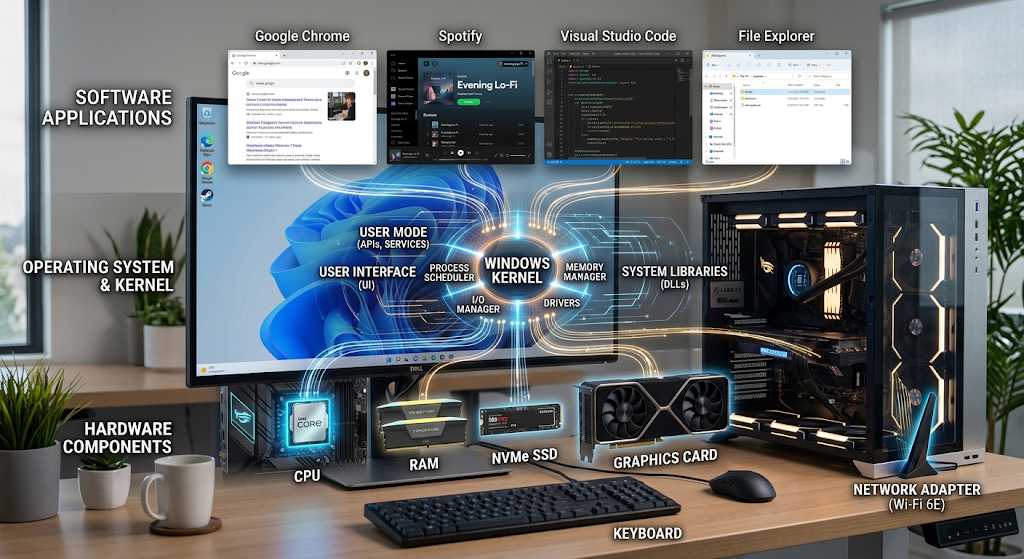
The Kernel between Applications and Hardware.
The interaction between applicational, operating system, kernel and hardware can be thought of as a layered structure. The highest level are applications that are interacted with by the user, such as browsers, games, development tools, and office programs. Underneath those applications are operating-system services and interfaces which offer common functionality. The central part of the operating system is the kernel which directly controls several hardware resources. The physical hardware consists of the CPU, RAM, storage drives, graphics hardware, network adapters and input devices on the lowest level. Typically, applications are not expected to know anything about the electrical and technical characteristics of each device because there is a uniform interface provided by the kernel. This abstraction of hardware is why operating systems can run thousands of applications without forcing each application developer to develop their own set of mechanisms to control hardware.
Let’s take a simple app that wants to save a document as an example. The application doesn’t have to be aware of the exact location in the physical space of each storage block, nor the electronic commands needed by any one specific SSD. It issues a request via an operating-system interface, and the kernel handles the request with the necessary file-system and device-management parts. The kernel can identify the process by which the request is made, check to see if the process can perform the operation, talk to the appropriate device driver, and control data transfers. The hardware then executes the requested operation and returns the result, which is ultimately accessible to the application. The process is typical of how the kernel is crucial to computing: it translates high-level software requests into controlled interactions with physical resources.
The Main Functions of the Kernel.
Process Management
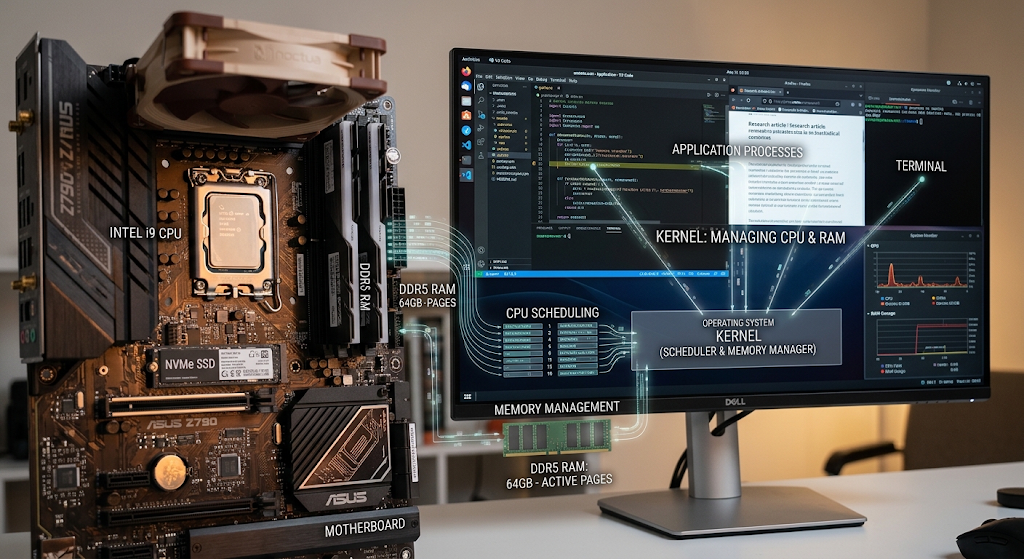
Process Management is one of the most important functions that the kernel is responsible for. A process is an active instance of a program; memory would have many processes competing for access to CPU resources in a modern computer. The kernel keeps track of these processes and allocates processor resources between these processes. If there are more than one program running, it is not possible to run every instruction of each program simultaneously on one CPU core. Rather, the scheduling mechanisms within the kernel decide which process gets to run and for how long. Can suspend one process, run another one, then resume the first process. The switching is fast enough that users can interact with multiple applications as if they were all open at the same time. Process management also involves developing and terminating processes, process coordination and dealing with the case when processes must wait for resources or for other processes to finish.
Process Management is especially significant for apps doing various kinds of work. A web browser could require processor time to process a webpage while waiting for information to be sent by the network, a music application may require periodic processing to keep the music playing, and a background service may perform maintenance activities that do not need to use the processor all the time. The kernel’s scheduler is used to coordinate these competing demands following the rules of the operating system. It also monitors the state of processes (running, ready, waiting for an event). In these ways the kernel ensures that an application doesn’t unnecessarily monopolize the processor. Process management is thus directly involved in responsiveness, multi-tasking, in using the resources efficiently, and in the general stability of the operating system.
Memory Management
Another responsibility of the kernel is managing memory. Programs must have memory to hold instructions, variables, temporary information and data during their execution. The kernel is responsible for managing allocation of physical memory and is designed to prevent any one process from accessing the protected memory of another process unless specific permission is granted by the kernel. This separation is necessary because there may be bugs in the applications and an unchecked memory access might allow a bad application to corrupt data belonging to another program or the operating system. Modern operating systems also employ other ideals like virtual memory, where every process runs in its own virtual address space. The kernel and hardware memory-management mechanisms cooperate to map virtual addresses into physical memory and to implement memory access permissions. This allows applications to run without the knowledge of each other in the same physical RAM space.
Virtual memory can also enable the OS to allocate memory to applications in a more flexible manner than allocating a fixed portion of physical memory to individual applications. Inactive memory pages can be swapped in and out of RAM and storage as needed, and so can be kept in faster physical memory if they’re used regularly. The kernel maintains information about the memory regions of processes and what rights have been assigned to them. It may set the memory to be read, written or executed as per the system requirements. These controls are meant to stop accidental interferences and offer a significant level of security. Effective memory management is therefore not only the provision of memory, but the management of memory throughout the computing system, such as its organisation, protection and efficient use of memory.
Using Device Control and Device Drivers.
There are numerous different types of computer hardware and the kernel is tasked with managing access to those hardware. These include storage drives, network adapters, USB devices, graphics chips, printers, audio devices, and mice and keyboards. Each manufacturer uses a different technology and a different manner of communication, so the kernel generally needs to have software interfaces for various hardware based on device drivers. The driver knows how to communicate with a specific device, whereas the rest of the operating system can communicate with it through more standard interfaces. This structure helps to minimize the knowledge of application specific hardware within the application. Applications may be calling to do something with a device, then it can go through the operating system, kernel, and into the right driver, which will interact with the physical device.
Interruption handling, and coordinating access when multiple programs want access to the same resource is also part of device management. Interrupts can be generated by hardware devices, for example to alert the processor that a data transfer is done or that network information has arrived. These events are handled by the kernel, and it decides what to do next. It may also cause queuing when a device is in use and coordinate access to ensure that several processes are not sending conflicting operations. If this were not handled in a centralized manner, applications would have to have a detailed knowledge of the behavior of each of the components/parts of hardware installed in a computer. Modern operating systems are more flexible and developer-friendly because they have a structured layer between software and hardware provided by the kernel and its drivers.
System Calls
System calls are the mechanism by which applications can request services from the kernel such as creating a socket, passing information to the kernel, and receiving information from the kernel. A system call is an interface that a program uses to request an operation from the operating system that needs the privileges of the kernel. They can involve opening or closing files, reading or writing data, allocating resources, communicating on networks, interacting with devices, etc.They can include opening or closing files, reading or writing data, allocating resources, communication via network, interacting with devices, etc. The system-call mechanism is how the kernel is notified of an application’s need for privileged hardware operations, its conditions are checked, the operations are carried out if conditions are met, and a result is returned. It is a boundary because most applications don’t have the same privileges as the kernel. The separation helps to keep the system organized and that any single application can not directly modify critical system resources.
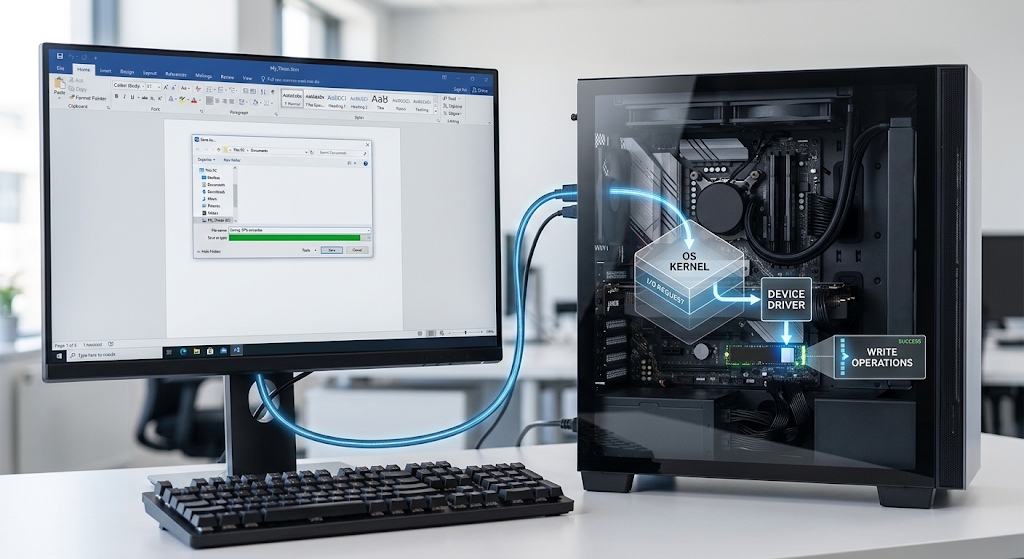
A system call can thus be thought of as a formal entry point between the user level software and kernel level services. If a program makes such a request, then the processor enters into a more privileged execution mode, allowing the kernel to perform the operation. Once the kernel has fulfilled the requested service or decided it can’t, control may be returned to the application. The details vary depending on operating system and processor architecture, but the principle is very important: Applications make requests for services and do not get unchecked access to protected resources. This design enables the OS to implement rules uniformly. It also provides developers a consistent programming interface to perform critical functions without having to know the implementation of each of the hardware components.
How the Kernel Maintains Security and Protection.
Security is related closely to the kernel due to the fact that the kernel is responsible for accessing a lot of the computer’s most vital resources. A modern operating system usually makes a distinction between applications running in regular user mode and kernel running in privileged mode. The applications generally run in a limited environment and the kernel has privileges to control memory, devices, processes, and other protected resources. The kernel can impose permissions and isolation controls to limit access a process can make. For instance, one application shouldn’t be able to read another application’s private memory just because both applications are installed in the same computer. Likewise, access to protected files, devices or resources of the system can be managed based on the operating system security rules.
The principle of least privilege is also supported by kernel-level Security: Software is given only the access it requires to do its job. If all applications ran with full system privileges, a programming error or security breach could have potentially far-reaching effects. The kernel can enforce separation between applications and privileged operating-system parts, thus reducing the impact many failures and unprivileged operations have. But kernel security doesn’t happen by itself and is far from flawless. These components are privileged and can have serious consequences if they contain vulnerabilities in their kernels, device drivers or another component. Operating-system developers routinely enhance security mechanisms, patch vulnerabilities, increase isolation and improve kernel parts to counter newly discovered threats.
Hardware Abstraction
Another important reason for the importance of the kernel is that of hardware abstraction. Application software can be used to run on different computer hardware by different manufacturers and different generations, but the software does not need to know the specific technical characteristics of the computer hardware it runs on. The kernel does offer some abstractions to conceal much of this complexity. An application can interact with file, process, virtual memory, network connection, input devices, etc. rather than with physical circuits and commands specific to the device. This enables software developers to write applications using operating-system interfaces instead of completely new versions of software for every conceivable configuration of hardware. These general operations are mapped to hardware-specific operations by drivers and by kernel subsystems.
When hardware abstraction takes place it does not render hardware differences irrelevant. How a system performs, features, drivers, processor architectures and device capabilities can still impact a system’s behavior. Rather, abstraction offers a common ground that software can communicate with various hardware. If you want to write data to a file, for instance, you can typically ask to write it there, regardless of the type of storage technology you’re using, such as a particular SSD or hard drive. The kernel and other parts of the operating system take care of the lower level details. This separation is one of the key features that make it possible to run a range of hardware architectures with the same application interfaces in today’s computing environments.
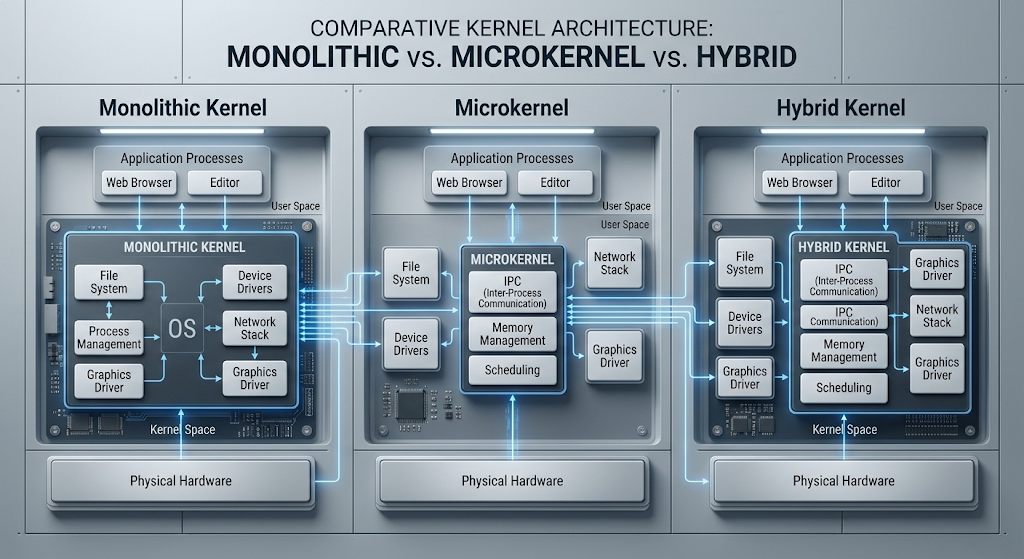
Types of Kernel Architectures
Monolithic Kernels
In a monolithic kernel, lots of operating system services are executing inside a single huge kernel within privileged mode. The different components responsible for process management, memory management, device drivers, file systems, networking, and other basic services can share the same kernel address space. The benefit of this is that the various components of the kernel can communicate effectively, since they are running in a tightly coupled environment.
It can be a good performer, too, because interactions between key components of the operating system don’t always need to switch between discrete services. The architecture may be complex, however, since several parts have high privileges. A serious issue with one privileged component such as a bad driver, can impact the entire system. Many traditional and modern operating systems employ designs that follow the monolithic approach, but may have other modular or layered features within the operating system.
Microkernels
Instead, a microkernel architecture attempts to make the basic kernel as small as possible. Only some services run inside the privilege kernel, others can be run as separate processes or servers. Other services can be split up into less-privileged components, while the microkernel focuses on basic tasks like inter-process communication, scheduling, and low-level memory management. This design can provide better isolation as failure of one service does not necessarily cause the failure of another service.
It may also facilitate the replacement and re-starting of some components by themselves. But when different components communicate with each other there can be added complexity and overhead. For decades, research in microkernel has had an impact on the design of operating systems, especially in operating-system designs where reliability, isolation, modularity, or security are key design concerns.
Hybrid Kernels
The hybrid kernel is a blend of concepts from the monolithic and microkernel design. The aim is usually to maintain the performance, integration and advantages of running key services in a privileged place and at the same time applying architectural concepts of modularity and separation. The term “hybrid” is used in different ways in various designs of operating systems and should not be considered a single standard architecture.
Many systems have various choices as to which services to keep inside the kernel and which to split out into other components. The point is, kernel architecture is a series of design decisions made about the performance, isolation, maintainability, reliability, and communication between the components of an operating system. The study of monolithic designs, microkernel designs, and hybrid designs will help to develop an understanding of why operating systems can be very different from one another, yet offer similar elementary services to applications.
The Role in Modern Operating Systems
The kernel is the heart of a modern operating system since it manages all of the other software components that use the resources. Applications require the use of processors in order to carry out instructions, memory for representing information, storage systems for storing data, devices to interact with the external world, and security systems for protecting resources. The kernel supplies or manages the mechanisms which support these activities. It also establishes application boundaries, handles privileged operations, reacts to hardware events and offers system call interfaces. Whether it’s opening a document, connecting to a network, launching an application or playing a video, countless common activities eventually rely on resources managed by the kernel. The kernel may be seen by the user only rarely, but still works in the background for the lifetime of a computing session.
Knowing the kernel also helps to understand why operating systems are more than graphical interfaces or bags of applications. The desktop, menus, icons, apps to configure the settings and other elements that are seen in the viewer are just a smaller piece of a much larger software system. Under these “clickable” elements, the kernel is constantly controlling processor execution, memory use, devices, system calls, security limits and hardware communication. The tasks it has to perform must be carefully coordinated, as the computer has to run a number of programs at once and safeguard essential resources. While the underlying intent is the same, that is, to create a controlled environment where software can safely and effectively use the hardware, the kernel architectures, scheduling policies, security models, and device-managing techniques may vary from one operating system to another.
Conclusion
The kernel is the central part of an operating system that links the software environment with the hardware of the computer. It is responsible for processes, memory management, hardware coordination, system calls, security boundaries, and abstraction of a lot of the complexity of the computer hardware from applications. It may have a monolithic structure, a microkernel structure, or a hybrid structure, which are different structures for organizing the operating-system functionality.
Nevertheless, the kernel is necessary since applications can’t manage all of the computer resources without the aid of the kernel. The kernel manages the sharing of the processor, memory, storage, devices and other resources, enabling multiple programs to run at the same time without losing organization or protection. Understanding the kernel gives a better understanding of what happens under the hood of an operating system and why this component, which exists in the background, is essential for state-of-the-art computing.