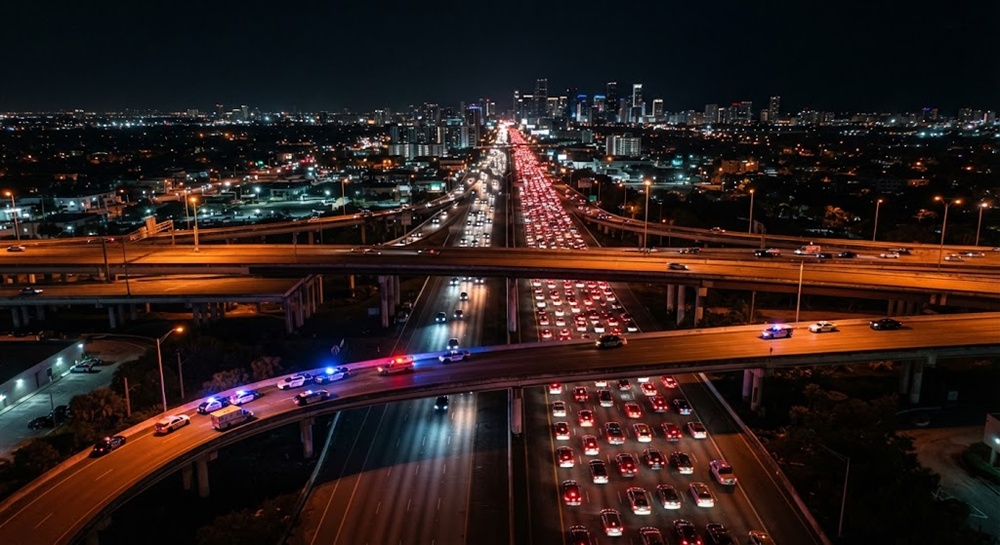
Florida drivers who dread the morning commute may be worrying about the wrong part of the day. A new study from Blakeley Car Accident & Personal Injury Lawyers, based on 2024 Florida Highway Safety and Motor Vehicles (FLHSMV) data, finds that the state’s roads are most deadly after dark, heading into the weekend. The six hours between 6 p.m. and midnight make up just a quarter of the day, yet they accounted for 36.4% of all Florida traffic deaths in 2024, a total of 1,143 lives. Statewide, Florida recorded 381,423 crashes last year, about 1,045 every day. Those crashes caused more than 235,000 injuries and 3,138 deaths, or one life lost roughly every two hours and 48 minutes.
The single deadliest hour of the day was 8 p.m. to 9 p.m. It covers just over 4% of the clock but accounted for 7.3% of annual traffic deaths (230 fatalities). That is three times the toll of the safest hour, 9 a.m. to 10 a.m., when 73 people died. The entire morning window from 8 a.m. to 11 a.m. recorded 243 deaths, only 13 more than that one evening hour. The 8 p.m. hour’s ratio of 1.08 deaths per fatal crash closely matches the statewide average of 1.07. That means the spike comes from more fatal crashes happening, not from a few unusually severe ones. The study points to reduced visibility, fatigue after work, impaired drivers, and heavy commuter, commercial, and nightlife traffic all converging in the evening.
The day of the week matters just as much. Saturday was the deadliest day in Florida, accounting for 17.4% of all traffic deaths (546). Friday followed at 15.8% (496) and Sunday at 15.2% (477). Together, those three days made up 48.4% of the year’s fatalities even though they are only three of the seven days in a week. Weekend days averaged just over 506 deaths each, compared with about 405 for the other four days, making weekends roughly 25% deadlier. Wednesday was the safest day, with 397 deaths, a 37.5% gap from Saturday.
When day and hour are combined, one time slot stands out above all others: Saturday from 11 p.m. to midnight, which recorded 48 deaths, more than any other hour of the week. Saturday’s danger builds steadily through the night, with 31 deaths between 9 p.m. and 10 p.m. and 44 between 10 p.m. and 11 p.m. Tuesday is a surprising weekday exception: its 8 p.m. to 9 p.m. hour also recorded 44 deaths, more than any other weekday evening hour.
The time of year adds a further layer of risk. March was Florida’s deadliest month, with 292 fatal crashes, nearly 42% more than July and September (206 each). March combines spring break tourism, which raises severe crash rates in tourist areas by around 12%, with Daytona Bike Week, which can bring up to 400,000 visitors to a city of about 73,000 residents. Almost 10% of the state’s yearly DUI-related crashes also happen that month. The five deadliest months (March, November, December, January, and February) accounted for 46.2% of all fatal crashes, driven by holiday travel, winter tourism, returning seasonal residents, and shorter days.
Driver behavior explains much of the evening spike. Alcohol impairment was the leading factor. Drivers at or above the .08 legal limit were involved in 24.5% of all traffic deaths (769), a share that rises to 29.2% when any detectable alcohol is counted. Most of these cases involved severe impairment, with 16.5% of all deaths (519) involving a driver at .15 BAC or higher. Alcohol related deaths peaked from 8 p.m. to 11 p.m. and again from midnight to 3 a.m. Speeding was involved in 11.5% of deaths (360) and peaked in the same 8 p.m. and 10 p.m. hours, which suggests the two behaviors often overlap. Distraction, involved in 7.7% of deaths (241), is the one factor tied to the commute. It peaked from 4 p.m. to 6 p.m., when phone use, navigation, and inattention on familiar routes are most common.
The study also identifies the people most at risk. Men accounted for 72.9% of deaths where gender was recorded, a ratio of about 2.7 to 1. Adults aged 25 to 64 made up 58.5% of all fatalities, reflecting the hours they spend on the road for work, errands, and commuting. Floridians aged 65 and older accounted for 21.3%, and drivers aged 16 to 24 for 15.6%.
“Most people think of rush hour as the most dangerous time to be on the road, but Florida’s data tells a very different story,” said a spokesperson for Blakeley Car Accident & Personal Injury Lawyers. “The real danger zone is weekend evenings, when darkness, busy roads, speeding, and impaired driving all come together. These deaths follow patterns we can see and predict, which means targeted enforcement and smarter choices behind the wheel can prevent them.”