Introduction
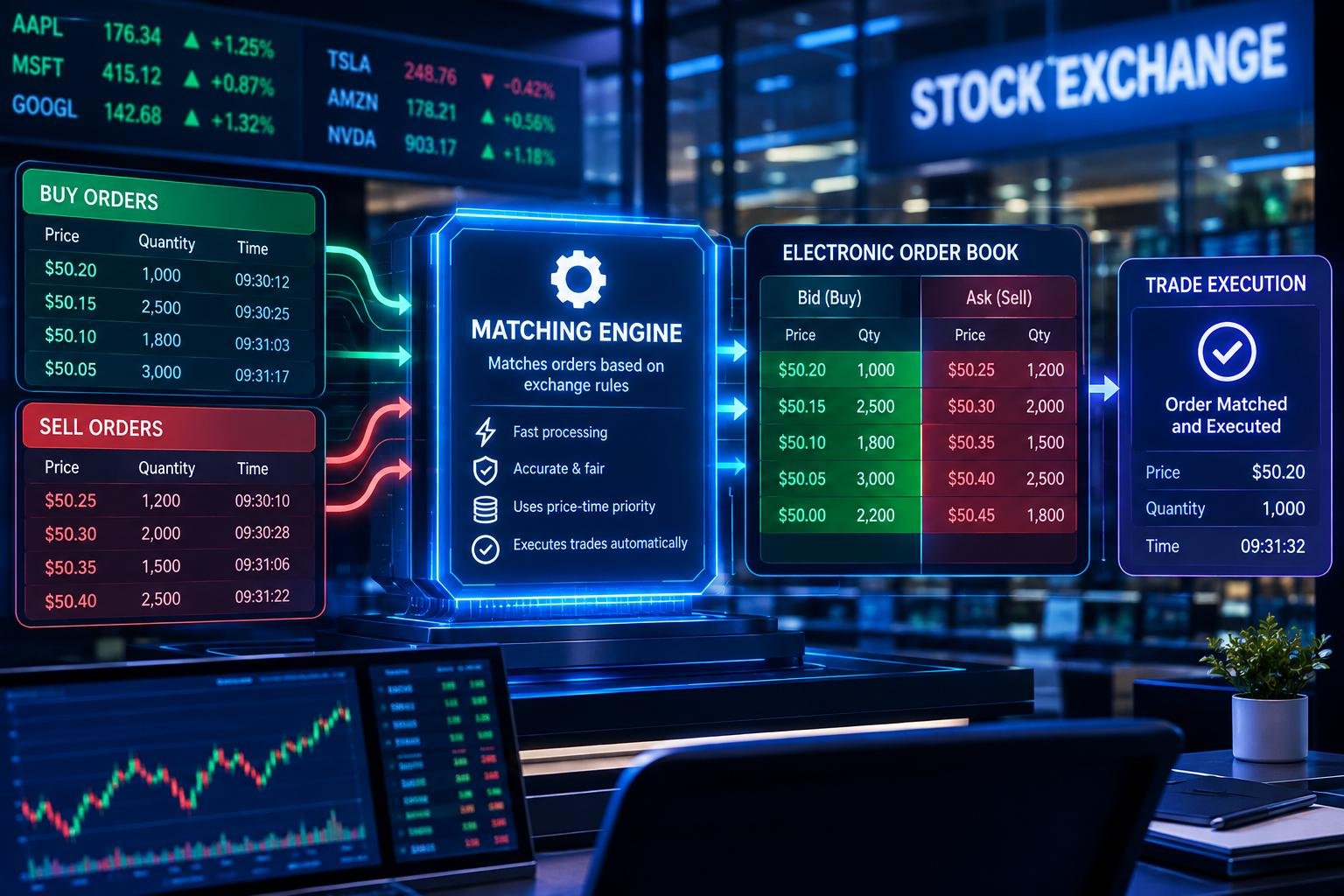
To efficiently handle thousands, even millions, of orders, it’s important that a modern stock exchange relies on the power of technology. The matching engine is an integral part of this e-process, which is used to find out which buy and sell orders can be matched. Investors might only see a button to buy or sell on the trading platform, but there’s a lengthy series of technological decisions that occur nearly instantaneously after an order is placed. Orders are submitted to the matching engine where they are entered into an electronic order book; the matching engine then scans through the order book for a suitable transaction. It is subject to explicit rules, such as price-time priority, which helps clarify the sequence of orders to consider when doing so.
What is Stock Exchange Matching Engine?
A stock exchange matching engine is a specific type of computer software program that will instantly match purchase and sell orders and identify the time when the orders can be matched. An important part of an electronic trading platform, as it brings the buying interest together with the selling interest. An investor does not just send an order directly to another investor when he or she puts in an order through a broker or a trading platform. Rather, it passes through a number of systems, and arrives at the exchange where the matching engine processes it based on the exchange’s rules. The engine should be able to read, process and keep the information accurate, and fair at the same time. This may include taking very large volumes of orders, cancellations, alterations and trades in a very short timeframe in very active markets.
The other crucial element of the matching engine is something known as an order book. The order book is an online listing of pending transactions to buy and sell a specific stock. Prices that a buyer is willing to pay are typically referred to as buy orders and prices that a seller is willing to sell are typically referred to as sell orders. A buy order is a buy price, and a sell order is a sell price. This book is checked continuously against the matching engine to determine if there are any matches for there to be an order. If, for instance, a buyer is willing to purchase a price that is at or above a seller’s price, the system could possibly recognize a possible match. The engine then uses its execution rules to determine what orders should interact, and how much of each order.
The Basic Process of how orders enter the Matching Engine.
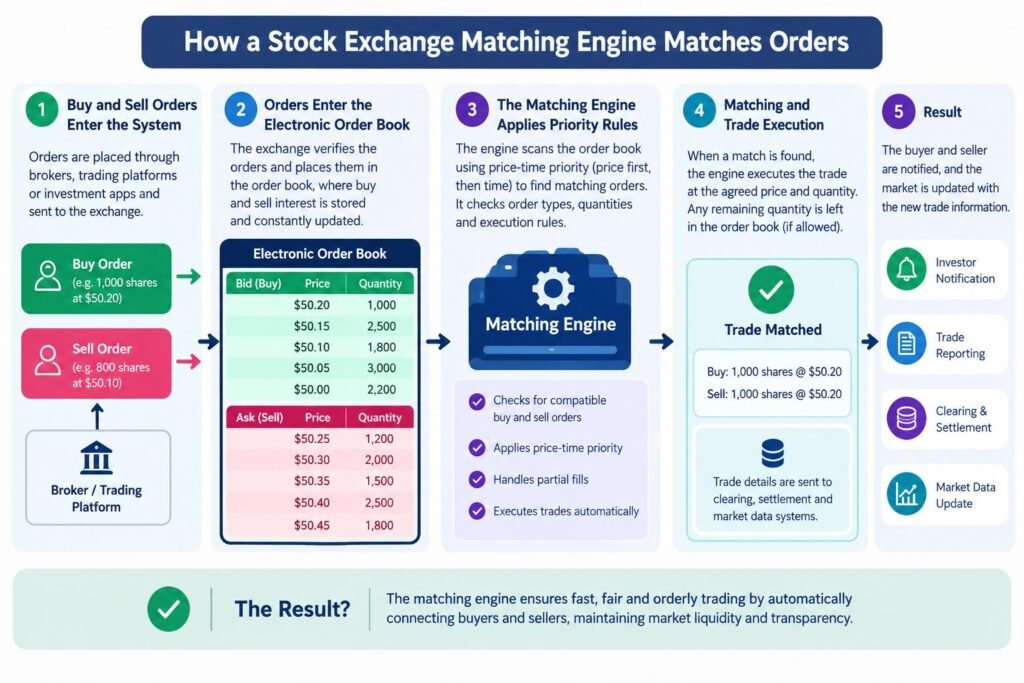
Orders have to be sent to the exchange’s trading system to be matched. An investor will usually place an order via a broker, investment application or a professional trading platform. The order will include details like the security being bought or sold, the investor’s buy or sell side, the amount of the security they’re interested in, and (if applicable) the price they’re willing to pay. The broker/mediary could conduct checks before sending the order to the appropriate trading venue. Upon receipt of the order, the exchange verifies the information in the order and whether it complies with the exchange’s rules. The accepted order is then run through the correct matching engine where it is acted on by the operating rules of the market and the type of order.
Orders may vary in how they are processed depending on the type of order. For example, a limit order could be to sell at a minimum price or to buy at a maximum price. A market order, on the other hand, typically is not a specific order, but one that will be filled at the most favorable price. This difference in how the order is placed, will impact the matching engine. A limit buy order can only match with a seller quote that is at or below the buyer’s limit quote, and a limit sell order can only match with a buyer’s quote that is at or above that of the seller’s limit quote. The engine can therefore perform more than just comparing and contrasting two numbers. It decodes instructions for the order and then enforces the rules before the transaction will take place.
Contents of the Electronic Order Book.
The order book offers the matching engine a constantly evolving view of buying and selling interest. It may be considered a two-way list; one with the “bids” and one with the “asks”. On the bid side, the higher price will also normally be given the higher priority as the seller will want to sell to the buyer who was willing to pay more. Keep in mind that prices tend to be more important on the ask side, as a buyer would normally want to buy from the lower ask. Two of the main parameters are of interest: the highest bid and the lowest ask, as they are the two best prices immediately available on each side of the market. The trading system continually updates the order book as orders come in, are executed, changed or canceled.
Assume that the order book (bids and asks) for a stock has an asking price of $50.20 and a bid price of $50.Suppose a stock has a highest bid of $50 and a lowest ask price of $50.20. At present, there is no common price between the two orders, so the matching engine does not match the two orders. However, if a new buyer puts in a bid to pay $50.20, then perhaps it’s possible for the new bidder to communicate with the original seller. Likewise, if the seller puts up a bid of $50, the new sell order might merge with the highest bid. If there are orders that match, the matching engine selects the order that it considers to have the highest priority for matching. The key factor is that the engine is not picking up random orders.
How Price-Time Priority Works
A widely-used concept in electronic markets is price-time priority. This way is based on the principle of price first, and then the time an order is received. Similarly, on the buy side, an order with a higher price generally will be executed before an order with a lower price. On the sell side, the lower price order will be given priority over the higher price order. In cases where two orders have the same price, the order that was received first is normally served first. This forms a queue in the orderbook that is structured. The order has therefore an incentive to put an order in the order book that reflects the true intention of a trader to take the position, as the position in the order book may impact execution time and even execution certainty.
Suppose that two investors want to purchase the same stock at $100 per share. Generally, Investor A will have the highest priority when an appropriate sell order arrives if Investor A is the first to place an order and Investor B is second to place an order at the same time. Suppose there is a third investor who puts in a $101 buy order. Suppose there’s a third investor who puts in a $101 buy order. The $101 order will be generally given a higher price priority as it is more expensive than the $100 orders. This shows the need for the matching engine to have extremely accurate order price and arrival record. Many market participants are competing for execution at the same price and even minor timing gaps could have an impact.
How the Matching Process Functionality Is Implemented
Once the new order comes in to the matching engine, the first thing the system will do is check if it can immediately match with an order that’s currently on the opposite side of the book. Buy: Seeks out sell orders that can be executed, and vice versa. If there are compatible orders, the engine’s priority rules are checked and it is able to find out how many orders may be able to be carried out. The engine may proceed to compare the incoming order with other orders that are eligible to be matched to it, but have different prices, depending on the order’s instructions, if the order size exceeds the quantity already matched at the best price. Every match made results in an execution and any unmatched amount can remain in the order book if allowed by the order. This is done without the exchange employee having to press a button.
The matching engine should also be able to deal with the case where only part of an order can be executed. Suppose someone places an order to buy 1000 shares and 600 shares are available to be bought from valid sellers at the given prices. The engine is able to perform the 600 shares it has in the program and then evaluate what to do with the other 400 shares, following the orders given in the program. If the order is not cancelled and the remaining 400 shares do not cancel, then the 400 shares can be left in the order book. If any conditions are imposed on the order which need to be fulfilled immediately, the remaining order quantity may be cancelled. This capability to deal with partial executions is a crucial characteristic as markets don’t offer the ideal combination of quantities. The engine thus manages the price, quantity and keeps a record of all the outstanding orders.
Speed and Performance of Engines
One of the hallmarks of today’s electronic exchanges is speed. An order matching engine can execute orders much quicker than a manual system where traders would need to communicate and coordinate them. But it’s not just about speeding up the system for the sake of speed. Fast processing speeds up the response to the changing information of the markets, so that when the market changes the participants can order, modify and cancel the orders. The engine should be able to execute these actions ensuring the correct sequence of events. This is especially significant in the most active securities where a number of orders could be received in very short spans of time. Efficient communication networks, high-speed databases, specialized exchange platforms and software, and optimized programs are therefore often employed to facilitate matching.
How Matching Engines can help to Facilitate Liquidity.
Matching engines also have a large role to play in market liquidity. Generally, liquidity is the ability of an asset to be traded immediately without a large change in its price. With a working electronic order book, buyers and sellers are able to put their offer or ask on the order book and thus, create orders that the matching engine can compare. If a large number of people are bidding and offering at various price levels, the market can be deeper, and thus offer more opportunities for incoming orders to be filled. Orders can be added by the market maker or other liquidity provider to the book and interact with others on the book. The matching engine conducts this activity in a structured way, facilitating the matching of various market participants without them having to communicate directly with each other.
Transparent and Orderliness of the Trading Process
A matching engine also helps in operating the market in a proper way and increasing transparency by following predefined rules for executions in a consistent manner. Usually, market participants have access to information like the available bid and ask prices as well as quantities, depending on the market, at these prices. This doesn’t imply that all the trading activity will be visible to the general public as different markets may have various rules regarding displayed and non-displayed orders. However, the organized order book enables the members to have an idea of the price at which the interest of the members is available for trading. Consistency of matching rules is also crucial as participants must have assurance that orders are being matched with the same consistency that is expected from the established rules. The engine therefore can be used as an automatic instrument for arranging the competing trading instructions.
After an Order is Matched, What Happens?
When the matching engine is able to find some orders that match, it produces an execution based on the rules governing the trading. Once the trade is completed, the trade information is then sent to other systems that handle functions like Trade Reporting, Trade Clearing, Trade Settlement and Distribution of Market Data. The broker and the investor can then be notified that the order (or portion of it) has been fulfilled. The transaction may also help the public market data that are utilized by other participants in
the market to track prices and trading volumes. It is important to note that the matching engine is mainly focused on the matching of matching orders. The activities that follow the creation of a financial market trade, such as for transferring securities between the parties to a transaction and transferring Why Matching Engine Rules Matter
Rules which are programmed into a matching engine are very practical in terms of how competing orders are treated. While price-time priority is prevalent, it is not the only matching method adopted throughout financial markets. In rare cases, other methods may be used which are suitable for specific instruments or market conditions. How orders are ranked, how quantities that are hidden or partially shown are ranked, how cancellations affect the ranking of orders, and how simultaneous orders are handled can all be determined by the specific rules. Therefore when participants rely on predictable execution they need to be familiar with the rules governing the particular exchange they are using. The matching engine is not deciding on the merits of one investor over another for a trade, it is simply carrying out a process that has been agreed upon by the market place.
The Matching Engine’s Role in Today’s Exchanges
The matching engine is the working unit of an electronic exchange which can be regarded as the key operating mechanism. Behind the mobile application, websites, or professional trading terminals, there is an infrastructure that enables the organization of huge volumes of trading activity. The matching engine processes the orders, places the eligible orders in the order book, sorts the orders based on the rules, finds the matching orders, trades when there is a match and also updates the market according to the activities. It can carry out these functions quickly and accurately, thus maintaining the smooth functioning of securities markets. If there is no way to structure, organize, and execute competing buy and sell orders, electronic trading wouldn’t be as fast, structured, and predictable as it is.
Conclusion
A stock exchange matching engine is far more than simply trading software. It is the system that puts together different buy or sell orders, prioritizes them, matches prices and quantities and ensures the orders are executed. The electronic order book offers a framework for the engine, allowing market participants to communicate with each other without entering into direct negotiations with each other. The price-time priority and automated processing are some of the principles that help determine the order of competing orders and ensure that they can be executed at extremely high speeds. Matching engines play a vital role in the modern exchange system by facilitating execution, liquidity, transparency, and orderly trading. By understanding how they operate it is easier to better understand what occurs behind the trading screen when an investor makes an order. Funds between the parties, are handled by other components of the financial-market infrastructure.
Get more well researched information about Stock exchange matching engine here.