Introduction
When investors and institutions place orders, cancel them and change their mind, the amount of information that the stock markets emit is tremendous. The price displayed on a trading app is thus just a part of a vast information system that works behind the scenes. Exchanges gather activity from their trading venues, sort them into market events and then provide market events via discrete data feeds. The information is given to brokers, financial institutions, technology providers and data vendors where it is analyzed and certain parts of the data are made available to investors. When the stock price changes, it passes through interconnected systems which need to maintain accuracy, sequence, timing and availability for a high volume of information.
The organizations that provide the information for distribution, organization or enrichment are referred to as market-data providers. Market data can contain any information that can be generated by financial markets, such as price, quotes, trades, order book information, volumes and more. Market data overview can be a real-time feed, rather than one set price, depending on the sequence of updates that are made. For instance, an exchange can broadcast the best bid/ask, last sale, changes to the depth of the order book, and trading-status messages. NYSE says that its real-time products include trades, quotes and the complete depth of book, auction information, and messages on security-status. The result is an information flow that is constantly changing that has to be received by downstream systems and interpreted before appearing in a familiar trading interface.
The Data of the Stock Market
Stock market data is more extensive than the stock price that comes next to a company. A typical quote will include a bid, ask, and quantity for those prices. The bid price is the highest price that a buyer is willing to pay at the moment, and the ask price is the lowest price that a seller is willing to sell for at the moment. What is the difference between these two is bid-ask spread. Market data also may contain the price and quantity of trades completed, the trading volume, the time of the trade, and order book changes. Depending on the feed, users could only get the top bid/ask they can or more comprehensive info with the multiple levels of price. These levels give participants an option of selecting data suitable to their applications.
The Process of how an Exchange Provides Market Information
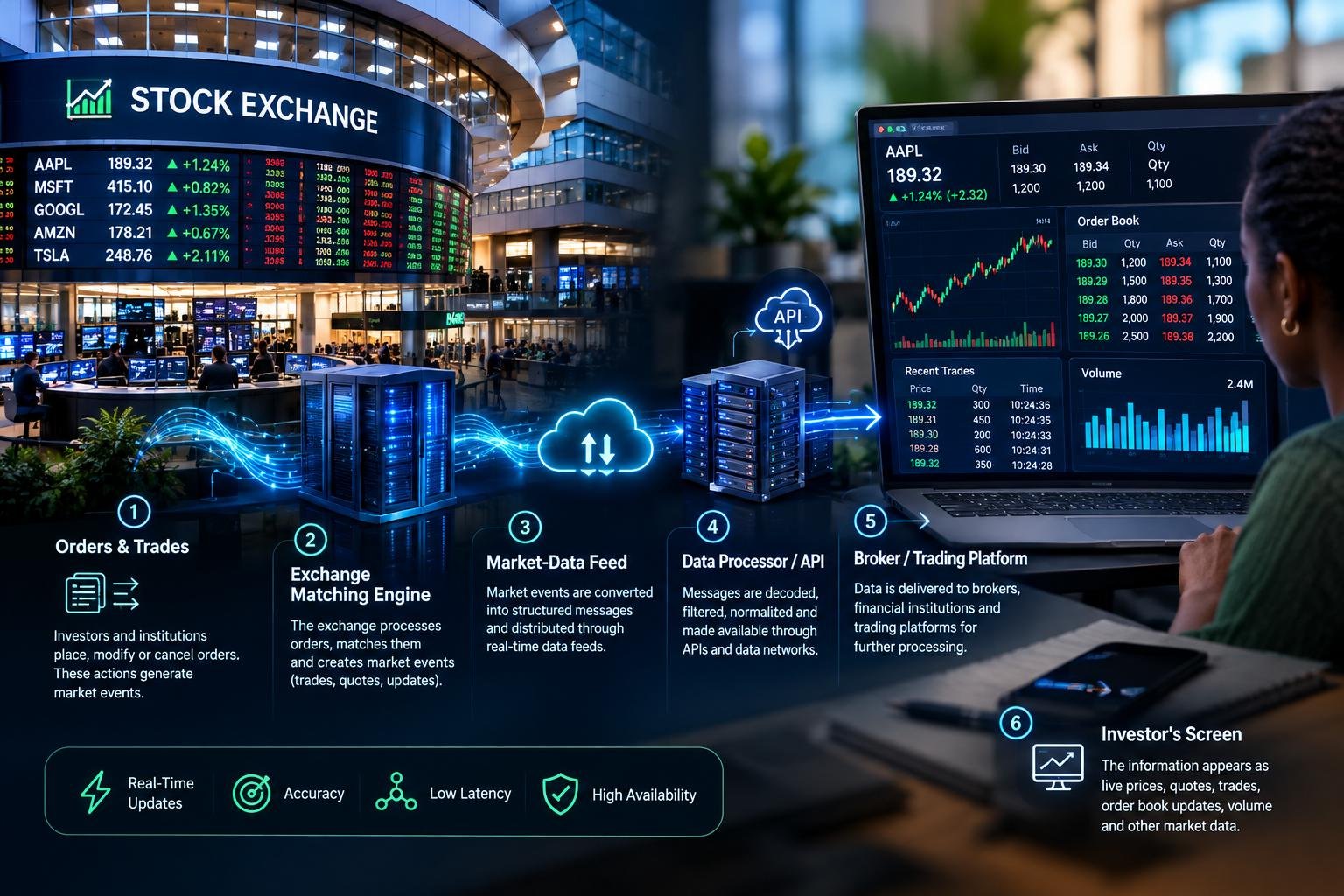
Orders start to be placed when orders are submitted to an electronic trading platform. The investor typically places the order via his/her broker or through another appropriate intermediary and the order is then directed into the trading system. The exchange takes the order and will engage with the order matching engine to interact with the orders in the market. An order can be added to the book, matched with another order, partially executed, cancelled or rejected depending on the rules of the market. Every event can alter the information in the market. A trade can create a trade message, and an order that updates the quantity at a price can cause an update of the order book information. The exchange’s market data infrastructure transforms these events into structured messages which can then be sent to authorize recipients.

Notify of Price Updates, Quotes and Trade.
Price updates are one of the most prominent types of market data as they are what the numbers on charts and quote screens are based upon. Suppose a stock has a best bid of $49.95 and a best ask of $50.00. Best Bid changes if new bidder comes in at $49.99. An available buying order can be accepted by a seller, with the quantity displayed decreasing, and execution message being generated. Once a new sell order comes through that is lower than the previous ask, the best ask may shift once again. These events may occur over and over again. Exchanges, therefore, send out messages to inform about market changes instead of sending out the whole market repeatedly. Real-time systems will leverage these updates to update quotes, last trade prices, volume statistics, charts and other displays as activity occurs.
The Role of the Order Book
A more detailed picture of supply or demand than one stock price only can be gained from the order book. It has great buy and sell interest organized in various price levels. A simple display will list a few bid levels, each followed by a few ask levels, and the quantity available at each level. The book can be modified when an order is added, cancelled, changed or executed. In some feeds, you may only see the top of the book (the best bid and best ask), some feeds you’ll see multiple levels or you’ll see a much deeper view. For instance, NYSE provides products for best bid and offer data, depth-of-book and feeds of events. A receiving system has to receive updates and make sure they are received in the right order and knows what quantities and price levels have changed in order to keep a local copy of an extensive order book.
Market-Data Feeds and Distribution
A market data feed is a particular stream of data that an exchange or another authorized source provides financial data in a structured format. It can be tailored to meet various objectives, including top-of-book quotes, trade reports, deeper order-book data or wider market data. Some providers offer direct exchange feeds and others combine data from many venues and then display the data via a common interface. The Nigerian Exchange, for instance, says its real-time data service is a tick-by-tick live stream that is delivered via a connection with its X-Gen trading platform and transmitted in FIX data. Where there are multiple venues, aggregation can allow for the synthesis of information from multiple sources prior to a market view being generated.
Reliable API Connections and Software Connections
Another way that software programs can get financial information is through an application programming interface (API). Rather than having to open a page and read a price, an application can reach out to an approved data service, and get structured information that its software can process. Depending on the API provider, quotes, recent trades, order book, historical market data and other information may be provided. For instance, streaming and REST APIs, provided by Nasdaq Data Link, enable the delivery of exchange data and other financial information in real time, such as last trade and last quote data. An API can be used as a software liaison between a data source and an application. The receiving program can decipher the information and send it to charts, portfolio screens, alerts, analytics and trading functions.
Data-Processing Infrastructure
Raw market data can’t just be pushed as is to anybody’s screen since it’s to be received, decoded, checked, organized and routed to the investor. A data company or a broker can have a server that receives incoming messages, translates each exchange-specific message into an internal one, keeps up to date market quotes, rebuild order books, and pass on some information to other services. The infrastructure should also be able to handle spikes in traffic as the amount of messages may rise rapidly during periods of peak demand. It is also important to have reliability. There must be a way to identify the lack of sequence and/or missing messages; there must be a way to recover the data that was missing or out of sequence; there must be a way to monitor the connections; and there must be a way to keep downstream applications in synch. Latency and network performance may also be a factor as the delay may cause a displayed quote to drop behind the current market rate.
The Journey From Exchange to Investor’s Screen.
The process of an exchange to an investor’s screen can be considered as a sequence of linked stages. First, there are events that occur in an exchange’s trading environment the order and transaction. The exchange’s systems agree to marketplace knowledge messages and send them out via the proper feeds when events are relevant. Those messages are delivered to a broker, a financial institution or a data provider and handled in the financial institution. The information can then be normalized, filtered, merged with other information sources or translated into a format that can be used for a specific application. The broker’s back end could pass the pertinent data to a cellular or web software via API or some other way. Lastly, the application converts the incoming data into some kind of visual elements, for instance, a stock price, bid and ask fields, chart, volume statistics or order book display. These stages are between the initial exchange event and the showing by the investor.
Importance of Latency and Accuracy
Market data timeliness is crucial because market data can be constantly changing during periods of active trading. But real time doesn’t mean that all investors are getting all the updates at the same time. There can be small delays in the flow of data through exchange infrastructure, the Internet, internet connection of the investor or his/her device and the processing system or broker server. The detail of information provided by the different subscriptions may also vary. Accuracy is as crucial as speed as a fast but inaccurate quote is of no use. The market-data system should maintain the order, quantity and price of messages, as well as their timestamps. This is why professional infrastructures have monitoring, recovery plans, validation and well-crafted data protocols, not just a simple connection between an exchange and an application.
Importance of Market Data to Trading Today.
The price information displayed in real time can be used for a wealth of functions besides individual investors. Brokers rely on the info to offer quotes and trading services and financial institutions can use it for execution, risk management, valuation, portfolio monitoring, and research. APIs and feeds enable technology companies to develop investment applications, dashboards, analytical tools and financial information services. Data providers can merge data from various venues to get a real-time overview of the markets. What you see is a quote screen, but what you don’t see is the exchanges, feed handlers, networks, APIs or application servers. This infrastructure enables trading platforms to keep their information regularly updated, instead of manually updating it from time to time.
Conclusion
The Stock market Data feeds are pathways that connect all electronic exchanges activity to the trading screens that are used by investors and financial professionals. Market data systems convert relevant events into price, bid, ask, trade, volume, order book change and market status information and events are generated by exchanges as a result of orders and trades. Feeds and APIs in turn deliver that information to brokers, institutions, technology firms and data distributors, who then process and re-distribute the information using specialized infrastructure. As the investor only gets to see the final result, e.g. the price change or the latest order book, it relies on a chain of technical processes. The operations are of crucial importance in today’s electronic markets, due to the need for participants to have up-to-date information on changing trading conditions.
Get more well researched information about Stock market data feeds here.