
The concept of data structures is considered as one of the most crucial concepts in computer programming because they help to organize, store, retrieve and manipulate data within a computer program. When an application uses information, it must have a convenient means to store the information to use in the application. The number of variables in a simple program could be a couple, while a large one might have thousands, millions, or even billions of individual pieces of data to manage.
These various scenarios are dealt with in an efficient way through the use of data structures. They assist the programmers to select the best way to store the information in relation to what the program will do with the information. Data structures are thus of fundamental importance to anyone learning a programming language as they are used at the basis of algorithms, databases, operating systems, artificial intelligence, and many other aspects of computing.
What Is a Data Structure?
Data structure is a way to store and organize data in such a way that can be used efficiently by a computer program. Data are the information that a programme requires to function, such as names, numbers, products, messages, customer records or locations. It is not sufficient to have information, but the program must have a reasonable distribution of the information. If a program contains thousands of students’ names, for instance, then the programmer must think about how to add these names, search for them, update them, remove them, and display them.
These operations are organized using a data structure. There are no universal rules about which data structure is best for each program problem. Selecting the right structure can simplify the construction of a program, improve the running speed, and optimize computer memory usage.
Importance of Data Structures
Data structures are of fundamental importance because programs are constantly operating on data. A program may require to add new data to the database, look for existing data, delete unnecessary data, update data, sort data or traverse an array of connected objects. The structure of the information makes it easy or difficult to complete these operations. This is particularly crucial in today’s software development landscape where applications typically manage vast amounts of data and must respond rapidly to user interactions.
For instance, a search system must have effective ways of finding information, and a social networking application must have structures that can represent the relationship between social network users. Knowing about data structures also helps programmers to understand why some algorithms perform better than others. Rather than having to deal with the data as a random group of numbers, a programmer can decide on an organization that is appropriate for the problem he is addressing.
How Data is Organised, Stored, Accessed and Manipulated
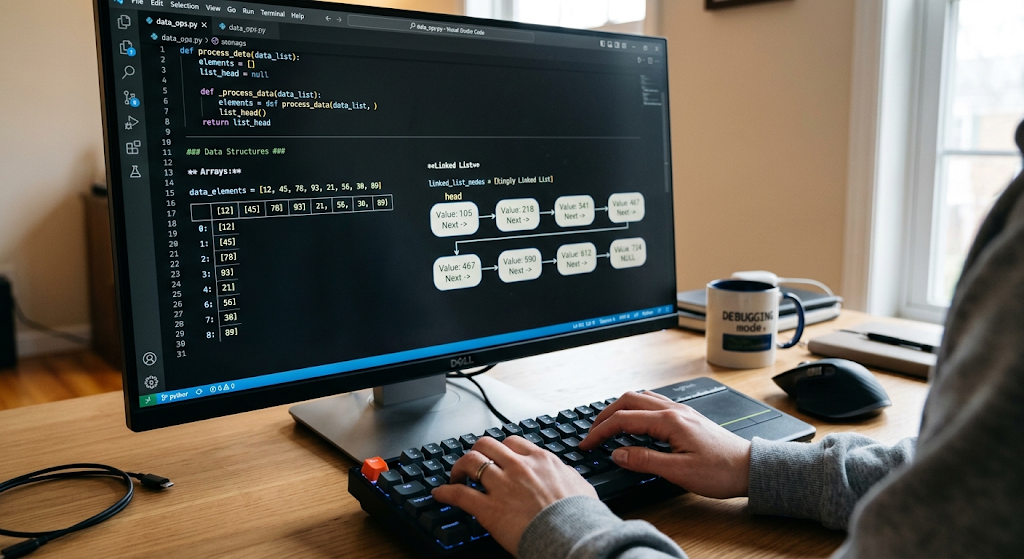
Data structures are used to define the rules of the data and the way that a program manipulates data. In other words, organisation is the way individual items of data are related to the collection. There are two aspects to the storage: The representation of data in memory, and how a program can access specific information. Manipulation refers to operations that are added, deleted, changed, searched, and sorted. Suppose the scores of students form a simple list.
A program could keep the scores all in one array and use position numbers to retrieve each score. Some other program may employ a list, with each element referencing another element. The same information can be available in both structures, with different ways of accessing and changing the information in each. This understanding of these differences enables programmers to recognize how choosing an appropriate data structure can make a huge difference in the performance and design of a program.
Common Types of Data Structures
While there are numerous data structures in computer programming, some basic ones should be encountered first. These include arrays, linked lists, stacks, queues, trees, graphs, hash tables, and heaps. All the structures have a different way of organizing information and different structures are efficient at performing certain operations. Some structures store data in a linear fashion, some others store data in a relational or hierarchical fashion.
Some are meant to be used as a quick reference because of their position, others are made to be used for operations like searching, prioritizing or keeping relationships between objects. To comprehend these structures, one doesn’t need to learn intricate programming code. The most crucial first step is to comprehend the conceptual model for every structure, its type of information, how information is accessed, and what sort of problems it can help solve. With these ideas in mind, implementing them in a programming language becomes easy.
Arrays
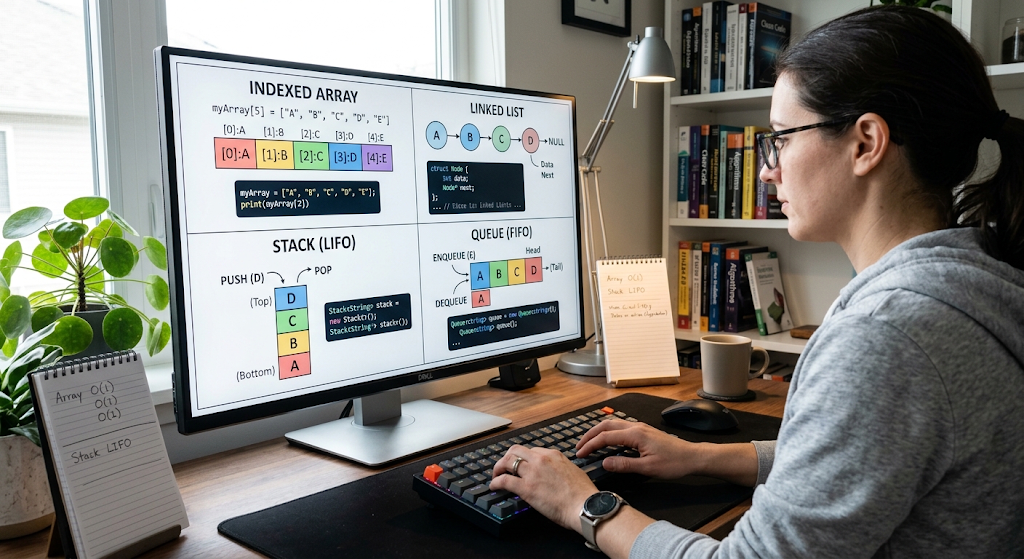
The array is one of the simplest and most popular data structures. It contains several items in an ordered collection, each of which is referred to by an index or position. For instance, if the array has the numbers 10, 20, 30, 40, and 50, each number would have a specific location. One of the primary benefits of arrays is the ability for programmers to easily access an element of the array given its index. Arrays are thus useful when the program requires access to items by their position.
Numbers, lists of values, tables, and a lot of other structured information is typically stored in an array. Other elements may have to be moved in the middle of the array when an element is inserted or removed, but this is dependent on the implementation of the array. Arrays are very useful when the ability to access the data is more important than making frequent changes to the collection.
Linked Lists
A linked list is a list with each element consisting of a single data element called a node. Each node has data and information about the subsequent node in the sequence, instead of a single block of storage. Other linked lists can have nodes point from backward as well as forward. This structure supports the ability to insert and delete nodes without having to shift all of the other nodes in the collection. For such programs, linked lists may be a useful data structure to use when the size of a collection and the order of its elements are often modified.
It may take longer to get to a specific position than to access an array element directly, however, because the program has to follow the links from the beginning to get to the desired node. In some ways, linked lists are a way of teaching the beginners an important programming concept: that data need not be arranged in one long, simple sequence in memory; that relationships among individual pieces of data can also determine the nature of a structure.
Stacks
Stack is a data structure with “Last In First Out”, or LIFO as the principle of operation. This will make the last item added the first one to be removed. An everyday analogy is a tower of plates: the last plate in the stack will be the first one removed. Stacks are useful in programming when the last operation should be performed before the first operation.
They are often related to function calls, undoing, processing expressions, and some kinds of algorithmic problems. A stack normally offers operations to push an object onto the top and to pop an object from the top. Stacks are relatively simple to understand, as they are accessed at one end of the collection. Learning stacks also helps novice learners understand that, just as the data itself is important, so too can be the rules of access to that data.
Queues
Another sequential data structure is the queue, which is different from the stack in that it has a different rule. The First In First Out, or FIFO, principle is the typical way a queue works, where the first element in the queue is the one that is removed first. A good example in real life is a line of people; and the person who enters the line first is served first, and the people who enter later are served later. Queues can be used to keep track of tasks waiting to be processed, messages waiting to be sent, print jobs, requests waiting for a resource in a computing system.
A queue typically has operations for adding items at one end and removing items from the other. This is especially helpful when fairness or order of arrival is important. A knowledge of queues is useful for the novice to appreciate that the use of data structures can influence the sequence of operations that occur in a program and make it possible to systematically process a collection of tasks rather than information.
Hierarchical and Relationship Based Data Structures.
Some sets of information can’t be presented in a straightforward list. There is some information that has parent and child relationships and other information that has many interconnected relationships. In such cases, trees and graphs can be used as data structures. They are particularly significant because in the real world many systems have relationships that cannot easily be conveniently represented by a single straight sequence.
For instance, the file system of any computer will be a hierarchical structure, which is obviously like a tree. On the other hand, a transportation network may have numerous locations in it, each connected to other locations differently, and this can be represented with a graph. Programmers can use knowledge about these structures to model more complex systems, and knowledge of algorithms for search, traversal, routing, and network analysis can be built on knowledge of these structures.

Trees
A tree is a hierarchical data structure consisting of nodes that are connected. It usually starts with a top-level node known as the root, with other nodes branching off the root. Nodes that are below are called children, and the node above is called a parent. With this organization, trees can be used to represent information with levels or categories. The good old file system is an obvious example; a main folder may have subfolders, a subfolder may have more subfolders and files etc.
Trees are also employed in numerous other parts of computing, such as search systems, databases, and compilers. There are some special Trees, for example Binary Trees and Binary Search Trees, which have different rules and are used for different purposes. The important thing to keep in mind is that a tree is used to represent hierarchical relationships, so it is appropriate for information that naturally has tiers, or levels, and is not a simple linear sequence.
Graphs
Graphs are a data structure that represents relationships between objects. It’s composed of nodes or vertices, and connections between the nodes, known as edges. A graph can have no specified starting point, unlike a tree, and is not necessarily hierarchical. This makes graphs suitable for representing complex networks. For instance, if we think of a social network, people are represented by nodes and friendships or connections are represented as edges.
The locations can be represented as nodes and roads as connections. Devices and communication links can also be represented on computer networks. A graph may be directed (arrows indicating direction in the connections) or undirected (arrows going either direction in the connections). They can also have weighted links (roads with distance or network links with cost). Graphs are useful since a lot of real world problems deal with relationships between objects instead of just pieces of information.
Hash Tables
A hash table is a data structure which we have for very fast access to info using keys. Instead of going through all elements in a set out of which a key is to be found, a hash table uses a process named hashing to determine the location of a particular key and its value. For example a program may use student ID numbers as keys and put into association with each ID a student’s info. When the program goes to get a certain record out of the bunch it can use the key to find the related data very fast.
Hash tables are very much used in programming for which they do best: fast lookups, in dictionaries, sets, for caching and as a mapping tool between related values. But also at times different keys may produce the same place for storage which is what we know as a collision. In any case of hash table implementation methods for handling these collisions while at the same time keeping access quick is a must.
Heaps
A heap is a particular kind of tree based data structure that is mainly used for the management of elements in a priority based manner. As an example of this we have the min-heap in which the element with the smallest value is given the highest priority, and the max-heap which does the opposite by putting the largest value at the top. Although the exact rules may vary based on the type of the heap, the main principle is that which we may term as the element of highest priority is made available for quick access.
Heaps see a great deal of use in which a report has to be maintained on the element which is the most important, the smallest or the largest in a set. We see them put to use in priority queues and also in algorithms like heap sort. For instance a scheduler may use a priority structure which the heap is ideal for in order to determine what task to process next. Also, in design of data structures which are operation based instead of just informational storage, heaps present an excellent example.
Data Structures and Algorithms

Data structures and algorithms are very much related fields in computer science. What a data structure does is to put info in an order and an algorithm does a series of actions to solve a problem or do a task. Which data structure you use will in turn determine what algorithms will be practical and how well they perform. For example, out of a group of random elements a search may have to go through each one to find what it is looking for, but with a proper tree structure it may eliminate large groups at each step of the search.
Also a queue which puts elements in the order they arrived in and a stack which does the most recent in first each of these will support certain algorithms better than others. This is where we see data structures and algorithms studied together. By understanding both very well developers are able to produce not only that which works but also that which scales up to large data sets.
Choosing the Right Data Structure
Choosing which data structure to use is based on what a program is supposed to do. As a programmer you should ask yourself if data will be accessed a lot, if the task at hand is to add or remove elements, if the data contains relationships or is in a hierarchy and if the application requires fast search or priority based processing. For instance a case may present where an array is the right choice for direct access to elements by their position, but at other times a linked list will work better for when elements are put in or taken out all the time.
Also a hash table may be what you want for fast look up via a key, also a tree is very useful in which you have to present a hierarchy. There is no one best data structure for all cases as each has its own set of pros and cons. What good programmers do is they study the issues at hand in a problem and pick out a structure that does the most to support the main actions that the program will do.
Data Structures in Real-World Applications
Data structures are a practical component of programming that you will see in the real world, not just in books. They are present in the technology which we use daily. In a messaging app which has to handle many conversations and messages at once, it is important to have good structures in place. With a navigation app you have to be able to put forward locations as well as show the interconnectivity of one location to another. And also an online store can’t function if it does not have ways to present products, manage customer information, order history, and also be able to perform searches. Also operating systems have to report to users in real time so they have to use some form of data organization for processes, memory, files, and resources.
In the case of a search engine that is dealing with an extremely large amount of data they have designed and developed really smart and efficient ways to file and get back to that data as fast as possible. Also, in games these structures are being used to create characters, to model the game world, present maps, save game state. Also even in what may be considered simple apps which may just seem to be a clock or a calculator behind the scenes they are making use of arrays and lists and stacks and queues and hash tables. Thus by studying data structures new programmers are able to see past the theory into the practical and also are given tools to better approach and solve the larger scale programming problems which they will come across.
How Beginners Can Learn Data Structures
Beginners do better to learn data structures step by step instead of trying to absorb all there is to know about each at once. A good place to start is with arrays which present the idea of collections, indexes and basic data access. From there we may look at linked lists, stacks and queues which present different ways to handle sequential data. Then we may study trees, graphs, hash tables and heaps which are more specialized for handling hierarchical info, relationships, fast lookups or priority issues.
Also it is very useful to have a go at writing out simple versions of these structures in code which in turn makes abstract ideas more concrete. Also beginners should play around with functions like insert, delete, search and traverse and see how each structure reacts. As they do this over time it will improve their grasp of algorithms, performance issues, and also why pro programmers choose certain structures for certain problems.
Conclusion
Data structures are the base for the organization, storage, access and manipulation of info in computer programs. We have arrays, linked lists, stacks, queues, trees, graphs, hash tables, and heaps which each present a different approach to data management and solution of specific programming issues. As beginners learn the basic concepts they move past just getting code to work and into how efficiently that code handles info.
Also data structures play a key role in the relationship between programming and algorithms as the structure of data determines how well operations perform. No matter if you want to develop websites, mobile apps, games, databases, AI systems or other software, study of data structures gives you valuable problem solving skills. By learning what each structure does, when to use which and how it performs in common operations, beginners can build a strong base for more advanced programming and computer science topics.