Introduction
Financial institutions process thousands of transactions, thousands of documents, thousands of customer requests, thousands of compliance tests and thousands of administrative actions each and every day. Many of these tasks were previously heavily reliant on manually entering data, review, verification and request processing by employees. Although human involvement is still of great importance, financial technology developments are transforming the way repetitive work is managed by organizations. Many of the key advances include automated transaction processing, which enables financial institutions to handle common financial operations with minimal manual involvement. Automated transaction processing is a growing trend among financial institutions, including banks, insurance firms, investment companies, fintech companies and more, aiming to boost efficiency, minimize human mistakes, cut down on costs and deliver uniform services. In today’s increasingly digital and complex financial landscape, automation has become a crucial component of the process for creating efficient, responsive and reliable organizations.
The Significance of Automation in Financial Services
Automation is the term used for applying software, digital systems, artificial intelligence and other technology to accomplish work that was previously done through a lot of human effort. In financial institutions, automation can be used in various tasks starting from payment processing, document management, customer data validation, and insurance claim management. It is not always about getting people out of the money business, but rather it’s about helping employees to spend less time on repetitive, and more time on judgment, communication, analysis, and professional work. For instance, if an employee used to input transaction information for several hours, they could use an automated solution to process a lot of the mundane work and save time on handling exceptions or customer queries. This change can help improve speed of operations as well as the utilization of the workforce within an organization.
Automated Transaction Processing
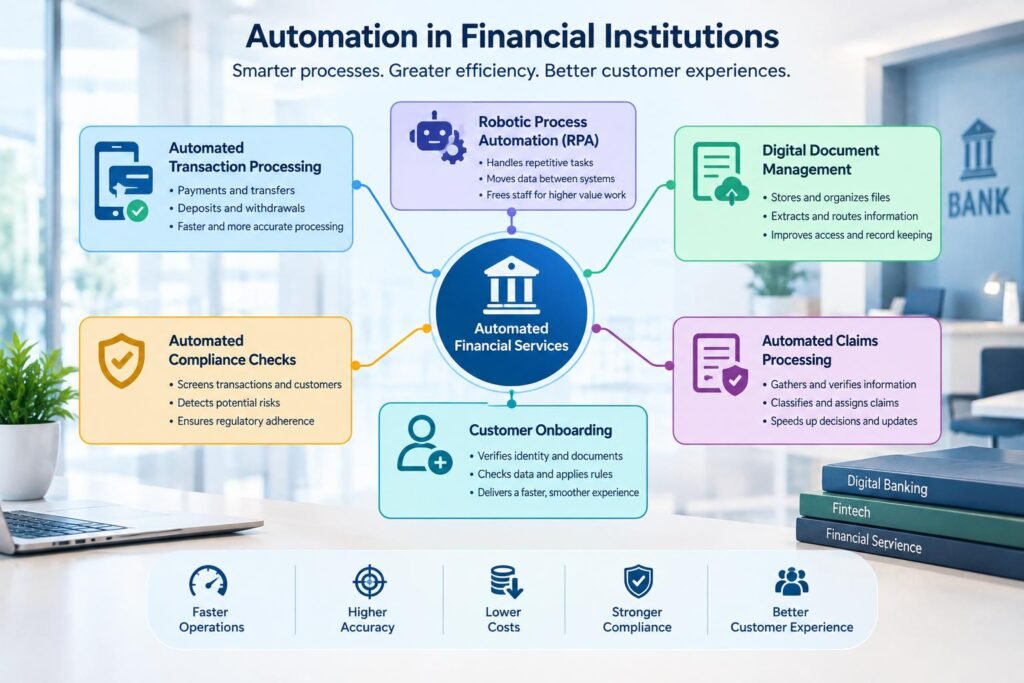
One of the evident places where automation can help increase efficiency is in transaction processing. Financial organizations and banks handle financial transactions, deposits, withdrawals, transfers, payments, refunds, settlements, and other types of transactions all the time. Manual processing can be time-consuming and can reduce the likelihood of accurate data entry, data duplication, delays, or missing data. Automated systems can accept transactions, check relevant data, enforce preprogrammed rules from transactions, modify records and transmit transactions through the proper processing channels. This enables bigger volumes of transactions to be processed in the same way, without having to have the employee carry out each one by itself. Automation can also give the status of transactions and leave a record in digital form which will make it more convenient for workers to keep track of these transactions. In addition to the increased speed of transactions, automated processing allows financial institutions to scale their operations while allowing manual staff to continue processing transactions at the same speed.
Robotic Process Automation in Financial Institutions
In the financial sector, another technology that is contributing to repetitive administrative tasks’ reduction is called Robotic process automation or RPA. RPA leverages software robots to carry out rule-based tasks with digital applications. These software robots can duplicate data between systems, fill in form fields with information, create reports, review records, email notifications and more repetitive tasks based on pre-defined instructions. For instance, an RPA system can gather data from an application in a bank and pass it off to another application without the investment of a human employee typing the data. Software robots can assist with data collection across various systems in an investment company, and generate regular reports. RPA can be beneficial as the volume of repetitive structured information becomes large in organizations. Delegating such tasks frees up time for employees to focus on more judgmental tasks and customer-facing work.
Increasing the Accuracy and Minimizing Human Error
One of the biggest benefits of automation is the ability to minimize the number of mistakes that can be made in repetitive manual tasks. Hundreds or thousands of times doing the same process can cause tiredness, distraction, or overwhelm for the employee. An error rate of even 1% can have a big impact when a company has to manage a huge number of financial records. Automated systems are programmed to run according to a set formula, therefore minimizing human error due to missing data or steps in the process. Validation rules can also be used before data is accepted, which can aid the identification of missing and/or incorrect data at an earlier stage. But, automation is not a guarantee of perfection in accuracy. The problems can arise even due to poorly designed workflows, incorrect rules or inaccurate data. This is why it’s important that financial institutions have trustworthy system testing, monitoring, human oversight, and regular updates to ensure that automated processes are able to deliver trustworthy outcomes.
Digital Document Management
Financial firms have to manage massive volumes of documents such as account applications, identification info, contracts, invoices, loan paperwork, investment statements, insurance forms, and regulatory documents. Handling these documents manually can be time consuming and require a lot of space. Digital document management systems are important for storing, organizing, retrieving and processing documents digitally. Allow authorized individuals to access information with ease and in a timely manner rather than having to look through physical documents or separate folders. Another benefit of automation is that it can identify the content of documents, data, add to a list of relevant data, route documents to the relevant departments and trigger workflows depending on what the document is. For instance, an automated system can detect a document in a required application process and verify that the document contains the necessary information to move it to a specific process. This minimizes administrative delays and allows for better records to be kept.
Improved Speed in Accessing Financial Information.
Digital document management is more than just about the number of trees saved. Employees often need to look at up to the date customer and financial data to fulfill requests, check applications, look into transactions, and compile reports. Automated Document Systems can provide information faster and help manage access to sensitive documents. Search capabilities can enable workers to locate certain documents based on customer information, document type, date, etc. Version control is a major benefit for organizations, as they can save confusion by not having to deal with employees using outdated documents. For regulated financial services, reliable record keeping is particularly significant as it can be required to show how decisions have been made or simply be required for audit purposes. A good digital document management system is thus capable of facilitating the efficiency of operations and improving information governance.
Automated Compliance Checks
Financial institutions must deal with a large amount of laws and has a duty to comply, as one of the most important duties. Compliance processes may include: review of transactions, name checks, document review, monitoring, and transaction identification for further investigation. Taking care of all these checks manually can take a tremendous amount of time and make it challenging to react swiftly to a lot of activity. There are some ways that automation can help, such as using rules that have been defined earlier for customers’ records and transactions, which can help to detect potential problems, and can alert employees to review. Automated compliance solutions can assist with activities like customer verification, sanctions screening, transaction monitoring and regulatory reporting. Technology can help streamline the process instead of forcing employees to look at each record the same way, it can also ensure that employees are spending their valuable time on those that require more in-depth investigation.
Supporting Risk Management
The automation can also enhance risk management by enabling financial institutions to continuously track information, instead of solely on a periodic basis. Automated systems can be used to match up transactions and customer data against rules, risk indicators, or presets. If any unusual activity is detected, the system will be able to alert others to investigate. This doesn’t imply that each automatic alert is a genuine offense or monetary risk. Cases still need to be analyzed by human professionals and the appropriate action taken. The primary advantage is that technology can help organizations to find out which situations are potentially important in a time efficient way. Automated monitoring can be used in conjunction with human judgment to develop more robust risk management processes, but with a decrease in the volume of routine screening that employees are required to undertake manually.
Automation for Customer Onboarding
There can be several stages to the process of customer onboarding, from gathering personal details and verifying documents to establishing accounts and fulfilling regulatory compliance. With these activities performed manually, customers can face delays, particularly if there are many employees to review large numbers of applications. Automated onboarding systems can help users navigate through online applications, check data, confirm documents, and pass applications from one step to another based on rules. This can minimize the waste of time and ease the account opening process. Financial institutions can also use automation to ensure that they follow their onboarding procedures uniformly with customers. Automated workflows save employees from repetitive data entry and enable them to focus more on applications that need extra consideration. The quicker a customer can get on board, the better the initial experience with the institution can be, and the less frustration he or she might have due to having to fill out unnecessary forms.
Balancing Convenience with Security
While automated onboarding enhances the customer experience, financial services organizations need to strike a balance between convenience and security. Personal and financial data is very sensitive and therefore automated systems should incorporate suitable security measures. Customer information can be protected from unauthorized access by means of identity verification technologies, encryption, authentication, access controls and monitoring systems. For information that isn’t verifiable, there should be clear procedures for automated processes as well. But if the application is filled out with conflicting data, it may have to be moved to a trained employee for manual checking. The combination of automation and human control enables businesses to deliver quicker services without considering all applications as the same. Accurate, secure, regulatory compliance, and customer information protection are also vital elements of effective onboarding automation, alongside fast speeds.
Automated Claims Processing in Insurance for the Insurance Sector
Automation is also being leveraged by the insurance companies to streamline claims processing. Typical claims handling tasks may include such processes as reviewing forms, checking policy information, reviewing supporting documents, communicating with customers, and determining if a claim is covered by the policy. Manually carried out, these activities can be time-consuming, especially for insurers who have a high volume of claims. Automated claims systems can gather information electronically, confirm policy requirements, and determine if there is missing information, classify claims and assign them to staff and employees. Artificial intelligence and data analysis can also be used to detect patterns that may be of concern and should be investigated in some systems. Simple claims can be handled more efficiently, and more complicated or questionable claims might be directed to specialists. This will reduce the workload of insurance companies and enhance the rate at which customers receive updates and decisions.
Processing Routine Work more Efficiently
The best place for automation is when it executes predictable actions, in repetitive situations, while human workers are allowed to make decisions that require their professional judgment. An automated claim process might be followed by a straightforward insurance claim with full documentation, while a more complex claim process with contradicting information could require that of claims professional. The same applies in banking, investment management, lending and more. Employees can concentrate on exceptions and more complex cases, while automation does the initial sorting, validation, calculating or information gathering. This split of responsibility can enhance productivity as the more skilled individuals spend less time on basic administration. It also can enable higher levels of scalability in operations, as organizations can process more work without needing to increase the proportionate amount of manual work.
The Overall Impact of Financial Automation in Businesses
These technologies together bring a major boost to the efficiency in operation. Automation can cut down on processing times, cut back repetitive data entry, standardize data, speed up access and help employees handle bigger loads. Financial institutions can benefit from lower operational expenses due to the fewer hours needed by their employees to perform basic tasks. Consumers will be able to receive payments sooner, faster and easier onboarding, more timely claims and better access to digital services. Automation can also provide a comprehensive history of the completed processes, enabling companies to track performance and identify areas for improvement. However, one must think carefully when implementing automation for success. Financial institutions need to invest in the security of their technology, the training of their employees, maintaining their systems, quality of their data and adequate human supervision. Automation is not the solution, it’s a way to leverage and enhance processes.
Conclusion
Automation is revolutionizing financial institutions, and is defined by the ability to diminish the need for repetitive manual tasks in finance, banking, insurance and investment management. Automated transaction processing, robotic process automation, digital document management, compliance checks, customer onboarding and claims processing are all examples of how technology can streamline financial processes and keep them consistent. The most significant advantages are those gained from the automation of routine activities and the concentration of staff on more complex choices, customer use, investigation and professional duties. With the new era of financial institutions embracing digital technologies, automation will be a key factor in handling the rising volumes of transactions and expectations of customers. By carefully planning and integrating automation, ensuring robust security measures, and retaining a balance of human oversight, organizations can enhance efficiency while maintaining the accuracy, compliance, and quality of their services. This is not only transforming financial institutions, but assisting them in developing more responsive, scalable financial operations in the digital financial environment.
Get more well researched information about Automation in Financial Institutions here.