Introduction
Modern stock exchanges are not the same as the trading floors where traders shout ‘buy’ and ‘sell’ over the heads of a crowd of other traders. There’s a very complex digital infrastructure behind each stock transaction, which includes systems that take orders, match buyers with sellers, disseminate market information, manage risk and execute the transaction. Financial markets have been revolutionized by the technology powering modern stock exchanges: trading is faster, more accessible and increasingly automated. It is the technology that enables the modern stock exchanges today, which have revolutionized financial markets by making trading faster, easier, and increasingly automated. An investor clicks a button within a mobile trading app and the order can go through a number of electronic systems before it is completed. They can consist of electronic order books, matching engines, market-data feeds, automated trading algorithms, clearing networks, settlement platforms, surveillance tools and cybersecurity controls. To understand what really occurs from placing a stock order to confirmation that the order has successfully been executed, it is helpful to know about these technologies.
How Electronic Stock Trading Works
Electronic trading is the backbone of today’s stock-market infrastructure. Exchanges do not have to depend mainly on human intermediaries to relay orders, but instead have computer networks used for this purpose that can receive and process thousands, if not millions, of orders quickly. Once an investor gives an order through a broker, the technology of the broker decides where and how to route the order. It could be routed straight to the exchange or another trading venue based on various criteria like price, liquidity, order type and execution rules. The incoming instruction is then passed to the exchange which carries out the instruction as per its protocols. This electronic configuration decreases hold-ups related to manual procedure and enables investors from around the globe to get the chance to take part in the market even during trading hours. It also provides a real-time information stream: prices, trading volumes and trading activity are updated when transactions take place.
Electronic Order Books
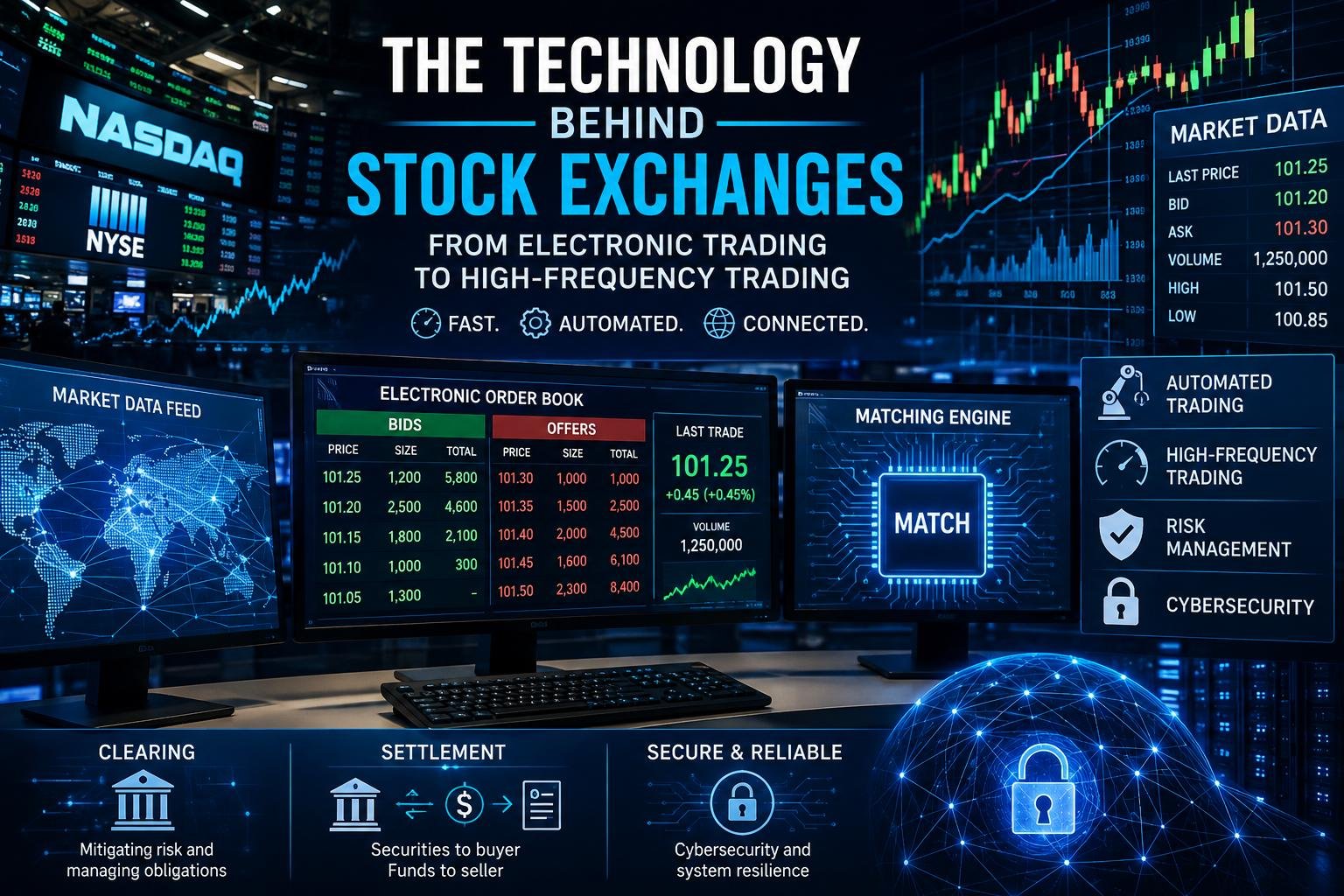
One of the most crucial technologies on the inside of an exchange is an electronic order book, which records the outstanding buy and sells interest for a specific security. In trading, usually the order to buy is referred to as a bid and the order to sell an ask or offer. These orders are arranged by the system by various rules, such as price priority and time priority. For instance, if a buyer is willing to pay more, they will usually be placed ahead of a buyer willing to pay less, and a seller that asks for more will usually be placed behind a seller who asks for less. Orders are constantly updated as new orders are received, existing orders adjusted or cancelled, and trades are executed. The information may be available to investors in part via their broker, but may be limited and/or superficial. The electronic order book then will always display the market’s “supply and demand” situation.
The Matching Engine
The matching engine is at the heart of an electronic exchange. Its main function is to match up buying and selling orders and carry out the transactions based on the rules of the exchange. Assume one investor places a buy order at a specified price and other investor is ready to sell shares at that price. The matching engine decides whether or not orders can be matched and, if so, forms a trade. Financial markets can process a great deal of instructions in very short periods of time and that is why speed is very critical. Specific hardware, software tuning, consistent network and algorithm design are thus necessary for the matching engine. Exchanges also implement redundancies in these systems to ensure that if there is a technical failure, trade does not needlessly be hampered. The matching engine in essence is the digital marketplace where competing orders converge and transactions are created.
Market-Data Feeds and Real-Time Information
The stock exchanges put out massive amounts of information every second, and market-data technology shares this information to brokers, financial institutions, professional traders, investors and data providers. The information included in a market data feed includes the most recent traded price; bid and ask prices; trading volume; order book information; or corporate or trading status messages. Some traders need extremely quick data since the slightest changes in timing can make a difference in trading. Data is thus transferred via high-speed networks and specially-configured infrastructure that will ensure minimal delays. Exchanges may offer various types of data, and while retail applications are good for most investors, the professionals might need more extensive or more frequent data. The traders need the accurate information to make decisions, and reliable market-data systems are vital to that. Any delay, interruption or wrong information sent could impact the order decisions, pricing, risk calculations and the overall operation of financial markets.
Automated Trading: Trading Algorithms.
Today automation is a significant part of the present-day stock markets. Automated trading systems are those that rely on a set of instructions or algorithms to decide when, where and how orders are placed. Traders can let the software do the work of watching the price and determining if they should buy or sell every time; this could be done based on programmed rules. An algorithm could split up a big order into smaller ones and make them as they go, to minimize the impact on the price. There are other algorithms that can be used to find specific prices, manage portfolios, rebalance investments, and/or react to market conditions. Automation can help offer consistency as software isn’t distracted or fatigued. But, there are also risks associated with automated trading. Exchanges and financial institutions implement controls to manage automated activity because algorithms can behave in unexpected ways due to a programming error, incorrect parameter, faulty data or an unforeseen market event that the algorithm designer didn’t anticipate.
High-Frequency Trading
HFT, or high-frequency trading, is a specialized technique of trading that utilizes cutting-edge technology and algorithms, and is especially focused on speed. In some cases, high-frequency trading companies can make decisions about the market and place or take orders on the market in less than a second. These companies can see opportunities slip by in a heartbeat, so they spend significant resources on their computing systems, network connections, data processing and strategies to minimize latency times. Some market participants employ technology like proximity hosting, meaning that their trading systems are close to the exchange’s systems to minimize the distance that electronic messages have to cover. While HFT can provide liquidity in certain market conditions, it can also raise concerns about market stability, fairness, and the impact of high-speed trading.
What is the Order of Events after an Order is executed?
Not all trades have to be executed. After a stock exchange’s matching engine has confirmed a trade, it has to pass through other infrastructure to the point where the buyer actually gets the securities and the seller gets the money. This process is made up of clearing and settlement systems. Clearing resolves what each party will be required to provide or accept and can assist in determining the amount that each party must provide. In many markets, the clearinghouse can be a place between the buyer and seller to help control counterparty risk and manage responsibilities. Settlement is the phase which involves the actual exchange of securities and funds. These processes are coordinated by modern financial markets through electronic systems, thus ownership may be changed without the need for owning or exchanging paper certificates, and the payment obligations are fulfilled. The technologies which underpin clearing and settlement are therefore vital as they will underpin providing the infrastructure needed to bring an electronic trade to a financial transaction.
Avoiding Risk and Clearing
Financial markets are complex and consist of many market participants who deal in significant quantities of assets, so it is very important for clearing systems to play an important role in risk management. With trades made, clearing infrastructure helps participants calculate their net obligations and ensure availability of financial resources to fulfill their obligations after the trades. In the case of a market in which it is necessary to clear the transactions, the clearing house may ask the parties to place margin or collateral to guarantee that no losses will be incurred if one party fails to perform. With the help of technology, these needs can be determined quickly when market values fluctuate. Automated risk systems can track exposures, recognize any unusual increase in obligations, and alert you if you breach any limits you’ve set. The processes lessen manual calculation and enable financial institutions to adjust their response to the changes in the financial landscape in real time. If one participant fails, it could cause problems for other market participants if they are interdependent in completing transactions, unless they are able to rely on clearing technology to ensure they can still do so.
Systems Incorporate Settlement and Digital Ownership Records
The final piece of a settlement technology that completes the process is the transfer of securities to the buyer and cash to the seller, following the procedures set in place by the market. Most securities are now not issued on certificates, but rather electronically, so that one could change ownership electronically. Records are kept by central securities depositories and other securities settlement infrastructures for the purpose of facilitating the transfer and safekeeping of securities. The settlement process details and timing, along with applicable rules vary by market, but the goal remains the same: to see that the buyer receives the securities and the seller is paid. Automated reconciliation systems may be able to match transaction information throughout the multiple institutions and discover mismatches that require investigation. Straight through processing can also minimize the manual involvement required by the flow of information from trading to clearing and settlement. The integration solution boosts efficiency and minimizes risk of data entry errors that can result from inputting the same transaction data multiple times in different systems.
Market Surveillance and Fraud Detection
Technology is also used in stock exchanges to keep track of trading activity and detect any activity that could infringe on the rules of the stock exchange. Market-surveillance systems can scan vast amounts of orders and transactions, searching for patterns that might suggest manipulation, insider trading, spoofing, layering, erratic price changes or any other irregularity. Financial markets provide a wealth of information which cannot possibly be reviewed by human investigators, so surveillance technology relies on automated rules, statistical methods and increasingly on sophisticated analytical tools to detect potentially undesirable activity. An alert can be generated when an unusual pattern is detected by a system that informs compliance teams and regulators to investigate the occurrence. Not all alerts are necessarily indicators of wrongdoing and unusual activity may have legitimate explanations. Rather, these systems are intended to aid investigators with prioritizing cases that require further investigation. Surveillance technology is also a key component to keeping investors at ease: markets aren’t very efficient if participants feel that the rules are not being applied consistently.
Effects of Cyber Security in Today’s Stock Exchanges
Another important aspect of exchange technology is cybersecurity; stock markets heavily rely on the digital infrastructure, which is highly connected. Sensitive information is constantly being exchanged, shared, and passed amongst exchanges, brokers, clearing organizations, data providers and financial institutions, which are all potential targets for cyberattacks. The successful attack may result in disruption of trading, compromise of confidential information, manipulation of systems or loss of financial services. Financial-market organizations implement many different layers of protection to minimize these risks, such as identity controls, encryption, network monitoring, access restrictions, system segmentation, vulnerability testing, and incident-response procedures. Cybersecurity teams also keep an eye out for abnormal activity and create a recovery plan for likely severe disruptions. Technology needs to do more than just speed, however, it must be reliable, resilient, and secure. Exchanges routinely have redundancy and disaster recovery mechanisms in place to keep critical functions operating or to allow for recovery in the event of a hardware malfunction, software issue, cyber incident or other significant problem with the primary infrastructure.
The Role of Cloud Computing, AI and Advanced Analytics in Stock Exchanges
Financial-market infrastructure is undergoing ongoing transformation with the introduction of new technologies. Scalable computing resources can be provided for some workloads, data processing tasks, analytics, and supporting applications through cloud computing, but there are opportunities for a specific infrastructure and well-managed environment for some critical exchange applications. AI and machine learning can be valuable tools for analyzing market data, identifying abnormal trading patterns and assist in risk assessment, monitoring operations. Advanced analytics can work on big data and uncover relationships and patterns that would be difficult to see in the data manually, supporting banks and other financial institutions in discovering relationships and patterns across markets. But, the technologies come with their own set of challenges related to data quality, model reliability, cyber security, regulatory compliance and operational resilience. The benefits of a sophisticated technology system are only realized when the results of its application are accurate and risks are managed. Modern exchanges thus not only operate automated systems, but also provide powerful computing and a multitude of tests, monitoring, governance and human oversight.
From Investor Click to Completed Transaction
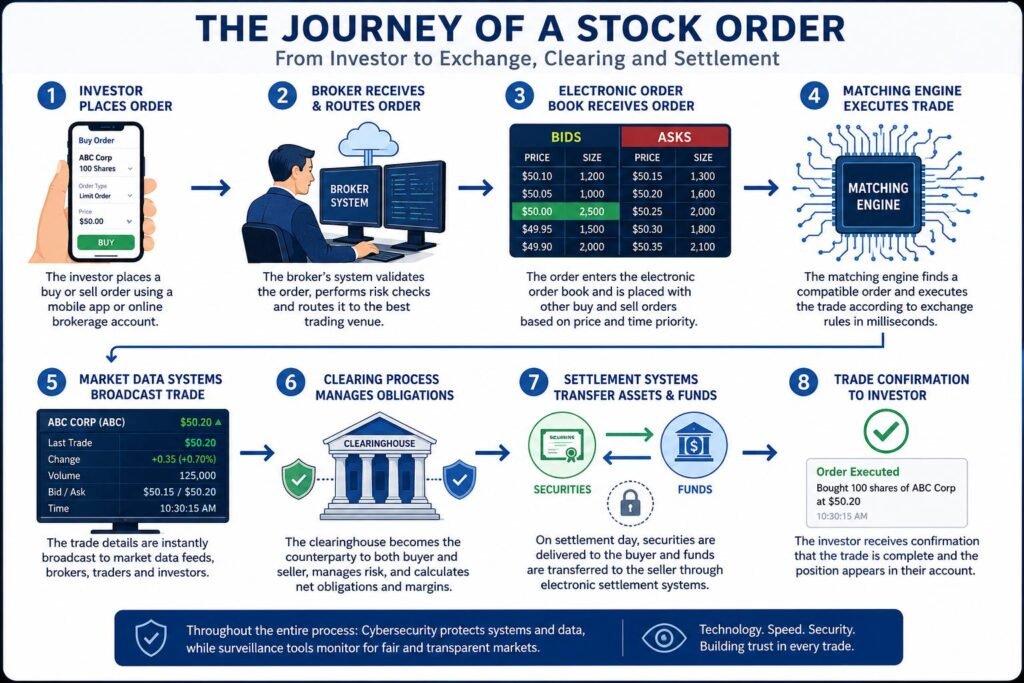
A stock order is a good example of the life of a stock order and how many technological systems are required for it to function. The investor typically can first choose a particular stock in a mobile app or their online brokerage account and then place a market order or limit order. The broker is given the instructions, carries out the necessary checks and forwards the instructions to a suitable trading venue. The order is received by the exchange via its electronic order book and passed to the matching engine where it is matched with orders. If there is an order that matches, a trade takes place and the appropriate market-data system(s) broadcast the trade data. After the trade trades pass through the clearing process, in which the obligations and risks are processed, settlement systems are used to coordinate the transfer of securities and funds. During all of this, cybersecurity measures are employed to safeguard the infrastructure and surveillance systems are used to keep an eye on what’s going on for any infractions. To the investor, the tap on the screen may seem to be something straightforward, but in reality, it is backed by complex series of interrelated technologies.
Conclusion
Stock exchanges are now operated in an entirely different way today, as most of the work, which used to be done by a stock exchange employee, has been replaced by a high level of technology and automation. Electronic order books: Keeping orders for customers to buy and sell; matching engines: fulfilling orders that are compatible. Market-data feeds deliver on-going data, automated algorithms make quick trades, and high-frequency trading utilizes specialized technology to make very fast trading decisions. In addition to the trading phase, the clearing and settlement systems facilitate the fulfillment of financial obligations, and surveillance systems keep an eye on markets for any unusual trading activity. Available additional protection against technological and operational threats is provided by Cybersecurity and Disaster-recovery systems. The stock exchanges will be more sophisticated as more and more technology develops, such as artificial intelligence, advanced analytics, networking and computing. Knowing this infrastructure helps investors to value all the business just as much as it helps them understand how each of the stock transactions is related to a highly complex technological ecosystem that ensures speed, efficiency, transparency, security and market integrity.
Get more well researched information about Technology behind stock exchanges here.