Introduction
Why is it important to know which costs are deductible for tax purposes? Because keeping up to date accounts, taxable profit to the minimum and avoiding disputes with tax authorities is very important and essential to your business. There are hundreds of costs a business can have throughout the year, however not everything is a tax deduction. Generally, the requirement is that the expense must meet the requirements of the tax provisions, which typically require the expense to be made for a business purpose and that appropriate records be maintained. Business owners should therefore differentiate between actual business operating expenses, penalties, entertainment expenses, etc. and expenses they might be doing personally. This distinction is even more significant when it comes to annual tax returns or a tax review. The proper classification also prevents businesses from deducting an expense that is later disallowed, with the consequences of an income tax liability, interest or penalties.
A related focus is on the accounting for assets and long-term investments. Often, ordinary operating costs would be different from capital expenditures, which are amounts that are spent to acquire, improve, or increase the useful life of assets that benefit the business in future periods of the accounting period. Businesses should consider it as an expense as part of depreciation, capital allowances, or other tax-specific approach as applicable based on tax jurisdiction. The same good planning should be used for entertainment expenses, fines, any expenses that include both a business and personal element, and personal expenses. While there are variations in tax laws from country to country, this is a general guideline when making decisions as to what can be deducted and what should not.
What Makes a Business Expense Allowable?
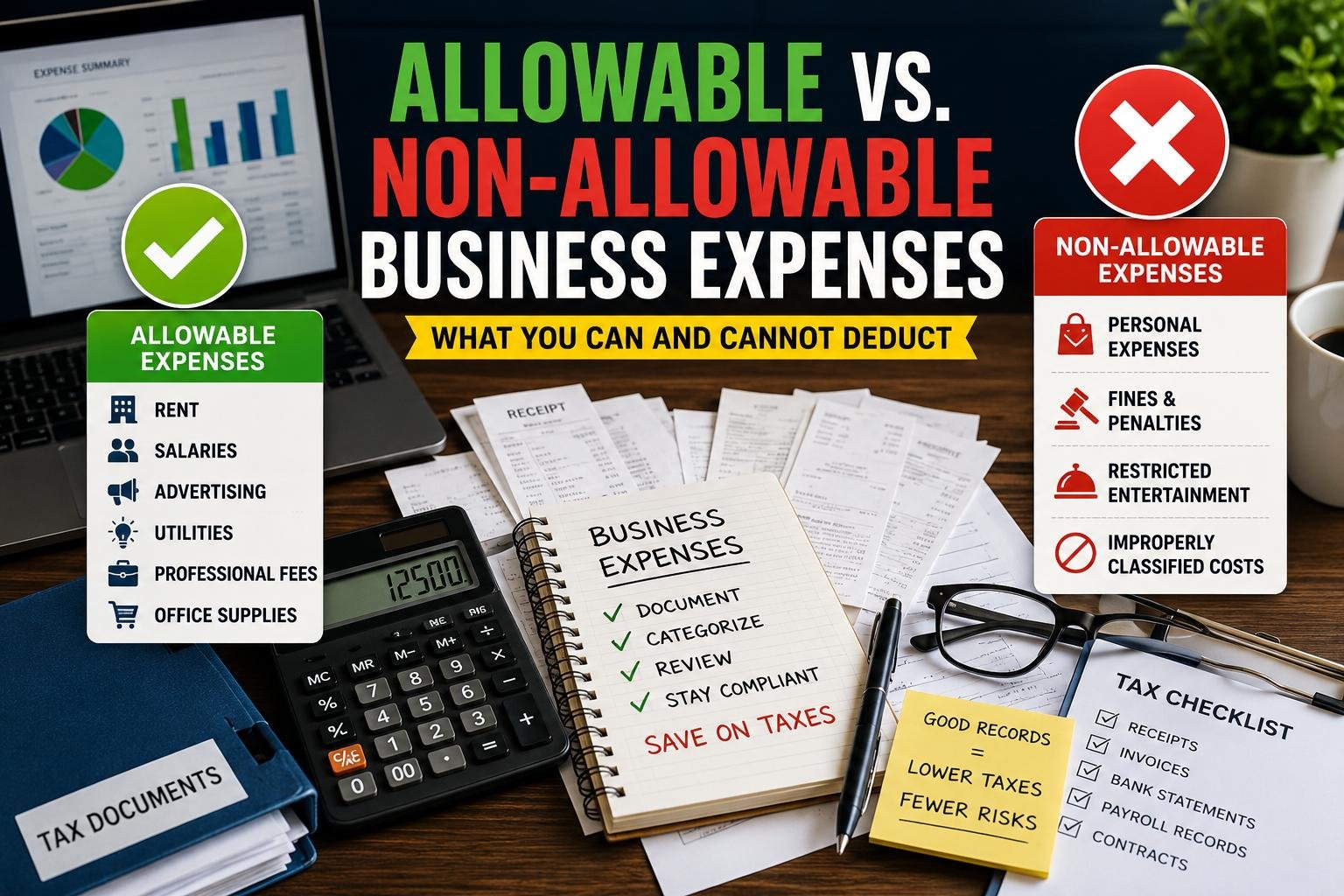
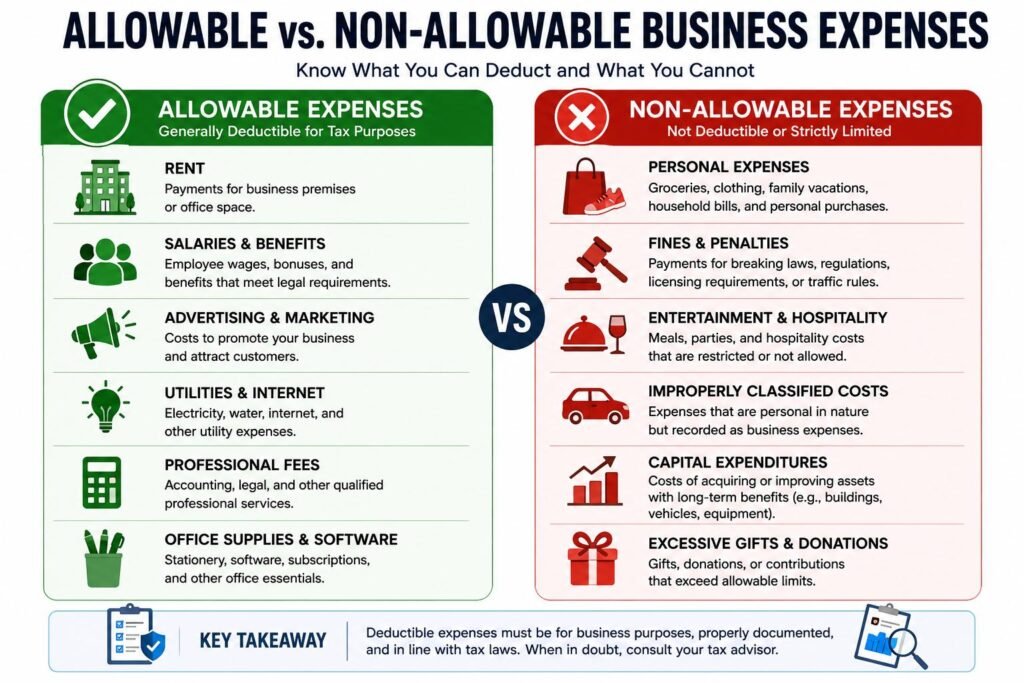
Business expenses are costs that are usually deductible by a business in determining its taxable profit. Requirements vary by jurisdiction, taxpayer and nature of the expense, but business purpose typically is one of the most important. There must be a business connection with the expense and solid documentation. Examples of deductible expenses are rent for business premises, salaries for employees who meet the legal requirements, qualified professional fees, business insurance, advertising costs, utilities and some transportation costs. Just creating the receipt doesn’t necessarily mean the amount is deductible. Before an accountant enters it into a tax computation, he should consider the purpose, supporting evidence, timing and tax treatment of any large expense.
Another critical factor is documentation, since if you haven’t got the documentation for your legitimate expense it can be quite hard to defend it. Businesses should keep the following records: Invoices, receipts, contracts, payment confirmation, payroll and bank statements, expense claims, etc. The records should enable you to identify who was paid, what was bought, when it was bought, how much was paid and the reason the business had the expense. Digital records may be helpful, but should be kept in such a manner that transactions can be traced back to the accounting records and back to the tax return. A proper book keeping system, therefore, should not just record amounts, but should record the business purpose and also keep the records required to establish that a deduction is taking place in accordance with the applicable tax rules.
Expenses Commonly Allowed for use in Operation
Many day-to-day expenses associated with a business may be considered deductible if they are related to business operations, and comply with the taxing authority’s requirements. Some of the costs that can be included are employee pay and benefits, rent, electricity, internet, accounting and legal fees, advertising/marketing, repair, software, business insurance, and office supplies. If, for instance, a company pays an accountant to prepare their financial statements, they are likely to have a business reason for this payment. Likewise, advertising costs to draw customers is generally linked to sales. But it is important for businesses to not take the fact that all expenses are in these categories as a given and assume they are all deductible. Certain expenses may be subject to special limits, recordkeeping requirements, timing restrictions or the expense may be partially disallowed where the expense has business and private components. So, it is wise to check the applicable tax laws before filing to avoid filing wrong claims.
Travel and vehicle costs are unique and may often be a mixture of business and personal travel. Qualifying costs include those incurred if a business owner visits a client, participates in a legitimate business conference, checks on a project or engages in other legitimate business travel. But if the owner runs a short business related activity on vacation, it cannot be considered a business expense. Likewise, if a vehicle is used for business and personal reasons, only the proportion of the vehicle that meets the requirements for the tax purposes will be deductible. Travel schedules, explanations of business purpose, receipts and invoices should be kept by the business. These records make it easier to prove the deductible amount, and help to establish that the expense wasn’t just an individual’s personal cost, but was really a business expense.
Non-Allowable Expenses that Businesses should Avoid
Non-allowable expenses are expenses that cannot be claimed as a deduction from the taxable income of the business if it is not allowed by the tax laws. The most frequent of these are personal expenditure. The business owner can pay for groceries, private clothing, family vacation, household bills and any other personal purchases, but the payments are business expenses and do not change their nature. This should typically be deemed to be separate from the true expense of the business and must be shown in the appropriate column, e.g. drawings, distributions, or in an appropriate column as per the structure of the business. Combining personal and business expenses also causes undue accounting difficulties and makes valid deductions more difficult to justify. It can also lead to other transactions being subject to questioning by the tax authorities if the business records show poor separation of the activities carried out at the private and commercial level. It is, therefore, one of the easiest steps to minimize classification errors to keep separate accounts and to set up clear expense policies.
Another area of risk is fines and penalties. Payments that are made as a result of a violation of a law, regulation, a licensing requirement, a traffic rule or other legal obligation are subject to certain limitations on tax deductibility, depending on the jurisdiction and payment. If a fine is deductible, a business must be satisfied that this is the case upon the underlying activity occurring but only on the basis that it was connected to a business. A regulatory penalty for not meeting a regulatory obligation is much different from a normal operating cost like an electricity bill or professional fee, for instance. The treatment of the expenditure in the accounts and the tax treatment may also be different, so that an expense that is entered in the accounts could be added back when computing taxable profit. Fines and penalties should therefore be picked out and reported on a separate line from other general administrative expenses, as these may be an accounting for actual fines and penalties.
Entertainment and Hospitality Expenses
The costs of entertaining can be a challenge as they can seem to have a commercial purpose but be capped by the tax rules. The expense of providing a potential client with a meal, of providing refreshments at a business function, of attending a social function, or of paying for hospitality is a possible expense that might be deductible as a business expense, depending on the rules that govern business entertainment in the jurisdiction in question. Some states permit some expenses associated with hospitality, others don’t deduct hospitality costs even if they are related to business relationships. Businesses need to therefore be mindful of the fact that entertainment is not automatically deductible just because someone was on the premises of the business and was a customer, supplier or prospective client. Any transaction must be assessed on the laws as applicable and the context of the transaction.
If there is potential for entertainment to be deductible, then it is important to keep detailed documentation. Receipt should be kept by the business and the date, amount, parties, place and true business purpose should be documented. For instance, if a meeting took place with a potential client for a contract or project, an expense report would be able to detail the reason for the meeting. It does not guarantee deductibility since tax law will ultimately decide whether or not the cost is deductible, but it makes it easier to see how the cost was incurred. Where there are differences between entertainment and business-event expenses and regular employee welfare, businesses should make a distinction as well. It is not wise to consider each meal, each celebration and each gift of hospitality as a business expense. The accountant can have restricted expenses identified by a disciplined classification system prior to the preparation of the tax computation.
Capital Expenditures and Other Long-Term Costs
It is important to note that capital expenditures are not a part of regular operating costs and should not be used to replace operating costs. Owned assets are acquired for some amount of time and can be relatively expensive, such as machinery, vehicles, buildings, computer equipment, furniture or other assets. Such costs are generally accounted for differently since the business benefits from them for an extended period of time or don’t use the entire value of the asset at once. Qualifying assets could be eligible for depreciation accounting and capital allowances or other statutory deductions for tax purposes, depending on the tax jurisdiction. What is crucial here is that the total cost of the purchase should be taken as an ordinary expense and this could lead to an incorrect taxable profit. There should be an asset register in place which includes details of the asset, the date purchased, cost, useful information about how it is used and the appropriate accounting and tax treatment.
Classification can be problematic too when repairs and improvements are made. A repair that brings back an existing asset to normal operating condition can be considered different from an expenditure that substantially improves the asset, extends its useful life or increases its capacity. This is important because the former could be considered as an existing expense, and the latter may be a capital expense. For instance, replacing a small component that is having minor problems on business equipment versus buying a large business piece that will boost the equipment’s productive capacity, may be very different. The classification will be determined by the facts and the tax laws. Therefore; it is important for accountants to review the actual nature of the expenditure and not just the description entered on an invoice or account code originally selected in the bookkeeping system.
Mixed-Use and Partly Deductible Expenses
There are some costs that do not clearly fall in the business category or the personal category and so they are especially significant when preparing taxes. A business owner can have a business phone in their home, own a business vehicle, have a mobile phone for both personal and business calls and be able to have an internet connection for both personal and business calls. In such cases, it might be better to only claim part of the cost, and it might be better to exclude the entire cost. Appropriate method is normally to determine the business part on a reasonable basis, reasonably supported and permitted by local tax law. The business needs to record the rationale for the allocation, and ensure that it uses the same approach each time. If such an expense is split between business and personal uses, for instance, supporting documentation should clarify the percentage split, rather than just making an unsupported guess into the tax computation.
Internal controls should be particularly robust in the case of mixed use expenses due to their susceptibility to challenge if any allocation seems to be arbitrary. A business may have written policies outlining how expenses must be apportioned and the documentation that is required by employees. The business proportion can be proven by mileage logs, usage records, work schedules, invoices, contracts, and other supporting documents. Auditors ought to also check out unusual claims, not taking them for granted to be ongoing expenses. The deductible can vary if the way the business is operated, business premises, employees, or assets have changed. Periodic reviews allow the classification of expenses to keep up to date. This is particularly important for small companies where the company owner might personally process numerous deals, and where individual and business expense is likely to be very easily confused.
How to Build an Audit-Ready Expense System
For the audit to be ready, it starts with a system that has distinct accounting categories. Businesses should establish special accounts for ordinary operations, capital expenditures, personal (owner) transactions, entertainment, fines and penalties, and other restricted expenses. This enables the accounting team to make the appropriate adjustments prior to preparing the tax return rather than after a tax authority has requested supporting documents. For every material transaction, there should be a suitable source document and unusual or high-value expenses should be accompanied by a brief explanation of the business transaction. Bank and credit-card bills should also be reconciled periodically, allowing for the detection of any missing receipts or unexplained payments, before the information is lost.
In addition, companies should conduct a regular tax review (not at the last minute) and adapt accordingly. Reviewing monthly or quarterly may help uncover expenses that have been misallocated and help correct the allocations before year end. A helpful approach is to audit expenses by category, pull up the expenses for comparison with previous years, explore any unusual expenses, check supporting documentation, and list expenses that need to be adjusted for taxes. Employees that incur costs should be aware of the company’s paperwork guidelines, such as deadlines for receipts and business use. Approval controls can offer an extra layer of security for larger organizations. These procedures will minimize the chance for unsupported deductions and provide greater ease of response should tax authorities request information.
Conclusion
Making sure you can distinguish between allowable and non-allowable business expenses is a part of doing business in a responsible manner. Common business expenses may be deductible if in compliance with the applicable legal requirements, but personal expenses, certain fines/penalties, limited entertainment expenses and capital expenditures may be subject to special considerations or may not be deductible. A company may have an expense in its books, but it doesn’t necessarily mean that the expense is deductible from taxable income. Careful consideration of expenses according to their purpose, supporting evidence, time, and tax treatment should, therefore, be conducted. They must also be aware that tax is complex and will differ depending on the jurisdiction and so general principles should always be read in the context of the legislation and guidance provided for the specific business.
The key components of a robust expense management process are accurate bookkeeping, expense policies, expense documentation, regular expense reconciliations, and professional tax review. Business owners and accountants need to keep personal and business costs separate, make sure records are kept on top of things, and be clear about capital costs, document mixed-use costs and flag potentially restricted costs before tax returns are prepared. These practices will ease the difficulties in determining the correct taxable profit and minimize the chance of costly adjustments, interest, penalties, and extended tax reviews. The objective is not to claim all possible expenses, however it is to claim all legitimate deductions that the law allows and keep records that will back these up. A disciplined approach safeguards the business, aids in financial reporting and provides a sound base for long-term tax compliance.
Get more well researched information about Allowable and non-allowable business expenses here.