Introduction
One of the most essential duties for a business is to comply with tax regulations and it is also a place where small accounting errors can turn into big problems. The obligations that businesses have to pay taxes on a yearly basis, make regular payments, file tax returns, keep records and serve as an employer or withholding agent. The shift to the Tax Acts 2025 has heightened the need for businesses in Nigeria to navigate the new tax landscape with the current requirements and not the previous tax processes. The Federal Government has announced that the Nigeria Tax Act, 2025 shall take effect from 1st January 2026 and all tax periods before that date shall be taxed according to the old tax regimes. This tax return guide issued by Forvis Mazars Nigeria is a helpful guide to help businesses recognize the significance of filing complete and timely tax returns.
Understand Every Tax Obligation before the Year Begins
To implement a solid system of tax compliance, the first step is to determine all of the tax liabilities that may exist for a business. Specific requirements will vary based on the legal structure, volume, operations, staff, address, sales and type of business conducted. A company can have corporate income tax reporting requirements, VAT requirements, withholding tax reporting requirements, payroll tax reporting requirements, and other industry-specific reporting requirements, whilst an individual or unincorporated business may have personal income tax reporting requirements. It is therefore necessary for businesses to have a tax obligations register, which documents each tax, responsible taxing authority, how often it is to be filed, when it is to be paid, who is responsible for filing the tax, what documents support it, and that it is being submitted. The 2025 tax reforms also ushered in a new administration in the revenue administration, the Nigeria Revenue Service took the place of the former administration of the federal government and the new Tax ID system was introduced to take effect from January 1, 2026. (FCT Internal Revenue Service).
Annual Tax Returns and Filling Deadlines
Filing of an annual return should never be considered as just a once a year exercise that should start just before the filing deadline. This should be the last step in an on-going compliance process throughout the year. It would be prudent for businesses to complete their accounting books, obtain bank account balances, review their revenue, review expenses allowed, determine their taxable income, review tax credits and tax deductions well before the return is due. The Nigeria Tax Administration Act provides that company’s tax returns are normally filed along with the company’s accounting year, and existing companies have a six-month period from the accounting year’s end to file returns. The due date may vary depending on the type of taxpayer, and there may be different filing requirements, so businesses should verify the due date of the rule for their category of taxpayers and not presume that all taxpayers’ due dates are the same. The NRS also offers a self-service system for taxpayers to file, pay, assess and obtain tax clearance. (NRS Self Service)
Monthly VAT Compliance
It is important to review transactions regularly and pay attention to VAT compliance every month as it can build up quickly if transactions are not being reviewed. The sales invoice(s), output VAT, purchase invoice(s), input VAT, exemptions, credit notes, debit notes, and adjustments should be reconciled by a VAT-registered business prior to preparing their VAT return. The taxable persons are required to submit VAT returns by not later than the 21st day of the month that follows, but there is specific treatment provided for qualifying small businesses and others in the 2025 framework. They should therefore find out if they have to register, charge, collect, file and pay VAT for their circumstances under the current law. (TheCable) This also includes the mandatory data to be provided on VAT invoices such as tax identification number of the supplier, invoice number, date of the supply, information of the purchaser, the value of the transaction, the VAT charged and the rate. (National Assembly of Nigeria)

Importance of PAYE and Payroll Tax Compliance.
Payroll compliance employers are required to have a separate payroll compliance process because salaries involve tax liabilities which differ from normal business expenses. Each payroll cycle should be checked for employee earnings, taxable benefits, deductions, applicable reliefs etc. and the correct amount of PAYE to be deducted. The employer shall then pay the deductions to the state in charge of taxes in the proper order and within the appropriate time and keep the payroll schedules and proof of payment. The federal tax authority is not necessarily responsible for all requirements for employees on the federal tax level; there may be state revenue authority requirements on the personal income tax level. The Joint Revenue Board has issued Personal Income Tax Guidelines for the new tax regime for the FY 2026, making it even more important that employers and taxpayers adhere to the new guidelines. Employers should also compare payroll records against their employee Tax IDs and annual returns to ensure they are consistent, before they turn into compliance problems.
Monitoring of Withholding Tax at the Point of Payment
Withholding tax is another area where businesses often make errors, in that the withholding tax can be triggered with certain payments to suppliers, contractors, professionals, landlords, investors, or others. The finance team should always check the payments prior to release and see if withholding tax will be required, and if, at what rate, and who will receive the withholding tax credit, and which tax authority will they be paid to. The Nigeria Tax Administration Act provides that tax deducted, collected or withheld must be remitted generally on the 21st of the month following the month of deduction, collection or withholding of the tax and penalties and interest will accrue where the tax is not remitted on time. Therefore, a proper WHT register ought to include details of the supplier, Tax ID, invoice date, payment date, taxable amount, tax rate, amount withheld, remittance date and evidence of payment or credit documentation.
Maintain Complete and Accurate Tax Records.
Without proper record-keeping it would be difficult to be compliant with taxes since a business would not be able to accurately complete its tax returns. Each business should keep sales invoices, purchase invoices, receipts, bank statements, payroll records, contracts, expenses records, computation of taxes, schedules of VAT and WHT, confirmation of payments, asset registers, financial statements and correspondence with tax authorities. Records must be kept in such a way that a transaction that has been submitted in a tax return can be clearly linked to the accounting entry and supporting document. They should also have proper digital copies of their data, in addition to the physical records or a single computer. New tax administration environment is more focused on the accuracy of the information, digital systems, and taxpayer records.
Estimated Tax Payments & Cash- Flow Planning
Tax compliance is not just a matter of completing tax forms, but also having enough money to pay when the tax is due. If the company’s tax burden is great, they may experience undue cash flow strain if they find out late in the year that they are liable for tax. Based on these factors, the finance team should, therefore, forecast the tax on the expected transaction, the taxable profit, credits available, tax liability of the previous year, etc. Installment arrangements/payments on account will only be considered as a payment method where permitted by the law, and businesses should carefully consider their options, taking care to confirm the reasons for their calculations. The Nigeria Tax Administration Act stipulates that tax shall be paid on or before the filing due date (in one payment or through prescribed installments) and the last installment shall be paid on the filing due date. Therefore, it is important to save regularly for taxation, thus freeing up working capital and limiting the use of tax savings for other business activities.
Create an Action Calendar for your Practice.
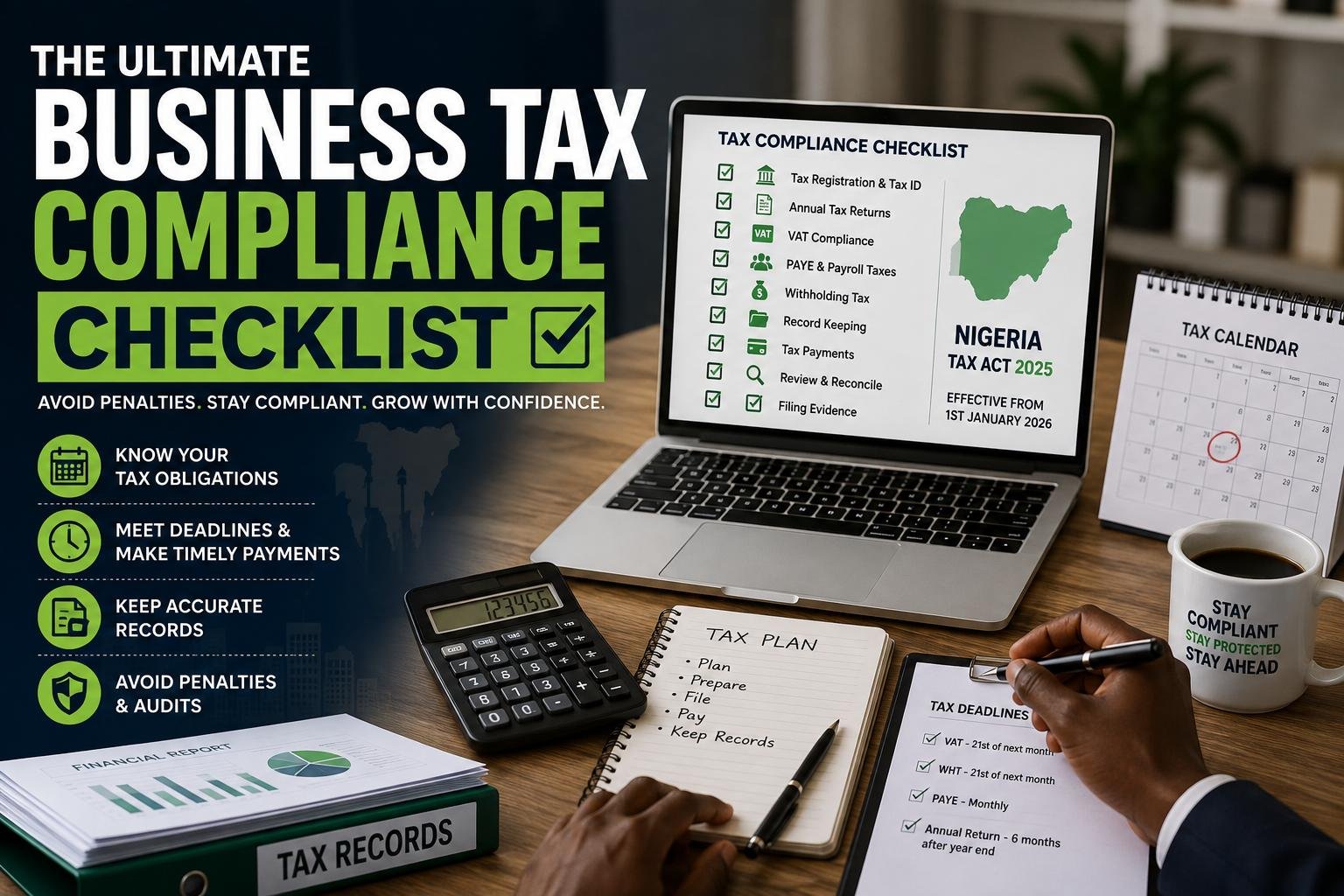
Using a tax calendar provides a valuable way to do this by making legal duties easier to manage as routine operational activities. The phrase “pay tax” should be replaced in a calendar with the type of tax, period covered, calculation deadline, review deadline, filing deadline, payment deadline, responsible person, reviewer and evidence required to be kept. Monthly payments, for example VAT, PAYE payments and withholding tax should be part of the monthly financial close while annual returns should be completed via a properly structured year-end timetable. For instance, the finance department could start to compile tax schedules a few months before the end of the accounting year instead of in the last few weeks. The tax reminders included in the business should also cover tax registrations, Tax ID update, tax-clearance certificates, license renewals and sector filings as applicable. These online systems for self-efilitation, payments, tax assessments, tax-clearance and taxpayer administration are increasingly becoming viable, as provided by the NRS. (NRS Self Service)
Apply Four Step Review before Every Filing
The filing mistakes that could be prevented can be minimized by a simple review process. The first step in preparing a tax return should be for the preparer to take time to reconcile the tax return and the accounting records and supporting schedules. Second, when you have the supporting documents, tax period, taxpayer information and figures, have another responsible person independently review these. Third, if the business’s internal controls require management approval for return and/or payment, then management needs to approve the return and payment amount before submission. Fourth, the finance department should return, pay and save the acknowledgement and update the compliance calendar. By separating the duties, one person won’t be able to make a mistake that goes undetected. For those enterprises that use accounting or enterprise software, automation can also be used to some degree. The NRS already has the capability to file VAT and WHT tax returns digitally and has already implemented system-to-system filing for VAT and WHT, with validation and tracking of the filing status. (dev.nrs.gov.ng)
The Ultimate Business Tax Compliance Checklist
- Verifies current Tax ID and registration information.
- Determine all federal, state and sector specific taxes to be paid.
- Write down due date of filing and payment of each obligation.
- Regularly reconcile bank accounts and accounting records.
- Ensure that all sales and purchasing records are kept.
- Reconcile input and output VAT records prior to the VAT return.
- Carry out payroll and PAYE calculations each month.
- Prior to making payment, check with supplier payments for withholding tax.
- Keep detailed WHT register and keep evidence of remittance.
- Maintain contracts, invoices, receipts, payroll records and tax schedules in good order.
- Plan annual tax bills to ensure adequate cash flow.
- Make tax calculations for the year ahead well in advance of the statutory filing deadline.
- Have tax returns checked by a third party prior to filing.
- Keep filing acknowledgements and receipts for payments.
- Reconcile tax books with tax authority’s tax records.
- Track changes in tax laws, regulations and official guidance.
- Regularly review compliance controls (once a year at a minimum).
- Consult a professional tax advisor in complex and/or uncertain transactions.
Protect the Business from Penalties and Audits
Unfortunately, a robust compliance system will not ensure that a business will never be chosen for an audit but it can make an audit much easier to handle. Tax authorities may request information, records, explanations or documentation and a business that can easily give such information will be in a better position than one that has to assemble information covering several years of business. Inadequacies in record keeping, failure to withhold tax, failure to file returns and late filing could create additional liabilities in the tax administration system. For instance, the Nigeria Tax Administration Act establishes penalties for deductions and remittances failures which may be administrative penalties and interest in particular circumstances. Compliance should thus be regarded as an internal control responsibility, and not as a response to a tax authority’s notice. The best practical remedies for preventing compliance issues that could have been avoided are the tools of accurate information, documentation, timely payment, and transparent communication.
Conclusion
The ultimate business tax compliance checklist is not only a list of dates, it is a full calendar of business tax compliance activities, identifying the obligations, calculating the liabilities, making sure that payments are made on time, filing accurate tax returns, keeping supporting records and making sure that compliance is monitored throughout the year. The 2025 Tax Acts, which took effect from 1st January 2026 for the relevant tax periods, should be of special interest to companies that are now doing business in Nigeria under its tax regime. A well-organized finance team should have a compliance calendar which is kept central, have regular tax account reconciliation, monthly reviews of VAT and withholding tax needs, PAYE correctly completed and filed on time, annual tax returns prepared well in advance and ensure that evidence is kept of all VAT and withholding tax returns and payments. Relatable accounting records coupled with clear responsibility, independent review, cash-flow planning and the timely utilization of official tax platforms, businesses can minimize unnecessary penalties, be more confident in their responses to enquiries and establish a tax compliance process that delivers long-term financial stability, instead of eventually turning to an emergency at filing time.
Get more well researched information about Business tax compliance checklist here.