Introduction
Dishwashing is a simple process, and good dish washing liquid depends on a combination of ingredients. Water is used to clean up loose crumbs and some soluble food items, but is not effective on grease, oils, proteins, starches, or food that gets dried on. This is where cleaning ingredients come into play. Most modern natural dishwashing detergents contain a mixture of surfactants, plant-based cleaning agents, enzymes, acids, water softeners, fragrances, preservative agents and other auxiliary components. The different components serve specific purposes, and knowing these purposes can enable ingredient-conscious consumers to identify ingredients by their intended roles and not just the marketing terminology. The term “natural” implies that the product consists of only basic ingredients from the home, however, for effective formulations a combination of selected ingredients is used to optimize grease removal, rinsing, stability, fragrance and overall performance while minimizing unnecessary or unwanted ingredients.
What makes Dishwashing Liquid Effective?
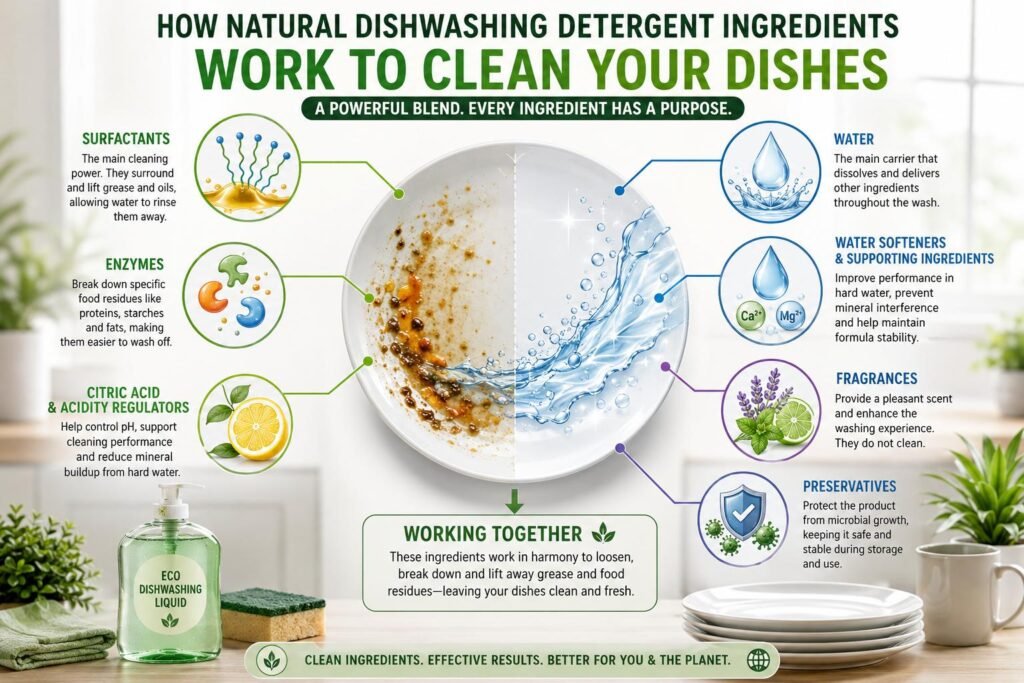
Dishwashing liquid is primarily used to loosen the food and grease from a surface so that the grease and food can be suspended in water and washed away. Common components that cause this process are typically surfactants, which alter the interaction between water and oils and other residues. Surfactant molecule contains a polar end that likes to associate with water, and a nonpolar end that likes to associate with oils and grease. Surfactants may be added to water and enclose the oily particles, allowing them to be separated into the washing water. This will stop grease from just oozing over a plate or sticking to a pan. These basic cleaning properties are complemented by other ingredients that help to remove certain food residues, neutralize the acidity, enhance the performance of the water, preserve the product during storage, or make washing more pleasant. This doesn’t mean that a formula designed to work well is necessarily one that features a primary star ingredient, but rather one in which the ingredients are combined to achieve a desired effect.
Surfactants: The Main Cleaning Ingredients
The most important component of dishwashing liquid is usually the surfactant, which enables water to work more effectively than it would normally to remove substances that cannot be dissolved by water alone. An example of this is grease. Water and oil do not naturally mix well, and just dunking a grease soaked plate in water may not help. To overcome this, there is a need to use a surfactant that will mediate between the water and the oily substance. They can release fat from dishes while washing and create configurations that prevent the accumulation of oily material in the wash water until it is rinsed off. Sustainable and natural products can contain plant-based derived surfactants, such as those containing coconut, sugar or other natural sources. However, consumers should still review the full ingredient list and take into account the formulation, concentration, application and any relevant safety information, as not all such “plant-derived” surfactants are completely harmless or suitable for everyone.
Plant-Derived Cleaning Agents
Plant-based cleaners can be incorporated into consumer formulations that claim to be alternatives to traditional cleaners. These ingredients can be derived from renewable natural resources like coconut, corn, sugar or other plants, and be extracted to create valuable cleansing agents. Their functions vary with the individual chemical. Some are effective as surfactants, others as an aid to wetting and foaming, grease removal or the sensory aspect of hand washing in general. It is crucial to separate the ingredient’s source from its cleaning action. Many products, such as detergents, are made from plants and also are processed extensively to become an ingredient in a detergent. Thus, for consumers considering eco dishwashing liquid, the question is not just whether the product contains a plant-derived ingredient, but how the ingredient functions in the formula, its manufacturing process, and whether the product and the process align with the consumer’s wishes for environmental and performance properties.
Enzymes: Food Residues.
Enzymes can also offer specific cleaning support, to decompose specific organic food waste. Enzymes do not act by detaching and dispersing the contaminants, as do surfactants, but act by biochemical reactions to make certain residues easier to remove. Proteases, for instance, are linked to the digestion of protein, which may be included in foods like sauces, eggs, milk and meat. Amylases act on starch residues, such as those found in foods like rice, pasta, potatoes and cereals. Some fats and oils can be used by lipases. Not all dishwashing liquids contain enzymes, and the kind, type, concentration and effectiveness of any enzymes present in dishwashing liquid will vary according to the formulation. Enzymes may be beneficial if left over food has dried on a dish as they offer a different method of cleaning as compared to surfactants. People wishing to use products containing enzymes should do so after checking the list of ingredients of the product, not assuming that all natural or eco-products contain enzymes.
Citric Acid and other Acidity Regulators
Another common and familiar ingredient that can also be found in dishwashing products is citric acid, which varies in its function based on the product. A detergent’s pH may impact the effectiveness of cleaning, stability and interaction with residues and surfaces, therefore citric acid can be used to adjust and control a formulation’s pH. Acidic ingredients can also be used to help resolve some of the mineral deposits that can occur in hard water, but a dishwasher detergent should not be assumed to be a special type of descaler just because it contains citric acid. Aids can also be used to help achieve the desired chemical environment of the product in some formulations. What is crucial to note for consumers is that citric acid may not be the main active in the process of removing the grease. The central cleansing function is usually done by the surfactants, and the acids like citric acid can provide supporting functions. Its inclusion illustrates that cleaning products are not made of a single cleaning chemistry, but are composed of a number of ingredients.
Water, Solvents and Supporting Ingredients
Water can be the bulk of liquid dishwashing products because it is the vehicle by which the other ingredients are dissolved, dispersed and carried. But water isn’t going to do the job that detergent can do. Solvents or other supporting ingredients can also be used by the formulators to aid in dissolution of specific ingredients, consistency and reliable performance during shelf life. Some formulas include components that will prevent undesirable reactions between the minerals in hard water and the cleaning agent. The supporting substances can enhance the performance of the surfactants and minimize the effect of natural calcium and magnesium ions that are present in hard water. Thickening agents can also be added to provide a desired texture to the liquid, which may be added to maintain formula uniformity throughout storage, depending on the formula. These can be important to a stable and usable dishwashing liquid, but may not be noticed by the consumer due to lack of dramatic bubbles or fragrance.
Fragrances: Sense Appeal, Not Cleaning Power.
Fragrance is one of the most noticeable ingredients in a dishwasher, but it’s not synonymous with cleaning ability. Sometimes, it is the scent that makes the dishes feel fresher when washing them, and can help to minimize or cover up the pungent smell of the food remains on the dishes or in the sink area. Depending on the product, natural or naturally derived fragrances can be essential oils, natural extracts from plants, or other fragrance substances. But mere presence of a botanical fragrance doesn’t necessarily indicate better grease removal. It typically has a sensory, but not a cleansing, function. Ingredients may also be important to consumers who are sensitive to specific fragrance ingredients, so fragrance-free products may be considered when available. This is because those looking to buy ingredients for their favorite projects should consider a perfume’s aroma without its cleaning properties. A detergent that smells like cat pee is nothing better than one with a mild scent or no scent at all; the cleaning is done by the ingredients in the detergent that counteract the odors, detergents and oils.
Preservatives: Designed to Safeguard the Cleaning Product.
Preservatives are not a typical ingredient in a cleaning product, but can be an important addition to liquid products. Dishwashing liquids are often composed of large amounts of water, so that microorganisms may grow if the formula was not sufficiently protected. Preservatives are used for controlling undesirable microbial growth, and can thus be a factor in determining stability and safety of a product for its intended shelf life. The preservative system is dependent on the formulation, packaging, pH, water content, and other factors. The absence of a conventional preservative system does not necessarily mean that it is superior, as it can present other formulation problems. If consumers are worried about specific preservatives, they should check the full ingredient list, not just front label claims, and follow the manufacturer’s information. Preservation is a functional aspect of the product being consistent from the time of manufacturing until it is used in a well formulated detergent.
Foam and Lather
Many consumers think of foam when they think of dishwashing, but there’s a correlation between the amount and the amount of cleaning performed. Air can be added to the wash solution and the bubbles formed can be useful in providing visual and sensory feedback while washing. But the grease removal capacity of a detergent varies depending on other variables like grease chemical composition, concentration, water temperature, contact time, mechanical action and grease type. Some effective formulas will result in lots of foam and others will make less foam but just as effective a cleaner. This is important when comparing products that are environmentally friendly since consumers might think they are getting more lather than performance. A detergent which creates a lot of bubbles is not always a better cooking oil remover, and a low foaming detergent is not a weak detergent. What really matters is if the formula can break apart, lift up and wash away the specific film of deposits that are present on regular dishes.
How the Ingredients Work Together
Highly effective dishwashing formulations depend on the synergy between ingredients, not on any one ingredient being able to do everything. Some of the grease and food particles can be dispersed and loosened by using a surfactant and some biological residues can be broken down by enzymes. Some mineral related residues may be helped by acidity regulators like citric acid which can help to maintain the desired formulation conditions. The water is the medium in which the formula is dissolved; and the supporting ingredients can enhance the stability of the formula, ensure consistency and optimize performance under various washing conditions. Fragrance can add to the sensory experience and preservatives will help to prevent undesirable microbial growth in the liquid during storage and use. This pairing is what makes it important to read an ingredients list, even though you know one or two of the ingredients: is it “good” or “bad”? An ingredient in a small amount could play a significant technical function, whereas an ingredient in a larger amount might only be a carrier in the formulation. Knowing function is a more helpful method of assessing a detergent.
Choosing an Ingredient-Conscious Dishwashing Liquid
People who want to cut down on impact on the environment, or who want to use simpler cleaning solutions, shouldn’t rely on various labels like “natural” or “green” or “eco” and should ask about what these terms actually mean to the final product. Brands such as Terreéa Home Rituals reflect the growing interest in more considered household cleaning products, but consumers should still evaluate what each product actually offers. Think about if the detergent is the cleaning strength required for the normal grease and food residue; if the ingredients are in line with personal tastes; if the packaging and application system also meets the environmental objectives set for the product. While an eco-dishwashing liquid might come across as a better alternative to the average dish liquid for consumers looking for a more environmentally friendly balance of ingredients, the composition is still important. Other factors to take into account include concentration, recommended dosage, packaging material, fragrance preference and hand dish washing capability. The ultimate decision is not about which detergent is the best detergent, but it is about which detergent will be the best detergent for the particular household you are looking at.
Conclusion
Once you know what is used in the dishwashing, it is easier to distinguish between ingredients added for cleaning and those added for only the purpose of adding texture, fragrance, preservation, or stability to the dishwashing. Surfactants are typically the key ingredient in grease removal as they facilitate water’s interaction with oily residues and removal during the rinsing process. Enzymes may be used to deliver more targeted action on proteins, starches or fats and citric acid and other formulation ingredients have a role in supporting pH control and overall performance. Ingredients used in the manufacture of cleaning products that are derived from plants could be another source of cleansing ingredients, but again, it is not enough to say that a product has plant origin because it is environmentally friendly or effective in cleaning. Fragrances enhance the sensory properties, preservatives prevent water-based formulations from spoiling, and auxiliary ingredients ensure product stability and usability. These functions are important for shoppers who are comparing an eco-dishwashing liquid with traditional ones, as they make a more informed basis for choosing their dishwashing liquid. The aim is not just to select the most natural sounding ingredients but to select a product that is well formulated to clean effectively and fits with the consumers’ focus of ingredients, ease of use and environmental responsibility.
Get more well researched information about Natural dishwashing detergent ingredients here.