Introduction
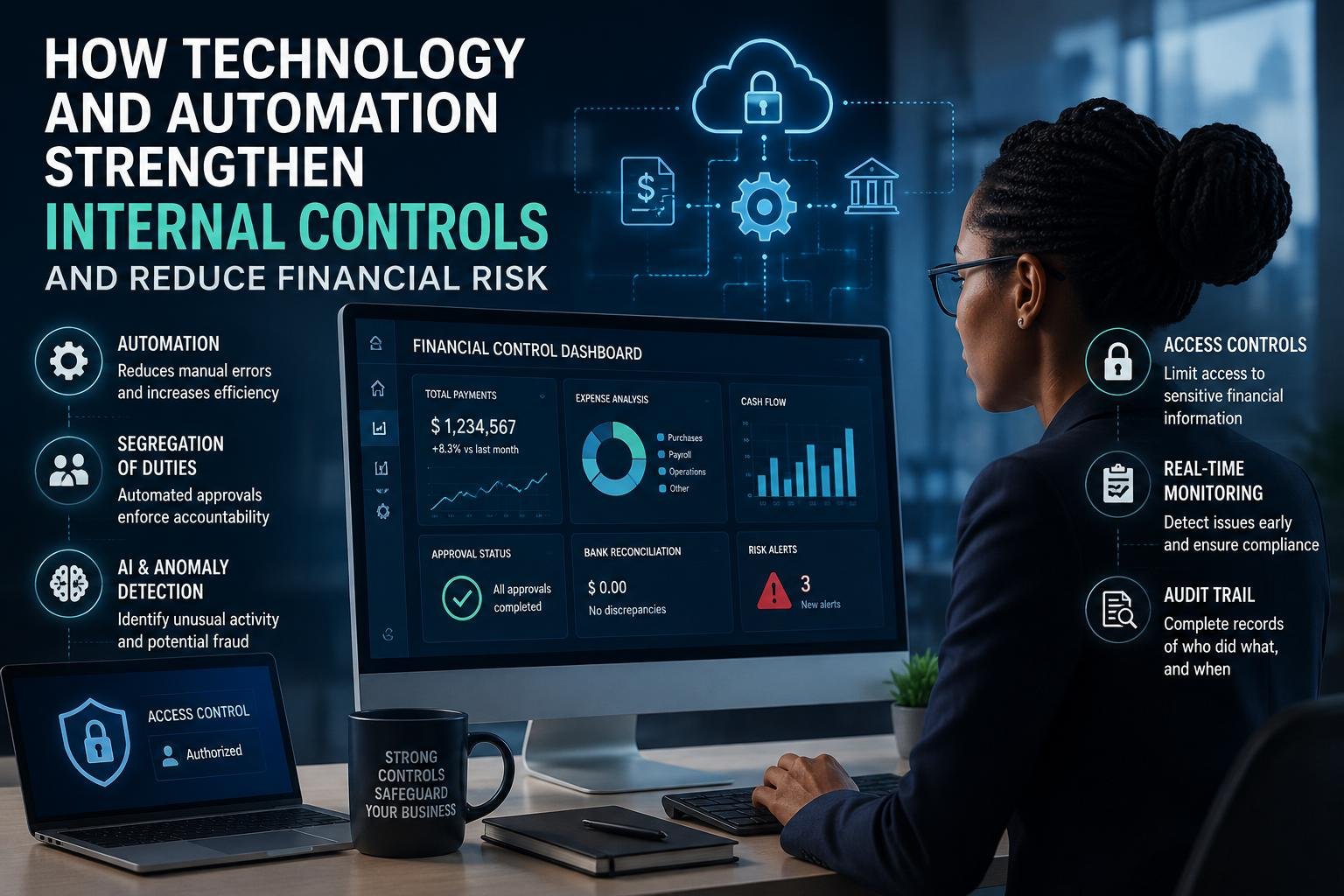
The use of technology has completely changed the way transactions, business activities and valuable resources are managed in organizations. Manual methods, spreadsheets, paper records and employees relying on their memory to carry out certain checks at the right time are all traditionally used to implement internal controls and this approach can be very reliant. These approaches may work in a small setting, but scale of the organization and transactions makes them increasingly difficult to manage. Organizations can use modern accounting software to more effectively record, process and track financial information, and to minimize reliance on repetitive manual tasks. With the help of technology, automation, artificial intelligence, and well-thought-out access controls, internal controls can become more efficient, effective and manageable. Technology does not replace internal control principles, but rather reinforces them, by incorporating key internal controls in day-to-day financial transactions and providing clear and accurate documentation of transactions.
Importance of Technology in Today’s Internal Controls
Important financial processes are consistent and rely less on personal opinion, thus reinforcing the internal controls through the application of technology. Manual method can involve the employee checking the invoice, verifying the supporting documents, securing authorizations, keying in the transaction and then reconciling the payment. Every step provides an opportunity for wrongdoing, slowdowns or intentional tampering. Automated systems can enforce rules to ensure that specific information is provided before a transaction can be processed, can route transactions to the appropriate reviewers and keep track of who is performing each action. This means that the working environment is more controlled as employees are not to wing it or make up their own rules. Technology can also help managers have better visibility on financial matters, providing them with faster access to financial information. If management is able to detect unusual transactions, missing approvals, duplicate payments or unexplained changes in a timely manner, corrective action can be implemented before the small problem turns into a big financial loss.
Minimizing Human Errors using Accounting Software
Incorporating accounting software can greatly minimize the opportunity for mistakes arising from repetitive data entry and manual calculations. With a traditional environment, employees can input the same data into multiple spreadsheets or multiple systems, and the risk of entering incorrect data, making mistakes in calculations, entering duplicate data, or missing transactions is increased. New accounting platforms can do recalculations, utilize accounting rules already preprogrammed into them, produce repetitive accounting entries, and link related financial records. For instance, if an approved purchase has been entered, the system could automatically adjust the related accounts and keep a record of the transactions without the employees needing to manually compute each of the amounts associated with the purchase. Automated bank reconciliation can also reconcile accounting records with bank transactions, and can identify any discrepancies for further investigation. These capabilities don’t replace the role of the professional judgment but do minimize non-value-added manual effort and enable accounting team members to spend more time looking at exceptions, investigating discrepancies, and completing and verifying financial information.
Automation of Approvals for Segregation of Duties
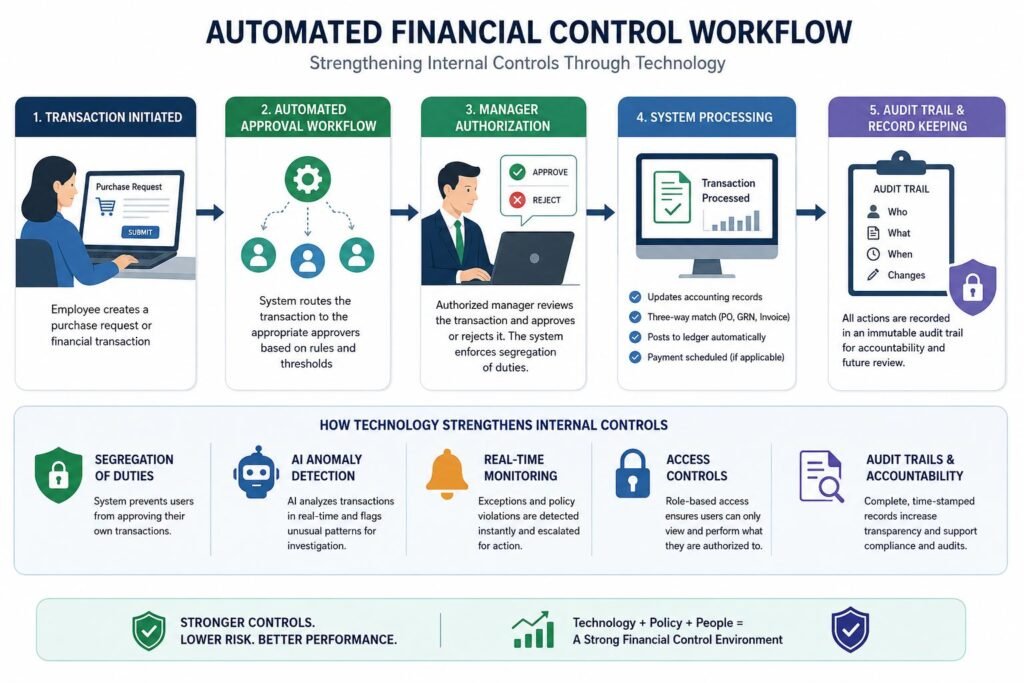
Another key aspect of how technology enhances internal controls is approval automation. Segregation of Duties is one of the most basic control principles since it will not allow a single individual to be in full control of the transaction from start to finish. In a manual environment however, it is difficult to enforce segregation of duties, especially if there is a small staff. An automated workflow may assign roles as per the roles defined and also will not allow users to approve their own transactions. For instance, a purchasing system might force an employee to make a purchase request and at the same time send it to an authorized manager for Authorisation. Upon approval the request can proceed to procurement or accounts payable for further processing. The system can additionally set up different approval thresholds according to transaction value. This provides a digital approval trail, and facilitates management and auditors to ensure that money was approved as it should be.
Anomaly Detection & Fraud Prevention using AI
Artificial Intelligence is providing opportunities for all organizations to detect financial transactions that could be of interest to investigate. While traditional control procedures involve employee review based on a set of rules, manual review of large amounts of financial information can be slow, and could allow unusual amounts of money to slip through the cracks. Anomaly detection using AI can sift through a vast amount of financial data, and can recognize patterns that do not match regular business operations. For example, a payment of a high amount to a supplier, a large number of payments made in a short time near the limit of the payment amount, repeated payments from the same bank account or payments at unusual times. The intent isn’t to consider all unusual transactions to be fraud, but to be aware of the potential for fraud. The intent is not to say that all unusual transactions are necessarily fraud, but be aware of the possibility of fraud. Instead, the technology can be used to identify additional transactions that warrant more attention. This enables the finance teams to focus on more complex projects and transactions are completed as usual.
Real-Time Monitoring and Compliance
Finally, technology can aid organizations to track adherence to financial policies and regulatory requirements. The manual compliance review process can be undertaken at regular intervals, so that issues can go unnoticed for weeks or months until someone catches them. Automated monitoring can always check transactions against pre-defined rules and alert when exceptions are found. An organization might, for instance, set the thresholds for transactions, specify payments that include restricted categories, require missing documentation, trigger unusual expense claims or detect transactions that fall outside of the organization’s policy. The ability to monitor in real-time is especially useful as financial risk can quickly build up. As early as possible in the failure of a control, corrective action can be taken. Automated records also give evidence that controls are working as consistently as expected, which can help to support internal reviews, external audits and regulatory examinations. However, automated rules should be reviewed and updated periodically when laws and regulations change or business activities change or when internal policies change.
Access Controls and Protection of Financial Information
Access controls are key since any financial software can be a huge liability if employees have too much permission. With technology, organizations are able to decide the access, creation, modification, approval, and deletion rights of individual users. Role based access can provide the appropriate level of access for employees to ensure they only have the permission they need to do their job. For instance, an accounts payable employee may have permission to record supplier invoices but restrict their access to updating supplier bank information and/or approving payments. A manager can approve transactions and may not have access to change accounting records after they have been approved. One could add an additional layer of security by requiring multiple factor authentications; that is, users would need to confirm their identity on more than one basis. Access rights should be regularly checked by organizations, especially when staff member’s jobs change or when they leave the organization. Quickly clearing way of any access that is no longer needed minimizes the chances that old computers will be used by someone who is not part of the company or that the information will be used by an unauthorized person.
Monitoring and Accountability of the Audit Trail
The creation of detailed audit trails is one of the big benefits of automated internal controls. The audit trail tracks the significant financial activities, such as who did an activity, what was changed, when an activity was performed, and, in some cases, what information would exist prior to an activity being performed. This has the benefit of increasing accountability as users will be able to trace back important activities to the account they are responsible for. Audit trails also can be used to trace back the origin of an error or suspicious transaction. For instance, if a supplier’s bank information is updated just prior to a significant payment, an organization could determine who updated the bank information, who authorized the payment, and if the payment was made in accordance with the procedures. It can be much harder to investigate such incidents without reliable audit records. Automated audit trails can, therefore, act as a deterrent to the wrong doing as well as evidence of it if it does occur, thereby helping to both prevent and detect.
The Use of Technology in Financial Processes
The greater the effectual collaboration of various financial controls, the more efficient technology would be. An organization may have accounting software for their finances, an automated purchasing system for procurement authorizations, expense management software for employee claims and analytical tools to help track out-of-the-ordinary transactions. If these systems are properly integrated, the information can flow from one process to another with reduced chances of human errors. For instance, a supplier invoice and receipts can be matched to a purchase order, and the purchase order can be paid prior to the receipt. This three way matching can be used to verify situations where goods have not been ordered or received, and are being charged for by an organization. Additionally, integration offers a more comprehensive perspective on financial operations for management. Rather than having to receive information from a variety of departments, authorized managers can get more consistent information and find links between purchasing, stock, payment and accounting.
Never Replacing Human Oversight with Technology
While automation can enhance internal controls, it is important for organizations to not think that technology takes away financial risk. People set up the rules, data and configuration for the automated systems which are then operated according to them. If these rules are not devised effectively, the system can end up automating an ineffective process. Likewise, erroneous information can yield inaccurate results and too much permission can compromise good controls. There is also the possibility that AI-based systems can produce false triggers or not detect new types of suspicious activity. But human supervision is still a necessary aspect. Employees need to be alert for major exceptions, investigate any unusual transactions, test automated controls, and determine if the technology still serves the organization’s goals. In addition, management should put in place procedures for changes to the system, software updates, access audit, data backup, and incident response. Industry best practices are a blend of technology’s agility and consistency and the human part of judgment, professional skepticism, and accountability.
Implementing Technology-Based Controls in an Organization
There is no need for an expensive system or a big technology team to start making internal control more robust with the help of technology. One way to do this is to find the processes in a money system that pose the highest threat and see where technology can be applied to maximum advantage. The initial activities that management can start with are those that involve high volume, like cash receipts, purchases, payroll, reimbursement, accounts payable and bank reconciliation. The organization should map the current procedure, take the shortcomings into account and decide which activities can be automated without posing new risks. Access rights would then be granted based on job responsibilities and approval workflows based on appropriate access. Once in place, management should conduct testing to ensure that controls are effective and track and review exceptions. The initial steps in moving to automation for smaller-sized companies should begin with a few high impacts automated controls and then slowly increment. It can help to make the investment in technology more manageable and be sure that technology is used to solve real problems of control and not just for the sake of technology.
Conclusion
Automation and technology are increasingly a necessary part of a company’s internal control system, as they can help minimize manual errors, enhance segregation of duties, pinpoint unusual financial activity, safeguard sensitive data, and better track compliance. Accounting software can enhance the precision and uniformity of monetary details, and automated approval workflows can make certain that transactions are approved properly prior to being processed. Access controls can limit financial transactions to authorized users and AI anomaly detection can detect unusual patterns, potentially signaling errors or fraud. Meanwhile, audit trails create increased accountability and enhance financial investigations. Technology should be considered as a complement to the sound control principles and not as a replacement for humans. With the right technology, a good policy, consistent oversight, accountability and reviewing on a regular basis, organizations can enhance their internal controls and minimize the financial risk as they expand their operations.
Get more well researched information about technology and automation in internal controls here.