Autonomous systems are one of the key sectors in contemporary technology, altering the way machines interact and work with the world with limited or no direct human command. Autonomous technologies are intended to detect their environment, make decisions and perform actions without human interaction. These systems are sometimes described as futuristic ‘inventions’ but there are many forms of autonomy that already exist in the world, as seen in the areas of transportation, manufacturing, agriculture, logistics and defence. The knowledge of how autonomous systems work allows them to differentiate between realistic expectations of what machines are able to accomplish and unrealistic.
The collection of technologies that make up an autonomous system include several high-tech technologies such as sensors, Artificial Intelligence (AI), machine learning, computer vision, and decision making algorithms. These technologies enable machines to sense their surroundings, process the data, anticipate potential scenarios and react accordingly. The idea is not to replace human activity, but to facilitate things to be carried out by such systems, in a more efficient, safe and repeatable way, in cases where the human control may be problematic or dangerous. Despite the ongoing research, autonomous systems have potential to increase in their ability, but they still have a few critical issues to address regarding safety, reliability, cost, and trust.
What Are Autonomous Systems?
An autonomous system is a machine or software-based system that can perform tasks without continuous, human input, by observing their environment, processing the information, making decisions, and then taking actions. Autonomous systems can respond to varying environments, unlike traditional automated machines with hardcoded instructions. In the case of a regular factory machine, it can perform the same operation each time, but an autonomous robot can detect the obstacles, change the path and handle things that are not expected.
The autonomy may differ significantly with respect to the technology and goal of the system. In some of these systems the human has to monitor or approve key decisions, and in others, they can function without a human operator for extended periods. If there is a modern driver assistance system in a motor vehicle, it can assist in steering and braking—however, it still leaves humans needing to be vigilant in the driver’s seat. An autonomous warehouse robot, on the other hand, can maneuver around a warehouse with little human assistance, carrying packages with it.
To grasp the principles of autonomous systems, consider the merging of technologies that enable machines to perceive, act and think. They are not intelligent like humans, but rely on pre-programmed rules and artificial intelligence that has been trained with a massive amount of data to perform specific tasks. Their capabilities rely a great deal on their sensors, software, training data, and operating environment.
Underlying Technologies of Autonomous Systems

Autonomous systems are built from sensors as they enable machines to gather data from the environment around them. Autonomous machines have various types of sensors that help them to understand their environment, much like humans do through sight, hearing and touch. In autonomous technology, common components include cameras, radar and lidar sensors, ultrasonic sensors, GPS and motion detectors.
For instance, self-driving cars are equipped with several sensors that enable them to sense traffic signs, pedestrians, and other cars, and give them a sense of the road conditions. Cameras deliver visual data, and lidar utilizes laser pulses to make comprehensive maps of the setting. Even under bad weather conditions, radar can accurately measure distance and speed of objects. Multiple sensors can be used together to build up a more comprehensive picture of the environment of an autonomous system than any one sensor could give.
Sensors are not 100% perfect though. They may become stressed in situations where the weather is too hot or cold, there is not enough light, or it is too crowded, or it is one that they are not trained to recognize. That is why engineers work on sensor technology and how to fuse information from various sensors together to work better.
AI serves as the ability of AI Autonomous systems to analyze data and make decisions. Unlike traditional instruction, AI enables machines to learn from experience, identify patterns, predict outcomes, and enhance their performance. One area of AI that is particularly relevant is machine learning, which is the ability to learn from vast amounts of data.
For instance, a self-driving car can be programmed with millions of instances of driving scenarios. The vehicle uses machine learning to identify objects, estimate the trajectory of other road users and make decisions. Likewise, agricultural robots could learn to recognize healthy plants, disease and also just what resources like water or fertilizer are required.
Machine learning is not about machines thinking like humans. Autonomous systems are not emotional, do not have personal understanding or general intelligence. They are provided with the patterns and execute specific tasks based on those patterns. If a system encounters a situation that is completely different from its training experience, its performance may decrease.
Computer Vision: Giving Machines the Ability to See
Computer vision is a technology that enables machines to understand what is capturing information through vision from cameras or other imaging devices. Understanding images and video is one of the most crucial technologies in autonomous systems as a lot of real world tasks involve understanding images and video.
Computer vision is used in transportation to identify lane markings, traffic light colors, road signs, and other objects in the vicinity. In agriculture applications, computer vision systems may be used to analyze plants and detect their diseases, pests, or areas of interest. Robots are outfitted with cameras that help them find items in a warehouse and navigate it efficiently.
The real world is unpredictable, so it’s difficult to develop reliable computer vision. Objects may look different under various light conditions, distances, weather, or location. Engineers need to make a system learn with various data to enable it to behave accurately under a variety of circumstances.
Case of Autonomous Systems

Automated Vehicles and Transportation
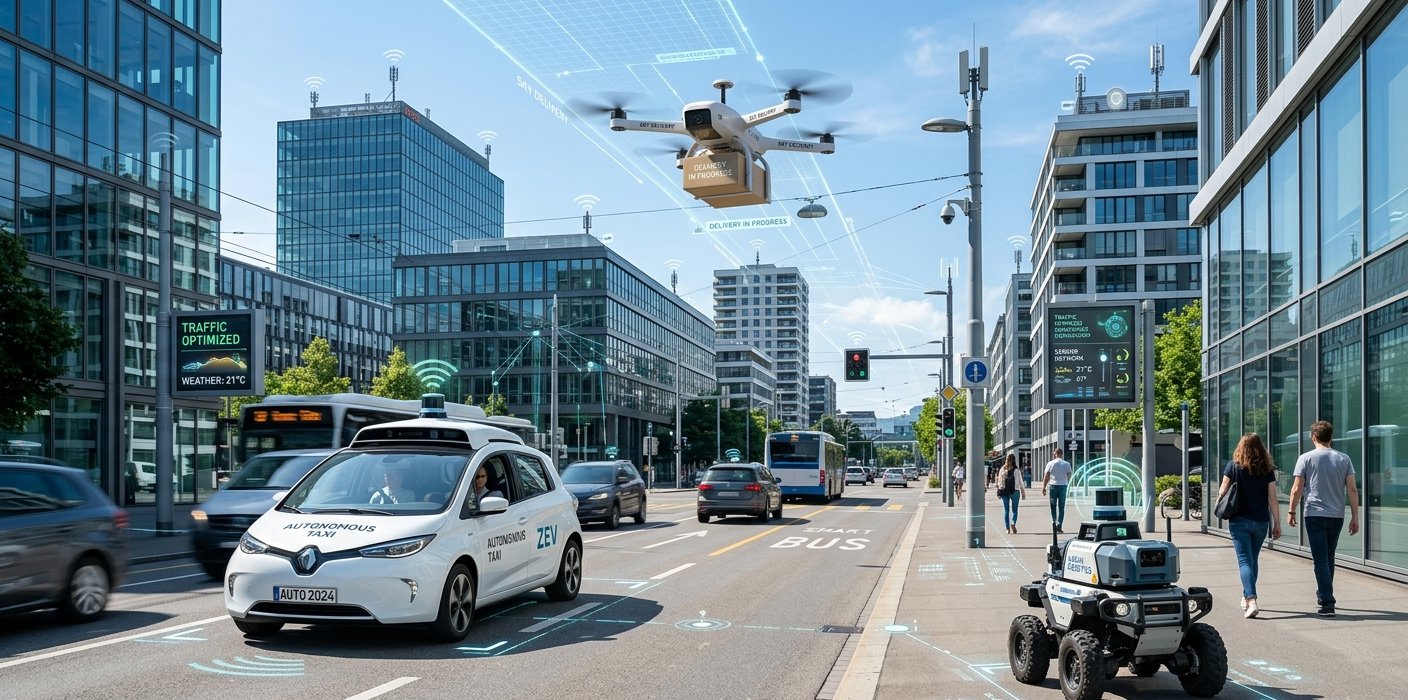
One of the most talked about applications of autonomous systems is the self-driving car. Vehicle manufacturers and researchers throughout the world are creating vehicles to help the driver or to drive on their own under certain conditions. These days, adaptive cruise control, automatic emergency braking, lane assistance and advanced driver assistance systems (ADAS) are used.
Self-driving cars that can navigate themselves through all driving conditions have yet to be developed and tested. Existing systems are most effective in controlled conditions with known parameters. Roads are a complicated situation that requires human judgment, weather conditions, construction sites and unforeseen circumstances to consider; it is a challenge for complete autonomy.
In addition to private cars, autonomous technology is also being applied to public transport vehicles, delivery vehicles and industrial vehicles. There is an investigation into autonomous trucks and delivery robots to achieve efficiency and lower transportation costs.
Application of Autonomous Systems in Logistics and Warehousing
Autonomous technology is a big consumer in the logistics sector because warehouses need goods to move quickly and accurately. AMRs can carry goods, manage stock and help humans with repetitive jobs.
Robotic systems are used in large warehouses to minimize the time it takes to find and transport products. The robots are capable of adapting to varying environments, navigating around obstacles and communicating with management systems. Robots do not take the place of workers but are used to do tasks that are physically heavy for the humans, while the humans are responsible for supervision and problem solving tasks.
Autonomous logistics systems are particularly useful in the context of growing orders for quick delivery, especially in e-commerce. But, the adoption of automation needs to be balanced with the issues of educating workers, job displacement, and the expense of using high-tech equipment.
Agriculture and Smart Farming
Other areas, such as agriculture, are also changing with autonomous systems. The adoption of drones and robotic technology, along with AI-driven monitoring systems, has boosted productivity and resource management on farms.
The autonomous drones can take photos of farmland, monitor the health of crops and detect issues early before they get worse. Robots can be used to help with planting, harvesting and weed removal, among other things. These technologies enable farmers to make informed decisions by offering them detailed information on the condition of their soils, how their crops grow and the environment.
In regions with limited labor availability or where bigger farms are needed, autonomous agriculture is very beneficial. Small farms however, may find difficulties to adopt those technologies due to the cost. Implementing successfully depends on solutions that are affordable, and training to enable farmers to take advantage of new tools.
Defense and Security Applications
In defense and security, autonomous systems can also be employed in settings that could pose a threat to humans. This can involve monitoring drones, self-driving cars for transport, or inspection or support robots.
These technologies can help to make the world safer by enabling robotic systems to move into hazardous environments and gather data while not putting people in harm’s way. The application of autonomous systems in defence, however, does pose some interesting ethical and legal issues, particularly in relation to the control of, decision making within and accountability for autonomous systems.
Many experts state that there should be some sort of human oversight on autonomous technologies, especially if decisions have serious consequences. One of the most critical debates in the realm of autonomous systems is that of balancing technology with responsible use.
Advantages of ASes
There are a number of possible advantages of autonomous systems in various industries. There is one very good thing: efficiency. Machines can be more productive than people and can be made to perform repetitive tasks over and over with the same performance. This can help in decreasing delays and enhancing productivity in business operations.
Another advantage is safety. Autonomous systems can be employed in dangerous environments such as extreme conditions, heavy machinery, and hazardous material. Advanced safety systems are employed in transportation to reduce accidents by alerting to risks and supporting the human operators.
In addition to the above, autonomous technology can enhance accuracy and decision making. AI systems can process massive amounts of data at a speed that surpasses human capabilities, enabling businesses to uncover patterns and make informed decisions. This can result in the improvement of resource utilization in agriculture. It can enhance delivery planning and inventory management in logistics.
Limitations and Challenges Faced by Autonomous Systems
While there are benefits to autonomous systems, they are not without their flaws. A key constraint is their reliance on data and technology infrastructure. The performance might be influenced by faulty data, software or sensor failure. Unexpected situations in the environment, which did not occur during training, may also be a problem for autonomous systems.
The other problem is to keep costs down. Investing in developing, installing and maintaining independent technology can be costly. For smaller organizations, it can be tough to implement advanced systems without cost-effective solutions.
Trust is also a crucial factor. There is a need for trust and confidence in autonomous machines, that they are safe, reliable, and used responsibly. When autonomous technology causes accidents, this can raise questions regarding the trustworthiness of machines for making decisions.
How Autonomous Systems Might Impact Jobs?
One of the most discussed topics related to automation is the effect on jobs from autonomous systems. Certain work routines that involve predictable or repetitive activities might vary due to automation in some jobs. There are, however, new opportunities arising from automation, such as software development, robotics maintenance, data analysis, and system management.
Technological change is often characterized by its impact on the nature of employment, not its impact on the level of employment. New skills could be required for the workers to work with autonomous systems and deal with the changing industries. Education and training will be an important enabler for people to take advantage of these developments.
Future work will probably need to be done in collaboration with humans and machines. Autonomous systems excel at tasks such as speed, precision, and endurance, while humans remain irreplaceable for their creativity, judgment, communication, and ethical decision-making abilities.
The Future of Autonomous Systems
As AI, sensors and computing technologies evolve, autonomous systems will continue to unfold. Sustaining systems can be more dependable, less expensive, and better-equipped to process complex environments in the future. But it will be a slow process and not a quick one.
The future is not one where machines fully replace humans, it’s one where humans and autonomous systems work together. Safety requirements, ethical issues, cyber security, and public acceptance are key facets of responsible development.
In different sectors, like transportation and logistics, agriculture, and defense, autonomous technology already has reshaped many industries. Knowledge of its potential and constraints will help in the decision making of society regarding the development and use of these systems. Future autonomy will not only be powered by technological advances, but also by decisions made about the role of machines in human life.