Introduction
Your business budget ought to be far more than just a spreadsheet detailing your anticipated income and expenditures for the year. If well-designed, it is a financial blueprint that can be used as a financial roadmap to get from what management wants to do to what it actually needs to do. If properly designed, it becomes a financial blueprint that can be used as a financial roadmap to get from what management wants to do to what it actually needs to do and to direct the available resources into the activities that create the most value in other words prioritizing investments . A lot of businesses are not profitable because they don’t have enough opportunities to make money but because they don’t know how to spend their money. A company can spend a lot on activities that are not really generating any return, and underinvest in such things as customer retention, product development, technology, employee development, or sales. Strategic goals and objectives are aligned with the budget, addressing this problem. In that sense, managers can ask what expenditures will have the greatest direct impact on growth, efficiency, competitiveness and long-term profitability of the business rather than how much the business can afford.
How to Make a Business Budget Alignment to Objectives
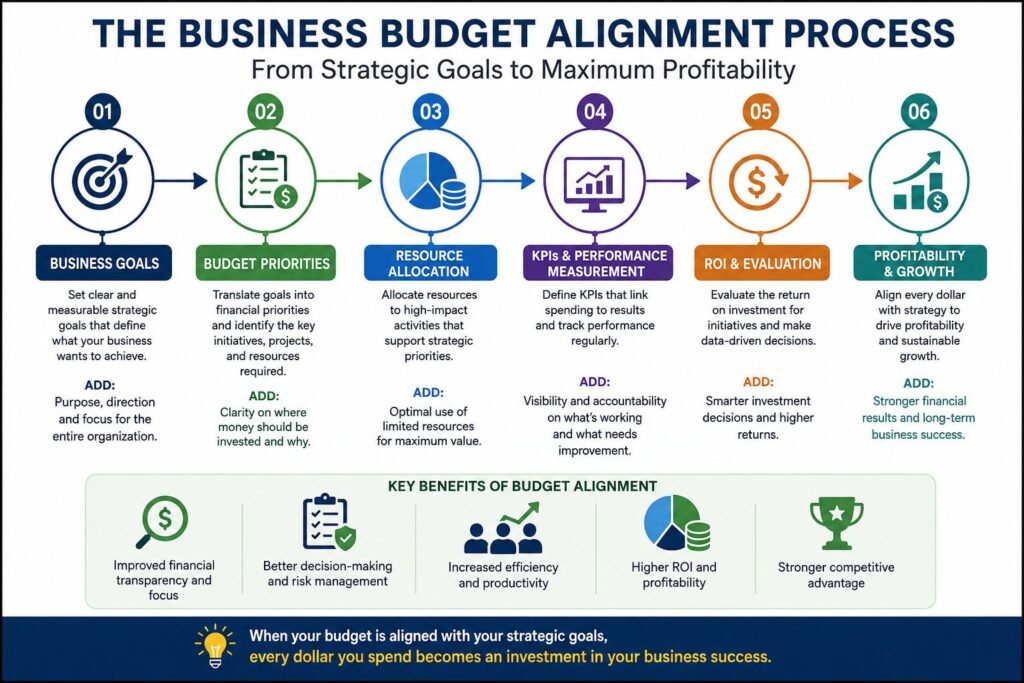
Budget alignment involves creating the company’s financial plan based on its key strategic goals, instead of a budget that is created separately from the business strategy. The strategic goals are what the organization wants to achieve, and the budget how the money and operations will help the organization achieve those goals. For instance, if a business’s strategic objective is to grow the market share, extra funds might be required for product development, distribution, customer research, and digital marketing and sales. If profit maximization is the main objective, management can focus on the automation of processes, negotiations with suppliers, inventory management, and cost management. The key to note here is that each large budget line should have a clear linkage with at least one business goal. If there is no meaningful business strategy that is derived from the spending, then management should ask if the spending should continue at the same level.
Set clear and measurable strategic goals and objectives.
Getting a budget to work in line with the business goals is the first step and it starts with stating clear business goals. You can’t give any support to a strategy that is vague, unrealistic, or can’t be measured. Rather than saying the company wishes to “grow”, management should set a performance target that includes either a revenue target (such as a 20% increase in annual revenue), a market entry, a customer retention target (such as a 10% increase in customer retention), an operating profit margin goal (a five percentage-point increase in operating profit margin), or a production waste reduction target (15% reduction in production waste). Having clear goals as a basis for financial planning helps to determine what the business is actually trying to do. Managers are then able to decide on the extra funding necessary for the activities and the reduction or elimination of expenses. Businesses don’t have unlimited funds, that’s why strategic goals should be prioritized. If leaders understand which the most important thing to achieve is, they can make tough budget choices without having to prioritize all departments or projects equally.
Communicate Strategy into Financial Priorities
Having set strategic goals, management should then convert these goals into financial priorities. This includes defining activities, projects, people, technology and resources needed to meet each objective and then estimating the costs of these. For instance, a firm looking to grow its ecommerce sales could dedicate resources to website enhancement, on-line advertising, ecommerce technology, logistics, customer support, and worker training. Just throwing money at these categories doesn’t necessarily work, though. Management should decide on the amount of funding needed, when the funds are needed and what is expected to be achieved by the expenditure. This is where it is even more crucial to prioritize investments, as the limited funds available should be allocated to those that will deliver the most value to the business and are best aligned to strategic goals.
Make KPIs that Link Spend to Good Results
Key Performance Indicators (KPIs) are markers that businesses use to assess if they’re generating the desired outcomes with their finances. Financial and operational KPIs should therefore be included in a strategic budget in the areas of major spending. Some useful measures are revenue growth, gross profit margin, operating profit, customer acquisition cost, customer lifetime value, conversion rate, inventory turnover, employee productivity, return on investment, etc. The suitable KPIs are reliant upon the company’s goals and industry. An organization with a customer loyalty agenda may pay more attention to repeat sales and customer lifetime value, whereas a manufacturing business may pay more attention to production costs, defect rate, capacity utilization and inventory turnover. KPIs are not just for the sake of having numbers. They should give management feedback on the extent to which spending is working towards the strategic goals, and whether resources should be shifted into or out of activities when performance is less than the desired level.
Implement the linkage of Department Budgets to Company-Wide Objectives.
One of the typical budgeting issues is having departments make budgets without knowing how their budget requests fit into the strategy of the organization. Sales will ask for more money to spend on promoting the business, operations will ask for more resources to operate with, human resources will ask for more resources to train with and information technology will ask for new software. These requests may seem like good ones on their own, but when added together, it can cost more than resources are available, or cause conflicting priorities. This should be avoided, however, by linking department budgets directly to the company’s overall goals. All departments need to define strategic objectives they will help achieve and then describe the impact their proposed budget will have on achievement of those objectives. This will promote accountability and collaboration as managers will not be able to justify budgets just on the basis of receiving the same level of funding last year. Rather, they are expected to explain how resources will lead to revenue, profitability, efficiency, customer satisfaction, risk reduction or any other significant strategic outcome.
Make the Investment Decisions based on the Importance of the Business.
Even if it is essential for the normal business operation, the value of all expenditures is not equal. Businesses should adopt a strategy of prioritizing investments based on impact, urgency, risk, and strategic value to a business’s mission. Projects with a high priority could be those that generate additional income, cut down on high expenses, boost the company’s competitive edges, enhance customer satisfaction, or mitigate major operational risks. In investments with less importance it may be decided not to invest if there is not a marked contribution to the strategic objectives. One way to do this is to rate the investments that are proposed based on the expected return, implementation costs, alignment with strategy, time to benefit, risk level, and resources needed. This will enable management to evaluate various opportunities against the same scales rather than relying on their own personal tastes or departmental urgings. Strategic prioritization also helps to better defend key investments when budget cuts are needed.
Construct the Budget, Based on the Expected ROI.
One of the most helpful ideas to link expenditure to profitability is return on investment (ROI). Management needs to estimate the financial benefits that they are likely to gain from the expenditure before they approve a significant investment, and then compare those benefits with the cost that they will be required to pay for the investment. In the case of a company that intends to invest $20,000 in automation, they should be able to roughly determine if automation is going to save money on the payroll, boost production capacity, cut down on errors or create new revenue. But all other factors such as implementation cost, maintenance cost, risk and timing of cash flows should be taken into consideration, and if the projected annual financial gain is $30,000, the investment may well have a sound business case. It’s not necessary to get the numbers exactly right when calculating ROI. They’re essentially used to spur responsible decision-making and to make sure the business doesn’t invest heavily in a project when the evidence of value is not substantial.
Apply Zero Based Thinking to Reduce Wasteful Expenses
Sometimes, businesses can benefit from the zero based budgeting principles, in which the managers rethink expenses instead of taking the previous year’s budget for granted. Traditional incremental budgeting is a budgeting process that is based on the assumption that previous levels of spending are appropriate and it is just a percent increase or decrease for the next period. This can enable dated expenditures, wasteful workflows, unutilized subscriptions, unnecessary administrative expenses and poor performing projects to remain unnoticed. The key to zero-based thinking is for managers to always demonstrate the value and need for significant costs. They do not have to be zero costs every year, it just means that every cost will start at zero. Rather, it suggests management to ask if current investments are still needed and still make sense in the strategic context. This can uncover savings that can be spent on other growth programs, technology, customer acquisition, employee development or other programs that offer better returns.
Develop Flexible Budgets on changing business conditions.
A well-planned budget should guide management and not be so strict that if the situation changes, the management is incapable of adapting to them. There is a chance that sales forecast, customer behavior, cost of suppliers, interest rates, competition, economic conditions and operational challenges can change throughout the financial year. When the reality is very different from what was assumed in the budgeting process, then a fixed annual budget can get very challenging. They can overcome this challenge in a number of ways, such as rolling forecasts, scenario plans and flexible budgets. Management may be able to create a scenario of a base case, an optimistic case, and a pessimistic case, and see how the funds would fluctuate based on each scenario. If, for instance, the company’s revenue is higher than expected, then it could expand its marketing efforts on successful marketing channels or boost production capacity. Management can safeguard key strategic projects and delay lesser critical costs when revenues drop. Flexibility means that the budget will continue to be a useful tool for decision making and not be a fixed document which management follows regardless of circumstances.
Make Appropriate Resource Allocations based on Strategic Priorities
Strategic budgeting gets into practice when it comes to resource allocation. With objectives, KPIs, investments and budgets fixed, management needs to decide on the best use of the available funds. One effective way to segment spending is to categorize it according to spending activities: essential operations, growth investments, strategic projects, risk management and discretionary spending. Operating costs are necessary to keep the company going and strategic investments are planned to enhance the future performance. While managing the business, the management should refrain from spending all resources on day-to-day expenses as there may be an initial investment to make for long-term growth, and the pay-off may take time to become apparent. Meanwhile, firms cannot let their balance sheet suffer just to come up with big plans for expansion. The goal is to achieve a balance at which the company is able to pay its debts and still have sufficient funds allocated to projects that will provide better revenue, margins, efficiency, customer satisfaction and competitiveness in the years to come.
Review the Budget Performance regularly.
Budget alignment should not be done at the end of the financial year only. Management should have periodic budget–to–actual reviews to see if spending and performance is on track. Monthly, quarterly or other frequency of these reviews may be used as appropriate for the business. Actual revenue, costs and cash flow, investment expenditure and KPI performance should be compared with the budget and then investigative action should be taken for significant variances. A favorable variance can be misleading; it does not necessarily indicate good performance by the business. For instance, a department could run under budget if they were able to postpone an important strategic piece of work. Likewise, if the increase in spending generated significantly more revenue or enhanced an important performance indicator, then the spending could be deemed acceptable. Thus, variance analysis must also consider business outcomes as well as the financial aspects.
Assign Department Goals and Objectives to their Employees
When employees and department managers comprehend how their work aligns with the company’s strategic goals, they are more inclined to utilize resources responsibly. Senior management should, therefore, link the departmental KPIs and individual performance expectations to the targets and outcomes in the budget. For example, sales could be measured for revenue growth, conversion rate, customer acquisition costs, and so on, whereas operations might be measured for production efficiency, waste reduction, delivery performance, and so on. Finance departments might have an eye on cash flow or working capital and profitability, customer service teams might watch retention, satisfaction, and resolution times. If these goals are considered in budget planning, departments will be able to visualize how much money they require based on the anticipated results. This also puts managers under increased pressure, as they are aware that if they get a bigger budget they have to produce measurable outcomes.
Look and Cut Spending that is not Aligned the Strategy.
A simple step to profitability is to discover spending that isn’t achieving any worthwhile strategic objectives. Businesses can easily have costs that have been added to histories of expenses, that were once used, or that have never been reviewed. This can be anything from unutilized software licenses, inefficiencies in processes, unnecessary administrative work, unprofitable advertising mediums, unused inventory, unnecessary services, or facilities that no longer serve the operational needs. Getting rid of these costs can provide savings up front and not negatively impact growth. But it shouldn’t be done at any cost. Reducing customer service, product development, employee training or marketing without considering how these activities relate to future performance could “save” money in the short-term, but hurt the business in the long run. The objective should be to eliminate waste whilst maintaining expenditure of value-added spending that strengthens customer relations, increases productivity and provides sustainable competitive advantage.
Increase Budgeting and Financial Transparency through Technology.
Strategy with technology can be more precise and efficient to manage budgets. While spreadsheets can be helpful to smaller companies, larger companies might find accounting software, budgeting tools, forecasting software, business intelligence software, and dashboards to be more beneficial, as they can give them more up-to-date information. A system that integrates the tools for tracking spending, revenue, cash flow and performance relative to the budget will enable managers to see what is really happening without having to wait for a long and cumbersome manual report. Automated reporting can also help minimize errors and provide department managers with more transparency of the impact of their spending on company-wide results. Technology, however, should aid and never supplant strategic decision making. Ambiguous objectives, faulty assumptions and inadequate management processes cannot be overcome by a complex budgeting system. It’s therefore important that businesses choose the technology that best suits their reporting needs, complexity, size and business strategy. The most important system is the one that enables decision-makers to know how the system is performing financially and be able to react rapidly to changes in the conditions.
Planning shouldn’t stop at the time of investment approval and funding. Post-investment reviews should be carried out to see if businesses have met the objectives of large projects. Managements should ask themselves to review the actual performance when a company invests in new equipment, software, marketing campaigns, employee training, expansion, etc. Was the project successful in generating an increase in income? Did it save a lot of money? Did it boost the productivity? Did the implementation take place within the approved budget? Have there been any unexpected advantages as a result of the investment? These questions enable management to gain insight into what investments have consistent returns. This information can be used over time to help better inform leaders’ budgeting decisions as they now have evidence of what is effective in their specific company. Reliable measurement of the outcome of investment can enable a firm to allocate resources from poor performing activities to those with better and more predictable returns.
Incorporate Strategic Accountability into the Budgeting Process.
There’s got to be accountability throughout the management levels to be successful with budget alignment. Senior leaders need to articulate clearly strategic priorities, finance teams need to share relevant and accurate financial information and department managers need to be accountable for the use of resources in line with agreed priorities. It is not about the punishment and blame of managers if actual spending is different from the forecasted budget. Rather, it is asking managers to know the “why” and the “what” of their financial choices and actions. A change in circumstances should be reflected in managers being able to tell the reasons for increasing, reducing or redirecting spending. Financial meetings can be held regularly to review the performance, discuss risks that may arise, review investment opportunities and make necessary adjustments. Budget padding – deliberately asking for more money than is required to appease budget planners in the future – is also stifled by a good culture of accountability. Clear Budgeting promotes departments to strive for business goals, not just the arbitrary levels of spending.
Establish a Continual Cycle of Planning, Measuring, and Adjusting.
Good strategic budgeting is effective when it is not just a yearly administrative task, but is an ongoing management process. It should start with setting goals, then with financial planning and resource allocation, with implementation, with measuring performance and then back to planning with the new insights gained from what has been implemented. This cycle is to give management the opportunity to be able to change assumptions when new information is received. If the marketing campaign has a greater return than anticipated, for instance, the company can raise the budget for that marketing channel. Management might cut further investment in a new product if the product does not meet the expected demand and investigate the causes of poor product performance. Likewise, if the operational improvements yield cost savings that exceed the forecast, then the savings can be reinvested in growth opportunities. This can help keep the budget as realistic as possible, and help the company avoid over-funding activities just because they were in an earlier budget only to realize that they were not needed.
Conclusion
One of the best ways to make sure that financial resources can directly help a business achieve long-term success is to align a business budget with strategic objectives. The first step to this is setting measurable goals, and breaking them down into financial priorities. Businesses can then take steps to further align by establishing measurable goals, linking specific department budgets to company-wide goals, comparing investments to ROI, cutting down on unnecessary spending, and reviewing actual performance against financial plans regularly. The strategic budgeting process is not about cutting down on spending on every individual item, but rather how to spend wisely on what matters most. Management can ensure that growth drivers are safeguarded, while at the same time eliminating waste, thereby optimizing resource use without compromising growth opportunities. If we approach budgeting as a continuous exercise in planning, measuring, learning and reallocating resources, each large-scale financial choice can have an impact on the strategic direction of the company, enhance profitability and improve the resilience of the company’s sustainability.
Get more well researched information about business budget alignment here.