
Introduction
One of the most critical checks of the accounting cycle is the trial balance. Financial records, whether large or small, are vital to any company as it enables them to make informed decisions, fill their tax returns and prepare financial statements. Accountants ensure that the income statement and balance sheet are mathematically correct before preparing them, and they do this by making a trial balance to check all ledger accounts have the correct numbers in them. This process is used to ensure that all debits in the accounting system match all credits, which the basic principle of double entry is bookkeeping.
Having a balanced trial balance does not mean that all transactions have been recorded properly, but it means that there is a high level of assurance that bookkeeping records are mostly correct and are ready to be used for other financial reporting. Also, knowing about the trial balances helps business owners to find out the most frequent bookkeeping errors before they turn into costly issues. Whether you’re studying bookkeeping or handling your own business finances, understanding how to create a trial balance is a crucial skill that enhances financial precision, leads to compliance, and boosts confidence in accounting records.
The trial balance preparation is very important in the process of bookkeeping because if the preparation of the trial balance is correct, it helps in verifying the balance of ledgers before the preparation of financial statements, thus, early in the bookkeeping process it is important to know how to prepare the trial balance correctly. This is because by learning this process, the chances of carrying through accounting errors to reports that investors, lenders, tax authorities and management will rely on are reduced. Regardless of whether bookkeeping is done manually or by accounting software, the principles remain the same and so is the trial balance, which is a universal accounting tool for use in industries and organizations.
What is a Trial balance?
A trial balance is a bookkeeping report, listing all the ledger accounts and their final debit or credit balances for a given date. It is used mainly to check that the sum of all the debit balances is the same as the sum of all the credit balances. Double entry accounting requires each entry to have a corresponding debit and credit amount, the trial balance is the mathematical proof that the postings in the ledgers stay in balance.
The trial balance is a tool that is usually created at the end of an accounting period (monthly, quarterly, or annual) to connect the recording of transactions with the preparation of financial statements. The report contains every asset, liability, owner’s equity, revenue and expense in the general ledger account. When finished, accountants will easily know if the books need additional research before going to books of financial reporting. While accounting software programs nowadays produce trial balances automatically, it’s still crucial that you know how they’re created by hand to better recognize posting mistakes, accounting relationships and how to use accounting information.
Importance of Trial Balance
Making a trial balance is no simple task! It gives a sense of security that bookkeeping records are kept in compliance with the principles of double entry accounting, and offers a solid base for the creation of financial reports. A business with a set of “ledgers” that don’t reflect the actual transactions could lead business owners, investors, lenders and government agencies to believe falsehoods. The well-done trial balance enables the accountants to identify mathematical errors before creating income statements, balance sheets and cash flow statements. It also makes auditing easier as trial balances are often prepared by auditors to determine whether the postings to the ledgers are complete and internally consistent.
Regular trial balances can help small business owners detect bookkeeping errors prior to them growing over time as they are reviewed more often. Accurate financial records help to make banks more confident and investors more confident, while the financial reports help managers in budgeting and planning. Routine preparation of trial balances also helps to promote good accounting practices by providing a regular review of book balances, which means anything unusual in the books will be dealt with at the time, rather than waiting to the year end to investigate.
Double Entry Bookkeeping: Also referred to as the Trial Balance
Trial balance is due to the double entry bookkeeping system. Each financial transaction involves at least two accounts and there are always equal debits and equal credits. The business’s cash and furniture accounts are affected, for instance, when the business buys office furniture with cash; the cash account decreases with a credit for the amount of cash used and the furniture account increases with a debit for the amount of cash used. Similarly, accounts receivable would also increase with a debit entry when a company records a revenue transaction on credit, and revenue would decrease with a debit entry when a company records a revenue transaction on credit.
These equal entries uphold the accounting equation Assets = Liabilities + Equity. Journal entries are made in a journal during an accounting period, and then are moved to individual ledger accounts. Each ledger account will eventually have an ending amount that will contain the balance of all transactions that have taken place on that account. The trial balance is a statement that gathers these balances together, so that the accountant can ensure that the accounting equation is mathematically balanced. If total debits are not equal to total credits, then there is a mistake in the bookkeeping process somewhere and should be investigated for the preparation of financial statements.
Detail of the Information that is included in a Trial Balance.
While it varies slightly in format from organization to organization, all trial balances have a similar amount of information. It starts with the business name, the title “Trial Balance” and the date of the report. Under this heading you will find a list of all of the general ledger accounts in order by the company chart of accounts. Traditionally, asset and expense accounts are listed with a debit balance, liabilities, owner’s equity and revenue accounts are listed with a credit balance.
The two monetary columns are for showing the debit balance and the credit balance. Each of the totals in each column is shown at the bottom of the report. These totals should be exactly the same if bookkeeping done properly. Reports exclude accounts that have a zero balance unless there is a policy to do otherwise. In addition, some accounting systems will assign an account number, which can help during investigations to find individual ledger accounts. The presentation of the balances in an organized manner would facilitate rapid comparison, spot unusual figures and ensure that the balances in the ledger accounts meet the mathematical requirements for double entry bookkeeping before proceeding with the next steps of financial reporting.
How to prepare a Trial Balance Step by Step.
To prepare a trial balance: After posting all transactions in the journal to the general ledger, follow a logical sequence to prepare the trial balance. The first thing to do is to make sure that all the transactions for the accounting period are fully entered. When journal entries are not made, the figures in the ledgers will be wrong and can result in false financial statements. Once postings have been verified, verify the ending balances of all ledger accounts by adding up the debits and credits and verifying if the account is debit or credit.
Next, create a worksheet with all the accounts in the same sequence as in the chart of accounts. Record the ending balance for each account in the appropriate column (debit or credit) based on the account’s normal balance. When all the accounts are on record, carefully add up both columns. If the totals are the same, this is a mathematical balance and financial statements can be prepared using this trial balance. Compare totals, recheck journal entries, ledger posting, calculations or classification of accounts until any discrepancy is detected and corrected. The systematic process will facilitate the maintenance of proper financial records by the accountant and ensure that the process of reporting is based on reliable bookkeeping information.
Example of Preparing a Trial Balance
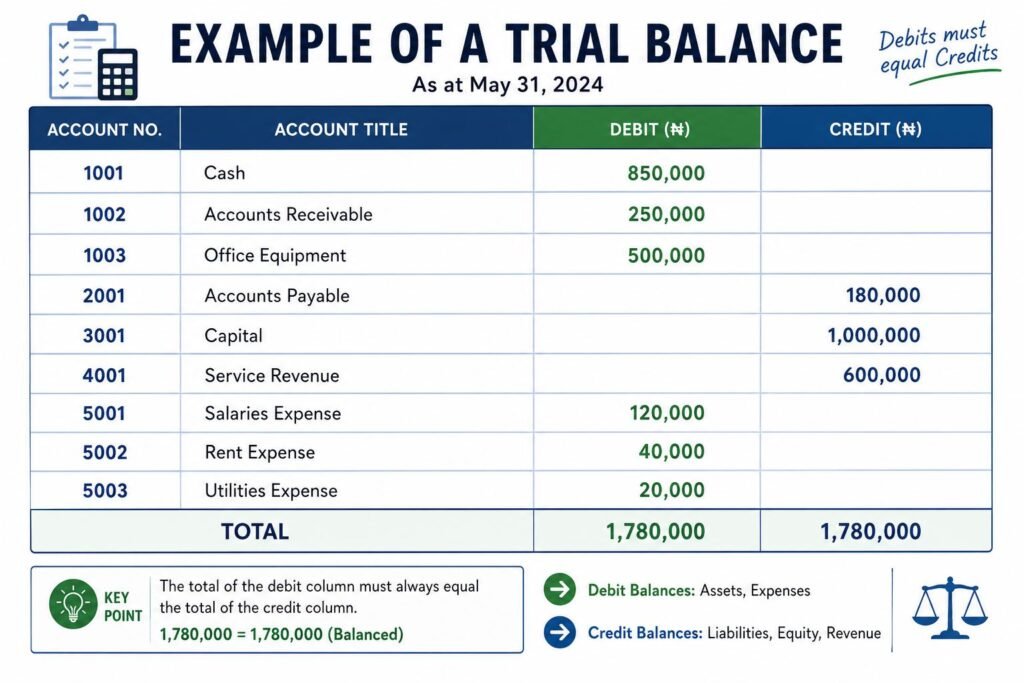
Suppose that at the end of the month a small business has the following balances in its ledgers:
The cash balance has a debit of ₦850,000, the Accounts Receivable balance has a debit of ₦250,000, the Office Equipment balance has a debit of ₦500,000, the Accounts Payable balance has a credit of ₦180,000, the Capital balance has a credit of ₦1,000,000, the Service Revenue balance has a credit of ₦600,000, the Salaries Expense balance has a debit of ₦120,000, the Rent Expense balance has a debit of ₦40,000, and the Utilities Expense balance has a debit of ₦20,000. The accountant records the title of each account on the trial balance and all debits appear on the debit column and all credits appear on the credit column.
The debit column totals ₦1,780,000 and the credit column also totals ₦1,780,000. Both totals are the same so the books are mathematically balanced. Now the accountant is ready to go ahead with preparing adjusting entries as needed, and to prepare the financial statements. This example illustrates how the trial balance is a useful tool for checking a number of ledger accounts in one report format that is useful before financial reporting is commenced.
Why the Trial Balance must Balance
The explanation of “why” a trial balance should balance is based on the principles of double entry bookkeeping. The total of all the ledger accounts should always be the same, as each transaction should result in an equal debit and credit entry. When the total of the debits is not equal to the total of the credits or vice versa, then there is at least one mathematical or posting error in the accounting records which are to be corrected.
A balance trial balance will show that every debit that is posted in the accounting system will have a corresponding credit somewhere else in the accounting system. Balance does not mean that all the transactions have been recorded in a correct manner, but it does mean that the accounting equation is mathematically correct. This balance is important to ensure the integrity of financial reporting because the balances in the financial statements of each account are based directly on the ledger balances. If a trial balance is not in balance, the financial statements could show the wrong amounts for assets, liabilities, revenues, expenses, or equity.
Therefore, any imbalance should not be discounted by a business; even if the difference is small, it could signify larger bookkeeping problems which need to be investigated immediately before the reports are provided to management or external users.
Common Errors in the Trial Balance
The knowledge of trial balance errors is important since a lot of bookkeeping errors can be made during the process of recording them and posting them. An error that often occurs is that you will enter a debit number instead of a credit number or vice versa, and the totals will not match right away. A common error is entering the number in the wrong account and/or maintaining the correct debit/credit balance. Journal entries may become illegible as well as be missed or duplicated accidentally or may be recorded with wrong dollar figures.
Another cause of an unbalanced trial balance could be a mathematical error in adding the balances on the ledgers. Further, transposition errors are the errors that arise from the digits being transposed, e.g., the recording of ₦5,430 instead of ₦5,340, and slide errors occur when decimal places and zeros are incorrectly placed. Other errors include only entering one side of a transaction, rather than both sides. These errors result in the imbalance of the debits and credits and need to be investigated systematically. Being aware of these frequent mistakes can help accountants identify and resolve issues faster and keep accurate books all year long.
Errors that cannot be Detected through a Trial Balance
The trial balance is a great control document, but will not detect all accounting errors. There are some errors which leave the Debits and Credits in balance even though they are incorrect. For instance, if you record one side of a transaction with the correct amount and the other with the amount you think you need then the totals are balanced. If you have the same number of debits and credits but post it to the wrong expense account, it will not be detected either. In the same way, if you debit an amount and credit an equal amount, but the transaction didn’t actually happen – the trial balance would still be balanced.
In a similar fashion, if a transaction is nonexistent on both the debit and credit side then the totals will also remain unchanged. Errors of compensation are another issue as two independent errors can happen and cancel out mathematically. The errors cannot be found by simply reconciling debits and credits, so accountants use reconciliations, supporting documents, analytical reviews, internal controls and audits to spot these errors. Thus, a balance sheet with no double entries is essential, but not proof that the accounting records are error-free.
When the Trial Balance is Not Balanced
If a trial balance does not balance, the accountants should not make arbitrary adjustments, but should go through a systematic investigation process. As simple arithmetical errors are surprisingly common, the first step is to be able to check that all additions and calculations within the trial balance are mathematically correct. Then check the trial balance amounts against the amounts in the ledger accounts to ensure that all the accounts have been carried out correctly. Check each ledger account to ensure that debit and credit amounts are correct and that the ledger account balances are correct. Review journal transactions – are they entered fully into both accounts?
Be aware of transposition, omissions, duplicates, wrong accounts, account wrongness or totals in the wrong columns. If the difference between the totals of the debits and credits is even, check if a debit has been entered as a credit, or a credit as a debit. A transposition error may be present if the difference is divisible by 9. These are logical steps that accountants typically go through in order to be able to find and fix any imbalances in an efficient manner without affecting the integrity of their financial records.
Best Practice in keeping a Trial Balance as Accurate as Possible.
Consistent bookkeeping practices are required to maintain an accurate trial balance not just at the end of the period. Journal entries should be made as soon as they occur and shouldn’t be delayed due to forgotten transactions as it will lead to errors. Frequent bank statement, supplier statement and customer balance reconciliation also ensures that the ledger records are accurate throughout the accounting period. Another advantage of standardized charts of accounts is that they provide consistency in transactions, as they are always categorized properly.
It is still important to check accounting software reports on a regular basis, even if it is automated, to ensure that they do not contain any errors. Always keep supporting documents like invoice, receipt, bank statements etc. handy as they can be used as evidence if there is any discrepancy in investigations. Supervisors and other internal or external accountants conduct regular internal reviews, which helps ensure the accuracy of bookkeeping by detecting any unusual account movements early.
Staff training is also very important as they make fewer posting errors if they are aware of the principles of double entry bookkeeping. These best practices help businesses minimize accounting mistakes, enhance financial report quality, and ease tax preparation, audits, and business decisions.
Conclusion
A trial balance is an important accounting document used to check that the mathematics of double entry accounting are correct prior to the preparation of the financial statements. It rolls all ledger accounts into a single report, and verifies that debits equal credits, giving the accountant the peace of mind that the bookkeeping is internally consistent. Knowing how to create a trial balance, analyze its output, identify discrepancies, and comprehend the limitations of the trial balance allows companies to have more effective financial controls and generate more accurate business reports.
A balanced trial balance will not of itself ensure that none of the accounting errors have been made but it is a very useful safeguard in the accounting cycle and should facilitate the detection of any large accounting errors. Companies that can regularly create trial balances, audit ledger accounts thoroughly, and address discrepancies quickly can lay the groundwork for more accurate financial reporting, informed decision-making, efficient audits, and sustainable financial success.
Get more well researched information about how to prepare trial balance here.