Introduction
Setting up a business is not just about selling and providing service. To know how well your business is performing in terms of money, every transaction inflow or outflow should be recorded properly. The chart of accounts is one such key instrument that makes this possible. It is the basis for structuring all financial actions in a manner that allows for easier bookkeeping, financial reporting, budgeting and tax preparation. Financial data can become confusing without a well-organized chart of accounts, and it becomes hard to gauge the profitability or loss of the business.
A chart of accounts is not just for big business that has a full-time accounting staff. Small businesses, startups, freelance or consultants and even online store owners can really benefit from having a structure of the account from the outset. Once each transaction is sorted, business owners can get accurate financial statements, pinpoint spending trends, get ready for tax time, and take data-driven decisions rather than guesswork.
Many new business owners think they can just keep track of their income and expenses in a spreadsheet and put it in order once the business is established. Unfortunately, recategorization of months of poorly categorized transactions can be costly and time-consuming. If you keep a proper chart of accounts from the beginning, then you will not have these issues and it will make a bookkeeping system that will “grow” with your business. Knowing the principles that are outlined in this guide will help you to develop one of your own that will fit your business instead of copying one that might not fit.
The Chart of Accounts is a business’s Financial Framework.
A chart of accounts, or COA, is a detailed listing of all the financial accounts that a business employs to book transactions. Consider it a filing system with each category of transaction being in its own file. Each sale, office supplies, equipment purchase, payment from customer, payroll, taxes, etc. is allocated to its own account so that it’s not all lumped together. This streamlined organization lets accounting software and bookkeepers categorize financial activity on a consistent basis during the year. Each transaction recorded to the accounting system will be linked to one account in the chart of accounts, allowing users to generate financial statements like the balance sheet, income statement and cash flow statement. The chart of accounts is the foundation of a business’s accounting system, as all financial reports rely on its accuracy, whether the business is running accounting software such as QuickBooks, Xero, Sage, or manually bookkeeping.
The Importance of having a Properly Organized Chart of Accounts for any Business
Having a well-structured chart of accounts can provide more than just bookkeeping advantages. It enables business owners to have a better understanding of the financial situation, by grouping assets, liabilities, income and expenses into sensible categories. So, owners don’t need to ask themselves where the money went, they can simply check the reports which will show them the payroll costs, marketing expenses, rent, utilities, inventory purchases, or loan balances. This degree of organizational structure helps to manage budgets, eases tax filing, aids in financial forecasting, and makes audits much less stressful. Investors and lenders also want to see business accounting records to be well kept before giving the green light to business funds, which makes a chart of accounts a valuable tool for business growth. A company might only process a few transactions per month, but a solid charting system at the outset will show consistency, and save time and money as a business grows.
The Five Main Types of Accounts
Each chart of accounts is structured around the 5 major categories of accounts. The categories are used for financial reporting and are accepted by the world’s accounting principles.
Assets
Assets are items of a business that have a financial value that the business owns or controls. These involve the equipment and money available to the business to keep it going and to produce revenue. Asset accounts include cash in business bank accounts, inventory for sale, office furniture, computers, delivery vehicle, machine, building, prepaid insurance, and money due from customers. The general rule for asset accounts is that they will increase when new assets are added to the business and decrease when assets are used, sold or sold for scrap. Because assets are listed on the balance sheet, logical grouping of assets into categories would enable management to know what assets are available to support the business operations. Many companies additionally split assets into current assets (cash flow is anticipated to be generated within a year) and non-current assets (assets are meant to be used for a long period of time).
Liabilities
Liabilities are the claims of others which the business has to pay. They can be supplier invoices that are unpaid, bank loans, mortgages, payroll taxes, customer deposits, accrued expenses, or credit card balances. By properly accounting for liabilities, business owners will make sure they know where their assets are being borrowed from, and not owned. Current liabilities are usually payable within one year and long-term liabilities are payable after the current year. Frequently reviewing liability accounts also helps companies with cash flow management as future payments become easily identifiable. Having an awareness of your obligations can help you make more informed borrowing decisions, create repayment plans, and prevent financial problems due to missed payments or over-accumulating debt.
Equity
Equity is the net worth of the business to the owner or the owner’s interest in the business. In sole proprietorships, equity will generally consist of the total amount of capital invested in the business, the profits that were retained as surplus, and the amount of money that the owner took out of the business. In corporations, equity is made up of common stocks, additional paid in capital, retained earnings and treasury stock (if applicable). Equity accounts are measures of the net accumulation of a business’s financial performance over time, and indicate the financial value that remains for the owners. Positive profit enhances equity, and business losses or withdrawals of the owner will lessen equity. An accurate account of equity is a valuable way for owners to assess the long-term performance of the business and helps investors, lenders and prospective purchasers understand the value that the business has generated.
Revenue
All income from a normal business activity is recorded in the Revenue accounts. Product sales, service income, consulting fees, subscription income, commissions, rentals, or other operating income are common sources of accounts included in these types of accounts. Companies might have distinct income accounts for various income sources to enhance monetary analysis. For instance, an e-commerce company might have several accounts for domestic sales, international sales, shipping revenues and discount adjustments. For service businesses, it may be possible to distinguish between consulting and maintenance contracts, or training services. Effective revenue recognition helps business owners and managers understand which of their products and services are best and assist in meaningful financial reporting. Revenue items are the ones that come in on the Income Statement and are crucial in determining business performance for a particular period of time.
Expenses
Expense accounts provide information about the expenses of running the business and earning income from the business. These can include rent, salaries, utility costs, insurance, advertising, office supplies and software, repairs, fuel, travel costs, legal fees, depreciation, bank fees, and much more. It’s important to categorize expenses logically so owners can easily pinpoint where they can cut expenses and not impact business. The detailed expense tracking also helps to make tax filing easier as all the expenses that can be deducted are already in place. These are things business owners can do without having to review hundreds of individual transactions: they can quickly see the total amount spent by category and they can compare the cost from month to month or year to year. Good expense tracking is vital to effective budgeting, financial planning and financial performance analysis.
Different ways to Assign Numbers to Chart of Accounts
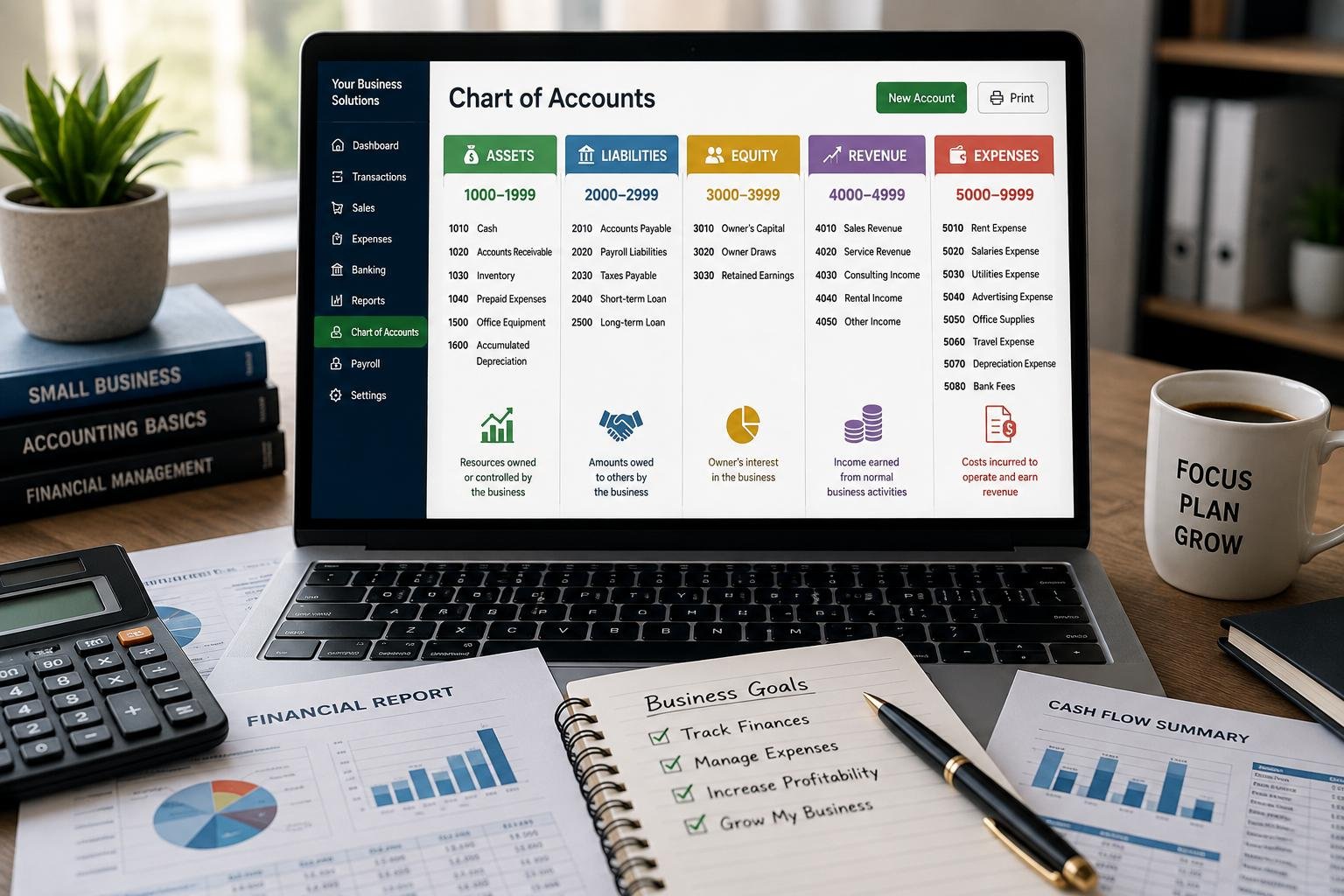
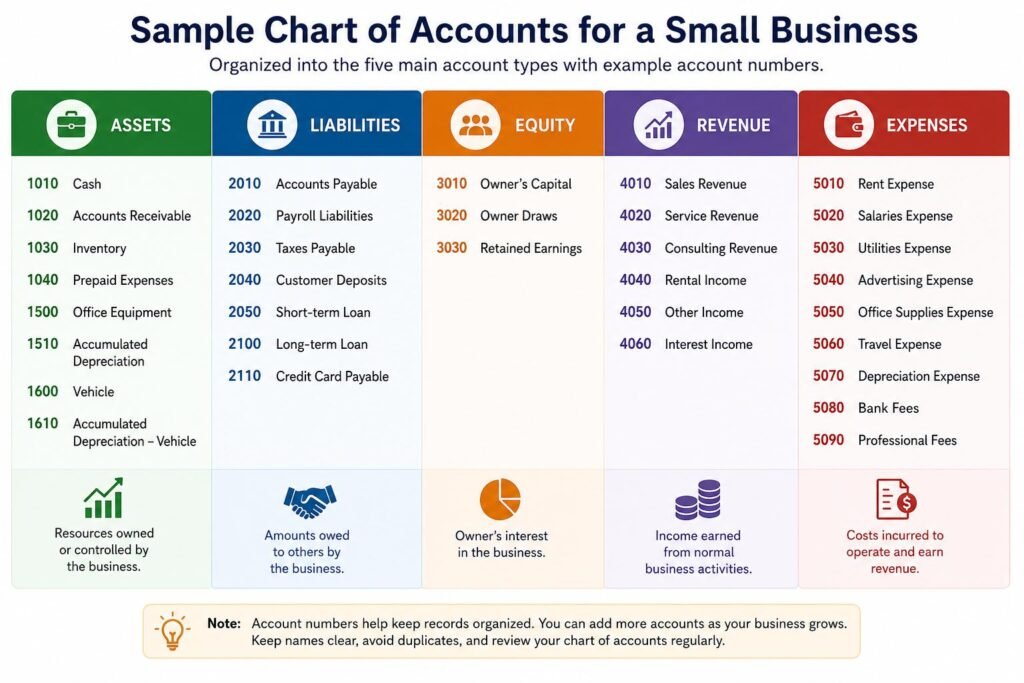
Most companies give numbers to each account to maintain financial records and make navigating accounting software easier. While numbering may be slightly different at different firms, there is a logical structure to numbering so similar accounts are grouped together. Typical asset codes start with 1-9, liability codes start with 10-19, equity codes start with 1-9, revenue codes start with 10-19 and expense codes begin at 10 and continue upward. Businesses have the option to label further detail of these classifications with further numbers within each category. For instance, cash could have 1010 as the account number, accounts receivable 1020, inventory 1030 and office equipment 1500. The use of this numbering makes it easier to find the accounts, to create reports and to extend the chart without disturbing the other accounts. Standardized numbering also helps streamline communication among bookkeepers, accountants and auditors who use account references to locate accounts.
How to Structure a Chart of Accounts for a Small Business
A chart of accounts doesn’t have to contain hundreds of names of accounts. Indeed, the fewer the categories the more useful the financial information can be. The first step is to determine which will be the primary groups of accounts, which are the big accounts for each of the five primary account types. Then, identify your business’s specific accounts instead of a template that has a lot of irrelevant accounts in it. For a consulting firm, accounts for professional fees, travel, software subscription and office rentals would be required, and for a retail store, inventory, cost of goods, sales discounts, and shipping costs would be required. Note that spaces may need to be left to expand by using a skipped number sequence if additional accounts are added to the file in the future. Also, business owners should not have duplicate accounts with similar names as it results in inconsistent transactions being recorded and inaccurate reports. Periodically checking the chart will ensure that no more accounts are deleted and that new business activities are added to the right account.
Common Chart of Accounts Examples that can be used by Small Businesses.
While each business will have various financial requirements, many small businesses will have similar account structures. Examples of asset accounts are cash, checking accounts, savings accounts, accounts receivable, inventory, prepaid expenses, office equipment, vehicles and accumulated depreciation. Typical liability accounts include accounts payable, payroll, taxes payable, business loans and credit card balances. Owner capital, retained earnings and owner draws are examples of equity accounts. Product sales, service income, consulting revenue, commissions and miscellaneous income may be included on revenue accounts. Some common expenses in expense accounts are advertising, bank charges, insurance, internet services, office supplies, rent, salaries, software subscription, telephone expenses, travel expenses, utilities, vehicle expenses, professional fees and more. These are the most common types of accounts that allow for flexibility, but have not become too cumbersome for most startups and small businesses to handle properly without overloading the accounting system.
A Good Chart of Accounts is a Key Component in this Process
Creating a chart of accounts is just the first step. It will keep financial records accurate over time if maintained properly. Business owners should check on the activity of their accounts on a regular basis to make sure that their transactions are accurate and that duplicate accounts are not opened by mistake. It should not have more categories than it is necessary to have for new accounts and not be used for one-off transactions that might belong to an existing category. This is particularly important where two or more employees or bookkeeper are recording the transactions as it can throw off the financial results and make comparisons between accounting periods inaccurate. While it is possible to have accounting software with pre-made account templates to maintain some consistency, it is important that the Chart of Accounts is tailored to the owner’s business. Other internal control procedures, such as the regular reconciling of bank statements, credit card statements, loan statements and balances with suppliers, are also important to ensure that posting errors are not made that could impact financial statements or tax filing.
Mistakes that are Commonly Made
A lot of new business owners develop their chart of accounts to be either too detailed or way too simple. Dozens of expense accounts make book keeping needlessly awkward and difficult and putting unrelated transactions into one general expense account makes it less valuable to have a financial report. One common error that people make is keeping personal and business expenses intermingled, leading to confusion when they get to preparing their taxes and analyzing their finances. Other companies don’t keep their chart current as they grow, leading transactions to be placed in the wrong categories. Poor accounting software navigation due to inconsistent naming conventions, duplicate accounts and poor numbering systems can lead to the problem of posting errors. These errors can lead to messy financial records and make future bookkeeping easier, and avoiding them can enable better business decisions.
Selecting the Best Accounting Software
The modern accounting software makes chart of accounts management easy and convenient with their customizable templates, automated transaction classification, financial reporting and bank integrations. The majority of popular accounting software will let you edit the names of your accounts, assign account numbers, set up subaccounts, and easily pull up balance sheets and income statements. Small business owners are better off selecting software that’s suited for their business needs but gives them the flexibility to grow later. Cloud-based accounting solutions also provide other benefits like remote access, multi-user collaboration, automatic backups and payroll and inventory system integration. No matter which software is chosen, the quality of financial reporting will still be reliant on a well-planned chart of accounts that is consistent with the actual structure of the business.
Conclusion
A chart of accounts is more than a collection of account names! It refers to the system which underlies all the financial management processes of a business. A business owner can improve their decision-making process, budgeting, tax compliance and long term planning by breaking the transactions down by assets, liabilities, equity, revenues and expenses into the five major classifications. Adopting a logical numbering system further adds to organization and the accounting structure grows as the business grows.
If you’re a small business, it may be best to begin with a simple and flexible chart of accounts. Don’t make things overly complicated, but instead focus on structuring your account so that it truly represents your business activities and has enough space to grow. With regular reviews, consistent transactions and accounts maintained in a proper manner, you will be able to keep your bookkeeping accurate since your first day in business until you’ve reached the peak of your business growth. A well-structured chart of accounts today can pave the way for informed business decisions and long-term success over the years.
Get more well researched information about chart of accounts here.