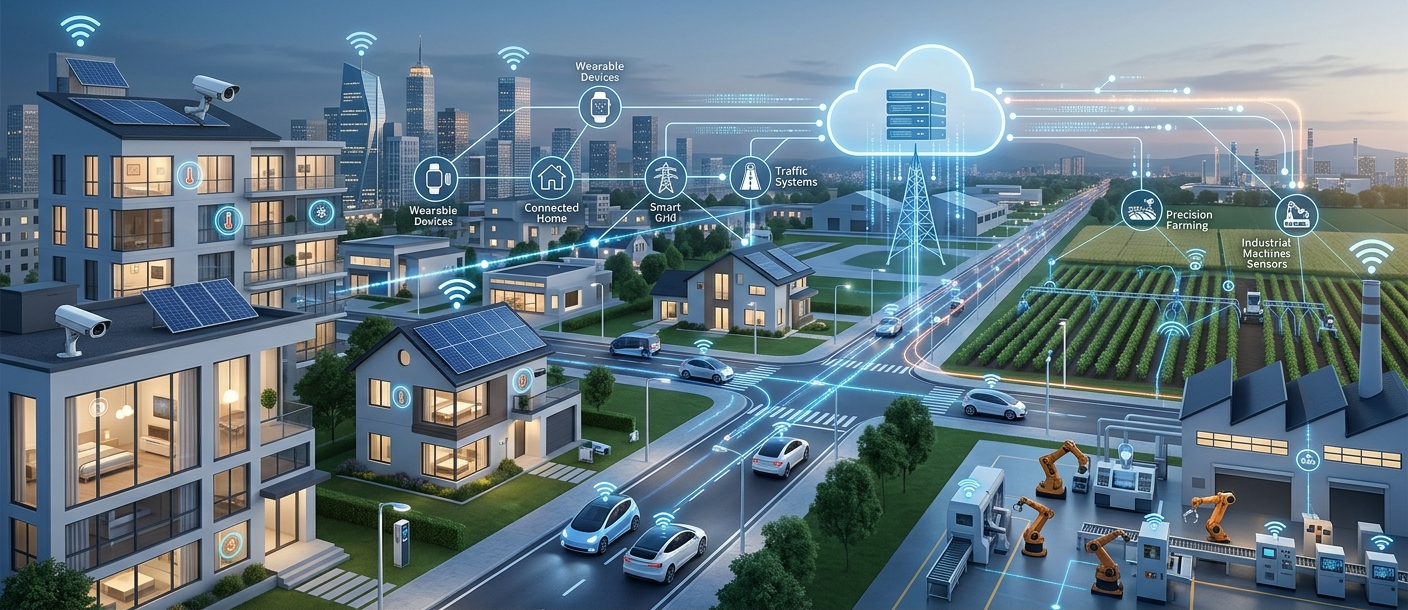
The Internet of Things (IoT) is changing the nature of the interaction between physical objects and the digital world. Whether you’re using the smart home of the future with intelligent thermostats and security cameras or the industrial Internet of Things, healthcare systems, or agricultural sensors, IoT systems need to be able to gather, share and interpret information through communication technologies. Although the term IoT means “smart devices connected to the internet”, the technology involves a complex architecture of sensors, communication networks, communication protocols, computing systems and data platforms. The functioning of this IoT system in various environments and industries can be understood by grasping how these devices can connect and communicate.
The essence of IoT connectivity is a marriage of hardware and software that allows devices to “sense” changes, communicate data back and forth, accept instructions, and make intelligent decisions. The basic components of an IoT device include a sensor to collect information from its surroundings, a processor to handle the device’s operations, and a communication channel to enable it to share information with other devices. They can communicate directly, or via a gateway, or send data to cloud platforms for advanced analysis. This is because the type of communication can vary depending on the factors like range, power consumption, speed, security requirements, and the purpose of the IoT application.
The Basics of IoT Architecture: The Foundation of Connected Systems
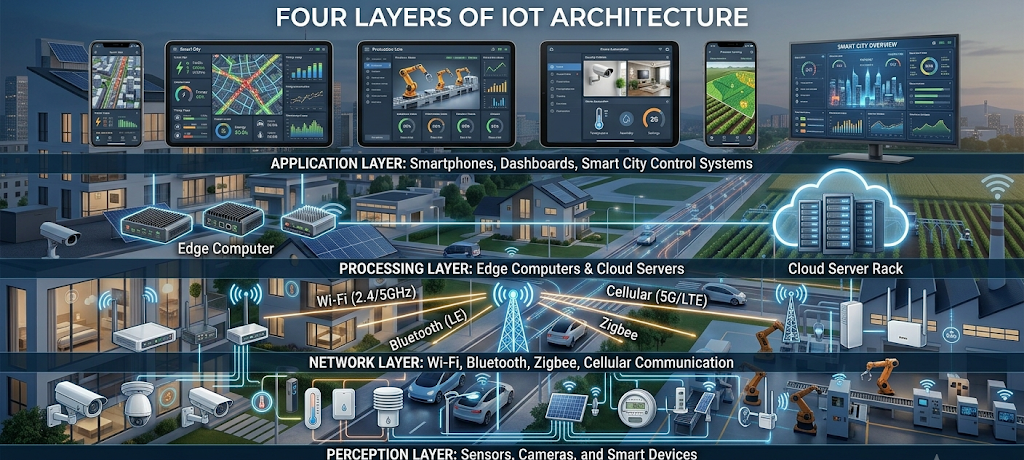
IoT architecture is the design that enables the devices, networks, and applications to function as a system. While the design of an IoT system may differ by industry and application, the basic structure of almost all IoT architectures is divided into four main layers: perception layer, network layer, processing layer and application layer. These are distinct layers that each serve a particular purpose in gathering, conveying, analyzing and reporting information.
These layers facilitate the transition from the physical to the digital, offering a path for data to travel from its physical surroundings into the realm of digital platforms where users and organizations can derive meaningful insights.
The Perception Layer: Collecting Data from the Physical World
The perception layer is the tangible layer of an IoT system. It contains a variety of sensors, cameras, actuators, and other hardware that comes together to sense changes in its surroundings. For instance, in smart agriculture, soil moisture sensors would be used to monitor the moisture level in the soil, and in smart factories, vibration sensors could be employed to monitor the performance of the machines.
These devices gather data, then translate the physical signals into digital data which can be read, stored and sent via communication systems.
The Network Layer: Connecting IoT Devices
The network layer is in charge of sending information from IoT devices to gateways, servers and cloud platforms. This layer covers communication technologies like Wi-Fi, Bluetooth, Zigbee, cellular networks, and long-range wireless technologies. The network to be used in an IoT system is based on the need of the application.
This means that a smartwatch might need short-range, low-energy communication, and a remote environmental monitoring station may require a network capable of transmitting data over a few kilometers.
The Processing Layer: Managing IoT Data
The processing layer controls the storing and processing of gathered information. These devices can be edge devices, local servers or cloud platforms. Raw data from sensors can be converted into meaningful information through processing.
For instance, a pattern can be sensed and the heating or cooling system can be adjusted accordingly without having to involve humans.
The Application Layer: Delivering User Experiences
The application layer is the layer which is directly accessed by users of IoT. That covers mobile apps, web dashboards, automation systems and enterprise software which provide information and enable control of connected devices.
From Smart Lights that can be controlled using a smartphone to remote monitoring of industrial equipment, the application layer is where IoT data becomes a practical solution.
Understanding How IoT Devices Communicate: Networks and Protocols
Communication networks and protocols are the backbone of IoT systems. The communication network that links devices together, and the rules that govern how information is transmitted, is called a protocol. Applications in the IoT domain do not have a single technology to suit all requirements, and hence various approaches to communication are required.
There are devices that require high-speed connections and there are those that are extremely low power and can run for years without the need to change the batteries.
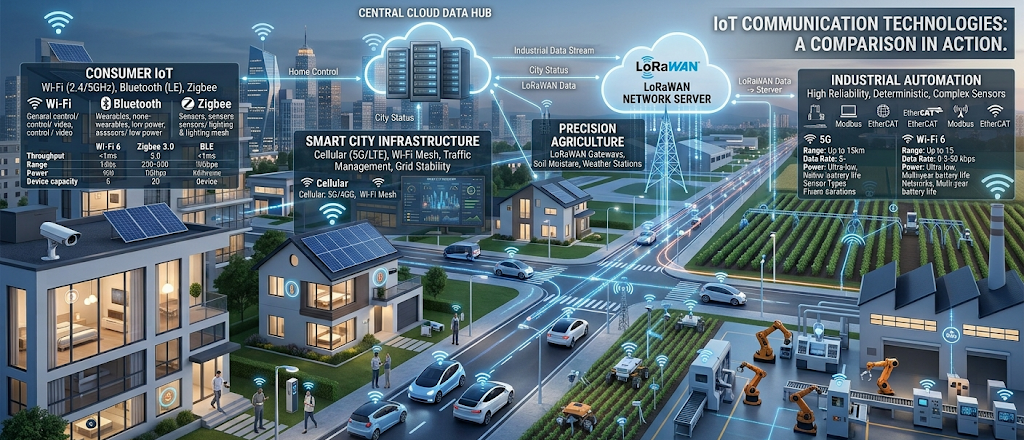
Wi-Fi: High-Speed Connections for Smart Devices
One of the most common communication technologies is Wi-Fi, which offers numerous advantages for providing reliable Internet connectivity and high data transfer speeds in IoT applications. Wi-Fi is used in many consumer IoT devices from the TVs to the security cameras, the voice assistants to the home automation systems, within households and businesses where there are already wireless networks.
The primary benefit of Wi-Fi is that it can transmit lots of data rapidly. This is applicable to devices which send video, sound or information. A smart security camera, for instance, would have to transmit high-resolution videos to a storage system or a monitoring application and therefore, have a strong connection. The power consumption of Wi-Fi devices, on the other hand, is typically higher than some other IoT technologies, so it’s not as well suited for sensors with limited power supplies that must run for a long time.
Bluetooth: Short-Range Communication That Consumes Little Energy
Another noteworthy IoT communication technology is Bluetooth, particularly when it comes to short-range communication and low power consumption. The introduction of Bluetooth Low Energy (BLE) was specifically for IoT applications where devices must communicate without using excessive battery power. It is commonly used in fitness trackers, smart watches, medical sensors and wearable devices.
Bluetooth in a way is not a direct internet access like wi-fi does. Rather, much of the Bluetooth IoT devices are more apt to communicate with a smartphone, gateway or hub which then communicates with the online systems. For instance, a fitness tracker could gather health and movement information via bluetooth and upload it to a mobile application which would analyze the data. With low energy consumption, Bluetooth is particularly useful for small devices that have to run for long periods between charges.
Zigbee: Reliable Communication for Smart Home and Industrial Systems
Zigbee is a wireless communication technology that was developed specifically for low power networks in the IoT. It is applied to smart homes where lights, security sensors, locks and automated appliances are featured. Zigbee also allows for mesh networking, which enables devices to form a network with multiple other devices within their range. Zigbee also features mesh networking, allowing devices to connect with other devices within range to expand coverage and increase reliability.
For the Zigbee network, it can pass information through the other connected devices to reach the information target. This enables a large number of sensors to communicate without needing to have a direct connection to the internet. Its low energy consumption, and its capacity to connect a number of devices, is useful in environments with a large number of sensors that must communicate together.
LoRaWAN: The Technology to Connect Large-Scale IoT Applications Over Long Distances
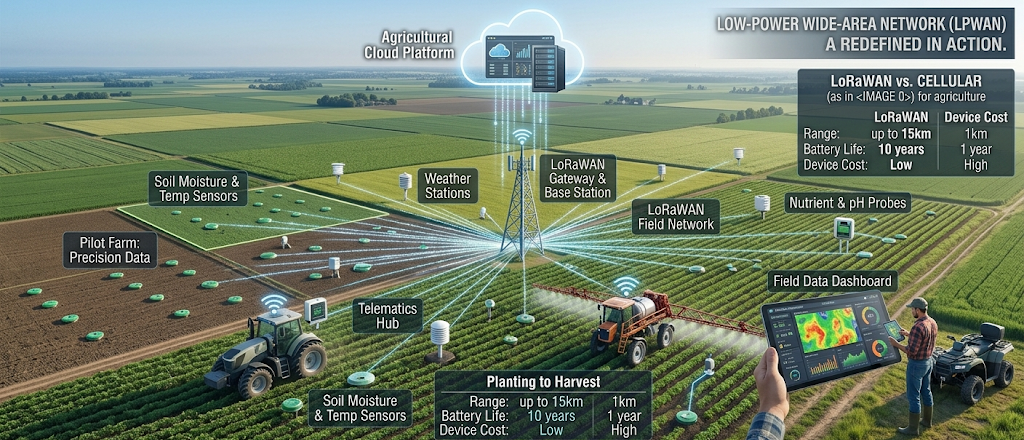
Communication between IoT systems over long distances while consuming minimal power is often needed. Long-range wireless technologies come in when it makes a difference. LoRaWAN is a low power wide area network that provides long-range connectivity between IoT devices and long-range networks, with minimal energy consumption.
LoRaWAN is widely applied in smart cities, agriculture, environmental monitoring, and industrial applications. Imagine a system where farmers can deploy sensors across their expansive fields and collect data without the need for costly cellphone networks or regular battery changes, thanks to LoRaWAN technology. LoRaWAN’s ability to transmit data for several kilometres and with low energy consumption makes it perfect for IoT devices typically sending small data packets occasionally instead of large amounts of data continuously.
Cellular Networks: IoT Connectivity Anywhere
With mobile communication infrastructure, cellular networks deliver connectivity to large areas for IoT devices. 4G LTE, LTE-M and NB-IoT enable devices to communicate using cellular technology, rather than local Wi-Fi connections.
The use case applications for cellular IoT include transportation, logistics, smart cities, and remote monitoring applications. For instance, a company can monitor vehicles, shipping containers or industrial machinery at various sites via cellular connected devices. Cellular networks offer the greatest benefit in terms of their coverage, and are ideal for many applications that span vast geographical areas. But cellular communications may need more power and more operating costs, than some low-power alternatives.
IoT Communication Protocols: How Data Moves Between Devices
Communication protocols are the methods used to transfer data, while networks are the technology used to connect devices.
Different protocols are designed for different requirements, such as reliability, speed, security, and resource constraints, for IoT systems.
MQTT: A Lightweight Messaging Protocol for IoT Systems
In the IoT world, one of the most popular communication protocols is Message Queuing Telemetry Transport (MQTT). It’s created for occasions where gadgets have restricted processing power, bandwidth or weak network connections.
MQTT is not direct device-to-device communication, but instead a publish-and-subscribe model. With this approach, data is broadcasted from the IoT devices to a central broker, and other devices or applications are hooked up to receive specific data from the central broker. For instance, a temperature sensor could be registering temperature changes and publishing them, and a monitoring dashboard could be subscribing to get the updates. This helps to reduce the traffic on the network and enables thousands of devices to communicate efficiently.
MQTT is lightweight and provides reliable communication, making it useful in various applications, including industrial monitoring, smart homes, and connected vehicles. Because it is very efficient it is ideal for IoT applications where devices regularly communicate small amounts of data.
Edge Computing vs. Cloud Computing in IoT
It is important to note that a huge amount of data is being generated from the connected devices and this data needs to be processed and analyzed, which is a major role of computing in IoT.
Two major approaches are used in modern IoT systems: edge computing and cloud computing. Depending on the application, each of the above approaches will have their own advantages.
Edge Computing: Processing Data Closer to Where It Is Generated
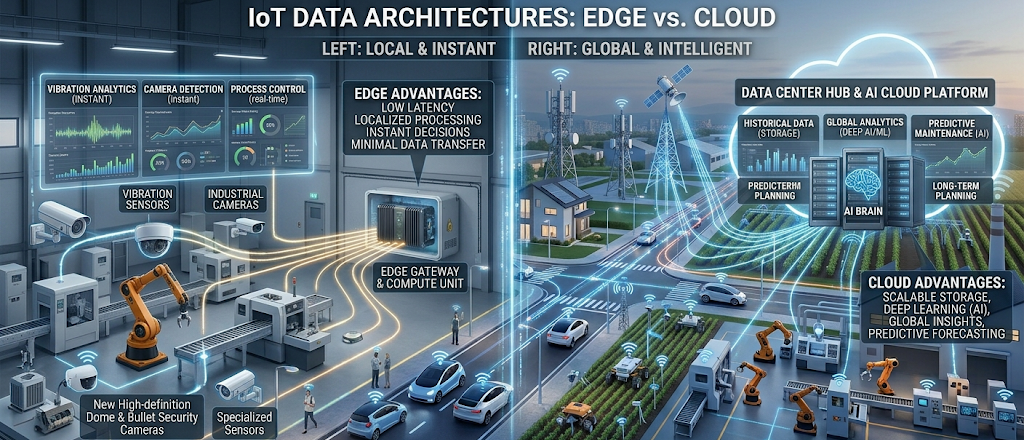
Edge Computing is bringing the computing power to where the data is created rather than transferring all data to a remote cloud server. Edge devices like gateways or local computers can process data on the spot and react quickly in an IoT system.
Useful for when quick decision making is needed. For instance, an industrial machine with sensors can detect some abnormal condition and take immediate action, bypassing the need to send data to a remote server. Edge computing also helps to lower bandwidth consumption as only critical data has to be sent to the cloud.
Cloud Computing: Remote Data Processing with Power
Cloud computing enables IoT systems to store, compute and analyze information on top-of-the-shelf remote servers. Cloud platforms offer the ability to store large volumes of data, along with analytics, artificial intelligence tools, and the ability to manage from a single central location.
When it comes to large amounts of data and a need for long-term analysis, cloud computing adds value. In a smart city, for instance, data gathered from thousands of sensors could be used to generate traffic pattern information, manage energy consumption and enhance public services through cloud-based systems.
Building the Convergence of Edge and Cloud Computing to Enhance IoT Performance
In the modern IoT systems, the use of only one way, like edge computing or cloud computing, is not enough. An edge device processes immediate data, and the cloud platform performs complex analysis, storage and large-scale operations.
With such a combination, the resulting system is more efficient. For instance, in a smart factory, real-time monitoring could be done using edge computing, with historical performance data uploaded to the cloud for predictive maintenance analysis. Faster responses and better decision-making and efficiency can be achieved with a combination of both methods.
The Future of IoT Connectivity
With the continued advancements in IoT technology, connectivity solutions will be increasingly sophisticated, efficient, and secure. New technologies like 5G networks and artificial intelligence, as well as enhancements to edge computing systems, will increase the potential of connected devices. What is expected in the future is for IoT systems to carry more devices with them and have much quicker communication and smarter automation.
Security will also be a key priority issue, since billions of connected devices are possible targets if not adequately secured. As IoT systems become increasingly embedded in the home, businesses, and critical infrastructure, strong encryption, more secure authentication techniques, and frequent software updates will become more and more vital.
Different technologies will need to collaborate if IoT is to have a future. Each of the following technologies, Wi-Fi, Bluetooth, Zigbee, LoRaWAN, MQTT, cellular networks, edge computing, and cloud computing have their own specific applications in the IoT world. When implemented effectively, these technologies can help create smarter solutions that make things more efficient, cheaper and easier for people to live in the world around them.
Conclusion
The architecture layers, wireless networks, communication protocols and computing technologies are needed to enable the connection and communication of IoT devices. Each component is important to enable physical objects to gather data, distribute information and carry out intelligent actions. Smart devices like Wi-Fi and Bluetooth can be connected to these technologies, and for larger deployments, Zigbee and LoRaWAN provide efficient low-power networks. Cellular networks offer connectivity over a broad area and protocols such as MQTT enable the reliable transfer of data between devices and applications.
Knowing the IoT architecture and communication technologies gives an insight into the workings of connected systems. With the proliferation of IoT devices in various sectors, including smart cities, agriculture, transportation, and healthcare, these technologies will continue to play a vital role in creating reliable, scalable, and intelligent digital environments.