
Artificial Intelligence (AI) is a technology that has made an impact in today’s world. AI is integral to many of our daily routines, from voice assistants to recommender systems, fraud detection to medical research. Many of these smart systems are underpinned by a formidable technology known as machine learning. While a traditional computer program needs a human to write down all the instructions needed for each and every possible scenario, machine learning programs can recognize the patterns, learn from information, and enhance their performance over time. By grasping the fundamental concepts of this technology, users can better appreciate the ways in which AI systems make decisions, solve problems, and learn more effectively as they amass more data.
Machine learning is an area of AI that is concerned with building systems that learn from experience, and do not just need to be programmed. Machine learning is the process of introducing massive data sets to computers and letting algorithms process the data to find patterns, connections, and valuable insights. They employ mathematical models to make predictions, to classify information and to refine their performance based on the feedback. It is crucial to delve into the core concepts of machine learning, including the algorithms’ ability to manipulate data, the variations in learning methods, and the significance of machine learning in the context of contemporary AI creation.

What Is Machine Learning?
Machine learning is a technique that helps computers learn from data and make decisions without needing to be programmed for each specific task. Machine learning systems are not programmed to perform a specific action in a specific way; they are designed to sense the data and respond accordingly. A spam e-mail filter, for instance, won’t just scan a list of words that characterize spam e-mails. Rather, it reads thousands or millions of instances of emails, learns what kinds of qualities are linked to spam messages, and improves with experience in recognizing spam.
Unlike traditional software systems, machine learning systems can also learn from their experiences. In a normal computer program, the results are generated according to instructions written by computer program developers, while a machine learning model develops its understanding from available data. The more accurate the data that the system receives, the better their pattern recognition and prediction capabilities will be. The learning process is the basis of numerous current AI technologies, such as search engines, online shopping recommendations, translation applications, facial recognition systems, and autonomous vehicles.
The Importance of Data for Machine Learning
All machine learning systems are built on data. An algorithm with no data to analyze, learn from, and improve. Data can be in the form of text, images, audio recordings, videos, numbers, customer behavior, scientific measurements or sensor information. Machine learning models analyze this data to detect patterns which might not be perceived by humans. For instance, an online streaming platform can determine what programs users watch, for how long and their tastes and suggest programs they might like.
Not every data yields useful results, though. The value, veracity and significance of the data can be significant to the effectiveness of a machine learning system. The model’s results might not be reliable if it is based on incomplete, incorrect, or biased information. Data preparation is thus a crucial step in the machine learning development process. One of the first steps taken by data scientists before algorithms start learning is to tidy, structure, and shape data into a format that the computer can interpret. Effective data management can lead to more accurate AI predictions and effective AI system development.
The Way Machine Learning Algorithms Learn
Machine learning algorithms learn from data and find patterns in data. A set of mathematical instructions which aids computers in doing a certain task. As the algorithm learns, it analyzes examples, makes comparisons and tweaks the internal parameters to minimize error and increase efficiency.
Typically, the process starts with training, where a machine learning model ingests a massive amount of data and tries to identify patterns. The model makes predictions or decisions based on the knowledge it has gained. The forecasts are then compared to the known answers or assessed with certain measurements. If they come up wrong, the system changes its settings, and attempts again. This process continues and the model will learn to perform the task through a gradual learning process.
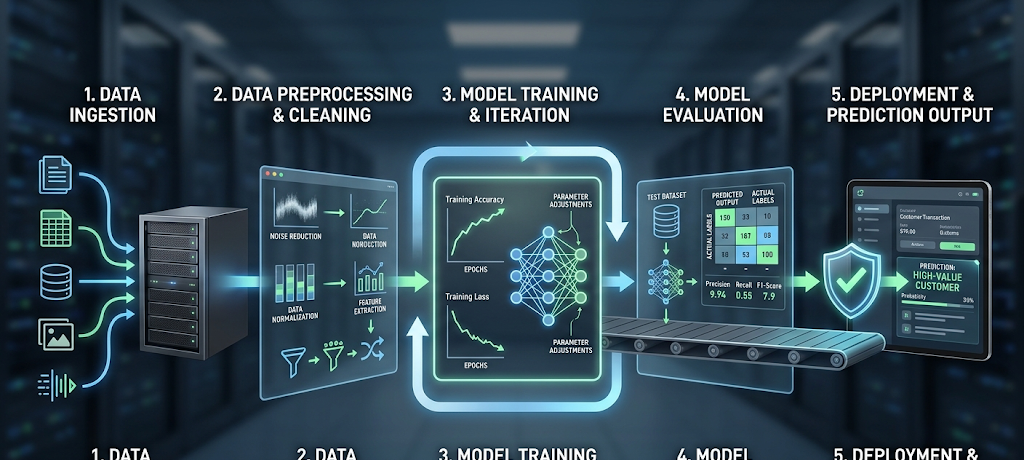
For instance, let’s train a machine learning algorithm to identify cat images. It would be given thousands of images with labels and the system would be able to learn about features like shapes, colors, textures and patterns. With time, it will learn what features are frequently seen in cats. When it gets a new image, it can guess whether the image contains a cat or not by learning what it has learned in training.
Types of Machine Learning
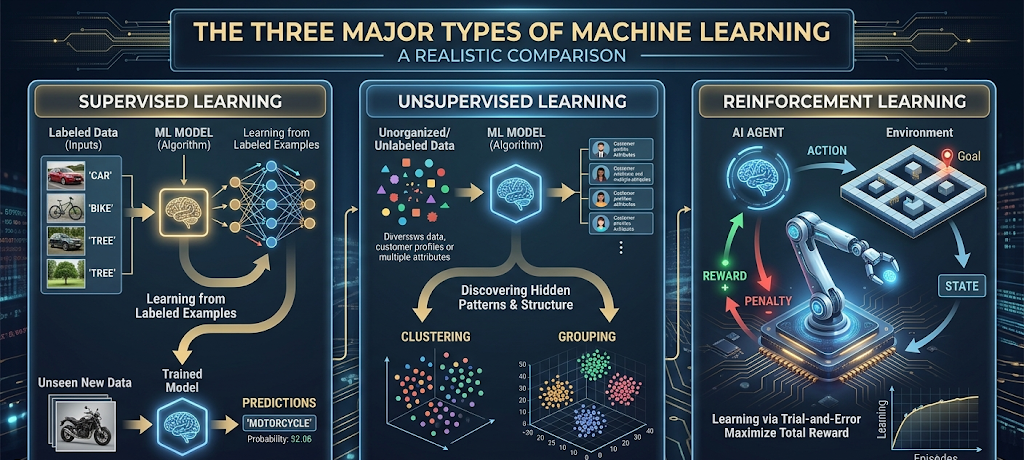
There are typically three types of machine learning: supervised learning, unsupervised learning, and reinforcement learning. Each approach teaches computers in a different way and is suitable for different types of problems.
By grasping these learning techniques, one can better comprehend the workings and the advantages of different AI systems in relation to different tasks.
Supervised Learning
One of the most popular types of ML is supervised learning. With this method, the algorithms are trained with labeled data, which are examples in which the input data and the correct answer are written. The machine learning model takes in these examples and learns the relationship between the inputs and the desired outputs. After training, the model can process new information and predict, based on what the model learned.
One simple use of supervised learning is in the field of email classification. Thousands of labeled emails (either “spam” or “not spam”) can be used to train a computer system. The algorithm learns the patterns from these examples and can determine whether a message is unwanted or not. Once a new e-mail is received, the system looks at earlier examples and guesses if the new one will go into the spam folder.
With the availability of historic data many industries have adopted supervised learning as an effective method to accomplish tasks. It is applied in the business sector for customer behavior prediction, the financial sector for suspicious transaction detection, and the healthcare sector for medical information analysis. Supervised learning is done using common techniques like regression (predicting numbers) and classification (sorting information into categories).
Unsupervised Learning
Unsupervised learning is a type of learning that relies on data without labeled answers. The algorithm is not provided with the patterns to search for, instead, it self-studies the information and finds patterns in the data. Useful when humans are not aware of relationships, or where there is a lot of information to be organised.
Customer Segmentation is an example of Unsupervised Learning. A company can gather data on millions of customers like their buying patterns, interests, and online behavior. A customer grouping algorithm is not necessarily supervised, but can be used to analyse the data and find groups of customers who have similar behaviours. These groups can then inform businesses about their marketing strategies and personalised experiences.
Unsupervised learning also has applications in fields like cybersecurity, scientific research, and recommendation systems. It can detect anomalies, trends and structure complex data. It can also be used to explore data and discover patterns that humans may not be able to see, since it is not dependent on labeled examples.
Reinforcement Learning
Reinforcement learning is a machine learning approach in which an AI system learns from interacting with an environment. The system learns without labels, and through action, feedback, and reward/punishment mechanisms. The task is to find out which operations on the machine give the best results in the long run.
One typical application of reinforcement learning is to train an AI to play a game. The system is initially blank of the rules and optimal strategies. Repeatedly trying different actions, it learns what makes it more likely to succeed and what makes it more likely to fail. After some time, the AI gains strategies that enable it to do complicated things well.
Another application of reinforcement learning is in robotics, autonomous vehicles, and automated decision-making systems. Robots could be trained to move efficiently and self-driving technologies could enhance their road response ability. This learning technique is particularly useful when a decision must be taken continually, and when there are no instructions or guidance for each and every possible option.
Machine Learning Applications in Everyday Life

While users may not recognize it, many technologies that they use on a daily basis rely on machine learning. Machine learning from search engines for understanding queries and their related results. The algorithms of social media sites recommend posts, videos, and ads according to the interests of users. When individuals are online shopping, the websites examine their activity and propose items that could be similar to their preferences.
Voice recognition systems like digital assistants are powered by machine learning that helps them recognize speech and respond correctly. Translation tools employ machine learning models to translate text between languages, taking into account context and meaning. These recommendation algorithms are employed by streaming platforms to forecast which movies, music, or shows a user may be interested in based on their past selections.
Machine learning may also help healthcare workers analyze medical images, find patterns in patient information and help researchers. It is used in the financial industry to detect fraudulent activity and to evaluate risks. The examples illustrate the journey of machine learning from the laboratory to real-world use, where it enhances efficiency, convenience, and decision-making in various sectors.
How AI Learning Benefits Over Time
Machine learning is a key characteristic that it continues to get better the more information it is fed. As a model processes more data, it can improve what it knows and get more accurate. This ongoing development enables AI systems to adjust to evolving circumstances and tackle more intricate duties over time.
But in some cases, it’s not possible to find improvement without effort. For quality, machine learning models need to be trained appropriately, continuously tested and supervised by humans. Performance is measured, algorithms tweaked, and systems keep delivering accurate results. AI systems don’t actually think or understand the world like humans do; they recognise patterns and make decisions according to what they have been trained on, so human involvement will always be necessary.
Future machine learning systems will likely be even more sophisticated, solving complex science, education, business and life problems. The responsible use of technology, accurate data, ethical considerations will become more relevant as technology continues to develop.
Challenges and Limitations of Machine Learning
While there are numerous benefits to machine learning, it also has some drawbacks. A big issue is data quality. Models learn from the data they are given, so if the data is bad or biased, so will be the model’s results. Another difficulty is that it is hard to understand some machine learning systems, as they may have a complex decision-making process.
Another critical consideration is privacy. Many machine learning applications are collecting a huge amount of personal information, which raises questions regarding data collection, storage, and usage. Organizations should ensure users’ information is secure and create artificial intelligence systems in a responsible manner.
Also, machine learning is not a replacement for human intelligence. While powerful, AI systems are not human, do not have emotions, do not create or have common sense. They are best used in conjunction with human knowledge and supervision. The knowledge of the pros and cons of machine learning can help society utilize AI technology better.

Conclusion
Machine learning is one of the most essential technologies used for modern-day AI. Machine learning has revolutionized the way people interact with technology by enabling computers to learn from data, identify patterns and enhance their performance based on experience. Different approaches to teaching machines how to solve problems and make decisions are supervised learning, unsupervised learning and reinforcement learning.
Machine learning is shaping numerous aspects of our daily lives, from recommendation systems and voice assistants to healthcare solutions and security applications. Despite these challenges, the technology has the potential to bring innovation and progress, and many opportunities for it remain. Machine learning keeps developing and understanding how it learns will help people appreciate the systems that are influencing the future of technology.