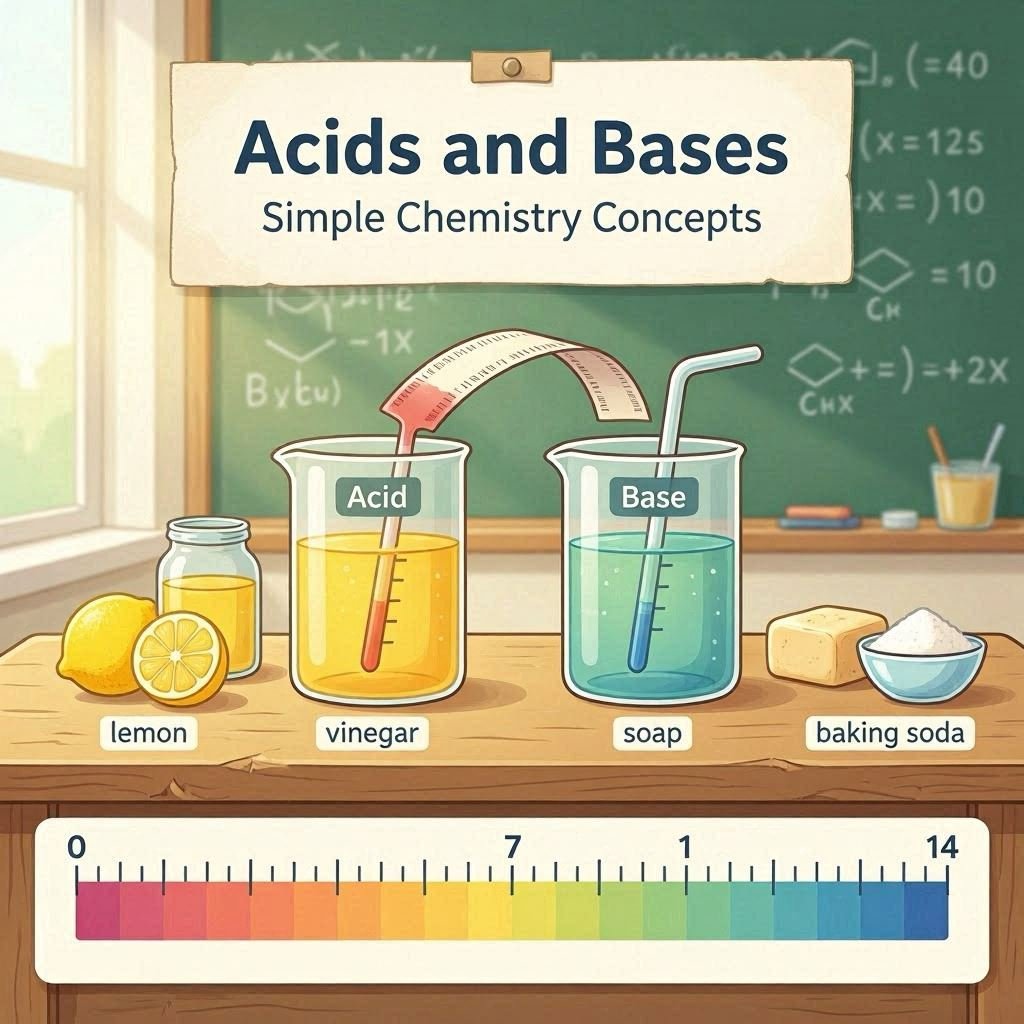
Many students consider chemistry to be a complex discipline with formulas, symbols and lab experiments. There are also numerous chemical compounds common to everyday life that are known but not recognized for their scientific importance. Acids and bases are amongst the most common and important chemical substances. Presence in foods, cleaning materials, medicines, and even in the human body. Lemon juice is sour, soap feels slippery and some household products react when mixed together because of their properties as acids and bases. The knowledge of the basic properties of acids and bases is a solid starting point in chemistry and will enable students to see that chemistry is related to their daily lives.
Neutralisation reactions are one of the most important of all acid and base reactions, and they are the reactions in which an acid and a base react to form new substances. These reactions are of importance in nature, industry, agriculture, and in everyday life. Neutralization reactions help to bring chemical conditions into balance, such as for the neutralization of acidic soil on farms or for stomach discomfort, when taking an antiacid tablet. Beginners can find confidence in chemistry and develop an appreciation of the importance of acids and bases if they understand what they are, what they are not and how they react.
Neutralisation reactions – how acids and bases react
What Are Acids?
Acids are substances that give off hydrogen ions when added to water. This scientific definition might be technical in the beginning, but there are many common materials that are good examples of acids. The sour taste of lemon juice, vinegar, oranges and some soft drinks is due to the presence of acidic compounds. There are a large number of acids that occur naturally and synthetically and are classified by their strengths. There are mild acids that are safe for consumption in small quantities and other corrosive strong acids that must be handled with care in laboratories and manufacturing.
Acids have some of the most readily observable qualities, one of which is sour taste. Citric acid is responsible for the tartness of lemons and acetic acid is responsible for the sharp flavour of vinegar. Acids also react with some metals, giving off hydrogen gas in some cases. They also have another characteristic property, which is that they change the colour of indicators – substances that are used to show if the solution is acidic or basic. For instance, blue litmus paper will change to red in an acid solution. These properties enable scientists and students to identify an acid and to study its properties.
Acids have many uses besides in food and the lab. Hydrochloric acid is present in the human stomach, aiding to break down food and kill harmful organisms. Acidic components are also used by plants and animals in their biological functions. Learning about acids enables learners to gain an appreciation of the way chemistry affects living organisms and everyday products.
What Are Bases?
Bases are substances that give up hydroxide ions in water or can take up hydrogen ions from acids. As with acids, bases also are common substances in everyday use. Some cleaning agents, soap, baking soda, and toothpaste are examples of substances that exhibit basic properties. The base will frequently possess properties that differ from those of an acid, and may thus be suitable to neutralize the acidic pH and to engage in significant reactions.
All bases have the following property when carefully touched: all bases feel slippery or smooth. This feeling is sometimes felt when touching soap or some cleaning agents. Bases are also bitter to taste (but it is never safe to taste a chemical! Bases, like acids, have an effect on indicators. Red litmus paper will change to blue in a basic solution. A simple test to identify acidic and basic substances in the educational environment.
The bases are used in various industries and in domestic use. Basic substances are common in cleaning products since they aid in the breakdown of grease and oil. A mild base, baking soda is commonly used in cooking and cleaning. Some medicines include some basic compounds that can assist to decrease too much acid in the tummy. The examples show that bases are not uncommon chemicals used in the lab, but common substances that have day-to-day applications.
Acids and Bases
Acids and bases do have some similarities as chemical substances, as well as some differences. They are both soluble in water, can react with it, and can affect the properties of solutions. But their attributes tend to be opposite when juxtaposed. Acids taste sour and bases taste bitter. Acids change the colour of blue litmus to red and bases change the colour of red litmus to blue. Acids give off hydrogen ions, bases give off hydroxide ions or are able to accept hydrogen ions.
Scientists have a scale called the pH scale to measure the level of acidity or basicity of a substance. The pH scale is from 0 to 14. The numbers below 7 for the pH level are acidic; above 7 are basic; 7 is neutral. Lemon juice, vinegar are acidic, with pH less than 7. Soap and baking soda are basic because they have a pH greater than 7. Pure water is said to be neutral with a pH value that approaches 7.
Knowing these differences enables students to categorize materials and anticipate their reaction during a chemical reaction. The pH scale is a convenient way to describe the chemical properties of many environments and to determine the acid / base balance.
Simple Diagram: The pH Scale
Acidic Neutral Basic
0—1—2—3—4—5—6—7—8—9—10—11—12—13—14
Lemon Juice Water Soap
Vinegar Baking Soda
Neutralization Reactions Explained
Neutralization reactions is one of the most important interaction between acids and bases. Neutralization reaction, an acid and a base combine to form a salt and water: This process will decrease the acidity or basicity of the initial substances and form a more neutral solution. Neutralisation reaction is one of the most basic types of reaction that is learnt in the first year chemistry course as it is very indicative of the interaction of different substances.
One such example is hydrochloric acid and sodium hydroxide. These substances react with each other in the proper proportions to yield sodium chloride, or table salt, and water. Neutralisation reactions can also take place in the real world, although they can be seen in the laboratory using strong chemicals. Antacid tablets neutralize stomach acid. On occasions, lime is added to acidic soils to enhance the ability of the soil to grow crops. Neutralisation is a method used by water treatment plants to balance chemicals and minimize impact on the environment.
Neutralization reactions are not just important in school, but in everyday life as well. These reactions are used in the industries to produce products, to handle waste, and to regulate the chemical conditions. Through the comprehension of this concept students will gain an understanding of the ways in which chemistry can be used to provide solutions to real world problems.
Simple Diagram: Neutralisation reaction
Acid + Base
↓
Neutralization
↓
Salt + Water
Example:
Vinegar + Baking Soda
↓
Chemical Reaction
↓
New Products Form
Find examples of acids in everyday life
People come into contact with many foods and household products that contain acids. Lemons, oranges and grapefruits have citric acid, one of the defining components of their flavor. Acetic acid is a component of vinegar and is commonly used in cooking, cleaning and food preservation. Carbonated beverages may include compounds that affect the taste and shelf life. This shows that acids are not only found in the lab, but also in everyday surroundings as well.
Food is not the only function of the acids. A stomach acid called hydrochloric acid helps break food down and gets rid of bad bacteria. Some skin care products include low concentrations of acidic ingredients which exfoliate the skin and enhance its appearance. Acids are also used in industrial processes for manufacturing, cleaning and chemical processing. For instance, sulfuric acid is used in a large amount in making fertilizer and battery.
Students identify acids as common substances and relate their knowledge in the classroom to their observations. Acids are not just substances that have no real significance in everyday life, but are instead substances that have practical uses and have meaning in the world.
Everyday Examples of Bases
Bases are also found in everyday life, and have many different uses. One of the most well-known examples of basic substance is soap. It is a good cleaning agent due to its chemical characteristics that help attract oils and dirt on surface. Another popular base that can be used in cooking, deodorizing and cleaning is baking soda. Simple compounds are used in toothpaste to keep the mouth healthy.
Many household cleaning products also use bases as they are good for removing grease and organic materials. Some cleaners use basic chemistry, like ammonia-based cleaners, or some detergents. Some pharmaceuticals also include ingredients that are alkaline to help neutralize the excess acid in the digestive system. All these products are examples of how bases are used and are useful in daily activities.
The knowledge of bases enables students to appreciate the reason why the products behave in a certain manner. People use the properties of simple substances regularly without realising the chemistry in play when they are washing the dishes, cleaning their teeth or cooking food.
Why Acids and Bases Matter in Science and Society
Acids and bases are more than just chemistry lab experiments—they play a role in many facets of daily life. Soil acidity management is critical for good crop growth in agriculture. An environmental scientist is responsible for studying the acid-base balance of a lake, river, or ecosystem. Doctors rely on understanding of the properties of acids and bases to help them comprehend the processes in the body and to create remedies. Acid and base chemistry is common in industries for the production of variety of products like fertilizers, pharmaceuticals etc.
Acid-base chemistry is also integral in scientific research. Chemical reactions are used to develop new materials, enhance technologies and address environmental problems. The knowledge gained by the student in these concepts are valuable scientific knowledge which can be used for further study in Chemistry, Biology, Environmental study and medicine. People who are not scientists can also gain knowledge from understanding about the behavior and interaction of common substances.
Acids and bases are of such general importance that they are still fundamental parts of chemistry curricula. They are practical and useful topics to introduce to students on concepts of scientific thinking and chemical principles.
Conclusion
Chemistry is the most important and common of the substances that you may encounter in chemistry are acids and bases. Acids give off hydrogen ions, are acidic (usually have low pH) and taste sour, bases give off hydroxide ions or take up hydrogen ions, are basic (usually have high pH) and have unique chemical properties. These concepts are easier to be understood and to show them their importance in everyday life with lemon juice, vinegar, soap, and baking soda.
One of the most important processes in chemistry is the interaction of acids and bases by neutralization reactions. These reactions form water and salts, and neutralize the acidic or basic properties. Neutralization reactions have numerous practical applications such as antacids, soil treatment, industrial production and environmental control. Knowing how acids and bases react with each other, the student and the beginner can have a solid working knowledge of chemistry and develop an appreciation for the chemistry that surrounds them.