Introduction
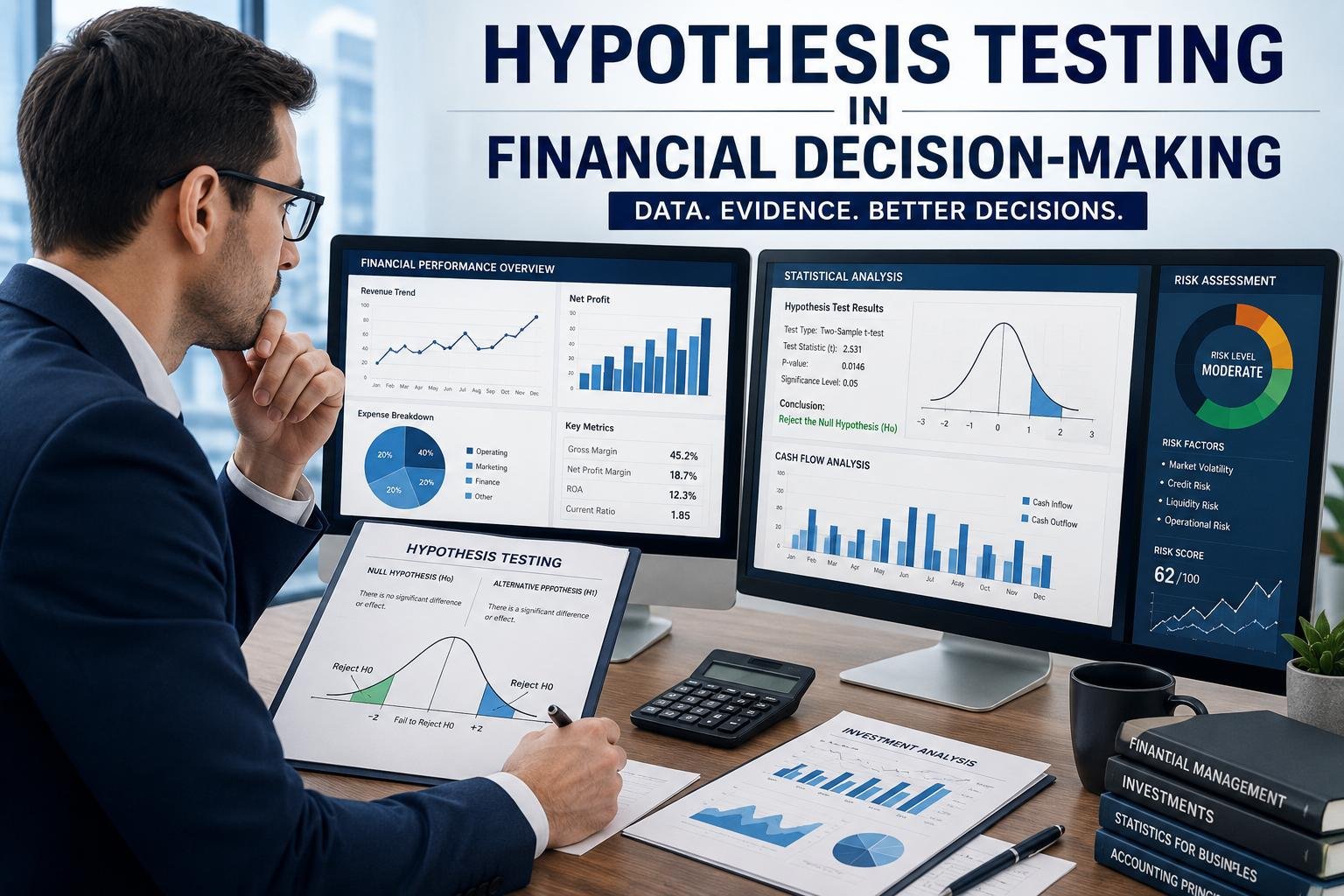
In the field of accounting and finance decisions are not usually based on guesswork. Organizations at all times are present with uncertainty as they evaluate investments, detect fraud, project profits, manage risk, or review financial performance. To reduce that uncertainty and to improve accuracy accountants and financial analysts turn to data driven methods. Of all the tools used in modern finance the most important is hypothesis testing in financial decision-making.
At the heart of this process is statistical decision theory and hypothesis testing that which allows professionals to put forward unbiased analysis of financial data and determine what support is there in fact for their assumptions. We see these stats tools to be that which enable companies to steer clear of large scale errors, to enhance the audit process and to better inform strategic planning.
Financial decisions play out over large sums of money, legal issues, and long term results. For instance a company may have to determine if a profit drop is short term or a bigger issue. An auditor may look at if abnormal transactions are a sign of fraud. Investors may put forth a new strategy to see if it really does improve results. In each of these cases statistical testing gives a framework to present the facts before coming to a decision.
This article reports on the value of statistical decision theory and hypothesis testing in accountancy and finance which we also look at how they play out in the context of small and large scale studies. Also we see how they are used in audit, risk evaluation, and in making decision based on the evidence.
Understanding Statistical Decision Theory
Statistical decision theory is an area of statistics which deals with choice in uncertain terms. This field uses probability, statistics, and logic to support decision makers in choosing the best option out of the present information.
In all of finance and accountancy uncertainty is present. Markets fluctuate, consumer want changes, and financial records may have errors. Statistical decision theory gives a framework which in which professionals present to evaluate options and at the same time reduce risk.
The theory generally involves:
- Identifying a problem or assumption
- Gathering relevant financial data
- Analyzing probabilities and risks
- Comparing possible outcomes
- Making choices that are based on statistics.
For accountants we see which improves the quality of financial reports and audit. For investors and analysts it also puts forward better forecasting and investment strategies.
What Is Hypothesis Testing?
Statistical hypothesis testing is a method which is used to determine that we have enough evidence to support a claim or assumption about a population.
A hypothesis is a proposition which we put to the test via data. In finance and accountancy issues which we put forward as hypotheses may include:
- Whether a company has seen large increases in revenue of.
- Whether internal controls reduce fraud
- Whether does a new pricing structure increase profit.
Do investments perform as expected?
Hypothesis testing professionals out of their own opinions or rather which is that results are from measurable and not personal judgments. Also decisions may be said to be based on what can be measured as opposed to what which may simply be assumed.
The Two Main Hypotheses
Hypothesis testing includes put forth which are opposite to each other.
Null Hypothesis
The null hypothesis states that which is to say there is no effect or difference. It is the assumed state of the world.
Example: Last year’s profits are the same as this year’s.
Alternative Hypothesis
The other hypothesis is that a large effect or difference is present.
Example: Today we see an increase in profits from last year.
Testing is done to see if we have sufficient evidence to reject the null hypothesis.
The Role of Statistics and Hypothesis Testing in Accounting
In modern accounting we see that the application of statistical decision theory and hypothesis testing is a must which is due to the fact that financial professionals usually work with imperfect data and variable results.
Improving Financial Accuracy
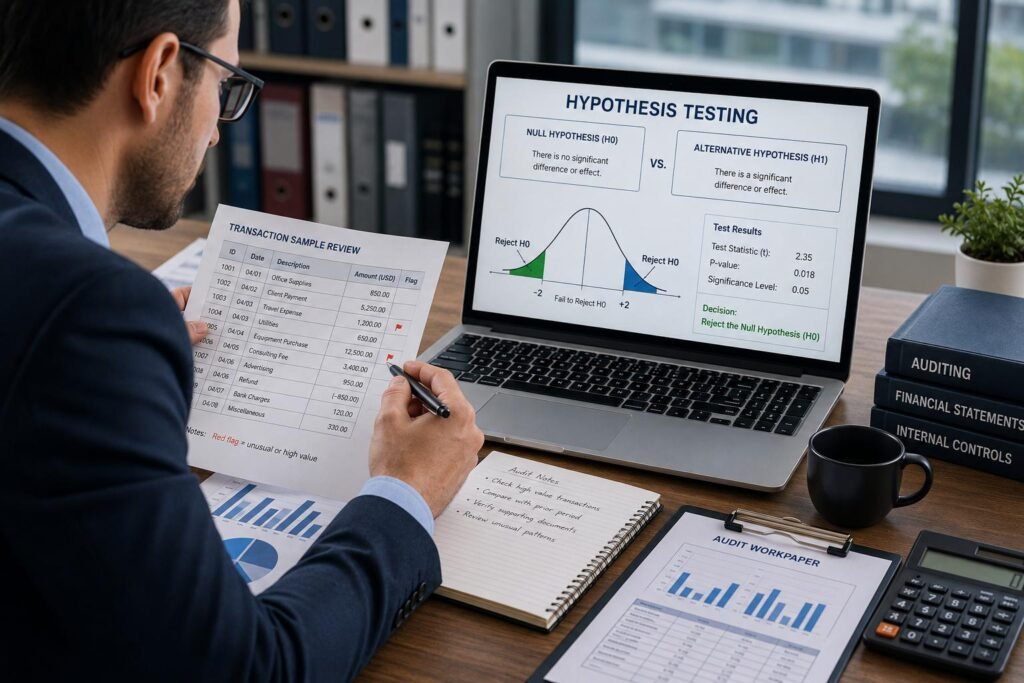
In daily operation we see that businesses process thousands of transactions which may make it impractical to check each and every record especially in large organizations. Accountants use statistical testing which allows them to look at a sample of those records and from that draw conclusions about the entire population. This improves efficiency while maintaining reliability.
Supporting Evidence-Based Decisions
Managers and investors want proof before they go ahead with financial strategies. Hypothesis testing gives out objective support for decisions which in turn does away with reliance on intuition. For instance before putting forth new investment strategy analysts may check that the returns are in fact statistically significant.
Reducing Financial Risks
Risk management is a key issue in finance. We use statistics to identify out of the ordinary patterns, to determine the chances of loss, and to measure uncertainty. This is a chance for companies to act early before issues grow.
Enhancing Audit Reliability
Auditors use statistics to look at financial reports to see if the numbers are as they should be and free of what we may call material errors. Also they use the element of hypothesis testing which is a key tool in their arsenal for looking at the health of internal control systems and also for the detection of possible fraudulent activity. Thus we see that which financial reports put out are of a higher trust value to investors, regulators, and stakeholders.
Steps in Hypothesis Testing
Hypothesis testing is a structured approach which bases results on logic and evidence.
Step 1: Describe the Issue.
First out is to identify what issue or assumption which is to be tested.
For example:
Has the company’s profitability improved as a result of cost reduction?
Step 2: State the null and alternative hypotheses.
Null and alternative hypotheses are presented.
- Null hypothesis: The strategy does not impact profits.
- Alternative hypothesis: The strategy greatly increases profits.
Step 3: Gather Data.
Relevant financial information is derived from accounting reports, surveys, or studies.
Step 4: Set a significance level for your test.
The level at which we set for significance determines the chance of making a wrong decision. A common significance level is 0.05 which in turn means there is a 5% chance of rejecting a true null hypothesis.
Step 5: Choose the Right Statistical Test.
The issue of which test to use is based on factors like sample size, data type, and research goals.
Step 6: Review Results.
Statistical analysis is conducted to assess the data.
Step 7: Make your choice.
The null hypothesis is either rejected or not at which point in the study we do not have enough info to reject it.
Hypothesis Testing for Small Samples
Small scale testing is what we see in cases of small sets of data. In accountancy and audit this is a common issue when:
- Examining specialized transactions
- Reviewing limited financial records
- Auditing small businesses
- Analyzing pilot investment programs
Small scale studies require special statistical methods as less data means more uncertainty.
Characteristics of Small Sample Testing
- Sample size is less than 30.
- Results are more affected by outliers.
- More focus is given to distribution assumptions.
- Statistical results may be unstable.
- Common Small Sample Tests
t-Test
The t-test is a common choice for small sample size which we use to compare means. For instance a financial analyst may report using a t test that has been run to report on a new budgeting system’s performance which in turn reports if there is in fact a change in operational costs.
Paired Sample Testing
This study reports on before and after financial performance of a policy change.
Importance in Accounting
Small sample studies are of great value when we do not have full data sets. Auditors tend to use well thought out small samples to look at sensitive transactions or identify atypical financial activity. Although small in size these methods may still be useful but professionals should exercise caution as smaller data sets also increase the chance of error.
Hypothesis Testing for Large Samples
In large scale studies which have a lot of data points, usually over 30 we use large sample testing. In today’s business environment large sets of data are the norm in accounting which we see from the fact that companies produce a great deal of financial info through digital systems.
Characteristics of Large Sample Testing
- Results are generally more stable
- Statistical estimates become more reliable
- Normality assumptions less of an issue.
- Data automation in analysis is what is seen to speed up the process of.
Common Large Sample Tests
z-Test
In large samples the z test is used to do so. For instance a bank may perform a z test that customer loan defaults have exceeded what is which is considered acceptable.
Chi-Square Test
This test examines relationships between categories. In accountancy we see that it is used to determine if certain departments or transaction types are related to fraud.
Importance in Financial Analysis
Large scale analysis allows for better evaluation of company-wide performance, market trends, and investment results. Financial institutions often perform large scale statistics to monitor credit risk, customer behavior, and economic trends.
Type of Errors in Finance
Hypothesis testing is a fallible process. Decision makers should be aware of the chance for statistical error.
Type I Error
A Type I error is when we reject the null hypothesis which in fact is true. In finance what we may see is the accusation of fraud against something which in fact is not true. This issue may cause damage to reputations as well as set off fruitless investigations.
Type II Error
A Type II error is when we fail to reject the null hypothesis which in fact is false. For instance an auditor may not notice actual financial fraud. This issue may result in financial loss or legal action. In this is the balance of those risks we put forward in statistical decision making.
Applications in Auditing
Audit is a primary area which we apply hypothesis testing.
Detecting Fraud
Auditors use statistics to find out of the ordinary transaction patterns which may point to fraud.
Examples include:
- Duplicate payments
- Abnormal expense claims
- Unusual inventory records
Evaluating Internal Controls
Companies put in place internal controls which reduce financial errors and also prevent fraud. Auditors determine the effectiveness of these controls. Hypothesis testing is used to determine if in fact control systems do better at improving financial reliability.
Sampling Transactions
Auditors look at random samples of transactions instead of each and every one. This is achieved without trade off of audit results’ quality.
Applications in Investment Analysis
Investors and financial analysts use statistical analysis for evaluation of investment opportunities and market performance.
Testing Investment Strategies
Analysts compare the performance of investments to determine which strategies do better. For instance they may look at how a diversified portfolio reduces risk.
Forecasting Market Trends
Statistical study helps investors to identify trends in stock prices, interest rates, and economic indicators. This increases forecasting accuracy which in turn supports long-term planning.
Evaluating Financial Performance
Companies’ use of hypothesis testing which they compare business performance over various times or between different departments. This will put to light which areas are doing well and which are not.
Risk Assessment and Financial Planning
In financial management risk assessment is a must as businesses live with uncertainty.
Credit Risk Analysis
Banks use stats to determine the chance of customers defaulting on loans. This is what determines lending policies and interest rates.
Budget Evaluation
Organizations see if there is large scale impact of spending on profitability.
Insurance and Financial Protection
Insurance companies use stats to determine what the future holds in terms of claims and financial risk. Accurate predictions help maintain financial stability.
Advantages of Hypothesis Testing in Accounting
- Objectivity: Decisions are made from factual data instead of assumptions.
- Improved Efficiency: Sampling decreases the need for analysis of each transaction.
- Better Risk Management: Statistical analysis which in turn enables companies to identify and proactively manage risks at the early stage.
- Stronger Financial Reporting: Reliable analysis enhances the trust in financial reports.
- Support for Strategic Decisions: Businesses can improve evaluation of policies, investments, and operational changes.
Limitations of Hypothesis Testing
Although we use hypothesis testing it also has its limitations.
- Dependence on Data Quality: Poor-quality data can produce misleading conclusions.
- Risk of Misinterpretation: Misinterpretation of statistics may result in poor decisions.
- Sampling Errors: A random sample may not be of the whole population.
- Overreliance on Statistical Results: Financial choices also to factor in professional judgment and economic conditions.
The Future of Statistics in Finance
Technology is changing the role of stats in accounting and finance.
Presently companies are using:
- Artificial intelligence
- Big data analytics
- Automated auditing systems
- Machine learning algorithms
These technologies speed up and improve accuracy of statistical analysis. However in that we still use the basic principles of hypothesis testing which is to have reliable tools to evaluate evidence and support decisions. As our financial systems grow in complexity statistical literacy will do also for accountants, auditors and analysts.
Conclusion
Hypothesis testing is at the core of financial decision making which we see in its use to test out assumptions with hard data. In the arena of statistics, accountants and financial analysts use this tool to improve accuracy, reduce uncertainty, detect fraud, and support strategic planning.
Both small and large scale testing approaches have their value based on what you have in terms of data. Small scale methods do well with narrow or large sets of data and in specialized audits, while large scale methods support in depth financial analysis and forecasting.
In large part it is true that statistical decision theory and hypothesis testing present a structured approach to financial decision making in uncertain settings. Through careful application of these tools companies may see an improvement in financial reporting, better risk management, and greater confidence in their decisions. As the fields of accounting and finance grow with the advance of technology and data analytics hypothesis testing will be at the fore front of tools for evidence based financial management.
Get more well researched information about hypothesis testing in financial decision-making here.