
Introduction
In today’s world of accounting we see great use of statistics to improve on financial report accuracy, audit results and in decision making. Companies produce large sets of financial data daily which accountants in turn have to assess to determine that it does in fact represent the company’s true performance. Also we see in account research and audit work the use of the chi-square distribution in accounting as a key statistical tool. This method allows accountants to put forth that which is expected to what we see play out in reality which in turn determines if we are seeing something significant or if in fact it is just chance.
The chi square distribution is very useful in the field of accounting as it allows for the analysis of categorical data, testing of assumptions, and evaluation of compliance with what is expected in financial reports. Auditors and financial analysts use chi square tests to look at the accuracy of accounting records, to identify atypical transaction trends, and to improve the validity of financial statements.
It is important that we understand how chi square analysis works for students, accountants, auditors and financial researchers. By using statistics properly organizations may improve risk management, reduce fraud, and make better financial decisions. In this article we look at the role of chi square distribution in accounting analysis, we explain tests of goodness of fit and we discuss how accountants use statistical tools to compare what is expected with what is seen in financial results for improved reporting accuracy.
Understanding Chi-Square Distribution
The chi square distribution is a type of probability distribution used to study the relationship between categorical variables and also to determine the difference between what is observed and what is expected. Also it is very much in use when data is in form of categories as opposed to continuous numerical values.
In the field of accounting and audit we see the chi-square distribution used to determine if what is reported in the financial statements is in fact what was to be expected. If we see large differences between actual and expected results accountants may require looking further into the issue.
The chi square distribution has the following features:
- It is always positively skewed.
- The values cannot be negative.
- It is a matter of degrees of freedom.
- The shape changes as sample size changes.
- It is used in hypothesis testing.
In the field of accounting which is focused on the evaluation of financial trends and transaction categories chi square methods are very useful for statistical analysis.
Role of Chi-Square Distribution in Account analysis
In the field of accounting the chi-square distribution is very important for a reason that it gives us a scientific approach to determine if actual financial results do in fact match what we expect. We see a lot of data in account which is broken out into different categories like expense types, transaction groups, audit issues, customer payment patterns, and tax reports and Chi-square also is a tool which helps to determine if this data which we see is in fact as expected or not.
Some key factors which make the chi-square distribution important in accounting are:
Improving Financial Accuracy
Accounting professionals use chi square tests to determine if accounting records are in agreement with what is expected which in turn improves the accuracy and reliability of financial reports.
Supporting Audit Investigations
Auditors also look at the ratios of different transactions which should be more or less the same in an ideal situation. Large variances may be a sign of error, fraud, or issues with internal control.
Assisting Risk Assessment
Statistical analysis is used by organizations to identify atypical patterns that put forward issues of operation and finance.
Enhancing Decision-Making
Managers and analysts use statistics in their business decisions. Chi-square analysis is a tool which we use to support financial conclusions objectively.
Strengthening Research in Accounting
Accounting scholars use chi square tests in the study of relationships between variables which include financial policies, auditing methods, tax compliance and corporate governance.
Concept of Expected and Observed Values
The basis of chi-square testing is in comparing expected values to what is actually seen.
Observed Values
Reported values are from what we see in the financial reports, audits, or accounting systems.
Examples include:
- Reported number of fraud cases which were detected.
- Real customer payment categories
- Recorded tax filing errors
- Actual expense classifications
Expected Values
Accountants report what is expected to happen in normal circumstances or which is put forth by theory.
For example:
- Expected frequency of transaction errors
- Anticipated distribution of customer payments
- Predicted audit outcomes
- Expected inventory discrepancies
The chi square test is for determining the statistical significance of the difference between expected and observed values. If for the most part the difference is small accountants may note that the variation is natural. If the difference is great it may point to financial irregularities or flawed assumptions.
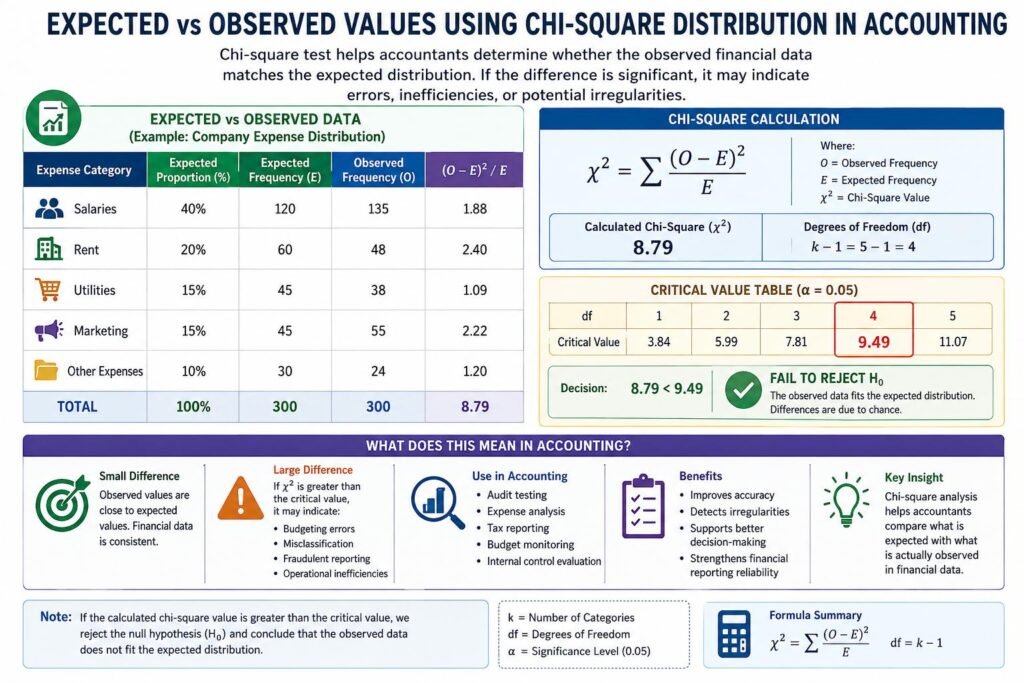
Tests for Goodness of Fit in Accounting
One of the primary uses of chi-square distribution is the goodness of fit test. The goodness of fit test is used to determine which financial data sets fit into a particular distribution. In accountancy this test is used to see if financial actions follow as per the Ɵ which is to be expected.
Example in Accounting
Suppose an accountancy department which puts out that company expenses will go to each division in certain proportions. Upon review of the actual expense reports we may see accountants use a chi square goodness of fit test to determine if the actual expense distribution matches what was put out.
If the report notes large differences which it also may include a full scale investigation:
- Budgeting errors
- Misclassification of expenses
- Fraudulent reporting
- Operational inefficiencies
Applications of Goodness-of-Fit Tests
In many areas of accounting we see the use of goodness-of-fit tests which include:
- Auditing transaction frequencies
- Evaluating payroll distributions
- Examining tax reporting patterns
- Analyzing customer payment methods
- Reviewing inventory records
- Assessing financial statement consistency
These results provide accountants with a statistical framework for financial reliability.
Chi-Square Test for Independence
In accounting analysis which is an important aspect of the field we have the chi-square test for independence. This test is to see if two categorical variables are related or independent.
Accounting Example
An accountant may wish to see if there is a relationship between:
Employee division and issue rate of accounting errors.
- Customer type and payment defaults
- Audit outcomes and company size
- Internal audit and fraud issues.
If the results of the chi-square test show dependence then accountants may report that one variable causes the other.
Importance in Financial Research
Accounting research that looks at the relationship between business variables often turns to the chi-square test for independence. This is a tool which reports patterns to organizations and in turn better decision making. For example research may look at how better internal controls play out in terms of reducing financial fraud. Statistical data from chi square analysis may in turn support put forth improvements to corporate governance.
Role of Chi-Square Distribution in Auditing
In the field of auditing the Chi-square distribution is very much used. Auditors’ role is to verify the accuracy and fairness of financial statements. While it is not practical to check every transaction, auditors use statistical sampling and testing techniques. Chi square analysis is used by auditors to determine if sampled financial data reflects what is expected.
Detecting Fraud
Fraud produces atypical transaction trends. Auditors use chi-square tests to find discrepancies between what is expected and what is reported in financial statements.
Examples include:
- Unusual invoice frequencies
- Abnormal payment patterns
- Unexpected inventory shortages
- Irregular payroll distributions
When auditors see stats which cross the threshold of significance they may look into issues more in depth.
Evaluating Internal Controls
Organizations put in place internal control systems to reduce errors and fraud. Auditors which in turn use chi square tests to determine if those control systems are working as they should. For instance auditors may check out what is recorded in the transaction reports against what is put forth as authorized.
Supporting Audit Sampling
Audit sampling is a process of choosing certain transactions instead of all of them. Chi-square distribution is used to determine if the sample data is representative of the whole population. This increases audit efficiency at the same time which does not trade off reliability.
Chi-Square Distribution in Financial Reporting
Financial reporting is based on precise and reliable info. Investors, creditors, and regulators use financial reports in which they make their decisions. Chi square analysis improves report quality by allowing accountants to assess data consistency.
Identifying Reporting Errors
Accounting professionals may use chi-square tests to identify out of the ordinary financial categories or issues in reporting trends.
For example:
- Unexpected changes in revenue categories
- Abnormal expense distributions
- Inconsistent asset reporting
Statistical analysis reports help accountants to identify issues prior to the finalization of financial statements.
Ensuring Regulatory Compliance
Companies have to adhere to accounting standards and we use chi-square analysis to determine if reporting practices are in line with what is required. This decreases the chance of penalties, misstatements and reputational damage.
Applications in Tax Analysis
Tax and corporate accountants also use chi-square distribution in tax related analysis.
Detecting Tax Irregularities
Tax auditors will look at what is supposed to be reported in tax forms against what is actually reported. Large discrepancies which may point out tax evasion or reporting mistakes.
Studying Taxpayer Behavior
Researchers report on the association between tax payer features and compliance actions. This data is used by governments to improve tax policies and enforcement strategies.
Use in Budgeting and Forecasting
Budgeting is about to project future financial results from past trends. Also chi-square analysis is used by accountants to determine if actual financial performance is what was expected.
Monitoring Budget Performance
Organizations may compare what is budgeted for each department against what is actually spent. If statistics bear out the difference then managers may have to revise budgets or look into operational issues.
Improving Forecast Reliability
Statistical analysis increases confidence in financial forecasts by detecting issues in financial trends. This is to improve business planning and to reduce uncertainty.
Advantages of Chi-Square Distribution in Accounting
In accounting analysis the use of chi square distribution has many benefits.
- Simple Interpretation: Chi square methods are easy to use and apply in particular for categorical data analysis.
- Effective for Large Data Sets: Today’s accounting systems produce large sets of financial info. Chi-square tests do well with large data sets.
- Supports Objective Decisions: Statistical data which in turn reduces dependence on personal judgment and improves decision making accuracy.
- Useful in Multiple Accounting Areas: Chi square analysis is used in auditing, taxation, budgeting, research, fraud detection and financial reporting.
- Helps Detect Irregularities: By noting what which actual results deviate from what is expected accountants are able to identify atypical financial trends better.
Limitations of Chi-Square Distribution
Although of use the Chi Square analysis also has drawbacks.
- Dependence on Sample Size: Large in sample size may produce statistical significance for very small practical differences.
- Limited to Categorical Data: Chi square tests are for categorical variables and may not apply to continuous numerical data.
- Sensitive to Expected Frequencies: Very low frequencies may reduce chi-square results reliability.
- Cannot Explain Cause and Effect: Chi square tests may find out associations but do not prove cause and effect.
Due to which these limitations exist accountants often use chi-square analysis in conjunction with other statistics for a more complete picture.
Importance of Statistical Thinking in Accounting
In today’s complex business environment statistical analysis is a requirement in accounting. Organizations are using data driven decision making to improve financial management, strengthen audit processes, and reduce risk. Accountants are using tools like chi square distribution which allows them to move beyond assumptions and base decisions on what is measured.
As technology and data analytics are growing, we see an increase in the role which statistical knowledge plays in the field of accounting. Which professionals that have a grasp of statistics do is that they better analyze financial info, interpret risk, and put their organizations’ success at the front.
Conclusion
In finance and accounting the Chi-Square distribution is a key tool which professionals use to compare what is expected in terms of financial results to what we see play out. Via goodness-of-fit tests and tests for independence accountants and auditors are able to assess the accuracy of financial reports, to detect anomalies and in turn to enhance the decision making process.
In audit practices we see that chi square analysis is used to detect fraud, to assess internal controls, and to improve audit reliability. In finance reporting it also improves consistency and supports attainment of accounting standards. Also the method is very much into tax, budget, forecast and account research.
Although chi square testing does have its issues, it is a very useful tool which it puts at the disposal of the accountancy profession for use in presenting objective stats. As data analysis and statistical analysis grow in importance in the business world, the study of chi square distribution takes on even greater importance for accountants, auditors, and financial analysts.
Through use of statistical tools which is effective accounting professionals may see an improvement in report accuracy, reinforcement of financial integrity, and support for better business decisions in a complex financial environment.
Get more well researched information about chi-square distribution in accounting here.