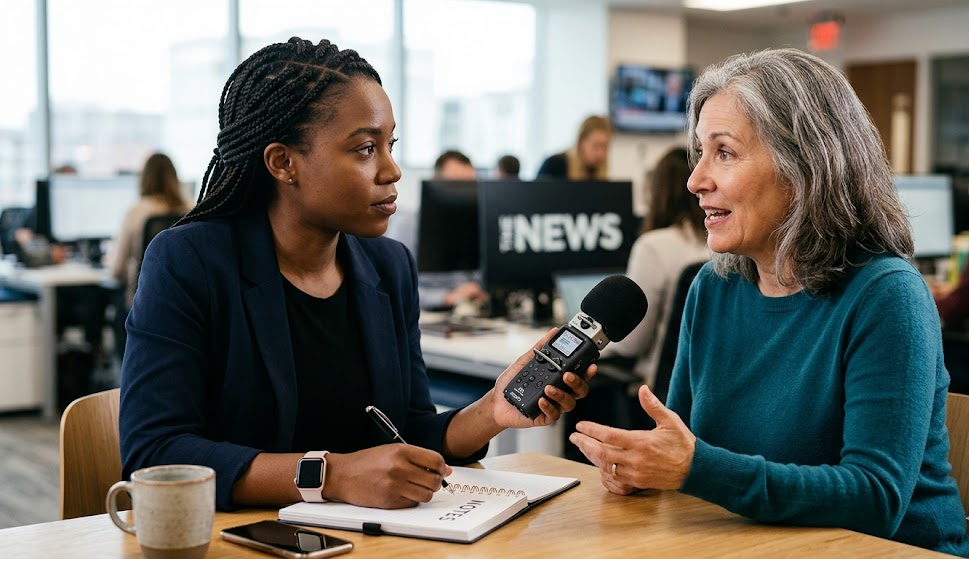
Interviewing is regarded as one of the most important skills of journalism. The skill of a journalist to pose a question, obtain accurate information and make a difference often determines the quality and credibility of the finished story. From breaking news reporting to investigative interviewing, effective interviewing is essential for journalists to find the facts, get the true voice and deliver a balanced message to their audience.
It’s not just about asking questions; it’s about professional interviewing. It takes practice, strategic communication, listening skills, ethical decision-making and documentation. Journalists in today’s world of fast-paced information and waning trust in news need to be adept at interviewing to ensure accurate, fair and publishable reporting.
This article explores the interviewing techniques that all journalists need to acquire, including how to prepare for interviews, verify sources, take notes during an interview, communicate with subjects in an ethical manner, and conduct a successful interview in various news environments.
Why Interviewing Skills Are Essential in Journalism
Interviews are one of the main sources for journalists to get their initial information. They can help fill a story with quotes and voices from eyewitnesses, experts, personal sources, and official sources that enhance the credibility and relevance of a story.
Journalists are assisted by strong interviewing skills because they include the following:
- Collect reliable and accurate data.
- Demonstrate the use of persuasive direct quotations.
- Clarify complex issues.
- Find new ways of reporting.
- Establish credibility with audiences by being ‘open book’ storytellers.
- Hold public figures and institutions accountable
By learning how to be effective in interviewing, journalists can feel confident and professional when interviewing different subjects, in different settings and for different types of stories.
Practicing for the Interview
Often, the key to an average interview and an exceptional interview is preparation. Research and planning will lead to more meaningful questions and important details being asked by the journalist.
1. Do in-depth Research on the Interview Subject
Journalists should research the topic, person and/or organization to be interviewed before interviewing them.
There are key steps to take in preparation:
- Reading through old articles and/or interviews.
- Analyzing public statements and official documents.
- Understanding relevant timelines and events.
- Learning key facts related to the story topic.
- Identifying potential conflict and/or sensitive areas.
It is important that the journalist is well-informed so that he/she can ask incisive questions and give appropriate answers whenever there is any unexpected information.
2. Define the Purpose of the Interview
Each interview must have a definite purpose. Ask yourself:
- What specific information do I have?
- What angle am I chasing?
- What are the quotes or thoughts that enhance the story?
- What information needs have to be substantiated?
You should clearly define your objectives so that the interview is on target and productive.
3. Prepare a Flexible Question Guide
A prepared question guide ensures essential topics are covered.
Some categories of questions which may be helpful include:
- Background questions: Set up context.
- Fact-checking questions: Ensure dates, names, etc. are correct.
- Opinion questions: Discuss ideas and opinions.
- Follow-up questions: Seek clarification on ambiguous answers and answers that are incomplete.
Flexibility remains important. Journalists should be prepared to dig for new angles of the story that they may uncover during the discussion.
Gaining Competence in Effective Questioning Skills
The key to a successful interview is the way in which the interview’s questions are posed.
1. Ask Open-Ended Questions
An open-ended question requires a more detailed answer as opposed to a yes or no.
Examples:
- Can you describe what happened?
- “What were the impacts on you in this situation?”
- Which one of the following is the most worrisome to you about this issue?
- Why do you think that they made this decision?
These questions will help sources to give more details and emotion.
2. Avoiding Leading or Biased Questions
Leading questions impact answers and can be deemed to be biased news.
Avoid:
- Do you not believe that this policy was unfair?”
- “Don’t you think that the event was a disaster?”
Instead ask:
- What are your views on the policy?
- What do you think of the event?
Neutral language safeguards objectivity.
3. Use Strategic Follow-up Questions
The best information will often be subsequent to the initial response.
Useful follow-ups include:
- “Please go on with that?”
- “What happened next?”
- “Can you provide an example?
- How did you conclude that?
These prompts encourage deeper and more specific answers.
Establishing Friendship and Trust with Sources
Trust is essential to good interviews. Respect and understanding are correlated with people’s willingness to be honest.
1. Introduce Yourself Clearly
When starting the interview:
- Identify yourself, name and media outlet
- Describe a topic of the story
- Explain how the interview can be utilized
- Describe the nature of the talk, whether it is on the record or off the record
Confidence and professionalism are created with transparency.
2. Practice Active Listening
Questioning is an essential part of listening.
Active listening involves:
- Maintaining eye contact.
- Avoiding interruptions.
- Attentiveness to voice and feeling.
- Noticing body language.
- Responding thoughtfully.
If you listen to the sources, they’ll give you more valuable input.
3. Show Respect and Empathy
This is particularly pertinent when applying for a job interview:
- Survivors of trauma
- Individuals who are vulnerable
- Children
- Hesitant sources
While empathy shouldn’t take the place of the objectivity that is crucial for an interview, respectful communication does boost the quality of the interview and ethical standards.
Mastering Note-Taking and Recording Skills
Journalists will be protected from misquoting sources or losing critical information if they are able to document it well.
1. Combination of Recording and Written Notes
Best practices include:
- Use of an audio recorder with permission
- Taking additional batteries and/or backups
- Handwriting key quotes
- Noting key points of a speech
- Recording environmental observations
Written notes are always required in case of technology failures.
2. Capture More Than Words
Also, journalists should consider:
- Emotional reactions
- Long pauses
- Facial expressions
- Surrounding environment
- Significant gestures
The information can be used to enhance the narrative and offer background information.
3. Review Notes Immediately After the Interview
As soon as it is possible:
- Organize your notes
- Highlight major quotes
- Clarify unclear shorthand
- Make notes of any other observations that come to mind
The sooner you review, the more accurate and efficient it will be.
Checking Sources and Confirming Information
One of the key roles of a journalist is to verify.
1. Verify Source Identity and Credibility
Journalists should check these things before using information:
- The full names and titles should be used.
- Professional credentials
- Institutional affiliations
- Relevant expertise
- The possibility of any conflicts of interest
Don’t assume any information is true until it is verified.
2. Cross-Check Facts Independently
Essential information should be verified through:
- Public records
- Official reports
- Additional interviews
- Expert consultation
- Archived documents
When it comes to spreading misinformation, there’s less risk of it when there’s independent verification.
3. Confirm Technical Details and Quotes
Always double-check:
- Spellings
- Dates
- Statistics
- Technical terminology
- Context of statements
Errors of any sort can have a large negative impact on credibility.
Ethical Interviewing Communication
Ethics should be the basis of any interactions in the media.
1. Honestly Express Your Desires
The journalistic ethics is that you never misrepresent:
- Their identity
- Their publication
- Their purpose
- How information will be utilized
Transparency is key to a journalist’s ethics.
2. Comprehend On-the-Record and Off-the-Record Rules
Differentiate if statements:
- On the record: Attributed publications, they are those that can be published.
- Off the record: Don’t cite this information. They are not for publication.
- On background: Text does not need to be copied word for word from the source, but can be paraphrased and/or summarized. They are usable without direct attribution.
Misinterpreting these boundaries can be detrimental, especially to trust and reputation.
3. Respect Dignity of Humans and Privacy
Avoid:
- Asking questions that are exploitative
- Intrusive personal inquiries
- Sensationalizing trauma
- Mounting pressure on vulnerable interviewees
Ethics in journalism puts humanity first, together with public interest.
Managing Hard Interviews
There are just some interviews that don’t go the way they should. Journalists need to be able to deal with problems.
1. Interviewing Unwilling Sources
Helpful strategies:
- Describe why their point of view is important
- Develop a discussion before challenging questions
- Be patient
- Allow silence
- Provide clarification as necessary
2. Managing Aggressive Interviewees
Stay professional by:
- Maintaining calmness
- Avoiding disputes
- Repeating questions vividly
- Focusing on facts
- Put your emotions under control
3. Conducting Interviews under Pressure
In times of breaking news:
- Ask essential questions first
- Verify if any facts are important
- Take short notes
- Do not assume certain things
- Concentrate on tasks even when there are distractions
The accuracy increases when under pressure and being composed.
Enhancing Practical Interviewing Skills
Interviewing skills are acquired through practice and reflection.
There are some suggestions for improvement:
- Reviewing interviews that are recorded
- Ascertainment of follow-up opportunities which have been missed
- Seeking editor feedback
- Practicing false interviews
- Studying seasoned journalists
- Reading interviews that are successful and have been published
The interviews are all learning opportunities that will strengthen future performance.
Frequently Asked Questions (FAQs)
What do journalists consider to be the most crucial interviewing skills?
Preparation can be one of the most important skills as this enables journalists to appear knowledgeable, prepared and ask informed questions, discover inconsistencies and lead the way in interviews. When the conversation is time to listen, too, though, it is of principal importance.
What can reporters do to help ease nervous sources?
Journalists must show respect to a source and adapt language and tone by speaking in a calm, empathetic and non-threatening manner and asking neutral questions prior to sensitive questions when speaking to a source.
Is it always a good idea to have an interview recorded if it is to be handled by a journalist?
If it is legal and ethical, it is strongly recommended to tape any interviews. It’s also crucial for journalists to take notes of their own, in case the devices go awry.
What are some ways that journalists check out information from their interviews?
They verify facts from public and official documents, secondary sources, consultation with experts and follow up with interviewees.
If a source says that they don’t want the information to be on the record, what does the journalist do?
The journalist needs to specify the terms and decide in advance whether or not he or she will agree. In a proportionate manner, and within agreed legal and ethical boundaries, ethical journalists will respect confidentiality.
Conclusion
Journalists must learn the basics of interviewing in order to become the art of a professional journalist. All aspects of preparation through to questioning, communication, note-taking, source checking, and more are essential to the accurate and trustworthy reporting.
Those who can interview will continue to make better stories, discover the truth and hold the public to account in a rapidly changing media landscape, whose expectations are also constantly evolving. Mastering interviewing skills is no easy task; it is one of the best ways the press can provide good and honest service to the people.