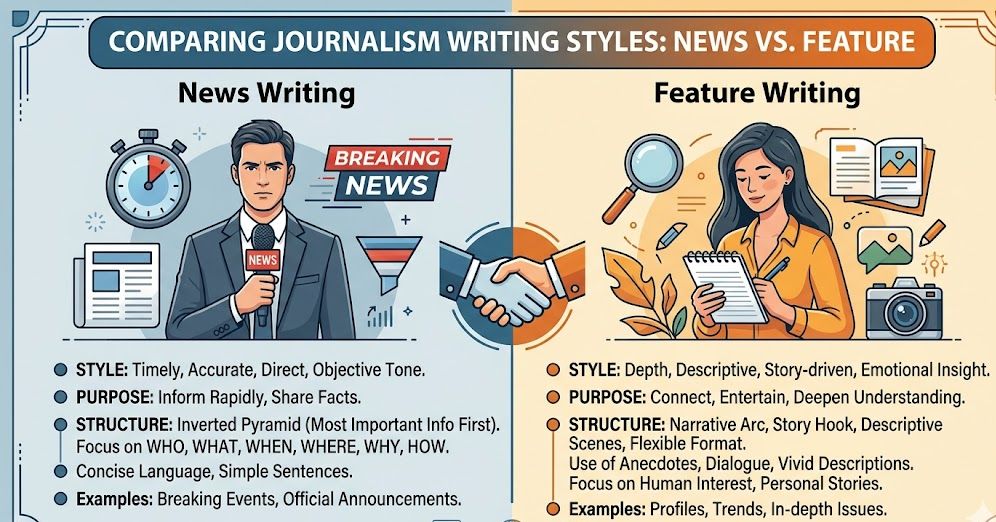
Journalism is not a uniform art and profession in which everyone writes the same way. The approach, structure and tone of the story vary according to the purpose and the audience that you are addressing. News writing and feature writing are among the most vital kinds of journalism writing. Both are designed to educate the reader, but they are very different in style, presentation, and purpose. It is important to have knowledge of these differences for all journalism students and aspiring writers so they can communicate effectively in the different media.
Both serve as the basis for modern journalism, which seeks to give viewers up-to-the-minute information and more human stories. News articles, which are factual and have to convey a sense of urgency, must be clear, whereas feature articles must be emotionally driven and story-driven. To compare straight news reporting with feature writing, the roles of the two in the media ecosystem as well as the ways in which the authors can use the style in various context should be examined.
Understanding News Writing in Journalism
News writing can be called the cornerstone of journalism as it provides the timely, accurate and relevant information to the people. Its primary purpose is to present information rapidly and clearly to make sure the reader does not become confused and does not get too much elaboration of an event. Usual topics of news writing are current affairs, political developments, public announcements, emergencies, and other matters which require immediate attention.
News writing is set up in the inverted pyramid form, in which the most important information is at the top of the article. This allows readers to fully understand the essentials even if they don’t read the entire story. In the first few paragraphs, reporters address the who, what, when, where, why and how of the story, which helps to make it clear and efficient. Objective and neutral tone, avoiding personal opinions or emotional language. Accuracy and speed of the reports are important as it is news consumers depend on them to make informed decisions.
Concise and simple sentence structure and vocabulary are common in a typical news article. The writer can use quotes from official sources to lend credibility if required, but does not become involved in the story. Focus is on facts, not interpretation, so the reader can draw his/her own conclusions about the facts.
What Is Feature Writing?
Feature writing is not straight news writing, but is more about depth, storytelling and reader engagement. Feature articles may also be informative, but they tend to focus on the human interest aspects of events and provide emotional insight, background and narrative that news articles typically lack.
Feature articles can have an opening anecdote, descriptive scene or quotation that pulls the reader into the article, unlike news writing. The goal is to not only convey information but also to make an emotional impact on the audience. Researching details may take longer for writers, as well as discussing multiple perspectives and providing vivid descriptions for readers to experience the topic.
The type of feature writing is usually found in magazines, the weekend edition of newspapers, in blogs and long-form digital publications. Topics can be personality profiles, cultural trends, social issues, travel experiences, or investigative stories. While factual correctness is still necessary, the tone can be more creative, imaginative and flexible, with the writer applying literary devices like symbolism, speech and imagery to improve storytelling.
The Purpose Of News Writing and Feature Writing
The difference in these two types of forms is apparent in their purpose. News writing is essentially about informing quickly and fairly, and getting the news to the public as efficiently as possible. In the world of breaking news, journalists need to get their reports out quickly and accurately, rather than spend time elaborating on the story.
Feature writing, on the other hand, is designed to inform, entertain, and may call to mind reflection. Feature writers delve into why it’s important and how it impacts people, not just what has occurred. This larger purpose enables people to have a deeper understanding and connection.
For instance, the number of affected people, emergency responses, and government actions, etc., in a news article, after a major flood. Another article about the same event could share a story of a family’s resilience and how they were supported by their communities in rebuilding their home. Both are good, but have different journalistic functions.
Differences in Writing Style and Tone
Tone is a very important aspect in distinguishing news writing from feature writing. The key to news writing is neutrality. Journalists should not make any emotionally charged statements, be subjective or use any type of embellishment which could imply bias. The writing has a clear focus and is factual, with no frills.
There is more room for style, however, in feature writing. To build atmosphere and keep the reader interested, writers can employ descriptive language, emotional details and creative sentence structure. The tone is serious and reflective, humorous and conversational, depending on the topic and audience.
Journalists-to-be must learn to be able to switch from one tone to another. When you come across a breaking political news, you want to be objective, but when you read about a great entrepreneur, you want to give it a bit of warmth and personality. Understanding the tone to match is important to ensure that writers communicate clearly and in line with their editors’ expectations.
Structural Differences Between the Two Formats
There are also significant differences in the structure of each writing style. News writing tends to be formal and conventional, and is intended to be efficient and easy to read.
The structure of News Writing
Most news stories contain the following elements:
- Headline: Understandable and well organized
- Lead paragraph: Summarizes key facts
- Body paragraphs: Give supporting paragraphs and quotations
- Background information: Provides any background information or contexts as needed
- Conclusion: Less formal, may conclude the story in a less formal fashion
This will enable editors to remove paragraphs from the end when there is not enough space for them to fit without missing any important content.
Feature Writing Structure
Feature articles typically will have more of a flexible storyline and may contain one or more of the following:
- Interesting opening or story hook
- Descriptive settings or character development
- Gradual unfolding of central themes
- Multiple viewpoints/ expert commentaries
- A meaningful/ reflective ending
The format makes the reader feel the need to continue reading to the conclusion and offers an emotional payoff or insight.
Storytelling Techniques in Feature Writing
The most distinctive characteristic of feature writing is a focus on story. Often, when writing nonfiction, writers will use techniques from fiction to make their nonfiction writing more engaging. Some of these can be in the form of scene setting, dialogue, suspense, symbolism and character-driven narratives.
A feature writer, for example, might start his story by saying, “A bright, painted treatment room was the first time a child had stepped inside.” This will help to make the story more vivid and more emotionally resonant.
The challenge for journalists using feature techniques is to be creative and accurate. Facts and figures can be used in a story, but should not be padded out or altered. While it may be artistic, ethical feature writing is always based on veracity.
Research and Reporting Approaches
Research, interviews and verification are required for news and feature writing, and often the extent or time required varies. News reporters are fast and usually have to report facts as they are provided by official sources, eyewitnesses, and public records, and as quickly as possible, since they are usually working under a deadline. Their goal is to get the publications published on time.
Generally, feature writers will have more time to do in-depth interviews, observe environments, and have more detailed background information. They can work on a story for many days or even weeks, so that they can develop the ideas and perspectives of a story in more complex ways.
In many cases, it’s because of this extended research that feature writers can discover elements of a story that news reporters might not have been able to see.
Audience Expectations and Reader Engagement
The style depends on the audience’s expectations as well. When readers are seeking answers and facts, they read news articles. They may read headlines and leads to keep up to date all day.
But with feature readers, you can expect to invest more time into a story. They look for interesting stories, have more depth, and provide good insights. Often, there is emotional engagement in the experience.
Knowing what the audience wants enables them to determine the best form for a topic in journalism. The decision of a city council vote may need to be covered in the news right away, but the effect of the vote on the people over the course of years may be more appropriate for a feature article.
When to use News Writing and When to use Feature Writing
It depends on the story’s purpose to select these two genres.
Use the News Writing format when:
- Reporting breaking events
- Covering official announcements
- Promoting emergency public communications
- Summarizing political and/or economic events
- Giving accurate factual information
Use Feature Writing format when:
- Exploring human-interest stories
- Identifying people or groups of people and their characteristics
- Looking into trends or a cultural issue
- Giving explanations of complex subjects in depth
- Developing emotionally appealing stories
Both are used by professional journalists, who will vary their writing style depending on the publication and audience.
Why Journalism Students Must Learn Both Styling to Master the Craft of Journalism
Knowing how to write a news notice and a feature is vital to journalism students and aspiring writers to be flexible in their careers and credible. Journalists are sought after for their ability to deliver timely and factual copy as well as deliver long-form stories that will capture readers’ interest.
Knowing both styles will help develop basic journalistic skills, such as:
- Research and fact-checking
- Interviewing skills
- Audience awareness
- Adaptability in tone
- Narrative construction
- Ethical decision-making
This combination of fact and story writing equips writers for the print, magazine and electronic media, as well as independent journalism, in newspapers and on television and radio.
Conclusion
News writing and feature writing are both essential, and they perform different and complementary functions in journalism. News writing is written to ensure that society remains informed with hard news that is factual and objective, while feature writing is written to add depth, emotion, and connect the reader to the story, to make them understand the big picture of events.
Understanding these two methods will enhance the versatility of journalists in their writing and better serve various audiences. Whether it’s a breaking news story or a powerful human story, it’s all about the right format for the right story. The best journalism is when journalism and creativity, reporting and storytelling, serve the same purpose to inform, engage and inspire.
Frequently Asked Questions (FAQs)
What is the primary difference between the methods of writing news and features?
There is not much difference in the way they are used except for style and purpose. News writing is about getting the facts across in a timely fashion, and feature writing is about creating a story, character and emotional appeal and context.
Is feature writing creative, or is news writing creative?
Yes. In a feature article, it is possible to be more descriptive, use more narrative techniques and perhaps more emotional, whereas in a news article, it is more important to be clear, neutral, and brief.
Do journalists have to be able to do both styles in one publication?
Absolutely. Many journalists write straight news articles as well as feature stories, as required by the editorial assignments and audience requirements.
Which is the easier writing style for the beginning writer?
News writing is a good choice for beginner writers as it allows them to learn discipline, accuracy and structure. Feature writing then builds upon them and can be developed to involve skills of storytelling.
Why is it significant to grasp both of these styles in journalism?
Having familiarized with both styles, journalists will be able to communicate through various platforms and audiences, which will make them more versatile and competitive in the job market.