The news story may seem straightforward when it’s read, but it has a clear structure that works to convey information rapidly and efficiently. Journalists don’t organize information arbitrarily; there is a definite way to present information so the reader will be able to read the most important stuff first, and then see a bunch of supporting context and analysis. In all media, including newspapers, magazines, online and broadcast, the news story is one of the most fundamental skills of the journalist.
The skills gained in organizing information are useful to journalists, who become more informed consumers of news, and useful to aspiring writers to develop skills in reporting information. News stories are more about being timely, clear and accurate, rather than academic essays or creative writing. Many readers will glance at the headline and initial paragraphs of a story; reporters have to make sure that the main story is conveyed within seconds. The need for efficiency has been taken up and resulted in a set of conventions for the writing and presentation of news.
At the centre of effective journalism is the standard format of news stories, a pattern of news reports which consist of headlines, news lead, body paragraphs and conclusion. Every section is different in its narration of the story, and it keeps the audience engaged and believable. The inverted pyramid is one of the most popular forms of organization, in which the most important information is presented first, and the less important information is presented later.
Why News Story Structure Matters
A good structure of a news story is vital as readers can easily access information, and the story will be efficient and quick. The digital age is a busy digital world, and people tend to read news in a disconnected manner, reading on their mobile device, looking at various headlines and news at the same time. Without a proper organization, readers may lose interest in a story and may not understand what information is being presented.
A news story has a structure, and it’s important for a number of reasons:
- Aids the reader to quickly pick out essential information
- Enhances readability and comprehension
- Supports editorial efficiency
- Adds to the professionalism and credibility
- Takes advantage of the various media to which stories can be adapted for print, web and broadcast
Structure is a sort of map for journalists. It helps the writer and the reader, and doesn’t allow any important details to get lost in extraneous explanation. Reporters can tell sophisticated stories in a manner that is accessible and believable by sticking to a format.
The Headline: The First Point of Contact
A news article’s headline is usually the most noticeable and impactful component of any article. It affects whether or not readers will read further or discard the article and go on to another. A compelling, clear headline will summarize the main idea of the story and grab the reader’s attention.
Features of an Effective Headline
It is suggested that a professional news headline be:
- Accurate: It should accurately represent the content of the story.
- Concise: It is important to convey the information concisely in the fewest words possible.
- Clear: Readers should feel a sense of getting a sense of the subject up-front.
- Interesting: Should be interesting in a way that doesn’t lead to false expectations.
- Relevant: It should highlight the most newsworthy aspect.
If a journalist is writing a headline for a major event that causes shocks to the city, then, rather than writing it as Major Event Shocks City, they could write City Flooding Forces Thousands to Evacuate After Heavy Rainfall. The second headline offers a greater amount of information and makes it clear that there is an urgency to the story.
The Lead Paragraph: Presenting the Core Facts
The lead (also known as “lede” in journalism), is the first paragraph of a news report. It’s meant for sending the vital information at once. The reader should be able to grasp the main idea of the story even if he reads just the lead.
Most news leads answer the Five Ws and One H questions:
- Who is involved?
- What happened?
- When did it happen?
- Which is where?
- Why did it happen?
- How did it happen?
Example of a Strong Lead
A clear lead might read:
Severe flooding on Tuesday morning left thousands of commuters in central Lagos stranded, shutting down many major roads, top emergency officials said.
This one sentence provides readers with information on what happened, where it happened, when it happened and implies the total impact of the event.
Types of Leads
Journalists can choose to use various types of leads to a story:
- Summary Lead: Provides a summary of main facts.
- Descriptive Lead: Uses vivid details to set the scene.
- Question Lead: Starts with a thought-provoking question.
- Anecdotal Lead: Begins with a brief story and/or personal experience.
When the story is a hard news story, it will usually be written using a summary lead since this will be a fast and clear story.
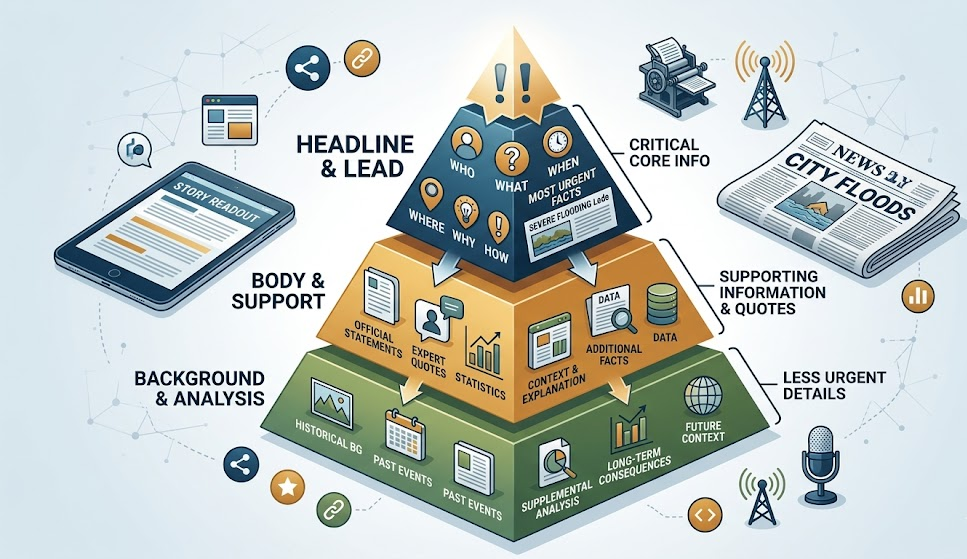
Understanding the Inverted Pyramid Style
The inverted pyramid structure is one of the key attributes of journalism. This organizational model has the information presented in order of importance.
How the Inverted Pyramid Style Works
The structure consists of three layers:
1. Key Facts at the Top
This section includes:
- Headline
- Lead paragraph
- Most urgent facts
These are the details that readers can’t do without.
2. Supporting Information in the Middle
This section elaborates on the lead with:
- Additional facts
- Quotes from sources
- Statistics and evidence
- Context and explanation
3. Background Information at the Bottom
The final section may contain:
- Historical background
- Related past events
- Less urgent details
- Supplemental analysis
The Advantages of the Inverted Pyramid
The structure is preferred by journalists because it:
- Enables readers to read the story quickly
- Makes it easier to edit, as editors can cut from the bottom
- Encourages reading in a digital format
- Organizes and clarifies ideas
Although news has evolved with new innovations in storytelling, the inverted pyramid is still one of journalism’s most trusted formats.
Body Paragraphs: Building the Full Story
The body paragraphs provide the main idea and details of the lead. They are used to assist the reader in going beyond the first set of facts and comprehend the wider meaning of the event.
What Body Paragraphs Typically Include
News body paragraphs are usually filled with:
- Official statements
- Witness accounts
- Expert commentary
- Information, data and statistics that are relevant
- The social and/or political consequences of a situation or event.
- Background context
Every paragraph should include one basic idea and be logically developed. Use of strong transitions helps readers to follow the various sections of a text and to remain engaged. Journalists are also required to be objective. They deliver information unbiased and without adding their opinions.
The importance of Quotes in News Writing
Quotes lend credibility and authenticity to news stories. They enable readers to hear from those engaging in or affected by an event.
Types of Quotes
1. Direct Quotes
These are used to put a speaker’s exact words.
Example:
Work was in progress to restore power as soon as possible, said the utility’s director
2. Indirect Quotes
These paraphrase the speaker’s statement.
Example:
The power company director said that all efforts are being made to restore power as soon as possible
Why Quotes Matter
Quotes can:
- Add emotional depth
- Provide expert insight
- Support factual claims
- Introduce diverse perspectives
- Develop readers trust
Reporters need to be careful in their selection of quotes. Not all the statements need to be quoted verbatim.
The Conclusion: Ending With Purpose
As opposed to essays, news may not in many instances have a dramatic summary at the end. Normally, instead, conclusions will give future context and/or future action.
These are typical of the things that can be used at the end:
- Upcoming investigations
- Planned government actions
- Expected developments
- Community responses
- Long-term consequences
An article about a new policy could conclude with the date on which the policy is to be implemented. Ongoing recovery activities can be the end of the disaster report. The aim is to give your readers updates on what happens next.
Changes to News Structure Brought About by Digital Journalism
While digital media has made new news presentation possibilities, it is traditional structure that remains central.
Latest Additions to News Story Organization
The news stories available today on-line usually include the following:
- Links to other relevant articles
- Embedded videos
- Interactive graphics
- Shorter paragraphs to be read on mobile devices
- Share buttons on social media platforms
- Optimized headings for Search Engines
Even in the face of these developments, journalists continue to use a good headline, a compelling lead and a structured story to convey their message effectively.
The Most Common Mistakes That Journalists Should Avoid
The structure of any important story can be undermined by poor structure. Common mistakes include:
- Placing key information at the end of the article which is too deep for readers
- Creating unclear and long leads
- Putting in details that are not needed at first
- Using weak transitions
- Brief and abrupt ending without context
- Integrating opinions in objective reporting
Even professional journalists make revisions and edits to make everything easily understandable and logical.
Conclusion
One of the most significant tools that journalists use to effectively communicate is the structure of a news story. Reporters use purposeful structure and elements of their reports to help readers grasp events rapidly and correctly, including clear headlines, informative leads, body paragraphs, and purposeful conclusions.
The inverted pyramid continues to be a major focus in professional journalism for several reasons, including its emphasis on clarity, speed, and the audience’s needs. In the digital age, new opportunities for stories have been available, but the essentials of an organized report have stayed the same. Knowing the structure of news stories can help readers better understand the media and help aspiring journalists develop the necessary skills to make trustworthy, informative and effective news reports.
Frequently Asked Questions (FAQs)
What does a typical report in the news section of a newspaper look like?
There are 4 main components to the standard format:
- Headline
- Lead paragraph
- Body paragraphs
- Conclusion
The advantages of this format are that it presents information efficiently and clearly to readers.
What is the inverted pyramid in Journalism?
Writing in an inverted pyramid is a technique that puts the most important details first, then secondary details and then background information in a news story.
Why is the lead paragraph important?
The lead is crucial because it gives readers the main facts from the story at the start, giving them the main gist of the story immediately.
What is the optimum length of a news headline?
Headlines should be short and to the point, usually 5-12 words for most publications and platforms.
What are the reasons for journalists to employ quotes?
Use quotes to add credibility, emotion and authenticity, and to give readers a chance to hear from the sources.
Are there any similarities in the structure of all news stories?
The general inverted pyramid style is used for most hard news stories, while some stories may be investigative or feature articles, and may have more flexible structures.