Muscles contract and relax to produce all of the body’s movements, such as holding posture, carrying heavy objects and engaging in sports. Movement appears to be simple, but muscles have the ability to contract in a variety of ways, depending on the type of force and motion needed. Knowing the different types of muscle contractions is a valuable understanding for students, athletes, fitness enthusiasts, and anyone interested in the human body, as they impact muscle performance, strength, and endurance differently. There are some contractions that shorten the muscle and others that are ones that create tension without shortening the muscle. Various types of exercise uses different muscle contraction for different purposes, whether it’s building muscle, gaining flexibility, recuperating or improving the endurance of your muscles. The physiological differences between isometric, isotonic and other types of contraction facilitate understanding of how muscles react to training and how different exercises affect whole body functioning.
Muscle Contraction and Movement Understanding
Muscle contraction occurs when muscle fibres develop tension by pulling the actin and myosin filaments within the muscle cell. Nerve signals, calcium ions and ATP are involved in controlling this interaction. Muscle contraction creates force, which enables the body to move, stabilize joints and maintain posture. The various kinds of muscle movements are the action of the muscles as they act and whether or not the muscle shortens or lengthens.
Muscles don’t always work the same way because different exercises require different types of work. There’s a different way to contract when you’re holding a heavy object versus running or slowly lowering a weight. Knowing these differences is beneficial to understand why some exercises are more effective for gaining strength, stamina/endurance and more effective at improving muscular control. All the contractions have their own function in movement and performance.
Isometric Contractions and Static Muscle Tension – Lactic acid buildup is prevented during isometric contraction and static muscle tension.
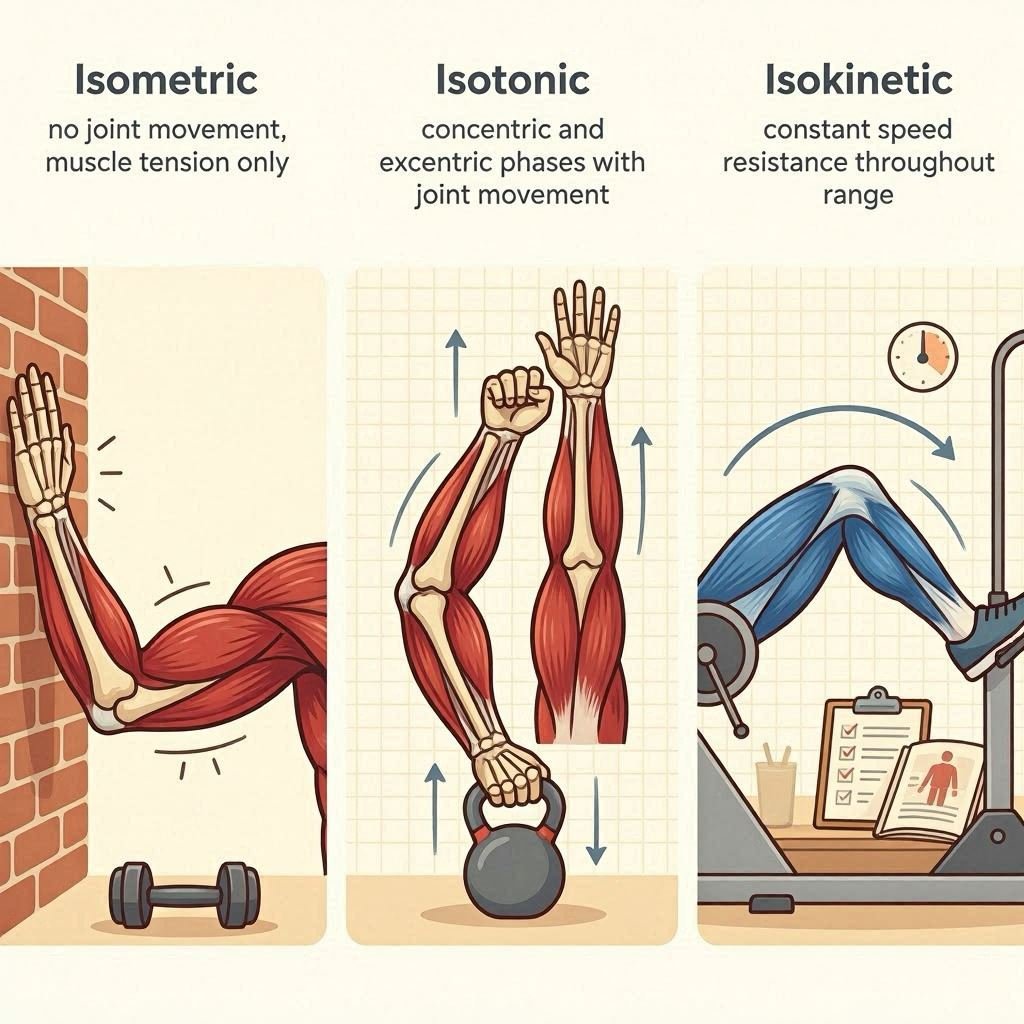
An isometric contraction is one of the most frequent type of muscle contractions. This is a muscle contraction in which the muscle force is generated without changing its length. The muscle is not moving and tension is created without any movement of the joint. Isometric contractions help maintain posture, body stability and the maintenance of position during exercise.
Examples of isometric contractions include holding a plank position, or carrying a heavy object without moving it. Although the body may seem to be still, muscles are also engaged in order to keep the body stable. The isometric exercises are widely adopted in rehabilitation and strength training due to their ability to offer joint stability and muscular endurance while reducing the load on movements. Additionally, these contractions help to enhance the capacity of muscles to sustain tension for extended periods, which is beneficial for sports and everyday life balance and control.
Isotonic Contractions & Dynamic Movement
There are other important categories of muscle contractions, namely, isotonic contractions, in which the length of the muscle changes during force production. Isotonic contractions involve visible movement of the joints, while isometric contractions are those that do not involve movement. The contraction is divided in two: a concentric contraction and an eccentric contraction, both of which are important in the performance of physical activity and exercise.
At isotonic muscle contractions, the muscle can shorten or lengthen, but the tension remains the same. Isotonic muscle action is crucial for a variety of everyday movements, including walking, running up and down stairs, and lifting objects. The majority of resistance training deals with these contractions, as they are essential to developing strength, coordination and efficient muscle usage. Isotonic contractions give us an idea into how we create and control movement during exercise.
Concentric Contractions and Force Generation
Concentric contractions are when a muscle shortens whilst producing a force. This kind of isotonic contraction occurs when you lift or push. In the case of a dumbbell bicep curl, for instance, a bicep muscle shortens when it works against resistance. The concentric muscle contraction is one of the muscle actions believed to be associated with strength and explosive power
The concentric movement involves a lot of effort as the muscle has to produce sufficient force to move the load against gravity or resistance. Concentric training is used by athletes to enhance their speed, acceleration and general muscular power. Concentric contractions are an important part of exercises that involve jumping, sprinting and pushing. Such motions are important for sports since they help the body to make rapid and powerful movements.
Eccentric Contractions and Muscle Control
Eccentric contractions are the ones in which the muscle stretches under tension. This is a type of contraction which occurs when a muscle resists or regulates movement. An example of eccentric contraction is when you lower a dumbbell while performing a bicep curl, where the muscle slowly stretches while you are lowering the weight.
Of the various muscle contractions, the ECCENTRIC is of particular interest in controlling the movement, absorbing shock and preventing injures. These are powerful contractions that produce a lot of force and work well for increasing muscle strength and size. Eccentric training is a widely used method in athletic conditioning and rehabilitation, as it enhances the control of muscles and the strength of tendons. Eccentric contractions are also known to cause delayed muscle soreness, however, due to the stress they put on muscle fibers.
Isokinetic Contractions and Controlled Speed
The other types of muscle contraction are isokinetic contractions, which occur less frequently but are important. In an isokinetic contraction the muscle moves at a constant velocity during the contraction. To ensure constant speed of movement, specialized equipment is needed such that the person does not exert more force for greater speed.
Precise measurement of muscle strength and performance is possible with isokinetic exercises, which makes them useful in physical therapy and sports science. These contractions are used to ensure the proper balance and coordination of muscles and to prevent injury. Isokinetic training offers the advantage of being a controlled and safe environment for rehabilitation and performance assessment, as resistance is automatically adjusted to the resistance produced by the muscle.
The importance of muscle contractions in exercise training
Various types of muscle contractions are essential for specific exercise techniques to provide certain training benefits. Many strength training programmes alternate concentric with eccentric movements to optimise the development of muscle mass and strength. Isometric exercises are commonly employed for stability and endurance, whereas isokinetic training is applied when working towards rehabilitation or performance testing.
The type of contraction has an impact on muscle adaptations. Concentric training can help increase explosive strength, whereas eccentric training increases resistance to injury and control of muscles. Isometric exercises are useful in maintaining strength when a joint’s movement is restricted, such as when recovering from injury. The knowledge of the various contractions influences the body can help people create better training plans that meet their needs and goals.
The development and adaptation of muscle tissue
The body changes in response to training and thus becomes stronger, more efficient and better coordinated. The adaptions are rather dependent on the type of muscle contractions that the exercise involves. Resistance training stimulates muscle fibres to increase in size and build strength and endurance training increases the capacity of muscle fibres to maintain contractions for longer.
The nervous system is also affected by different types of contraction. Practicing a movement multiple times creates a better brain-muscle connection that helps you perform the movement smoothly and efficiently. A combination of contractions are used by athletes to build well-rounded physical skills, such as strength, endurance, speed and stability. Knowing these adaptations are the reason different training methods give different results.
The importance of muscle contractions in everyday life
There are not only sports and exercise related types of muscle contraction, but many others that are used during the course of your daily life. Postural control (standing upright) depends on constant isometric contractions to keep the body upright, whereas walking is a combination of concentric and eccentric contractions. For example, all the different types of contractions need to be active when you are carrying groceries or sitting down.
Such frequent muscle contractions emphasize the value of muscles health and conditioning. Mobility, balance and injury prevention are all related to efficient muscle function throughout life. Knowing the mechanism of muscle contraction and its reaction to exercise helps people make decisions about their exercise, recovery and physical health.
Conclusion
Muscle contractions are an integral part of human movement, exercise performance and muscle-building. Isometric – stability and posture, isotonic – movement – concentric and eccentric. Isokinetic contractions provide meaningful resistance for rehabilitation and/or performance testing. These different types of contractions also have distinct physiological properties and uses, which affect the muscles’ ability to produce force, respond to exercise, and function during physical activity. Knowing these contractions enables students, athletes and fitness enthusiasts to better appreciate the depth of muscle functions and the need for selecting the right training methods for different purposes.