Introduction
Understanding which financial information travels through an accounting system is a base requirement for students and professionals in the field of accountancy. At the core of this process is the accounting cycle which is a structured set of steps that which do proper transaction recording, classification and summarization. This article we put forth a very detailed step by step guide to the journals, cash books, and ledgers which are the books of original entry and also we see how they play a role in the preparation of a trial balance.
In the first part of this article you can expect to find out more about the accounting cycle to have a greater grasp of its context and value.
Introduction to the Accounting Cycle
In business we use the accounting cycle which is a step by step process to record and manage financial transactions over a certain accounting period. It also sees to it that all financial information is accurate, complete and ready for report.
The cycle includes the following steps:
- Identification of transactions Detection of transactions.
- Recording in journals (general ledgers).
- Recording to ledgers.
- Preparation of trial balance.
- Modifications and final reports.
Books of prime entry and their role in preparation of trial balance.
What Are Books of Original Entry?
Books which serve as the primary records of entry also known as the prime books are what first document business transactions. Each action a company takes in terms of finance is first recorded here before we see it in the general ledger.
These books ensure that:
- Transactions are recorded in the order they occurred.
- Supporting details are preserved
- Errors may be corrected easily.
Main books for original entry are:
- General Journal
- Cash Book
- Purchases Journal
- Sales Journal
- Returns Home and Returns Outwards Books.
In each case the function is different which in turn makes the accounting process more organized and efficient.
Step 1: Recording of Transactions in the Journal
The journal is a fundamental and very flexible primary record. Also it is what we term the “first record” book.
Features of a Journal
- Records transactions in chronological order
- Uses the 2 column system (debit and credit).
- Includes account of detailed explanation of each transaction.
Format of a Journal Entry
A typical journal entry includes: In a typical journal entry one finds:.
- Date
- Account to be debited
- Account to be credited
- Amount
- Narration
Example
If a business buys goods with cash:
- Debit: Purchase Account.
- Credit: Cash Account
Purchases A/C Dr XXXX
To Cash A/C XXXX
(Being goods purchased for cash)
Importance of the Journal
The journal ensures that: The journal which reports that:
- All transactions are captured
- The accounting duality is maintained.
- There is a complete audit trail.
Step 2: Using Separate Journals (Subsidiary Books)
As businesses grow out to record every transaction in the general journal which becomes inefficient. To simplify we see that companies begin to use specialized books which are also known as subsidiary books.
Types of Special Journals
- Purchases Journal: Used for credit purchases of products.
- Sales Journal: Used to account for credit sales.
- Purchase Returns Book: Records goods returned to suppliers.
- Sales Returns Logbook: Records goods returned by customers.
Advantages of Special Journals
- Saves time
- Reduces errors
- Allows division of work
- Improves efficiency
Each of these books is dedicated to a single type of transaction which in turn ensures clarity and organization.
Step 3: The Accounting Journal
The cash book is a special book of original entry which also functions as a ledger account.
Types of Cash Books
- Single Entry Cash Book: Records only cash transactions.
- Dual Column Cash Book: Includes cash and bank transactions.
- Three Column Cash Book: Includes cash, bank, and discount columns.
Features of the Cash Book
- Records all cash transactions
- Maintains a running balance
- Serves as a journal and a ledger.
Example
When cash is received from a customer:
- Debit side: Account that is not interest bearing.
- Credit side: Customer’s Account.
Importance
The cash account reports that:
- Proper tracking of cash flow
- Prevention of fraud
- Accurate bank reconciliation
Step 4: Entering into the ledger
After that which we do is record the transactions in the journals and subsidiary books we do the posting to the ledger.
What Is a Ledger?
A record of accounts which groups all transactions related to a specific account.
Types of Ledger Accounts
- Personal Accounts (e.g., customers, suppliers)
- Actual accounts which include assets like cash, equipment
- Nominal Accounts (e.g., expenses, income)
Posting Process
- Each entry from the journals is posted to the appropriate ledger accounts.
- Debit transactions go to the debit side of the ledger.
- Credit entries are posted to the credit side.
Example
From the earlier journal entry: In an earlier journal entry:
Purchases A/C Dr XXXX
To Cash A/C XXXX
Publishing it would:
- Purchases Account: Debit side
- Cash Account: Credit side
Importance of the Ledger
- Classifies transactions
- Provides account balances
- Forms the foundation of financial statements.
Step 5: Adjusting Accounts Balance
At the end of an accounting period ledger accounts are adjusted which determine their closing balances.
How to Balance an Account
- Add up the account of both sides.
- Find the difference Identify the difference.
- Enter the amount in the column with smaller total.
- In each period bring down the balance.
Types of Balances
- Debit Balance (e.g., assets, expenses)
- Credit Balance (e.g., liabilities, income)
Balanced out is the process which sees each account put in the right position before we move to the trial balance stage.
Step 6: Compiling the Trial Balance
The trial balance is a report of all ledger account balances as of a certain date.
Purpose of a Trial Balance
- To check the precision of calculations in records.
- To make sure that total debits equal total credits.
- To be used in preparation of final accounts.
Key Rule
Total outgoings should always equal total income.
If all parties agree it indicates that the books are correct from an arithmetic standpoint though of course there may still be errors.
Common Mistakes not Detected by Trial Balance Report
Even though the trial balance does not report any issue, some mistakes can still go by.
- Omissions of transaction (not recorded).
- Recording errors (of which the wrong amount is recorded).
- Compensating errors
- Errors of principle
This is a key element in which care must be taken at every step.
Practical Example: From Journal to Trial Balance
Let’s consider the case of a simple transaction:.
- Owner invests ₦100,000 Owner puts in of ₦100,000.
- Purchases goods to the value of ₦20,000 on credit.
- Sells goods for ₦15,000 cash Sells out at ₦15,000 cash.
Step 1: Transaction Records.
- Debit Cash, Credit Capital
- Debit Purchases, Credit Supplier
- Debit Cash, Credit Sales
Step 2: Entry into the ledger.
- Each item is recorded into the appropriate account.
Step 3: Equilibrium of Accounts
- Accounts are brought to agree on final numbers.
Step 4: Balance Sheet of Accounts.
- All accounts are included to prove that debits equal credits.
Importance of the Entire Process
The path from journals to trial balance is very important because it:.
- Ensures systematic recording
- Enhances accuracy
- Facilitates error detection
- Prepares data for financial statements
Without proper books of original entry the accounting system is a mess.
Relationship between Books of Original Entry and Final Accounts
Books that record first entry and ledgers which are base:.
- Income Statement: Derived from income and expense statements.
- Balance Sheet: From assets and liabilities reports.
The trial balance serves as a link between transaction recording and financial statement preparation.
Advantages of a Structured Accounting System
Through the proper application of the accounting cycle which includes:
- Accuracy of results: Double-entry ensures that errors are minimized.
- Transparency of: Each transaction is traceable.
- Effectiveness: Division of work improves productivity
- Conformance: Helps meet regulatory requirements.
- Choice Making: Provides reliable financial information for management.
Challenges and How to Overcome Them
Common Challenges
- Recording errors
- Misclassification of transactions
- Incomplete records
Solutions
- Regular review of entries
- Proper training
- Use of accounting software
- Internal controls
Conclusion
From the beginning of the recording of transactions in journals up to the point of preparing a trial balance the accounting process is very systematic and essential. Books of original entry play the base role in this system which in turn sees to it that each and every financial transaction is accurately recorded and put in order.
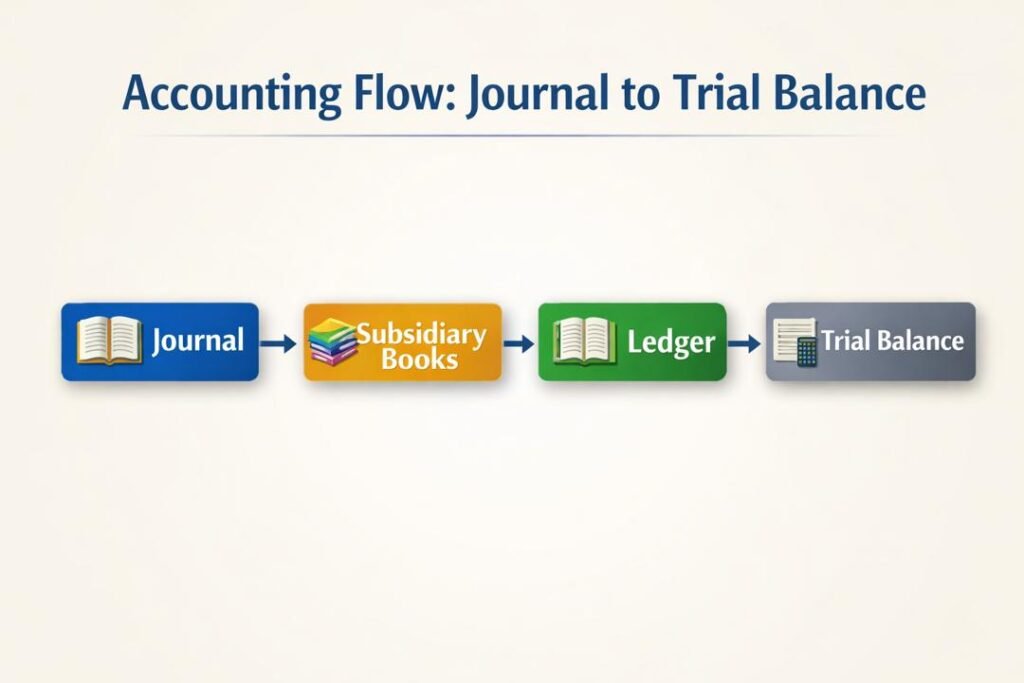
In the process we see how financial data moves from journals to subsidiary books, to ledgers, and then to the trial balance which is a structured approach. At each step the data is built upon what was done in the past which in turn creates a reliable system for financial report.
Through this framework individuals and businesses may keep accurate records, identify errors at early stage, and put together meaningful financial reports. In the end we see that this structure not only include accounting knowledge but also raises confidence in the issue of real world financial data.
Get more well researched information From journals to trial balance here.