Introduction
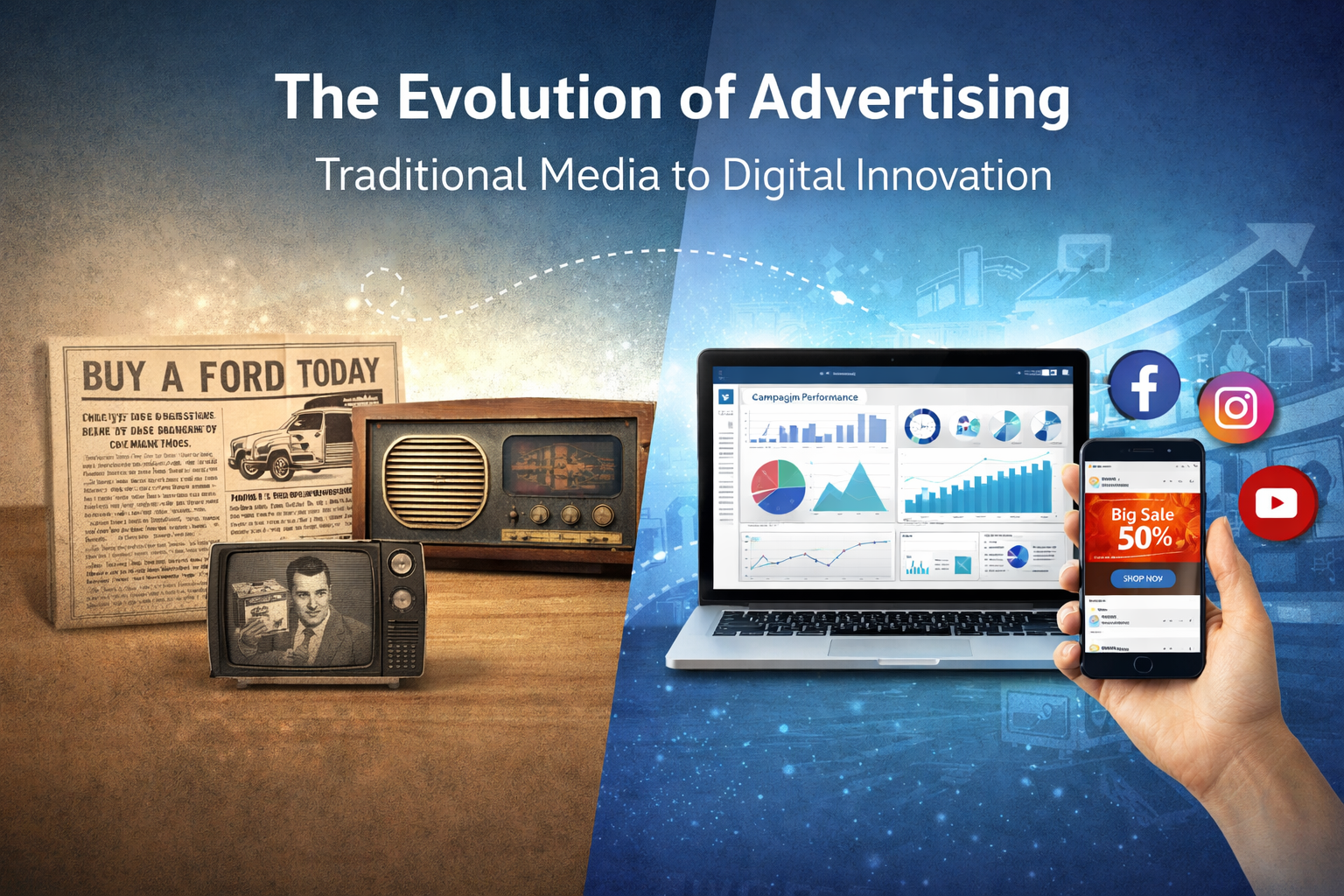
The evolution of advertising has long been at the core of a business’s connection with the public. From the days of town criers, who announced products in busy markets, to present-day digital campaigns, which are driven by algorithms, advertising has seen great change. To understand that journey is to see how we got to modern-day strategies, which in turn tell us that businesses must constantly adapt to stay competitive.
The historical development of advertising presents a dynamic transformation which is a result of cultural changes, technical advances, and variation in consumer behavior. What was at first a very basic word-of-mouth promotion has grown into a very complex industry which is able to target people very precisely.
This article traces the evolution of advertising from print and TV to the digital age, which also saw a transformation in the tools we use, how we target our audiences, and how we measure campaign success.
The Evolution of Advertising
Old and Pre-Industrial Advertising
The evolution of advertising has a history which goes back thousands of years. In ancient times, we see that merchants in cultures like that of Egypt, Greece, and Rome used basic methods to put forth their wares and services. Papyrus was used for posters, walls for inscriptions and town criers for announcements. These were the early forms of advertising.
The Age of Print and Mass Media
The inception of the printing press in the 15th century was a game-changer in evolution of advertising. Issued flyers, pamphlets, and newspapers made it to larger audiences. By the 17th and 18th centuries, newspapers became the main advertising medium.
This is the time which saw the introduction of more structured messaging, which included headlines and persuasive language. Also, at this point in history, we see that advertisers began to play up the emotional appeal and put a great deal of focus on what their products do for the consumer, which in turn laid the base for what is present in today’s marketing.
The Traditional Advertising Evolution
Journals and Magazines
In the 19th and early 20th centuries, newspapers and magazines grew to be great advertising tools. Businesses used these to grow brand recognition and to reach out to consumers.
Print ads were a platform for in-depth stories which included text with graphics. Also, we saw the introduction of segmentation, which is that different publications went after particular audiences, which in turn enabled much targeted marketing.
Radio Adverts
In the early 20th century, the advent of radio brought about a revolution in advertising, which saw the birth of audio storytelling. Brands now had the stage to present to audiences via voice, music, and sound effects.
Radio ads created emotional connections, which in turn made messages more memorable. Also, they reached audiences in their homes, which greatly expanded their influence.
TV and visual media storytelling
Television, which put together audio and visual elements, transformed advertising. By the 1950s, TV commercials had become the dominant force, which also had an unrivalled reach and impact.
Brands put large investments in creative storytelling, celebrity endorsement campaigns, and memorable tag lines. Television advertising did more than just push products; it also shaped culture and consumer lifestyle.
Shift to digital advertising
The Internet’s Growth
In the second half of the 20th century, the internet came into play, which marked the start of a new age in advertising. At first, digital ads were basic banner ads which appeared on sites. This served as the base for data-driven advertising.
Search Engine Advertising and Pay-Per-Click
Search engines transformed the way businesses reached consumers. With the introduction of pay-per-click (PPC) advertising, which in turn made it became possible for companies to put out ads based on user search terms.
This approach we saw great success with in that we put ads in front of users who were looking for related products or services. Also, we saw it present us with measurable performance indicators like click-through rates and conversions.
Social’s Role in Ad Evolution
Social Media as Ad Centers
Social media, which includes the likes of Facebook, Instagram, and Twitter, has become the core of what we see in advertising today. These platforms enable brands to connect with users directly, which in turn fosters a more interactive experience.
Unlike what we are used to in traditional media, social media enables real-time interaction, feedback and content sharing, which in turn has transformed advertising from a monologue into a dialogue.
Influencer Outreach
In the digital age, influencer marketing has grown to be a very powerful tool. This is to say that companies partner with individuals who have already built up credibility and large-scale followings, which in turn allows us to reach very engaged audiences.
This approach is based on trust and authenticity, which is what makes it so effective with younger audiences.
Technological Changes that are Redefining Advertising Today
Data Analysis and Personalization
In the digital age, we see that what has transformed advertising the most is the implementation of data analytics. Companies today are able to collect and analyze large sets of user data, which in turn they use to design very personal marketing campaigns.
Personalized content, which in turn improves user experience by putting out relevant info, which in turn increases engagement, and we also see better conversion rates. Also, it enables advertisers to run campaigns in real time.
AI and Automation
Artificial intelligence in the field of advertising has brought in automation and prediction. We see that AI-powered tools, which analyze user behavior, determine preferences and bring to you very precise targeted ads.
Automation also does away with tedious tasks in campaign management, which in turn reduces costs and improves efficiency.
Audience Reach Changes
From Bulk Marketing to Exact Targeting
Traditional ad methods went after large audiences, which they tried to reach out to en masse. While they did a good job of raising awareness issues of which resources were thrown away was not addressed.
In that regard, which is digital advertising, we see a focus on precision targeting. Advertisers are able to segment audiences by demographics, interests, behavior and location.
Behavioral and Environmental Targeting
Today’s advertisers use behavioral data to determine what users prefer, which in turn allows them to put out very personal ads.
The context in which the ad is served improves the relevance of the ad to what the user is viewing at the moment.
Development of Campaign Assessment
Classic Measures
In the past, in traditional media, we had issues with what the best way was to measure ad effectiveness. We had metrics like circulation numbers and audience ratings, which only gave us a broad idea of reach.
We had little ability to track down specific responses or conversions, which in turn made it hard to determine ROI.
Digital Measures and Present Time Data
Digital advertising has redefined campaign measurement with in-depth analytics. We see advertisers tracking impressions, clicks, conversions and user behavior in real time.
This degree of insight enables us to continuously improve, which in turn sees campaigns produce maximum impact.
Issues in the Digital Advertising Age
Privacy Issues
As data collection has grown in sophistication, privacy issues have raised their head. Regulations like GDPR and other data protection laws have made advertisers adopt more transparent practices.
Burnout and Competition
In the digital space, which is very competitive, we see that users are presented with many ads daily. This leads to ad fatigue, which in turn reduces ad effectiveness.
To that end, brands should put out creative, relevant, and value-oriented content.
The Advertising to come
Rising Technologies
Technologies like augmented reality (AR), virtual reality (VR) and voice search are redefining advertising. We see in them a very interactive and immersive experience.
Ongoing personalization efforts
Personalization is to remain at the core of what makes advertising successful. We are seeing in AI and data analytics great strides, which will, in turn, enable very precise targeting and customized messaging.
Summary
Advertising has transformed in step with larger social and technological trends. From ancient market notices to very complex digital campaigns, we see advertising transform to meet business and consumer requirements.
Today, in the age of integration, which puts data, technology and creativity together, advertising has never been more effective, and we are also able to measure it better. As we see continuous innovation on the horizon, companies must be agile in their approach, adopting new tools and strategies to relevant in a very competitive environment.