Introduction
Starting out in a small business is a very exciting venture. Many entrepreneurs at the start are full of energy, have a great idea, and are very determined to see it through. But what we see from the stats is that which a large number of small businesses go under within the first two years. Also while many owners think of failure as a result of some sudden disaster or economic crisis, in fact it is not so. Some of the reasons small businesses fail, little issues which at the time may have gone unnoticed grow into larger problems that eventually can’t be dealt with. Poor pricing, weak financial management, lack of customer research, high inventory levels, and supply chain issues are some of the most common which over time wear at a business’ stability.
These issues must be known by any entrepreneur who wishes to build a sustainable company. The good news is that many of these warnings appear well in advance of a business’ crisis point. By learning to see these signs early, not depending on a supplier and putting in practical solutions, business owners can improve resilience, protect profitability, and put themselves on a path to long term growth. This article looks at eight reasons which cause small businesses to fail within two years, the warning signs for each issue, and the doable steps entrepreneurs can take to avoid becoming just another failure statistic.
Why Understanding Failure Patterns Matters
Many at the start of their venture put all their energy into growth which in turn causes them to ignore the structure which will support that growth. They put into play and put out large amounts of time and capital into getting customers in the door, bringing products to market, and see an increase in sales but do not put in the work to build out strong operational bases. This does indeed work in the early stages which is in part due to go get results that come from hard work and great ideas which can in fact cover up for weak systems. But as soon as we scale up and customer wants grow and we add more expenses our flaws begin to show. Little cash flow issues turn in to big financial issues. We have issues with inventory which either leaves us with too little or too much product. We see a rise in customer complaints that go out to the public. In the end the business hits a wall in what it can do for recovery.
Identifying what has caused failure in the past is a tool which entrepreneurs use to put in place preventive measures as opposed to reacting to crises. While it is rare for a successful business to completely avoid challenges, what we see is that which does best is the business which identifies risks at the early stage and which is quick to react. By this they are able to fortify their base, improve their decisions and in turn increase their chance at long term success.
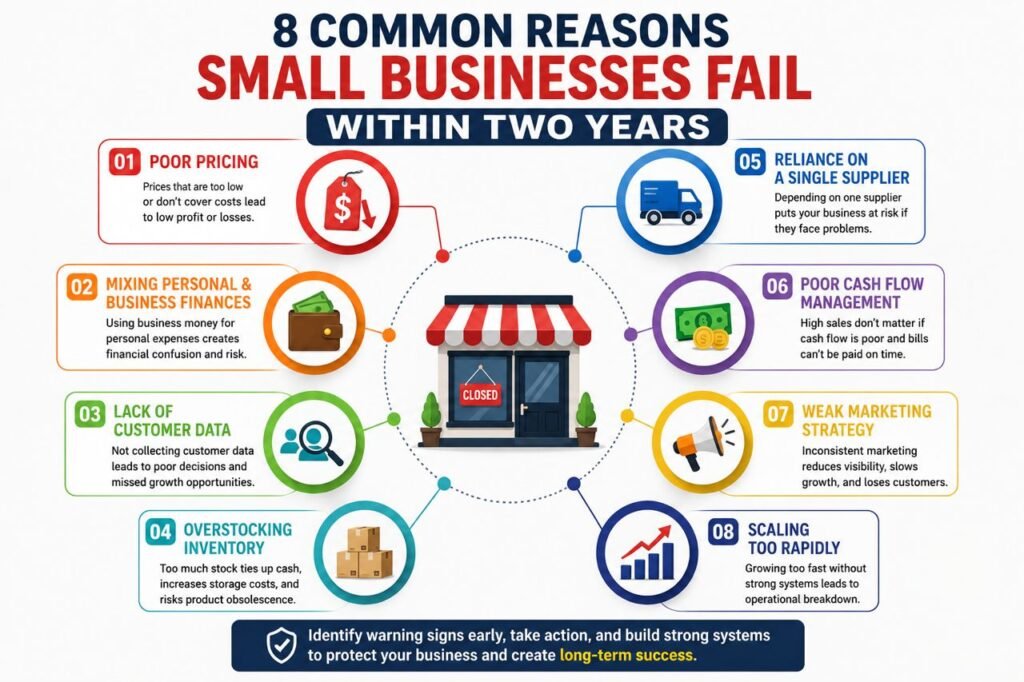
1. Weak Pricing Tactics
Pricing is a very important issue for business owners which at the same time are very much a mystery. We see many new entrepreneurs setting prices based on what the competition is doing instead of looking at what their own operating costs are. Also we have those that will underprice products and services in a go at attracting in the customer fast. While low prices may get you in the game at first, in the long run they often deplete profit margins to what is unsustainable. We may see businesses that look very busy and very successful but in actual fact is losing money on each sale. Over time with expenses going up, inflation, and high operational costs the financial pressure mounts which in the end puts the business at risk.
Warning Signs of Pricing Problems
One of the most telltale signs of poor pricing is large sales volume with low profitability. If what is reported as revenue is increasing but what is deposited in the business account is not, pricing may be a issue. Also business owners may see that they have difficulty in covering fixed costs, a very high use of credit, or a lack of investment in growth areas. Also customers who constantly ask for discount may also put into the picture that your pricing is out of whack or not what the market is expecting.
Simple Fixes
Entre which is a must out of the system which I am to out the only the reworded text as you had asked for: Business owners should be to report on total cost of bringing to market their products or services which include labor, rent, utilities, marketing, transport, and taxes. Price should cover these costs also which at the same time should present a healthy profit. We also see value in doing a quarterly review of prices which in turn will help companies to adapt to what the market is doing and to also which is also see as that rising input costs are put in check. Also we see that which do value based pricing which puts customer results at the front of the queue as against the sole use of price as a competitive tool also do well to increase profit.
2. Blending personal and business finances.
One out of the top issues for new entrepreneurs is they use business accounts like personal wallets. Many put in personal expenses from business accounts and put personal income into business without keeping proper records. Although this may seem like an easy solution at the time, it causes issues which in turn make financial management very hard. Without a clear line between personal and business finances issues arise in which the owner has trouble with determining profit, tax issues, and also accurate tracking of cash flow.
Warning Signs of Financial Mixing
Businesses that see this issue usually have incomplete financial records and struggle to identify where exactly the money is going. Owners may find out that which aspects of the business are for real (profit wise). Tax preparation turns into a stress and time issue and financial reports don’t come out as accurate. Also there is the issue of unexpected cash shortages because at the same time money is used for personal expenses.
Simple Fixes
Creating different bank accounts for business functions is the first major step. Business owners should put in place a regular salary or owner draw rather than do random withdrawals. Accounting software is also a great tool to use for tracking expenses accurately and which in turn promotes transparency. Clear financial boundaries which are set early on improve decision making and also give a better picture of business performance.
3. Lack of Customer Data
Many small scale businesses put all their effort into making sales but at the same time ignore the collection of info which would tell them about their customers. Out of this lack of info which is very important, they base their decisions on what mostly are proven to be false assumptions. While they may think they know what their customers want, what they do and do not like to buy, and how satisfied they are in fact they are very much in the dark. As the competition grows, those which don’t have access to customer data struggle to change what they do and also to keep their best customers.
In present market conditions customer data is what any business values the most. We see that info on purchase behavior, demographics, preferences and feedback which in turn we use to make informed decisions on products, price, marketing and customer service. Those companies which ignore this info risk becoming irrelevant and missing out on growth.
Warning Signs of Missing Customer Insights
A business may see a drop in repeat purchases, low customer engagement with marketing campaigns, or have trouble determining which products are of the most interest to customers. We may see a lack of consistency in marketing efforts due to the lack of reliable data for decision making. Also we see an increase in customer complaints which in turn is a result of issues that go unaddressed.
Simple Fixes
Businesses can look to collect customer info via loyalty programs, email opt ins, surveys, and purchase history. We can use customer relationship management tools to sort and look at that info which also which also does a great job of presenting trends and opportunities for growth. Also for small businesses which may not have access to large scale CRMs, simple spreadsheets can still present very useful data.
4. Overstocking Inventory
Inventory management is a fine line. Many entrepreneurs are afraid of running out of stock which is why they order in large quantities. While it is true that we must have sufficient inventory, overstocking does in fact put a strain on our finances. Capital tied up in unsold products which could be put towards marketing, staff, equipment upgrades or other important business areas is instead idled. Also, excess inventory increases storage costs and the risk of our products becoming obsolete.
Warning Signs of Overstocking
Businesses that struggle with overstocked warehouses see products sit on shelves for long periods. We see storage costs go up at the same time as cash flow decreases. Also reports of owners’ frustration with having to discount products in order to make room for more stock which in turn recoups some of that investment. We also note that inventory counts report of slow moving items which just pile up and do not generate revenue.
Simple Fixes
Entrepreneurs must track inventory turnover rates and note which products are consistent under performers. It is also a good idea to purchase in smaller amounts more often which in turn improves flexibility and reduces risk. Use of inventory management software which reports in real time on stock levels and sales trends is a very useful tool. Base demand forecast on past sales data which in that way will help to avoid excessive purchases.
5. Reliance on a single supplier.
Relying mainly on a single vendor may seem practical as it simplifies order and relationship processes, but in reality it produces great deal of operational risk. Should that supplier go through delays, financial crisis, produce low quality items, have labor issues, or face logistics problems, the business may find itself unable to service its clients properly. Also supply chain disruptions can come to bring the whole operation to a stop causing us to loose out on large sums of money and also we lose the trust our customers have in us.
Warning Signs of Supplier Dependence
In many cases of business which have issues with suppliers we see that they do not have many options when disruption happens. We see product shortages which in turn affect how the business runs and also the fact that the business’ negotiation power is weak as the supplier knows this they have few choices. Also we see that delivery delays immediate play an impact on how customers view the business and in turn revenue generation.
Simple Fixes
Business owners may put in place a network of many suppliers which is what we are saying here. Although it may be that one supplier is the main which is fine, having backup options does reduce vulnerability. We see that regular evaluation of suppliers is a must do which in turn helps to identify what risks are on the horizon and also performance issues. Diversity in supply also which is what we are putting forth here improves resilience and also better bargaining power.
6. Omitting Cash Flow Management.
Profitability is a different issue from cash flow. A company may present as profitable in the reports but at the same time have issues paying bills which they attribute to poor cash flow management. Also many entrepreneurs put all their attention on sales and revenue which in turn causes them to ignore the timing of income and expense which is a big mistake. This in turn causes a situation where outgoings must be paid before we get in from the customers which in the end cause financial stress although sales may be high.
Warning Signs of Cash Flow Problems
Frequent overdraft issues, delayed payment to suppliers, trouble covering payroll, and dependence on short term debt also point out cash flow issues. Also businesses may put off large investments which in turn are a result of lack of sufficient cash at the right time.
Simple Fixes
Cash flow prediction which in turn allows for identification of upcoming shortfalls and proper planning. We see that which is encouraged by prompt customer payment, secure terms with suppliers, and keeping emergency reserves which in turn improve stability. Monthly cash flow reviews should be made a regular part of management practice.
7. Weak Marketing Strategy
Many companies put out large scale marketing campaigns at product launch which they scale back once early customers materialize. Also we see that for the most part growth in customer base is an ongoing process. Out of the picture the role of constant marketing is to drop which in turn causes visibility to go down, customer growth to level off and competitors to take over. Also it is a common fallacy that great products will by themselves create a sustainable customer base which we know visibility is a key element in very competitive markets.
Warning Signs of Marketing Neglect
Decline in website traffic, drop in inquiries, reduced social media engagement and standstill in sales is a sign of low marketing activity. Also what we see is that customer acquisition costs go up as companies put all their eggs in short term promotion baskets instead of investing in long term brand building.
Simple Fixes
Creating out of a consistent marketing plan maintains visibility. We do content marketing, email campaigns, social media engagement, and customer referral programs which009 produce steady interest without the need for large budgets. We also measure marketing performance which leads to continuous improvement and more efficient spending.
8. Scaling too rapidly
Growth is seen as a mark of success which in turn brings about the issue of success which in fact may not be so when systems are put in place to support that growth. We see companies that get ahead of themselves by adding staff, opening up new locations, or introducing new products before they have first made sure their infrastructure is stable. What may present as a rise in revenue in the short term from expansion also at the same time may be causing more of the issues which in large part led to growth in the first place. Also see how we have grown our business too fast in some areas which is now causing us to play catch up in terms of fixing what we did not put in place before we grew.
Warning Signs of Premature Scaling
Operational breakdowns increase, we see a rise in customer care issues and employee output goes down. We see cash reserves fall as resources are put into many initiatives at the same time. Management is may feel they are in over their heads with increasing complexity and competing priorities.
Simple Fixes
Business owners can put in place basic stability in core functions before we see growth. Growth may be planned out based on what the numbers tell us instead of just ambition. Incremental growth allows companies to see what is working and what is not which in turn allows them to fix issues before they grow into large problems.
Building Business Resilience before Scaling
Preventing failure is a larger scope than what is achieved by simply steering clear of mistakes. What we put in place should be systems that see the business through challenges which do present themselves. Resilient companies also run healthy cash reserves, watch key performance indicators, which they also
diversify their revenue from, and which they constantly look at what risks are out there. They put in practices of financial discipline, get to know their customers well, improve operational efficiency, and do strategic planning. Instead of waiting for a crisis to hit they identify what may go wrong and have solutions at the ready.
Entrepreneurs are to review business performance in many areas which include finance, customer care, inventory management, supplier relationships, and marketing performance. We see that consistent small improvements which are made routine produce better long term results than large dramatic changes which are made in emergency situations. Resilience is achieved through preparation, discipline, and continuous learning.
Conclusion
Small business failure is not usually an instant event. Most failures are the results of a series of ignored warning signs which in time weakens the organization. Poor pricing, mixing personal and business finances, lack of customer data, overstocking inventory, supplier dependency, cash flow issues, inconsistent marketing, and premature growth are what we see most often in the first two years. Also it is also very much to our benefit that we identify and address each of these issues before they cause permanent damage.
Entre in to this picture companies which see through these trends gain a great advantage. By paying attention to warning signs, putting in place workable solutions, and developing robust systems business owners may improve their game and also raise the bar for long term success. Growth which lasts is based on sound foundations not assumptions. The businesses which do well and excel are those which identify issues at the pass and do something about them before they become crises.
Get more well researched information about the Reasons small businesses fail here.