ai trading means using artificial intelligence to help with trading decisions, not letting a black box trade for you. On Tactfolio, an AI assistant helps you write investing rules, test them on past prices, and save them. You read every rule, and you decide what runs. This guide shows how to use AI as a helper, not as a shortcut, so you keep control while the assistant does the routine work.
A good platform should combine AI help with clear testing on past prices, honest costs, and a practice run with pretend money before real money is used. It should also work as an algo trading tool that follows fixed rules. It should show every rule and every test, so you can judge the idea for yourself. Here are the seven AI strengths that matter most.
How to Choose an AI Trading Platform
Start with three questions.
· Can you read what the AI built?
· Can you test it on unseen data?
· Who decides? Only you should start trading.
Avoid any platform that claims its AI picks winning stocks.
1. Describe Your Idea in One Sentence
The first strength of ai trading on Tactfolio is how easy it is to start. You describe an idea in one sentence, such as holding QQQ while it is above its 50-day average, and otherwise splitting between two bond funds. Your AI assistant builds that idea as a strategy in your account. You do not need to write code, learn a new language, or fill in a complex form. A clear sentence becomes a clear set of rules, and you can change any part of it in the visual builder before you test it.
2. An Assistant That Builds Readable Rules via MCP
Tactfolio connects to AI assistants through MCP, the Model Context Protocol, so assistants such as Claude and ChatGPT can use Tactfolio tools in your account. The assistant builds the strategy, runs the test on past prices, and saves it privately for you to check. Every strategy is a set of rules you can read as a tree of plain blocks. The assistant cannot trade or publish. Only you can start a strategy. That connection uses OAuth sign-in in your browser, with no API key to copy, so setup stays simple.
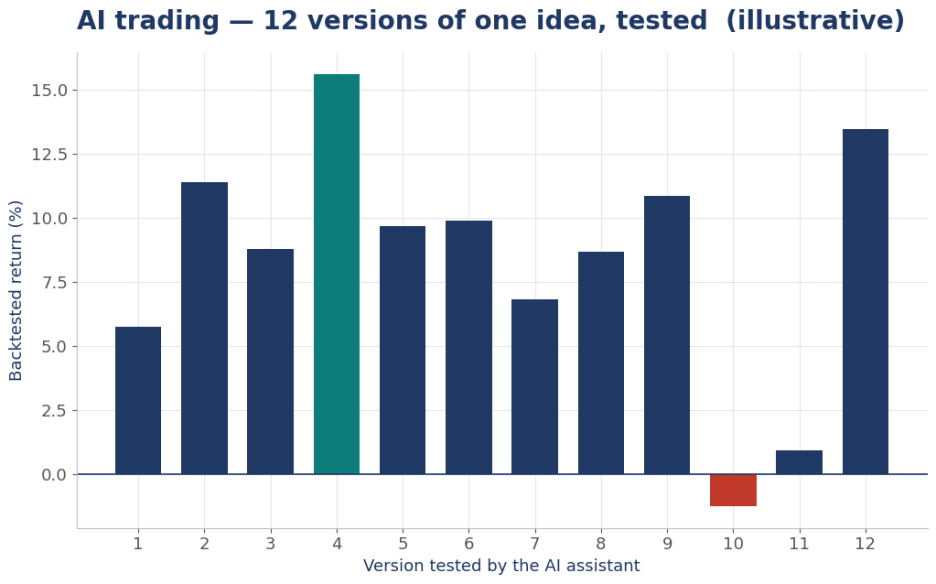
3. AI Trading Tests Up to 12 Versions of One Idea
A good ai trading platform does not test one version and stop. Tactfolio lets your assistant test up to 12 versions of an idea, then compare them side by side. You can try a different lookback, a different bond fund, or a different trigger, and see which version holds up best. That comparison saves hours of manual work, and it stops you from falling in love with the first version you see. The winner is chosen on evidence, not on how clever the first draft sounded.
4. Out-of-Sample Check on Unseen Years
This is the test that separates honest ai trading from overfitting. Tactfolio tunes a rule on older years, then checks the winner once on recent years it has not seen. A rule that only fits old prices will fail that check, and you will see it before you risk money. When you publish a strategy, its page also draws an out-of-sample line on the day you published it. Everything after that line is a real test. A rule that passes this check has earned more trust.
5. Reality Checks and a Next-Day-Open Line
Every past-price test on Tactfolio also shows a next-day-open line and a reality checks table with higher costs. A rule that only works in a perfect world shows up fast, because its edge disappears when costs rise or when trades happen at the next open instead of the exact close. Past-price tests use daily prices of United States stocks and ETFs, dividends reinvested, and a 0.05% cost on every trade. Those checks make its weakness visible before you trust it. That is why Tactfolio shows these checks on every test.
6. Rules You Can Read and Throw Away
The best ai trading platforms make it easy to reject a bad idea. On Tactfolio, every AI-built rule is readable, block by block, so you can spot a strange condition, a wrong ticker, or a rule that trades too often. If you do not like it, throw it away and try another version. Readable rules, tested on unseen years, guard against that trap. You can also change one block at a time and rerun the test, so a rejected idea can still teach you something useful.
7. Run on Paper or Alpaca Only When You Start It
AI should never trade on its own. On Tactfolio, your assistant can build and test a strategy, but it cannot place trades or start trading. You start it yourself, first on paper, with pretend money at real prices and a daily email after the close. When you are happy, you can run the same strategy in your own Alpaca account. From then on, the strategy follows its own fixed rules, long only. You stay in charge. The AI proposes, the test checks it, and you decide.
Frequently Asked Questions
Is ai trading legit?
AI can help with research, but it cannot promise profits. On Tactfolio, the AI only helps you build rules, and every result is a test you can check.
Can AI trade stocks for me?
Not on Tactfolio. Your AI assistant can build and test a strategy, but it cannot trade. You start it yourself, on paper or in your own Alpaca account.
Do I need to know how to code for AI trading?
No. Describe an idea in plain words, or build it by hand in the visual builder. Connecting an assistant takes one or two commands from the AI Agent page.
Conclusion
The best ai trading platform is one where you can see and test what the AI built. Describe one idea, test up to 12 versions, and run it on paper first. Tactfolio is free to start. Try one idea today.
Past-price tests and practice results are hypothetical, and past results do not guarantee future results.