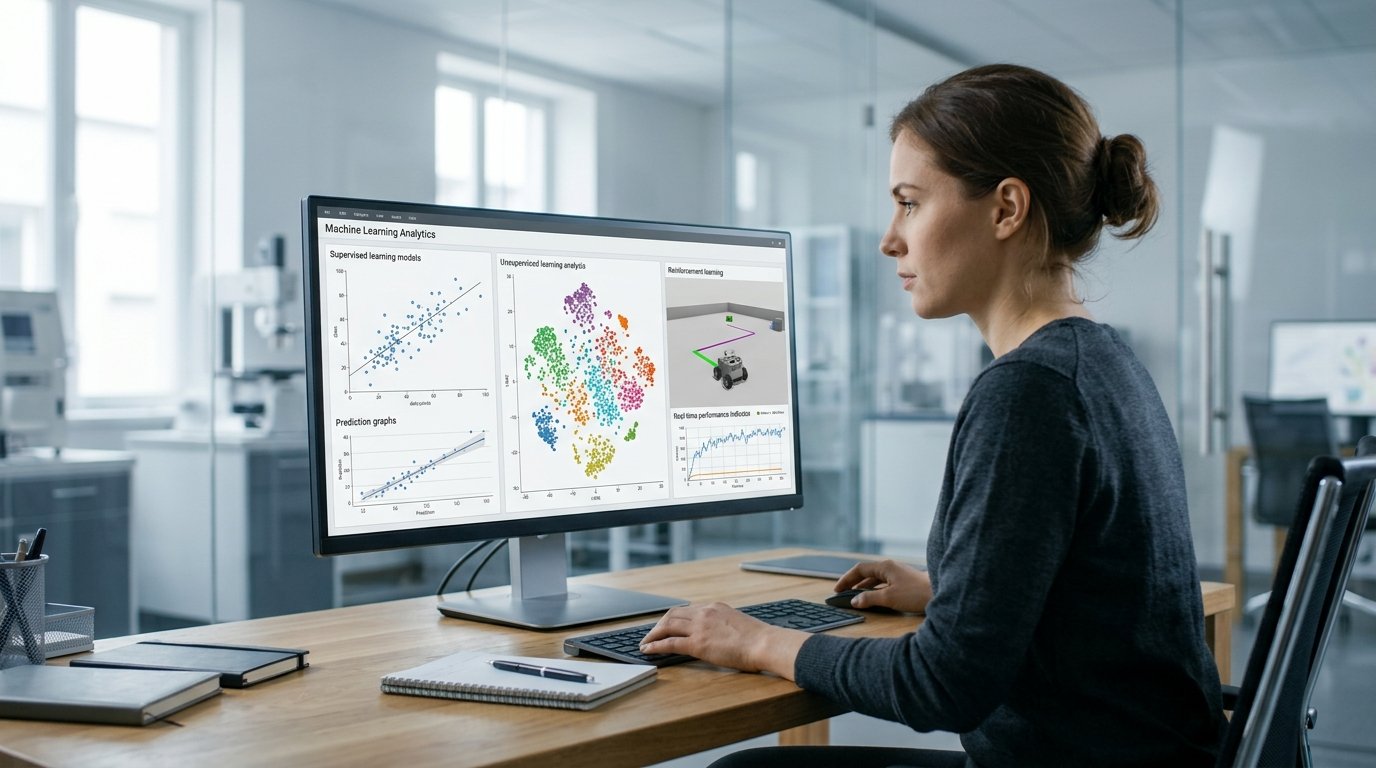
Types of Machine Learning include different approaches that allow computers to learn from data, recognize patterns, and make predictions. Machine learning is a division of artificial intelligence that enables technologies like email filters, product recommendations, fraud detection, and robotics. The type of machine learning used depends on the problem at hand, the available data, and the results we want.
Here are the three primary approaches: supervised learning, unsupervised learning, and reinforcement learning. In supervised learning we use labeled examples to predict outcomes, in unsupervised learning we have to discover patterns in unlabelled data, and in reinforcement learning we see improvement of decisions via actions and rewards. To do this well is to help beginners identify the best fit approach for each problem.
What Is Machine Learning?
Machine learning has the ability to see the relationships in data that in turn allows computers to carry out tasks also without fully having to run through pre-written rules by the programmer. For instance a program may be trained to sort out spam e’s from the ham or to look at what happened in the past with sales in order to try and determine what to expect in the future. Also this makes the field of machine learning a great tool for looking at complex issues and to put in place solutions for repeatable tasks.
The goal is to create models which do well on new data instead of just memorizing training data. In supervised learning we have known answers, in unsupervised we identify patterns, and in reinforcement learning improvement comes from experience. Each of these has its own set of strengths and applications.
What is Supervised Learning?
Supervised learning uses labeled data to train models in which we present the algorithm with input which also includes the answer we are looking for. For instance we may tag an email as spam or legitimate, a home listing may have its sale price included. From these we train the model which in turn fine tunes its predictions to decrease error.
Supervised learning does in fact cover classification and regression. In classification we see which category an item falls in like determining which are fraudulent transactions, in regression we see the prediction of a number which may be a value of future sales. Also it works best with large sets of labeled data but at the same time collection and labeling that data is very time and resource intensive.
How Supervised Learning Works
Developers collect and prepare data which they label, also they divide it into training and testing sets. The model is presented training examples which it uses to identify patterns, at the same time separate data is used to see how it does with unknown information. This process is what we use to see if the model has learned from the data or is just memorizing it out of overfit.
After we train the model it will put out predictions for new data. Also its performance should be an ongoing focus as customer tastes, market trends and other issues may have shifted. By which point we may have to update the training data and retrain the model in order to maintain accuracy.
Real-World Example: Email Junk Detection.
Email spam filtering is a practice of supervised learning. We train a model on a set of tagged emails which it uses to determine out looks for trends in message content, suspicious links, sender info, and format. The model uses these trends to put forth which of incoming messages are spam and which are valid communication.
Businesses can also use tools like email spam detection to assess email quality which in turn identifies issues that may affect deliverability. This example also shows how supervised learning does classification using labeled data.
Advantages and Limitations of Supervised Learning
Supervised learning we see to present proven results which are obtained by comparing our results with the given answers. It includes services like fraud detection, image classification, sales forecasting, and customer churn prediction. Should the data used in the training set be a true representative of what is seen in the field then it will put out a useful model which also reduces the need for manual work.
Also in supervised learning we require labeled data which may prove to be a high cost. Also models may inherit from bias, do poorly in novel situations, or may degenerate in performance when settings change. This approach is best for when the desired result is known and we have enough reliable instances.
2. What is Unsupervised Learning?
Unsupervised learning is a field in which models find structure in data without the benefit of known outcomes. We see that the model does not have any pre-labeled examples to learn from; rather it looks for what is the same and what is different, also what is out of the ordinary. For instance a retailer may look at customer information to put together groups of consumers which have very much the same buying trends without going in with a preconceived idea of what those groups should be.
Common in these is what is used for clustering, dimensionality reduction and anomaly detection. These tools which in turn help out organizations’ with the exploration of data, simplifying complex info and finding out what is out of the ordinary. But the also identified trends may require human analysis to see if they in fact have meaning.
How Unsupervised Learning Works
The process starts out with the collection and preparation of unlabelled data. Developers choose which features are relevant and apply an algorithm which in turn looks for relationships between variables. For example a model may put customers into groups based on purchase frequency, spending trends, and product choice.
Analysts look at the results to see which are useful. A model may put out many groups, but these groups don’t in and of themselves represent true categories. We evaluate their stability and practical value which in turn helps to see if the results support informed decisions.
Real-World Example: Market Segmentation.
Customer based approach is what we use to see which aspects of unsupervised learning are beneficial to business in terms of understanding our customers’ behaviors. A retailer which looks at purchase history and spend trends is able to put together groups like that of the frequent buyers, the occasional shoppers, and the customers which may shop a lot but do not buy.
Businesses can use this data to improve marketing campaigns, personalise recommendations, and develop loyalty programs. Also customer behavior changes over time which is why segmentation results should be reviewed regularly and customer information handled responsibility.
Advantages and Limitations of Unsupervised Learning
Unsupervised learning which doesn’t require labeled data to function is at play here. In customer analysis, scientific research, manufacturing and cybersecurity we see its value. Also it is used to identify what doesn’t fit in which for instance in which we see which machine performance or network activity that breaks out from what we expect.
Its issue is that which we find out may not be of use. Results do play into data quality, which features you choose and the settings of the algorithm. Unsupervised learning does best when you are looking to explore the data, to find natural groups within it or to identify outlying points.
What is Reinforcement Learning?
Reinforcement learning is a process in which an agent is put into an environment and it acts out based on that which it knows and what it receives in return of reward or penalty. The agent does not depend on labeled examples but from the results of its actions. Over time the agent forms a strategy which is aimed at maximizing the total expected reward.
The primary elements are an agent, environment, action set, perception, and reward. For instance a robot which is learning to get around a room will try out various movements and get info on how it is doing. Through repeated interaction it improves its choices.
How Reinforcement Learning Works
Reinforcement learning is a process that goes around in a circle of observation, action, feedback, and correction. The agent looks at its environment, does an action, gets feedback and from that experience improves its future performance. A warehouse robot may learn what motions work best for it to deliver items efficiently and which ones to avoid that cause it to hit things.
A primary issue we face is that of exploration versus exploitation. Exploration is trying out different actions to find better strategies, and exploitation is using actions which we think are already good. Also training can require large amounts of computing resources which is why we use simulations and controlled testing.
Real-World Example: Robotic and Autonomy Systems.
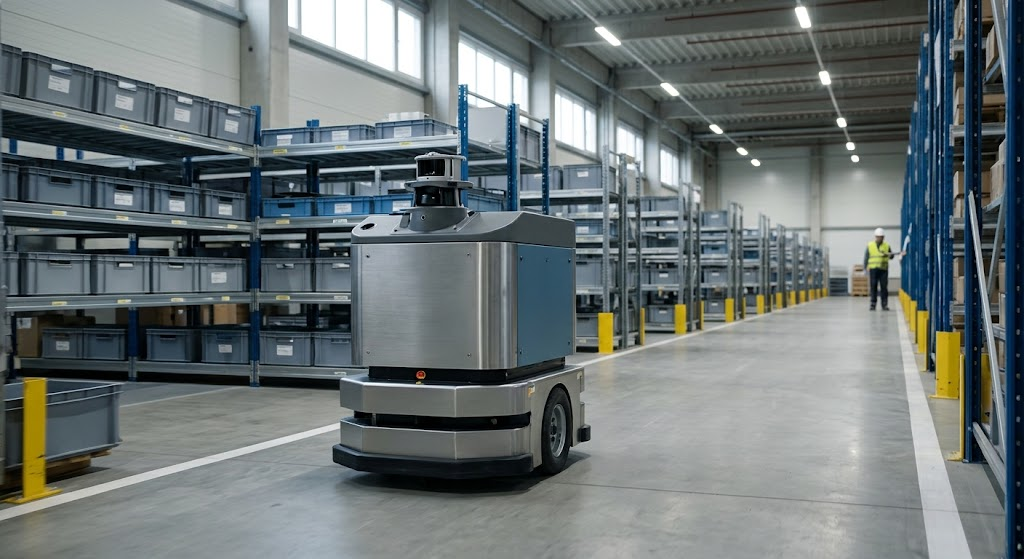
Reinforcement learning for robots which is a method of training them to put together movement strategies that in turn enable better navigation of warehouse environments, to avoid obstacles and reach targets. We reward the robots for good navigation and learn from their poor choices which in turn we use to improve their performance in simulation which we then test in the real world.
Autonomous navigation has issues which are quite the same as systems must react to obstacles and changing environments. In terms of control and navigation reinforcement learning is a solution but also in which vehicles’ performance is a function of what they see, what they plan, what they locate and what they do for safety. It is a component which may be present for safe operation.
Advantages and Limitations of Reinforcement Learning
Reinforcement learning is a tool for which decisions’ effects are seen through time. It may also be used in robotics, simulation control, games, some scheduling tasks and in which we look at the total long term reward instead of what is right in front of us.
Training can be a costly affair and also poor reward design may bring in elements of unwanted behavior. In simulation we may see our strategies which transfer to the real world do not perform well. Best for reinforcement learning are situations which require repeat decisions from systems and that which gives out useful feedback.
Main Points of Contrast Between the Types of Machine Learning
The present study reports that we see that different approaches to machine learning may be characterized by what they do and what they use for input. The types of machine learning differ in how they use data and produce results. In supervised learning we use labeled examples to predict outcomes, in unsupervised learning we put unlabeled data into the machine, which in turn tries to find data structure, and in reinforcement learning we program the machine to develop strategies based on actions and results. Understanding these differences also helps us explore individual machine learning algorithms and select the most suitable approach for a particular problem.
Although for different uses these approaches do present themselves as complementary. A business may use unsupervised learning for customer segmentation, supervised learning for purchase prediction, and reinforcement learning for fine tuning recommendation systems.
Comparison Table
| Feature | Supervised Learning | Unsupervised Learning | Reinforcement Learning |
| Training information | Labelled data | Unlabelled data | Rewards and feedback |
| Main objective | Predict outcomes | Discover patterns | Improve decisions |
| Common tasks | Classification and regression | Clustering and anomaly detection | Sequential decision-making |
| Example | Email spam detection | Customer segmentation | Robot navigation |
| Main advantage | Measurable predictions | Reveals hidden patterns | Optimizes long-term decisions |
| Main limitation | Requires labelled data | Patterns may be unclear | Training can be costly |
| Best suited for | Prediction tasks | Exploratory analysis | Decisions with future consequences |
No one size fits all in terms of approaches. Supervised learning does very well at using labeled examples, unsupervised learning is great for exploring data, and reinforcement learning outperforms in situations where actions play a role in the future. What you choose determines how well you use your resources.
How to Pick the Best Machine Learning Strategy.

Choosing the right approach starts with understanding the problem, the available data, and the desired outcome. The types of machine learning help developers determine whether supervised learning, unsupervised learning, or reinforcement learning is most appropriate for a particular task. Beginners can strengthen their understanding by applying these concepts to practical machine learning projects, evaluating their results, and learning from their mistakes.
If the aim is to find out patterns in data which did not have predefined categories at the start, unsupervised learning is a better fit. In the case of a system that has to make choices which in turn teach it over and again, reinforcement learning is a method to look into. Also developers should look at training costs, safety issues, and what large scale incorrect results may bring.
Issues to Consider Before Choosing a Method.
When you choose a method consider these questions:.
- Are there labelled examples? To which supervised learning applies.
- Is it to find patterns out? As for unsupervised learning.
- Does the system have to learn from action and reward? In terms of reinforcement learning.
- How will we measure success? Choose what methods work best.
- When the error occurs in the model we see it play out, look at what breaks down and what measures we put in place.
- Which resources are there? Related to data, computing power, and training costs.
These issues we put forth for developers to use in their choice of approach which aligns with what they are trying to achieve. Not all problems require complex machine learning; at times simple statistics or basic rules do the job.
Can these three learning approaches work together?
Supervised, unsupervised, and reinforcement learning are used in large scale AI systems. A retailer may use unsupervised learning for customer segmentation, supervised learning for purchase behavior prediction, and reinforcement learning for dynamic recommendation improvement.
Robotics also provides a good example. We see a robot which uses supervised learning for object recognition, unsupervised for exploration of sensor data, and reinforcement for improving movement. But that which combines approaches brings in more complexity which in turn requires that each element be studied in detail and proven out in terms of performance.
Conclusion
Supervised learning, unsupervised learning, and reinforcement learning present what machines do with data and experience. In supervised learning we see machines trained on labeled examples which they use to predict outcomes. That’s what makes it so useful for email spam detection and fraud identification. Unsupervised learning is what we turn to when we have unlabelled data which we want to bring structure to; it is used for customer segmentation and in exploratory analysis. Reinforcement learning is about improving machines’ decision making through rewards and feedback which is what makes it a great fit for robotics and navigation.
The best way to recall the differences is that for supervised learning we have known answers, for unsupervised learning we see hidden patterns in the data, and for reinforcement learning we give rewards. What you do depends on the present data set, what you want out of it, what risks you are willing to take, and the resources at your disposal. By which also to identify what is best for you, as a beginner or business to use when you apply machine learning to real world issues.