Direct-to-consumer brands face critical question in 2026: build on TikTok Shop or Instagram Shopping? Both are viable. Both are growing. Both are different. Instagram Shopping is mature platform with massive reach. TikTok Shop is emerging platform with explosive growth trajectory. Choice determines brand success. Wrong choice wastes time and resources. Right choice creates competitive advantage. This is platform selection decision most DTC brands ignore.
Why Platform Choice Matters: TikTok vs Instagram
Platform choice determines: where customers discover product, how brand converts customers, what profit margin is viable, how fast brand scales. Instagram Shopping prioritizes established brands with existing reach. TikTok Shop prioritizes new brands with creative content. Choose Instagram and compete against mature sellers with massive followings. Choose TikTok and compete in less saturated, higher-growth environment. Most DTC brands should choose TikTok in 2026. But not all. Understanding differences is critical.
The Platform Comparison Matrix: Feature by Feature
Audience Size and Demographics
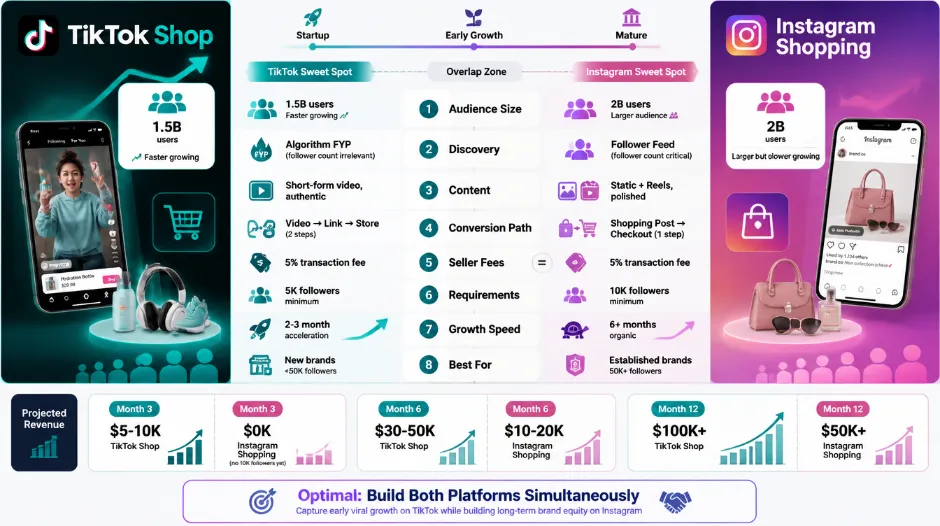
Instagram: 2+ billion monthly active users. Predominantly 18-49 age group. More affluent demographic in developed countries. Higher purchasing power per user. TikTok: 1.5+ billion monthly active users. Predominantly 13-40 age group. More global demographic. Lower average purchasing power per user but larger addressable market. Winner for reach: Instagram. Winner for growth: TikTok.
Discovery Mechanism
Instagram: Discovery through follower feed and explore page. Algorithm prioritizes accounts you already follow. New products struggle for visibility unless you have large existing following. TikTok: Discovery through for you page (FYP). Algorithm shows content to users based on interest, not follower count. New products can go viral without large existing following. Winner: TikTok for new brands. Instagram for established brands.
Content Format
Instagram: Static images, carousel posts, reels, stories, shopping posts. Emphasis on aesthetic and polish. Professional product photography expected. TikTok: Short-form video (15 seconds to 10 minutes). Emphasis on authenticity and trend participation. Raw, unpolished content performs better than professional. Winner: TikTok for authentic storytelling. Instagram for aesthetic brands.
Conversion Path
Instagram: Click shopping post → product page on Instagram → checkout on Instagram or external site. Single tap to product. Frictionless for followers who already see content. TikTok: Watch video → click link in bio or product sticker → redirect to external store. Two steps. More friction. But higher intent (viewers watching video before purchase).
Seller Fees and Economics
Instagram: Platform fee depends on fulfillment. If using Instagram Checkout: 5% transaction fee plus payment processing. If directing to external store: no platform fee. TikTok Shop: TikTok takes 5% transaction fee. Payment processing on top. Similar to Instagram economically. Both platforms: 5% commission is reasonable for platform.
Seller Requirements
Instagram: Minimum 10,000 followers to enable Instagram Shopping. Business account required. TikTok Shop: Minimum 5,000 followers. Creator account required. Lower barrier to entry. Winner: TikTok (lower requirements).
Where TikTok Shop Wins: The New Brand Advantage
TikTok Shop is superior for brands under 50,000 followers. Algorithm allows new brands to reach massive audiences without follower base. TikTok content goes viral based on creativity and trend participation, not follower count. New brand with 5,000 followers can generate same views as brand with 50,000 followers if content is compelling. This is TikTok’s unfair advantage. Using buy TikTok followers for shops strategically reaches 10,000+ baseline quickly. Baseline provides credibility signal. Algorithm then amplifies content. New brands reach profitability months faster on TikTok than Instagram.
TikTok Advantages:
Viral potential for new creators. Algorithm discovery regardless of follower count. Trend participation drives visibility. Authentic content performs better than polished. Lower barrier to entry (5K followers vs 10K). Younger demographic (Gen Z and early millennials). Higher engagement rates. Shorter sales cycles (impulse buying common on TikTok). Creator-brand partnership opportunities.
Where Instagram Shopping Wins: The Established Brand Advantage
Instagram Shopping is superior for brands with 50,000+ existing followers. Conversion from existing follower base is highest ROI. Followers already know brand. Shopping post appears in feed they view daily. Conversion is high. Instagram Shopping also works better for aesthetic-focused brands: fashion, beauty, home decor, luxury goods. Instagram’s visual-first platform is perfect for these categories. Using TikTok growth services in parallel to Instagram Shopping creates platform redundancy. But Instagram Shopping is still primary revenue driver for established brands.
Instagram Advantages:
Higher conversion from existing followers. Better for aesthetic/visual brands. Mature platform (stable, reliable). Larger affluent demographic. Shopping experience is native (no external redirect). Direct checkout available. Better for brand building. Strong for influencer partnerships. Established payment infrastructure.
The Content Strategy Difference: TikTok vs Instagram
TikTok Shop Content Strategy
Show product problem-solution in 30 seconds. Show customer using product. Show before-after transformation. Show trending audio with product demo. Show behind-the-scenes of product creation. Show honest product review (negative reviews increase trust). Post 3-5 times daily. Participate in trending sounds/hashtags. Authenticity is currency. Unpolished content outperforms professional. Raw enthusiasm beats slick marketing.
Instagram Shopping Content Strategy
Show product in lifestyle setting. Show multiple product angles in carousel. Show customer testimonial. Show product detail (close-up of craftsmanship). Show before-after if applicable. Post 1-2 times daily on feed. Post stories 3-5 times daily. Emphasize aesthetics. Professional photography expected. Consistency in visual style matters. Build brand identity through aesthetics.
The Growth Timeline: Which Platform Scales Faster
TikTok Shop Timeline (New Brand, Zero Followers)
Month 1: Create account. Post daily trend-based product videos. Build to 5,000 followers organically through viral content. Enable TikTok Shop. Month 2: 10,000 followers. First sales appearing from algorithm reach. Month 3: 50,000 followers. $5-10K monthly revenue from TikTok Shop. Month 6: 200,000+ followers. $30-50K monthly revenue. Month 12: 500,000+ followers. $100K+ monthly revenue potential.
Instagram Shopping Timeline (New Brand, Zero Followers)
Month 1-2: Cannot enable Instagram Shopping (need 10K followers minimum). Build followers through organic content and ads. Month 3: Reach 10K followers. Enable Instagram Shopping. Month 4: First meaningful sales. Month 6: 50,000 followers. $10-20K monthly revenue. Month 12: 200,000+ followers. $50K+ monthly revenue.
Timeline advantage: TikTok accelerates by 2-3 months to profitability. Revenue advantage: TikTok reaches similar revenue 3-6 months faster. This acceleration is significant for new brands.
The Category Reality: Which Platform Works for Which Products
Fashion & Apparel
Winner: Tie. Fashion works on both but differently. Instagram: Show how to style products. Use professional photography. Target fashion enthusiasts. TikTok: Show trending outfits. Show styling hacks. Target Gen Z. Both work well. Choose based on target demographic age.
Beauty & Cosmetics
Winner: Instagram. Visual product showcase is critical. Before-after transformations are Instagram’s strength. TikTok works but Instagram is superior for beauty.
Tech & Gadgets
Winner: TikTok. Unboxing videos perform exceptionally well. Demo videos go viral. Honest reviews build credibility. TikTok format is perfect for tech education and trend participation.
Home & Decor
Winner: Instagram. Aesthetic showcase is Instagram’s strength. Room transformations are perfect for carousel posts. Visual consistency is expected.
Food & Beverage
Winner: TikTok. Recipe videos and food hacks go viral. Trending sounds paired with food. Quick unboxing of snacks. TikTok algorithm favors food content.
Fitness & Wellness
Winner: TikTok. Workout videos and fitness hacks perform well. Before-after transformations are engaging. Trending music pairs well with fitness content.
The Strategic Recommendation: Build on Both, Prioritize Based on Brand
If Brand is Under 50,000 Followers: Prioritize TikTok Shop
Build aggressive TikTok presence. Use Instagram Shop growth as secondary channel. TikTok’s algorithm discovery enables faster growth and revenue. Instagram becomes profitable once you reach 50,000+ followers anyway. Start where algorithm helps. Move to Instagram as brand matures.
If Brand is Over 50,000 Followers: Prioritize Instagram Shopping
Leverage existing follower base on Instagram. Convert followers to customers immediately. Use TikTok as brand awareness channel but expect lower direct conversion. Instagram Shopping converts at 3-5x higher rate because followers already trust brand.
Optimal Strategy: Omnichannel Approach
Launch TikTok Shop and Instagram Shopping simultaneously. Post to TikTok 3-5 times daily (aggressive growth). Post to Instagram 1-2 times daily (quality over quantity). TikTok drives algorithm reach. Instagram drives follower conversions. Over 12 months, this dual approach reaches: 500,000+ TikTok followers, 200,000+ Instagram followers, $100K+ monthly revenue from TikTok, $50K+ monthly revenue from Instagram. Combined: $150K+ monthly revenue from both platforms.
The Platform Risk: Understanding Volatility
TikTok risk: Algorithm changes could suppress reach overnight. Political bans could remove platform entirely (US ban discussions ongoing). Higher volatility. Higher reward when algorithm favors you. Instagram risk: Meta owns both Instagram and Facebook. Company prioritizes its own ecosystem. Lower volatility. Lower reward from organic reach. Instagram monetization is mature but capped. TikTok monetization is exploding but volatile.
Risk mitigation: Build on both platforms. Diversify revenue. Do not rely on single platform.
The Bottom Line: TikTok for Growth, Instagram for Revenue
DTC brands should use TikTok Shop for growth and Instagram Shopping for revenue. TikTok’s algorithm enables new brands to reach profitability months faster. Instagram’s follower base enables established brands to convert existing audiences. Choose platform based on brand maturity and follower count. Under 50K: TikTok first. Over 50K: Instagram first. Ideal approach: build both simultaneously. Scale aggressively on platform with algorithm advantage. Convert reliably on platform with follower advantage. By 2027, winning DTC brands will have presence on both platforms with revenue from both.